


Page 63 - CIJ June 2025-Digital Edition
P. 63
WASTE MANAGEMENT


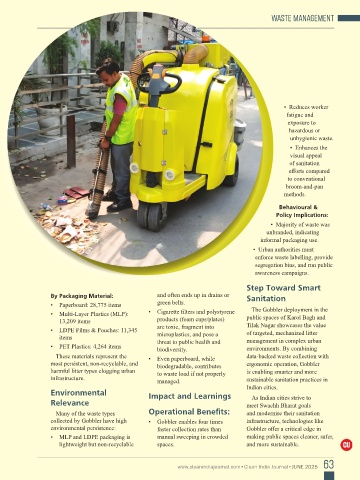
                                                                                               •  Reduces worker
                                                                                                fatigue and
                                                                                                exposure to
                                                                                                hazardous or
                                                                                                 unhygienic waste.
                                                                                                 •  Enhances the
                                                                                                 visual appeal
                                                                                                 of sanitation
                                                                                                efforts compared
                                                                                                to conventional
                                                                                               broom-and-pan
                                                                                               methods.

                                                                                             Behavioural &
                                                                                            Policy Implications:
                                                                                          •  Majority of waste was
                                                                                         unbranded, indicating
                                                                                       informal packaging use.
                                                                                     •  Urban authorities must
                                                                                     enforce waste labelling, provide
                                                                                     segregation bins, and run public
                                                                                     awareness campaigns.

                                                                                  Step Toward Smart
                  By Packaging Material:             and often ends up in drains or   Sanitation
                  •   Paperboard: 28,775 items       green belts.
                                                                                    The Gobbler deployment in the
                  •   Multi-Layer Plastics (MLP):   •   Cigarette filters and polystyrene   public spaces of Karol Bagh and
                     13,209 items                    products (foam cups/plates)   Tilak Nagar showcases the value
                  •   LDPE Films & Pouches: 11,345   are toxic, fragment into     of targeted, mechanized litter
                     items                           microplastics, and pose a    management in complex urban
                                                     threat to public health and
                  •   PET Plastics: 4,264 items      biodiversity.                environments. By combining
                   These materials represent the   •   Even paperboard, while     data-backed waste collection with
                  most persistent, non-recyclable, and   biodegradable, contributes   ergonomic operation, Gobbler
                  harmful litter types clogging urban   to waste load if not properly   is enabling smarter and more
                  infrastructure.                    managed.                     sustainable sanitation practices in
                                                                                  Indian cities.
                  Environmental                   Impact and Learnings              As Indian cities strive to
                  Relevance                                                       meet Swachh Bharat goals
                   Many of the waste types        Operational Benefits:           and modernise their sanitation
                  collected by Gobbler have high   •   Gobbler enables four times   infrastructure, technologies like
                  environmental persistence:         faster collection rates than   Gobbler offer a critical edge in
                  •   MLP and LDPE packaging is      manual sweeping in crowded   making public spaces cleaner, safer,
                     lightweight but non-recyclable   spaces.                     and more sustainable.

                                                                                                            63
                                                            www.cleanindiajournal.com•Clean India Journal•JUNE 2025

