


Page 37 - CIJ May 2025- Digital Edition
P. 37
MARKET REPORT


                  household chores has led to a   being led by 100 cities, has made   in robotic vacuum cleaners, AI-
                  growing need for convenient     great strides, completing 7,380 of   powered sanitation systems, and
                  solutions, propelling the adoption   8,075 projects with an estimated   IoT-enabled hygiene solutions.
                  of smart cleaning devices.      17.8 billion USD in investment.   Companies are investing in
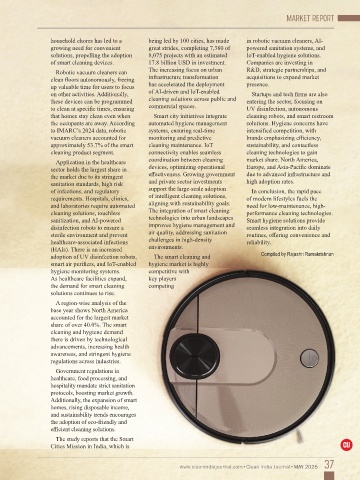
                   Robotic vacuum cleaners can    The increasing focus on urban   R&D, strategic partnerships, and
                  clean floors autonomously, freeing   infrastructure transformation   acquisitions to expand market
                  up valuable time for users to focus   has accelerated the deployment   presence.
                  on other activities. Additionally,   of AI-driven and IoT-enabled   Startups and tech firms are also
                  these devices can be programmed   cleaning solutions across public and   entering the sector, focusing on
                  to clean at specific times, ensuring   commercial spaces.       UV disinfection, autonomous
                  that homes stay clean even when   Smart city initiatives integrate   cleaning robots, and smart restroom
                  the occupants are away. According   automated hygiene management   solutions. Hygiene concerns have
                  to IMARC’s 2024 data, robotic   systems, ensuring real-time     intensified competition, with
                  vacuum cleaners accounted for   monitoring and predictive       brands emphasizing efficiency,
                  approximately 53.7% of the smart   cleaning maintenance. IoT    sustainability, and contactless
                  cleaning product segment.       connectivity enables seamless   cleaning technologies to gain

                   Application in the healthcare   coordination between cleaning   market share. North America,
                  sector holds the largest share in   devices, optimizing operational   Europe, and Asia-Pacific dominate
                  the market due to its stringent   effectiveness. Growing government   due to advanced infrastructure and
                  sanitation standards, high risk   and private sector investments   high adoption rates.
                  of infections, and regulatory   support the large-scale adoption   In conclusion, the rapid pace
                  requirements. Hospitals, clinics,   of intelligent cleaning solutions,   of modern lifestyles fuels the
                  and laboratories require automated   aligning with sustainability goals.   need for low-maintenance, high-
                  cleaning solutions, touchless   The integration of smart cleaning   performance cleaning technologies.
                  sanitization, and AI-powered    technologies into urban landscapes   Smart hygiene solutions provide
                  disinfection robots to ensure a   improves hygiene management and   seamless integration into daily
                  sterile environment and prevent   air quality, addressing sanitation   routines, offering convenience and
                  healthcare-associated infections   challenges in high-density   reliability.
                  (HAIs). There is an increased   environments.
                  adoption of UV disinfection robots,   The smart cleaning and         Compiled by Rajashri Ramakrishnan
                  smart air purifiers, and IoT-enabled   hygiene market is highly
                  hygiene monitoring systems.     competitive with
                  As healthcare facilities expand,   key players
                  the demand for smart cleaning   competing
                  solutions continues to rise.
                   A region-wise analysis of the
                  base year shows North America
                  accounted for the largest market
                  share of over 40.0%. The smart
                  cleaning and hygiene demand
                  there is driven by technological
                  advancements, increasing health
                  awareness, and stringent hygiene
                  regulations across industries.
                   Government regulations in
                  healthcare, food processing, and
                  hospitality mandate strict sanitation
                  protocols, boosting market growth.
                  Additionally, the expansion of smart
                  homes, rising disposable income,
                  and sustainability trends encourages
                  the adoption of eco-friendly and
                  efficient cleaning solutions.
                   The study reports that the Smart
                  Cities Mission in India, which is

                                                                                                            37
                                                            www.cleanindiajournal.com•Clean India Journal•MAY 2025

