
































Rajiv Gandhi International Airport Green to Silver to Gold
 The Rajiv Gandhi International Airport (RGIA), Shamshabad, Hyderabad, a Greenfield project that turned operational in March 2008, is celebrating 10 years of “sustainability, energy efficiency, carbon neutrality, water conservation and environment friendly waste management”. Sprawling across an area of 5,495 acres of land, the property consists of airport area, office buildings, residential townships, training centers, MROs, workshops, bus terminals, eateries, parking zones, STPs, rainwater harvesting areas, waste management & recycling areas and many more. Going from Silver, the GMR officials have been working strategically to reach up to Gold LEED certification by implementing technologies and processes to achieve quality result. Clean India Journal presents a bird’s eye view of the entire facility.
It was in 2008, a few days before the launch of the airport, that the Clean India editorial team visited the site, as it was getting set to receive the first flight on the runway. A lot of activity, construction around the area… 10 years now, it is still buzzing with activities and upgradation besides the construction of the next terminal.

India’s sixth largest and fourth busiest airport and still growing, upkeep and maintenance of all the facilities is a matter of “proper planning, implementation and monitoring”.
GMR Hyderabad International Airport Limited (GHIAL) is a joint venture company promoted by the GMR Group (63%) in partnership with the Airports Authority of India (13%), Government of Telangana (13%) and Malaysia Airports Holdings Berhad (11%). GHIAL was incorporated to design, finance, build, operate and maintain a world class Greenfield airport.. The Airport was opened to passengers in 2008, apart from passengers, it also deals 495 metric tonnes of cargo a day, and has the capacity for three lakh tonnes annually. On average, the airport sees almost 500 truck movements a day. The 11-yearold passenger terminal is already grappling with the growing passenger load; a second terminal is under construction.
GMR FMS has developed a workable, viable model that takes responsibility for cleaning, maintenance, waste management and other activities and also adopts every possible measure to reduce its carbon footprint.
“To a passenger, an airport operator is not actually visible. The operation entity has no direct connection with the passengers or the flights, yet the onus still lies on the airport staff to deliver services,” according to the officials at GMR.
India’s first carbon-neutral airport in its passenger category
 “All our work boils down to one simple philosophy — Sustainable development. Not only because of legal implication, but because we genuinely believe that we should leave a better world for generations to come.”
By finding ways and means to cut down on its power consumption and relying on renewable energy (solar), RGIA has managed to consistently offset its carbon emissions. For starters, the passenger terminal building itself is designed as a green building, allowing illumination by natural light during the day, and diminishing the need for artificial illumination. It has received the ‘Leadership in Energy and Environmental Design’ (LEED) certification for its unique design, from the United States Green Building Council rated ‘Silver’. At present, RGIA is in the process of upgrading to the ‘gold’ category.
Two 5MW on-site solar power plants provide 15-20 % of the airport’s energy needs,and reduces dependence on grid electricity. Some of the airlines operating from the airport use solar power for their ground support equipment. For example, some use solarpowered electric buses to ferry passengers to and from the aircraft. These buses have the added advantage of being quieter, which also helps control noise and air pollution. The State Road Transport Corporation too has deployed 40 such buses to shuttle passengers between the airport and the city, curbing the need for fumeemitting private transport, further cutting down on carbon emissions.
A sheltered bus station built for commuters is overflowing, as passengers waiting for their respective buses are provided with subsidised meals. For better maintenance of the bus station, better facilities like new block of washrooms, drinking water facility, waiting area, etc., are in progress.
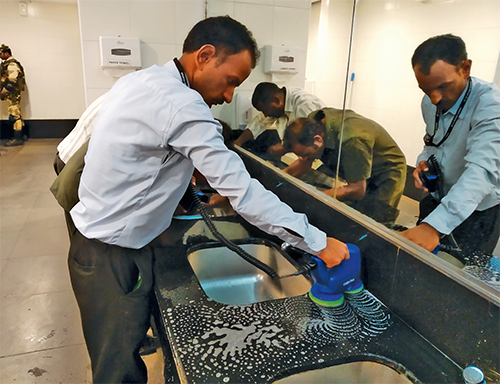 RGIA received a “Certificate of Merit” in National Energy Conservation Awards 2011 from the Bureau of Energy Efficiency (BEE), Govt. of India and “Excellent Energy Efficiency unit” in National Energy Management Award 2014 from Confederation of Indian Industry (CII) for its achievements.
Another of RGIA’s green initiatives is rainwater harvesting. During the monsoons, the airport’s extensive grounds act as a catchment area for rainwater, which is collected in drains and stored in reservoirs. This also allows for the recharging of groundwater. Three storage tanks, with a total capacity of seven lakh cubic metres collect this water, and reduce the demand on municipal water supply.
A green belt covering 683 acres has been developed in addition to the natural vegetation. These green areas act as carbon sinks, absorbing over 265 tonnes of carbon dioxide every year.
What is most commendable is that despite passenger and air traffic increasing year after year, RGIA has managed to consistently remain carbonneutral.
Environment-friendly aircraft management
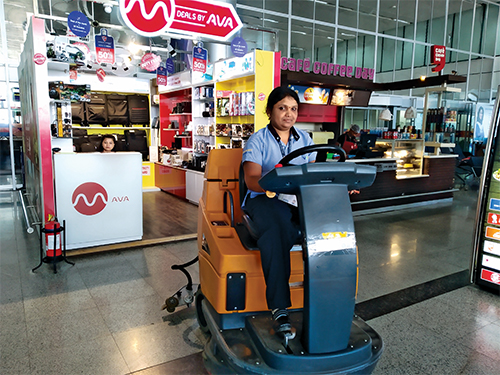 For the last four years, RGIA has really focussed on how aircraft manoeuvres can be modified to reduce carbon emissions. For example, before and after landing, aircraft now taxi with one engine shut off. This helps airlines cut costs on expensive air fuel as well. The RGIA Air Traffic Control authority has also devised a continuous descent approach for arriving aircraft, in which 30% less fuel is burnt. Pilots are being encouraged to push back from the departure gate without switching on engines. “There is always a tussle between flying out fast and being environmentfriendly. You can do both, if you start just one minute early. Mind-sets are changing.”
Airport waste management
The mind-set of the RGIA management towards waste is this: waste is a resource. By following the three ‘Rs’ (reduce, reuse, recycle), it is leaving no stone unturned in ensuring that lesser and lesser waste is generated, and that which is generated is promptly segregated and either disposed properly, or processed to form useful products.
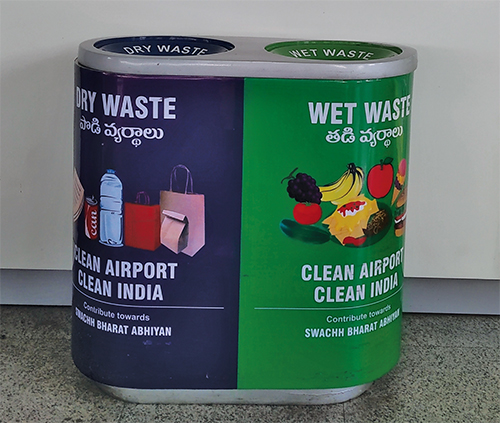
The range of waste generated is vast: Food waste, paper, tin, glass, plastic, hazardous, biomedical, construction, etc. Using Chassismounted Hydraulic Compactors, Auto Tippers, Multi Cap Refuse Collectors and other devices, this waste is collected and brought to a centralised waste processing facility. Here, waste is segregated into various categories. While the passenger terminals have always two bins side-by-side for wet and dry waste collection, not all passengers put the right waste in the right bin. “But over time, our need to segregate waste is reducing. More and more people are conscious about separating different kinds of garbage.”
Food waste is mixed with sawdust and digesting bacteria; open-air, aerobic composting is done, and up to two tonnes of compost produced every day. This compost is used in place of chemical fertilisers for the airport landscaping, and at on-site vegetable farms. RGIA was the first Indian airport to set up its own composting plant.
Non-biodegradable waste is collected and separated according to categories. Hazardous waste is put into closed containers and appropriately disposed to the authorised agencies. E-waste is collected by the IT department and handed over to authorised recyclers. Even oil and grease from aircraft maintenance is collected and handed over to the authorised agencies for the reprocessing. . Since the new terminal is being built and the existing one remodelled, excavated soil is shifted to low-lying areas, and steel waste and wood waste are sent to recyclers.
Wastewater is collected, treated and reused at the airport itself. It is pumped through a closed-pipe system to two in-house sewage treatment plants, where it undergoes continuous aeration that encourages the growth of bacteria which digest its organic constituents. After several stages of filtration, it is used for flushing purposes in the passenger terminal, as well as for landscaping. A whopping 46% of RGIA’s water need is met by its own recycled water.
Stakeholder sensitisation
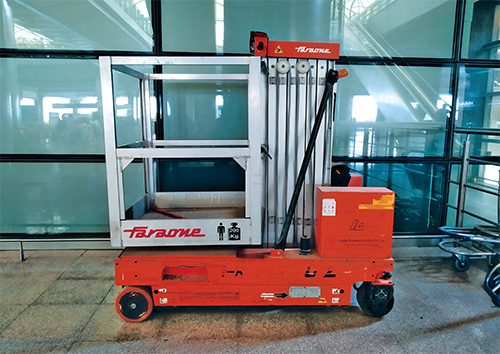 An airport is managed by several agencies, each of which is itself under the authority of a different body. Members of some agencies, such as the CISF and Customs, are frequently transferred just as they are beginning to adapt to RGIA’s ethos. GMR facilitates better coordination between these agencies for better results. Five years ago, it launched a program called Rishta, to impart soft-skills training to airport employees.
“Here we have stakeholder engagement. We make them drivers of projects. We give them timelines, and see how they deliver. We are working for a cultural change towards being sensitive to the environment.”
RGIA was the first airport in the country to install waste recycling machines as a pilot project. These machines could crush plastic PET bottles, steel/ aluminium cans and plastic bags in an eco-friendly manner. Passengers who deposited this waste in the machine either got an option to simply make a donation (of waste), or claim a discount coupon in return for submitting their empty plastic water bottles/bags/metal cans.
Most airport retailers have phased out plastics thinner than 50 microns, and are using jute and paper substitutes.
Outreach
According to government regulations, the airport area extends up to a 10km radius from the Airport Reference Point, most of which falls outside the boundary of the airport. Within this area, there should not be disposal of any kind of waste which can attract rodents and pests, which in turn attract birds. Birds are known to come into contact with aircraft during take-off and landing, impacting aircraft safety.
“We’ve gone to villages and schools in the adjoining areas, to teach them how to segregate and process garbage. Pamphlets don’t work; children are the best coaches for their parents. We’ve gone beyond having meetings, and just being reactive to a problem. Our team is continuously roaming the area not to get content for our management meetings, but to actually resolve problems.”
GMR has also mapped out the neighbouring areas so that when a problem area is identified, it knows which village/local/ government body should be contacted for conflict resolution.
Particular vigilance is maintained on poultry farms in the area, and how they dispose waste. They are constantly engaged with in dialogue, to ensure their business isn’t affected either. At times, GMR intercedes on their behalf with the government to ensure appropriate waste disposal machinery is in place.
Under the aegis of its Varalakshmi Foundation, GMR also provides free training and hostel stay to youths from the surrounding vicinity, and teaches them skills like housekeeping. Successful candidates are often hired from the campus itself.
In a recent survey, RGIA was rated the world’s 8th best airport by passengers; one of the parameters was service quality. The accolade surely comes as no surprise, and is well deserved.grid electricity
Ask the expert
Have a question about this article? Put it to the people in it. We pass your details on and they come back to you directly.