









 CIJConnect Bot-enabled WhatsApp today at 4:00 PM.
From biometric attendance and GPS-enabled garbage tracking to complaint apps and mechanised sweeping, Vasai-Virar Municipal Corporation is steadily transforming its sanitation ecosystem through technology, citizen engagement and decentralised waste processing while simultaneously tackling segregation challenges, legacy waste management and behavioural change. Clean India Journal speaks to Archana Dive, its Deputy Municipal Commissioner (solid waste management), on the plans for the area lying on the outskirts of Mumbai.
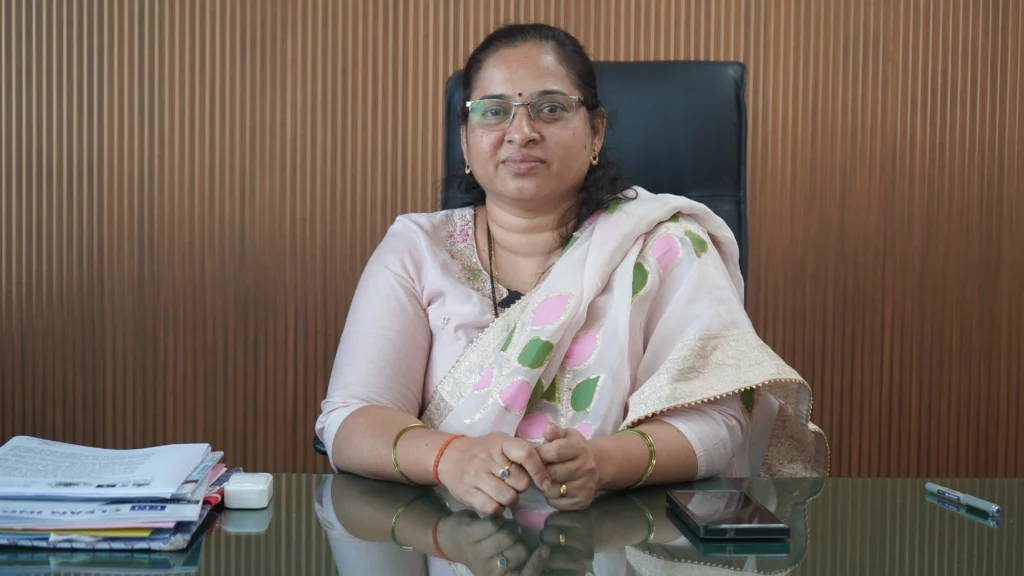
For years, waste management in the Vasai-Virar Municipal Corporation functioned through entirely manual systems. Today, the civic body is steadily moving towards a more technology-backed sanitation network — one that combines biometric attendance, GPS-enabled tracking, citizen complaint apps, mechanised sweeping and sensor-based traceability.

According to Archana Dive, Deputy Municipal Commissioner (Solid Waste Management) at Vasai-Virar Municipal Corporation, the shift towards digitisation has gradually transformed the functioning of multiple departments within the corporation.
“We have tried to use software in every department — whether it is fire, garbage or waste disposal department. It has helped us save time and improve efficiency,” she said.
Waste Goes Digital
Technology interventions now form a key part of the corporation’s sanitation operations. The civic body has introduced biometric attendance system in the solid waste department, GPS tracking for garbage collection vehicles and wearable devices for sanitation workers.
“We are giving wristwatches to all cleaners so that we know whether they stay put in their work area for eight hours or not,” said Archana.
The corporation has also integrated facial recognition through biometric systems to verify whether the designated sanitation worker is physically present. “We now know whether the same worker is present there or not,” she added.
Complaint Revolution
One of the corporation’s most significant interventions has been the launch of a citizen complaint app aimed at resolving recurring issues related to unattended garbage and delayed collection services.
“We used to receive many complaints from citizens saying there was garbage lying somewhere or that collection vehicles had not reached their societies,” said Archana.
The initial response to the app was overwhelming. Within the first two days of its launch, nearly 150-200 complaints were registered. “Citizens were assured that complaints would be resolved within 24 hours, failing which contractors would face penalties of Rs 10,000 per day. The complaint remains active on the app until the contractor resolves it and uploads the photo. We monitor everyday to check if complaints are resolved within 24 hours,” told Archana.
Segregation Struggles
Like several urban local bodies, Vasai-Virar initially faced resistance while implementing source segregation.
“Citizens used to say that we were taking segregated garbage from them but putting it into the same vehicle. So, they questioned the need for separating wet and dry waste,” said Archana.
To address this concern, the corporation initially deployed separate vehicles and later introduced partitioned tippers and collection vehicles to ensure separate transportation of wet and dry waste streams. “We are trying to increase awareness among contractors and citizens and ensure wet and dry segregation at source,” the official added.
BWG Push
With new waste management rules placing greater responsibility on Bulk Waste Generators (BWGs), the corporation has started pushing societies and establishments towards decentralised waste processing and composting.
Under the new framework, BWGs are expected to process waste at their own level instead of relying entirely on municipal systems.
“Our role is to explain the new rules to them. We are not just compelling them but also showing them how it can be done,” said Archana.
Recognising that many societies struggle with space and manpower constraints, the corporation is now working towards empanelling organisations that can support decentralised composting and recycling. “If there is no space in the society or nobody to manage it, we are trying to identify organisations that can help. If we empanel eight to ten such organisations, it will become easier for societies,” she added.
Smart Traceability
The corporation is also exploring future-ready systems for end-to-end waste traceability.
The official informed that the civic body is planning to install sensors on bins and eventually create systems that can verify whether waste has been collected from every household. “Installing sensors on bins is our future plan. Every household should know whether garbage has been collected or not,” said Archana.
At present, the corporation still lacks household-level digital verification systems. “We are not able to identify now if garbage has been collected from every household or not,” she admitted. “If we develop software for this, it will help us monitor collection more effectively.”
Cleaning After Dark
The corporation has also redesigned collection schedules in commercial areas to reduce congestion and improve operational efficiency.
“We do not collect commercial waste in the morning. We have created a separate night shift for garbage collection in commercial areas,” the official said.
Sweeping has additionally been made compulsory in key commercial stretches.
Machine vs Man
At present, seven mechanised road sweeping machines are operational across the city. However, manual sweeping continues in areas where damaged or uneven roads make machine deployment difficult.
“The roads are sometimes uneven or damaged, so it becomes difficult for sweeping machines to operate there. In such places, manual sweeping is done,” said Archana.
She also confirmed that robotic sewage-cleaning systems continue to remain operational, although the department falls outside her direct administrative jurisdiction.
Processing
Waste processing operations are currently being carried out at the dumping ground near Gokhi Bridge.
According to the official, an earlier processing project had functioned for nearly two years before a fire incident forced its shutdown. “The project was running for two years, but there was an accident and the project caught fire. Fresh tenders were subsequently issued for both fresh and legacy waste processing, and the work has now been awarded to Sai Utility,” she said.
The corporation is simultaneously working on biomining legacy waste accumulated at the landfill site. Although the project was originally planned with a two-year timeline, delays occurred due to rainfall and operational challenges.
“We had given a two-year timeline, but there were obstacles and rainfall-related issues because of which the work has taken longer,” she said.
Awareness
While technology and enforcement remain important, Archana repeatedly stressed that sustainable sanitation ultimately depends on behavioural change and citizen participation.
“I personally feel awareness should begin in schools. When children are taught not to throw garbage irresponsibly, they begin correcting adults at home as well,” she said.
The corporation currently conducts awareness campaigns through meetings, outreach drives and audio systems mounted on garbage collection vehicles.
“We use audio systems on our vehicles to spread awareness in society,” she said.
Under the new regulatory framework, waste management compliance has also been integrated into project approvals. While granting permissions and occupancy certificates, the corporation now reviews whether waste processing provisions have been incorporated and seeks No Objection Certificates from the garbage disposal department.
Despite these measures, Archana acknowledged that resistance from citizens and establishments continues in some cases. “When we try to enforce certain things, sometimes people become angry and we do not get the cooperation we expect,” she said.
However, Archana believes visible behavioural shifts are slowly emerging across the city. “This transformation will not happen all at once, but slowly we are able to see the change,” she added.
Greener Vision
Having served in multiple municipal bodies since 2008 — including Worli, Shriwardhan Nagar Parishad, Pen Nagar Parishad and Kalyan-Dombivli Municipal Corporation — Archana reflected on how urban sanitation systems evolve with scale and population growth.
“The experience of working in a Nagar Parishad and a Mahanagar Palika is very different,” she said. “In larger municipal corporations, the scale and complexity of work are much bigger.”
On her long-term vision for waste management, Archana spoke not just about operational efficiency but also about changing how dumping grounds are perceived.
“My dumping ground should look clean. There should be trees and greenery there so that even common citizens can visit or walk there comfortably,” she shared.
Her message to citizens remained centred on responsibility and environmental consciousness.
“We clean our own homes consciously. If we start thinking that this city is also ours, cleanliness will spread automatically,” the official said.
While acknowledging that plastic usage cannot be stopped entirely, she urged citizens to reduce consumption and prioritise recycling. “I am not saying plastic can be stopped 100%, but its use should be reduced because it harms the environment. Whatever can be recycled should be recycled and reused. If we want to give a better environment to the next generation, it is in our hands,” Archana added.
HIGHLIGHTS
• Biometric systems monitor sanitation staff attendance.
• GPS tracking introduced for garbage collection vehicles.
• Citizen complaint app ensures faster grievance resolution.
• Contractors penalised for unresolved complaints beyond 24 hours.
• Wearable devices deployed for sanitation workers.
• Separate vehicles introduced for waste segregation.
• Commercial waste collection shifted to night operations.
• Seven mechanised sweeping machines currently operational citywide.
• Sensors planned for end-to-end waste traceability.
• Bulk waste generators encouraged towards decentralised composting.
• Legacy waste biomining continues despite operational delays.
• Awareness campaigns conducted through garbage collection vehicles.
• Waste compliance linked with project approvals and permissions.
• Corporation aims for greener, cleaner dumping grounds.