


































Laundry Sector’s Growth Playbook

India’s laundry sector is evolving fast as organised players expand and consumer expectations rise. Beyond cleaning clothes, success now hinges on technology, manpower, location and customer experience. While opportunities are growing, industry experts stress that profitability depends on discipline, research and consistency — reminding entrepreneurs that this is a long-term, hands-on business built on strong fundamentals and patience. Clean India Journal’s Manka Behl understands the nitty-gritties from experts
India’s laundry and dry-cleaning sector is undergoing a quiet transformation as urban lifestyles evolve and organised services gain ground.

According to market studies, the industry is expected to grow significantly in the coming years, driven by rising disposable incomes, changing consumer habits and the increasing presence of organised laundry chains across cities.
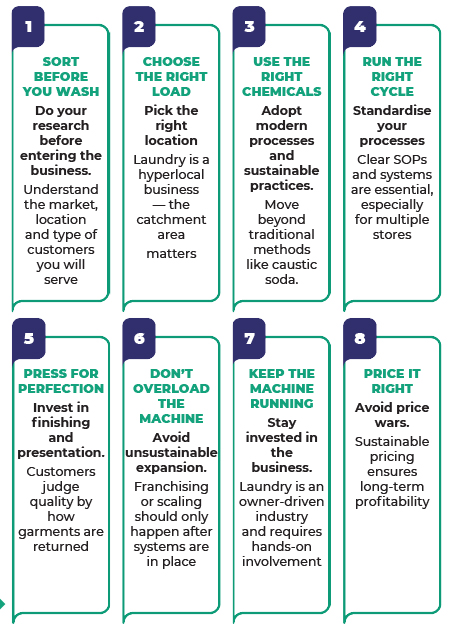
As competition intensifies and more brands enter the market, the challenge for operators is no longer limited to cleaning garments. Building a profitable laundry business today involves decisions on technology adoption, manpower management, location strategy, expansion models and customer experience.

Even as the industry modernises, practitioners say the fundamentals remain unchanged. Consistency, operational discipline and a deep understanding of the market continue to determine whether a laundry venture survives the early years and grows into a sustainable enterprise.
“Running a profitable business is something which comes every day in our mind,” said Sagar Sodha, who is the National Head of Laundry Services at Jyothy Labs Limited. He was speaking during a panel discussion on ‘Laundry Store Management: Running a Profitable Business’ held during the Clean India Show.
“Profitability is built store by store — driven by consistency, discipline and the courage to maintain pricing without compromising on quality.”
— Sagar Sodha
Real Learning

For many entrepreneurs entering the laundry sector, the first couple of years are less about profits and more about learning the business from the ground up. From manpower management to operational systems, the early phase often exposes gaps between expectations and reality.
For Clezo CEO Prachi Bhoir, it started five years ago as a small live laundry store with a small team. The challenge intensified when the business expanded to a second store. “For new entrants in this field, the main challenge is recruitment of the skilled manpower,” she said, explaining that many workers come from the unorganised sector and are used to traditional methods. “Washmen who come from the unorganised sector have worked for many years, and then changing their mindset from caustic soda to eco-friendly solvent is something that we need to deal with,” explained Prachi.
The early stage of any business is also financially demanding. “In the initial phase, funds are limited. Everything is self-funded and we are building a network,” Prachi said, adding that building relationships within the industry plays an important role.
“Scaling too early breaks the business — strong systems, trained manpower and patience must come before expansion or franchising.”
— Prachi Bhoir

Another major hurdle, according to Rajesh Nair, Managing Partner of EcoClean Solutions, is the lack of guidance. “When you have no one to guide you initially, every guy who comes to sell the machine or chemicals becomes your best friend. Whatever he tells you becomes the gospel truth,” he said.
Without proper research, entrepreneurs end up investing heavily in equipment without understanding the scale or nature of the business they are entering. “You don’t see what your load is, what business you are going to generate or what kind of work you will get. You just invest money because you think that is right,” added Rajesh.
The financial reality of the business, he said, often becomes clear much later. Rajesh recalled expecting to break even within six months. “It took me 28 months to break even.”
The expert advised that during that period, entrepreneurs must constantly manage expenses, manpower and operational challenges.
Before accepting customers’ garments, Rajesh spent months experimenting with his own clothes. “I had a lot of my own clothes washed and spoiled before I could even take in customer clothes,” he said.
Rajesh’s advice to newcomers is simple: Research thoroughly and connect with people in the industry before starting the business.
“Laundry rewards research, not impulse — wrong location, wrong investment and lack of knowledge can delay success far longer than expected.”
— Rajesh Nair
Expansion Model

Once a laundry business stabilises, expansion becomes the next question. For many operators, the choice lies between opening company-owned stores or adopting a franchise model.
Asad Raja, Director of Edward Laundry Pvt. Ltd, noted that both models have their own dynamics. “In a personal business the investment is yours, but in a franchise business brand value comes with the franchise and the investment from the brand owner is less. Franchising allows brands to expand into multiple areas of a city where a single operator may not be able to serve customers effectively,” said Raja.
However, several operators believe franchising should only begin once operational systems are firmly in place, pointed out Sagar.
Agreeing with him, Prachi stated that her business began receiving franchise enquiries within two years of starting operations, but the company waited until its internal systems were ready. “Now we have a team and trainers ready; the SOPs are set. We are confident and ready to give franchise,” she added.
Rajesh, on the other hand, shared a more cautious experience. Although he started receiving franchise enquiries early in his journey, Rajesh initially decided against it. Eventually he experimented with one franchise outlet. “The model was that my store would be the hub and the franchise would be the collection centre. After operating the model for about a year and a half, I realised that the arrangement was not financially sustainable as neither of us were making money. Hence, we decided to exit the arrangement amicably,” he said.
For Rajesh, the principle is straightforward. “If both the parties cannot make money, then it should not be done. It should be a win-win for both.”
“Franchising accelerates growth, but without strong systems and brand value, expansion can quickly turn into inefficiency instead of profitability.”
— Asad Raja
Sustainability
The rapid expansion of branded laundry chains has also raised concerns within the industry. Some brands claim to have opened hundreds or even thousands of stores in a short span of time.
An audience member pointed out that such claims can sometimes be misleading. “There are brands who claim to have opened more than a thousand stores in the last five years, but many of those stores have shut down. This trend can damage the credibility of the industry as a whole. How do we educate the public that because of some mistakes by some brands the whole industry is not bad?” he asked the panel.
Rajesh stressed that the success of any retail laundry outlet depends heavily on its location. “Our business is highly hyperlocal,” he stated.
He recalled seeing a franchise outlet set up in a poor location despite a large investment. “There was no way even five people would pass by that road. Without a strong residential catchment or customer base, even a well-branded outlet may struggle to survive. So, when you are looking at putting money into the business, be cautious as the amounts are not small— 18 lakh,
20 lakh, 30 lakh or even 50 lakh,” said Rajesh, advising potential investors to evaluate franchise opportunities carefully.
At the same time, he maintained that the business can be extremely rewarding when the fundamentals are right. “If your location is right, there isn’t a better business than this,” added Rajesh.
Image Make-Over
As the sector evolves, technology is increasingly becoming central to laundry operations. Experts believe the first step toward modernising a laundry business is adopting software to manage operations. “The most fundamental modernising aspect of your business is to get a software in place. In the early days, we were trying to manage everything on Excel. Goods were getting misplaced and garments were getting interchanged,” said Rajesh.
However, once software systems were introduced, tracking garments and managing workflow became much easier. “We started tagging garments. We knew what was coming in, what was going out and which garment was at which stage,” said Rajesh.
Modern equipment and finishing systems help ensure consistent results. “Good finishing equipment makes a huge difference in how you present garments to customers. Modernisation also includes improvements in packaging, delivery management and employee tracking systems. Some software systems even track how much work employees are doing and link compensation to that,”added Rajesh.
Standardisation
As laundry brands expand into multiple outlets, maintaining consistent service becomes a critical challenge.
Sagar stressed that the experience across stores must remain uniform. “If you have multiple stores — be it 10, 15 or 20 — the experience across those stores has to be the same. Achieving that level of consistency requires strong processes and regular audits. Though often uncomfortable, audits play an important role in improving operations,” he said.
One of the most important aspects auditors checks is store hygiene. “In laundry stores, hygiene often takes a back seat because garments are lying everywhere. But customers increasingly judge service quality based on what they see. If you don’t take care of customers’ soiled garments, the customer starts wondering how you will take care of my finished garments,” explains Sagar.
Financial discipline is another key area, particularly when managing multiple stores. “With multiple stores there is a lot of cash flow every day, so financial propriety becomes very important,” the expert added.
Adding that profitability starts at the store level, Sagar said that even large businesses must ensure that individual outlets generate healthy margins. “Every store has to be profitable. Only then the company becomes profitable after removing fixed costs,” he said.
Sagar further advised that operators entering the industry should avoid competing purely on price. “If the industry has to grow it has to grow with a particular pricing. Don’t enter the industry to cut prices.”
Price competition, he warned, can damage the entire ecosystem. “Maintain the price and give good quality so that everybody grows,” said Sagar.
Looking Ahead
Despite the challenges, industry practitioners remain optimistic about the future of professional laundry services.
Rajesh Nair described the business as a long-term opportunity. “This industry is a long-term play. Anyone who comes in thinking that tomorrow I will start counting money should not enter this business,” he said.
Over the next few years, the industry is likely to see more brands and more competition. Asad Raja emphasised the importance of patience and trust to survive. “Entrepreneurs must also study the market carefully before entering. They must research the market and understand their own strength first,” he added.
Prachi touched on a broader question often raised by entrepreneurs considering entry into the sector: Why choose the laundry business over other service industries. “Laundry occupies a unique position as an essential service while also offering long-term scalability. A lot of players coming into this sector now, but the focus should remain on building a sustainable business model,” she suggested.
Rajesh offered a final reminder that laundry is not a passive business. “This is an owner-driven business. The owner has to be in the game.”
Even as the industry modernises with technology and organised chains, the fundamentals of the laundry business remain rooted in service and trust.
Industry experts believe that success in this sector rarely comes overnight.
As Sagar summed up, the business may appear simple, but it demands commitment. “If you are going to get bored in two years, break-even will not happen. If you have the passion for customer service, then it is the right business. Otherwise, mutual funds might give a better return,” stated Sagar.
The Profit Cycle: Laundry Lessons from Industry Experts