














CIJ Connect

Charnock Ride-On and Mini Scrubber Driers in India on CIJ Connect

Our Products
Smart Products. Integrated Hygiene.
About Us
Engineering Cleaner, Safer & More Productive Workspaces

Established in 1999, Charnock Equipment’s Pvt. Ltd. is one of India's leading providers of professional mechanized cleaning solutions. For over 25 years now, Charnock Equipment’s Pvt. Ltd. has been a trusted name in India's professional cleaning industry, offering a comprehensive range of industrial and commercial cleaning equipment, hygiene systems, cleaning chemicals, and facility maintenance solutions designed to enhance operational efficiency, workplace safety, and hygiene standards. With a strong focus on quality, innovation, and customer satisfaction, Charnock delivers complete cleaning solutions under one roof. Our extensive portfolio includes scrubber dryers, sweepers, industrial vacuum cleaners, high-pressure washers, escalator cleaners, housekeeping tools, cleaning chemicals and customized facility solutions that improve productivity while maintaining the highest standards of cleanliness.

Driven by innovation, quality and customer-centric service, Charnock partners with businesses across manufacturing, healthcare, pharmaceuticals, hospitality, retail, education, airports, warehouses and facility management. Supported by a strong nationwide sales and service network, technical expertise and operator training, we help organizations create cleaner, safer and more efficient environments with reliable solutions tailored to their operational needs.

Clean India Show by Clean India Journal

Why Charnock
Capabilities & Strengths That Set Us Apart

Complete Cleaning Solutions

A comprehensive portfolio covering mechanized cleaning equipment, hygiene systems, chemicals and housekeeping solutions under one trusted brand.

Industry-Focused Expertise

Specialized solutions designed for manufacturing, healthcare, pharmaceuticals, hospitality, retail, logistics, airports, educational institutions and commercial facilities.

Reliable Service Network

Dedicated sales and after-sales support with trained service engineers, genuine spare parts and prompt technical assistance.

Innovative Cleaning Technology

High-performance equipment engineered to improve productivity, reduce manual effort and optimize operational costs.

Customer Training & Technical Support

Professional operator training, product demonstrations and ongoing technical guidance to maximize equipment performance and lifespan.

Trusted Partner for Facility Management

Preferred by facility management companies and leading organizations for dependable, efficient and sustainable cleaning solutions.

Enquire Now

Connect with our experts

Please enable JavaScript in your browser to complete this form.
=
In Conversation
Starting small with limited resources and hands on execution

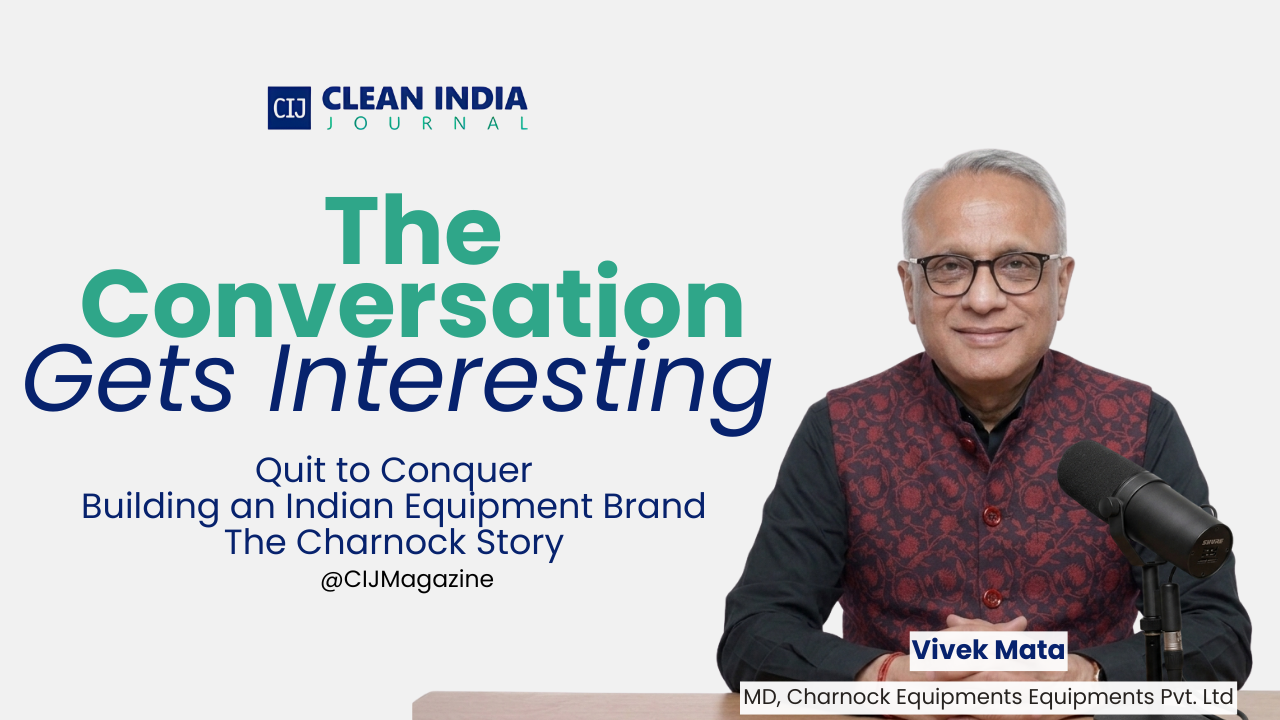
Quit to Conquer: Charnock’s Rise as an Indian Industry Leader

From breaking away from a conventional job to championing the Make in India cleaning equipment industry, Vivek Mata, MD of Charnock Equipments, shares his journey of building a leading Indian cleaning equipment brand. Discover how he transformed a local venture into a strong player in the industrial cleaning machines market, once dominated by global companies.

Explore More
Our Perspectives
Latest Insights

Ready to Transform Your Cleaning Operations?

Partner with Charnock for integrated cleaning and workplace hygiene solutions — trusted since 1999 across 11 branches and 13 dealer points nationwide.

Book a Demo

Clean India Show 2027

Register as a visitor

17 to 19 March 2027, Bombay Exhibition Centre, Mumbai. Entry is free for industry professionals.

Or visit cleanindiashow.com

CHARNOCK

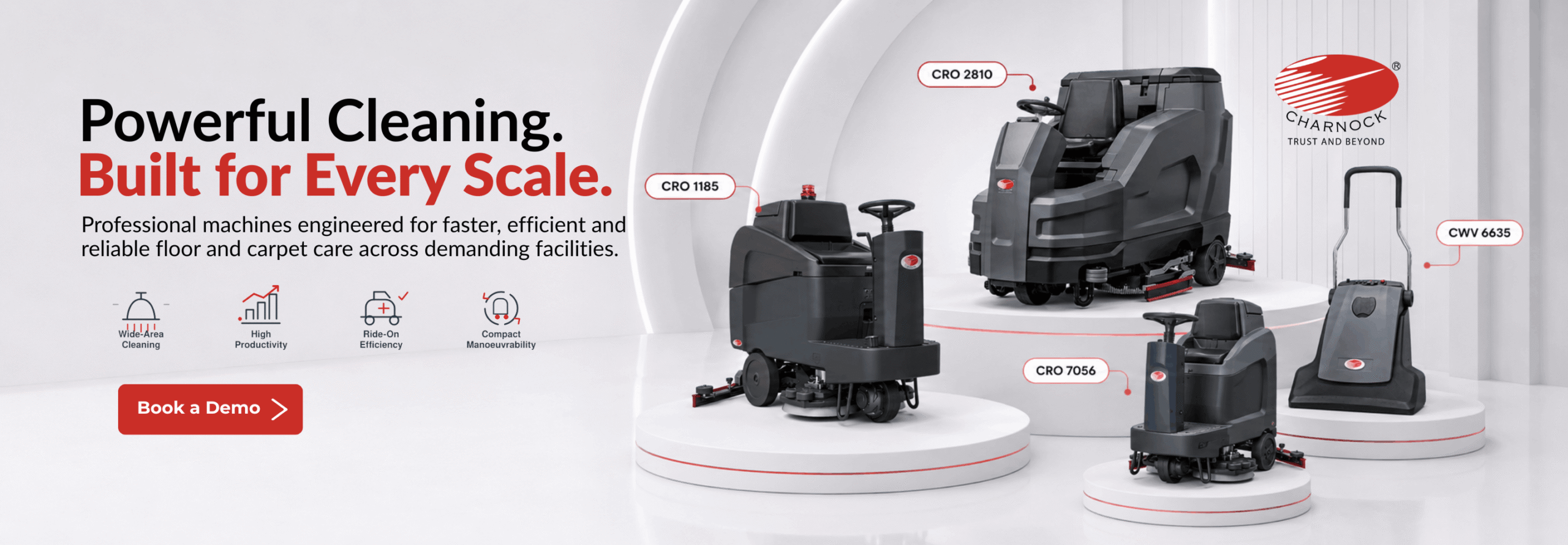
Wide Area Carpet Vacuum Cleaner — CWV 6635

Enquire now

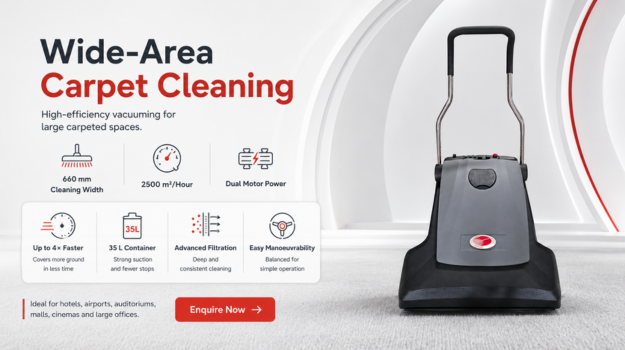
Wide-area carpet cleaning — high-efficiency vacuuming for large carpeted spaces.

A 660 mm cleaning width and dual motor power give the CWV 6635 a rated 2500 m² an hour — up to four times faster than conventional vacuuming, with a 35 litre container so the machine keeps working instead of being emptied. Balanced for simple manoeuvring despite the width, and built for the places where carpet is both extensive and constantly walked on: hotels, airports, auditoriums, malls, cinemas and large offices. From Charnock Equipments Pvt. Ltd.

Why Choose the CWV 6635?

660 mm wide, 2500 m² an hour

A domestic-width vacuum on a ballroom or a departure hall is a scheduling problem, not a cleaning one. Width is what turns an overnight job into a manageable one.

Dual motor power

Two motors deliver the suction that a single-motor machine loses as it gets wider. Deep, consistent pickup across the full path rather than strong in the middle and weak at the edges.

35 litre container

Fewer emptying stops on a large round. On carpet especially, the trips to the bin are usually a bigger share of the shift than anyone budgets for.

Product specifications
Product
CWV 6635 wide area carpet vacuum cleaner
Type
Wide-area dry carpet vacuum
Cleaning width
660 mm
Productivity
2500 m²/hour — see build note 6c
Speed comparison
Up to 4× faster than conventional vacuuming, per the banner
Motors
Dual motor power
Container capacity
35 L
Filtration
Advanced filtration for deep and consistent cleaning — see build note 6d
Handling
Balanced for simple, easy manoeuvring
Surface
Carpet and soft floor coverings
Manufacturer
Charnock Equipments Pvt. Ltd
Where it is used
  • Hotels
  • Airports
  • Auditoriums
  • Malls
  • Cinemas
  • Large offices

Specifications from the product listing and banner creative. Filter grade and sound level are not published — request the datasheet if either matters for your site. Charnock's wider range also covers ride-on and walk-behind scrubber driers, single disc machines, burnishers and carpet care.

Width and pickup
Carpet hides its soil, which is why it gets under-cleaned

A hard floor shows you when it is dirty. Carpet does not — it holds grit deep in the pile, looking acceptable while the fibre is being abraded from within. That is the real cost: not appearance, but the replacement cycle of a very expensive floor covering. Vacuuming a ballroom or a departure hall with a domestic-width machine guarantees it gets done less often than it should, so the answer is a machine wide and powerful enough that thorough and frequent stop being alternatives.

Width that changes the schedule

660 mm at a rated 2500 m² an hour, up to four times conventional vacuuming. Coverage is what decides whether a large carpeted area gets cleaned nightly or weekly.

Two motors, even pickup

Suction is what pulls grit out of the pile rather than skimming the surface. Dual motors hold that across the full 660 mm instead of fading toward the edges.

Filtration and a 35 L container

Advanced filtration keeps fines in the machine rather than returning them to the room, and a large container means the round is not punctuated by trips to the bin.

In conversation
Starting small with limited resources and hands-on execution
Ask us anything
Questions about the CWV 6635

Rated at 2500 m²/hour across a 660 mm cleaning width — up to four times conventional vacuuming.

Treat that as the comparison figure rather than a shift plan. Real coverage in a hall full of seating or a hotel corridor with doorways will be lower, as it is for any machine.

Because it decides frequency. A domestic-width vacuum on a ballroom or departure hall means the job takes so long it gets done less often than it should.

Carpet hides its soil — it looks acceptable while grit sits deep in the pile abrading the fibre. Under-cleaning is invisible right up until the carpet needs replacing early.

Maintains suction across the full path. A single motor stretched over 660 mm tends to pull well in the centre and weakly at the edges, which leaves strips that look clean and are not.

Suction is also what lifts grit out of the pile rather than skimming the surface — the part of vacuuming that protects the carpet rather than just tidying it.

The specification states advanced filtration for deep and consistent cleaning, but a filter grade or class is not published.

If you need a specific standard — for an airport, a hospital or an allergy-sensitive environment — ask Charnock for the datasheet before ordering. It is a fair question and worth getting in writing.

It holds 35 litres, which on a large round means substantially fewer stops than a conventional machine.

Emptying trips are usually a larger share of a carpet-cleaning shift than people budget for, so container size affects real productivity as much as cleaning width does.

It is balanced for simple operation, so the width does not come at the cost of manoeuvrability.

For sites with a lot of furniture, seating rows or tight corridors, ask about turning space at a demonstration — that is where a wide machine either works or does not.

Use the Enquire now button. Carpet type and pile depth, total area, furniture density and how much of it can be cleared decide the specification.

Charnock's wider range also covers ride-on and walk-behind scrubber driers for hard floors, so a walkthrough can cover the whole site rather than one surface type.

CHARNOCK

Large Ride-On Scrubber Drier — CRO 2810

Enquire now

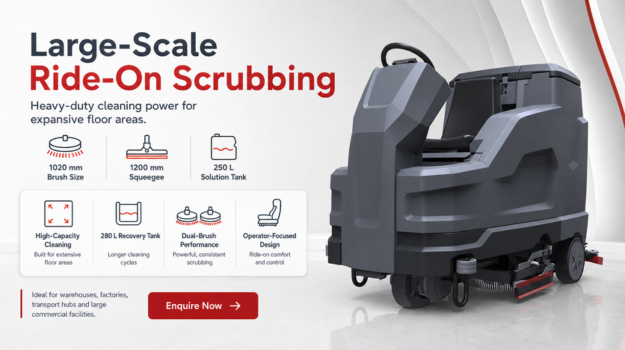
Large-scale ride-on scrubbing — heavy-duty cleaning power for expansive floor areas.

Charnock's largest ride-on scrubber drier: a 1020 mm dual-brush deck behind a 1200 mm squeegee, on a 250 litre solution tank with 280 litres of recovery capacity. Charnock terms it a true workhorse for large-scale operations — deep scrubbing and instant drying in a single pass, with an ergonomic seat, intuitive controls and good visibility for long shifts. Built for warehouses, factories, transport hubs and large commercial facilities. From Charnock Equipments Pvt. Ltd.

Why Choose the CRO 2810?

1020 mm dual-brush deck

Two brushes across a metre of floor, giving powerful and consistent scrubbing rather than one brush working harder. On an expansive floor, width is what decides whether the shift finishes.

250 L solution, 280 L recovery

Long cleaning cycles between stops, and a recovery tank larger than the solution tank — so the machine runs out of clean water before it fills with dirty, never the other way round.

Operator-focused design

Ergonomic seat, intuitive controls and clear visibility. On a machine that runs long shifts over large areas, operator fatigue is what quietly costs you coverage.

Product specifications
Product
CRO 2810 large ride-on scrubber drier
Type
Battery ride-on scrubber drier for large-area cleaning
Brush size
1020 mm
Brush configuration
Dual brush
Squeegee width
1200 mm
Solution tank
250 L
Recovery tank
280 L — see build note 6b
Cleaning action
Deep scrubbing and instant drying in a single pass
Suction
High-performance suction motor
Operator
Ergonomic seat, intuitive controls, clear visibility
Duty
Built for demanding environments and long operating hours
Manufacturer
Charnock Equipments Pvt. Ltd
Where it is used
  • Warehouses
  • Factories
  • Transport hubs
  • Large commercial facilities
  • Heavy-duty industrial floors
  • High-traffic commercial spaces

Specifications as published by Charnock and its distributors. The ride-on range runs from the compact CRO 7056 up to the 250-litre CRO 2810. Contact the team for the datasheet matched to your floor area and layout.

Built for scale
On a large floor, the machine that stops least wins

Cleaning a warehouse is not a harder version of cleaning an office; it is a different problem. Coverage per hour matters, but what actually decides whether a shift finishes is how often the machine stops — to refill, to empty, or because the operator has had enough. The CRO 2810 is engineered against all three: a metre of dual-brush width, 250 litres of solution before a refill, 280 litres of recovery before an empty, and a seat somebody can work from for a full shift.

Dual brushes, consistent pressure

Two brushes share the load across 1020 mm rather than one brush stretching to cover it. The result is even scrubbing edge to edge, which is what stops a wide machine leaving strips behind.

Tanks sized for the round, not the spec sheet

250 litres of solution and 280 of recovery means long uninterrupted runs. Refill and empty trips are usually a bigger time cost on a large site than the scrubbing itself.

Scrub and dry in one pass

High-performance suction behind a 1200 mm squeegee recovers the water as fast as the brushes lay it down. Floors are walkable immediately — no cordoning, no slip exposure in a live facility.

Ask us anything
Questions about the CRO 2810

A 1020 mm dual-brush deck with a 1200 mm squeegee behind it.

The squeegee running wider than the brush path is deliberate — it recovers everything the machine lays down even on a curve, which is what leaves the floor dry rather than merely wet-cleaned.

250 litres of solution and 280 litres of recovery. On a large site that is the figure that matters most, because refill and empty trips usually cost more time than the scrubbing does.

The recovery tank being larger than the solution tank means the machine runs out of clean water before it fills with dirty — never the reverse, which would mean stopping mid-run with a full dirty tank.

Two brushes share the load across the full metre, giving powerful and consistent scrubbing edge to edge.

A single brush stretched to that width tends to lose pressure at the edges, which is how a wide machine ends up leaving strips behind on a floor it has supposedly cleaned.

Yes. High-performance suction behind the 1200 mm squeegee recovers water as fast as the brushes lay it down, so the machine scrubs and dries in a single pass.

In a warehouse or transport hub that matters for more than convenience — a wet floor in a live facility is a slip claim waiting to happen.

That is what the operator-focused design is for: an ergonomic seat, intuitive controls and good visibility, on a machine built to run for extended hours in demanding environments.

Operator fatigue is the quiet cost on large-area cleaning. A tired operator covers less ground and skips more of it, whatever the machine is rated at.

Size to site. The CRO 7056 is 560 mm with a 0.8 m turning radius, for congested areas. The CRO 1185 is 850 mm with 110 L tanks and variable pressure to 63 kg, for mid-size commercial floors.

The CRO 2810 is 1020 mm with 250/280 L tanks, for open ground where the priority is finishing the area. Past a certain floor size the smaller machines stop being cheaper — they just take more shifts.

Use the Enquire now button. Total area, aisle width, floor type and shift length decide the specification more than headline figures do.

For a machine this size, ask specifically about access — door widths, lift capacity and turning space at the ends of runs. Those are the constraints that catch people out after purchase rather than before.

CHARNOCK

Ride-On Scrubber Drier — CRO 1185

Enquire now

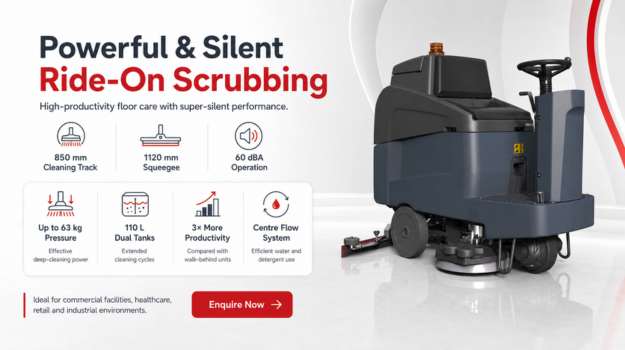
Powerful and silent ride-on scrubbing — high-productivity floor care with super-silent performance.

The CRO 1185 covers an 850 mm cleaning track behind a 1120 mm squeegee, on 110 litre dual tanks. Balanced weight distribution gives it genuine manoeuvrability for a machine of this size, and variable brush pressure reaching up to 63 kg lets it deep clean rather than merely maintain. Detergent control with auto-stop halts flow until the traction pedal is engaged, and the Centre Flow system keeps water and detergent use efficient. From Charnock Equipments Pvt. Ltd.

Why Choose the CRO 1185?

Variable brush pressure up to 63 kg

Pressure that can be dialled up rather than fixed. That is what lets one machine handle both the daily maintenance pass and the periodic deep clean instead of hiring the second one in.

60 dB(A) operation

Around the level of ordinary conversation. Quiet enough to run in a live retail floor, a hospital corridor or an occupied office rather than waiting for the building to empty.

Detergent control with auto-stop

Flow stops the moment the traction pedal is released, so nothing is dispensed onto a floor the machine is not moving across. Over a shift that is where chemical spend quietly disappears.

Product specifications
Product
CRO 1185 ride-on scrubber drier
Type
Battery ride-on scrubber drier
Cleaning track
850 mm
Squeegee width
1120 mm
Tank capacity
110 L dual tanks (solution and recovery)
Brush pressure
Variable, up to 63 kg
Noise level
60 dB(A) — see build note 6b
Productivity
3× a walk-behind unit, per the product listing
Water & detergent
Centre Flow system for efficient water and detergent use
Detergent control
Auto-stop — flow stops and starts with the traction pedal
Manoeuvrability
Balanced weight distribution
Structure
Robust build for efficient deep cleaning
Manufacturer
Charnock Equipments Pvt. Ltd
Where it is used
  • Commercial facilities
  • Healthcare
  • Retail
  • Industrial environments
  • Warehouses
  • Institutional sites

Specifications as published by Charnock and its distributors. The ride-on range runs from the compact CRO 7056 up to the 250-litre CRO 2810. Contact the team for the datasheet matched to your floor area and layout.

Pressure, flow and quiet
A scrubber's running cost is mostly water, chemical and hours

The purchase price of a scrubber drier is the smallest number in its life. What actually accumulates is the solution poured onto the floor, the detergent mixed into it, and the operator hours spent covering the area. The CRO 1185 addresses all three directly: brush pressure that can be raised so a single pass does the work of two, flow that stops the instant the machine stops, and quiet enough operation that cleaning can happen during the day rather than on a premium night shift.

Variable pressure, not fixed

Up to 63 kg of downforce when a floor needs it, less when it does not. Pressure does work that extra chemical would otherwise have to, and only where it is required.

Centre Flow with auto-stop

Water and detergent are delivered efficiently and cut off the moment the traction pedal is released. Nothing pools under a stationary machine while the operator answers a question.

Balanced weight, wider recovery

Balanced distribution keeps an 850 mm machine manoeuvrable, and a 1120 mm squeegee recovers wider than the brush path — so floors come up dry even on a curve.

In conversation
Starting small with limited resources and hands-on execution
Ask us anything
Questions about the CRO 1185

An 850 mm cleaning track with a 1120 mm squeegee behind it.

The squeegee being wider than the brush path is deliberate — it recovers everything the machine lays down even on a curve, which is what leaves the floor dry rather than merely wet-cleaned.

It lets one machine do two jobs. Up to 63 kg of downforce handles ground-in soiling on a deep-clean pass; dial it back for daily maintenance and you save brush wear and power.

Pressure also does work that extra detergent would otherwise have to, so the setting affects your chemical bill as well as the result.

The banner rates it at 60 dB(A) — roughly the level of ordinary conversation, which makes daytime operation viable in retail, healthcare and offices.

If you have a specific noise limit written into a lease or a ward policy, ask Charnock to confirm the figure for the exact configuration you would buy.

Flow stops and starts with the traction pedal. When the machine is not moving, nothing is being dispensed.

It sounds minor and is not. Every pause — a phone call, a door, a person walking through — is solution that would otherwise pool on the floor and be recovered as waste.

110 litre dual tanks, solution and recovery. Runtime depends on your flow setting and how heavily soiled the floor is.

Ask for a figure against your own duty cycle rather than a headline number — flow rate is the variable that decides it.

Access versus coverage. The CRO 7056 is 560 mm wide with a 0.8 m turning radius and 70 L tanks, built for congested areas and narrow passages.

The CRO 1185 is 850 mm with 110 L tanks and variable pressure to 63 kg — more ground per hour and more scrubbing force, on a machine that needs more room to work. If your site is open, the 1185 finishes more of it.

Use the Enquire now button. Floor type, aisle width and total area decide the specification more than headline figures, so a site visit answers more than a spec comparison.

Charnock's ride-on range runs from the compact CRO 7056 up to the 250-litre CRO 2810, so a walkthrough can also confirm whether a different model suits part of your site better.

CHARNOCK

Mini Ride-On Scrubber Drier — CRO 7056

Enquire now

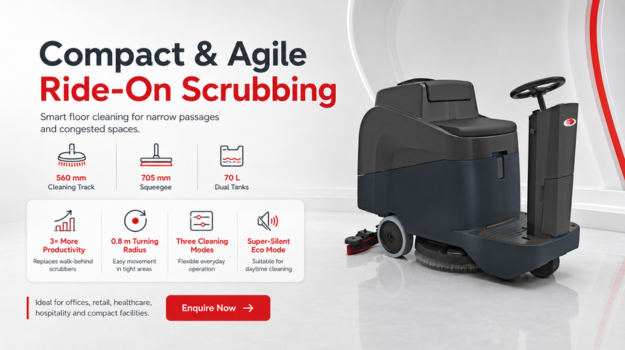
Compact and agile ride-on scrubbing — smart floor cleaning for narrow passages and congested spaces.

The CRO 7056 is a mini ride-on scrubber drier designed specifically to replace walk-behind machines. A 560 mm cleaning track, 705 mm squeegee and 70 litre dual tanks sit on a chassis compact enough for the most congested areas, with a 0.8 metre turning radius and super-silent Eco Mode operation. Charnock rates it at three times the productivity of a walk-behind scrubber — the point being fewer operator hours for the same floor. Equipped with a storage compartment for cleaning tools. From Charnock Equipments Pvt. Ltd.

Why Choose the CRO 7056?

3× the productivity of a walk-behind

The machine exists to replace walk-behind scrubbers, not to sit above them. Same congested spaces, an operator who rides instead of walks, and a fraction of the hours for the same floor.

0.8 m turning radius

Most ride-ons buy productivity by giving up access. This one turns inside a metre, so narrow passages stay on the machine's round instead of reverting to a mop.

Super-silent Eco Mode

Quiet enough to run during occupied hours, which turns floor care from a night-shift task into something that happens when the floor actually needs it.

Product specifications
Product
CRO 7056 mini ride-on scrubber drier
Type
Battery ride-on scrubber drier, designed to replace walk-behind machines
Cleaning track
560 mm
Squeegee width
705 mm
Tank capacity
70 L dual tanks (solution and recovery)
Productivity
3× a walk-behind scrubber, per Charnock
Turning radius
0.8 m
Climbing capacity
20%
Drive
Rear-wheel drive
Cleaning modes
Three cleaning modes
Eco Mode
Super-silent Eco Mode system
Chemical dosage
Chemical dosage system with three dilutions
Brush pressure
Brush pressure boost
Brush handling
Brushes connect and disconnect automatically
Controls
Electronic brush and squeegee raise and lower
Water sensor
Intelligent water sensor system protecting brushes and vacuum
Storage
Onboard compartment for cleaning tools
Maintenance
Designed for easy maintenance
Manufacturer
Charnock Equipments Pvt. Ltd
Where it is used
  • Offices
  • Retail
  • Healthcare
  • Hospitality
  • Compact facilities
  • Narrow passages & congested areas

Specifications as published by Charnock and its distributors. Charnock's ride-on range also includes the CRO 1185, CRO 8055, CRO 8065 and the 250-litre CRO 2810 for larger areas. Contact the team for the datasheet matched to your floor area and layout.

Compact by design
Most ride-ons buy productivity by giving up access

The usual trade in floor care is simple: a walk-behind reaches everywhere and covers little; a ride-on covers ground and abandons the tight sections to a mop. The abandoned sections are where the labour hours quietly go. The CRO 7056 is built to close that gap rather than sit on one side of it — 560 mm of cleaning track on a chassis that turns inside 0.8 metres, so the aisles and passages stay on the machine's round instead of being handed back to a person with a bucket.

Three dilutions, dosed not guessed

The chemical dosage system carries three dilution settings, so the mix matches the floor rather than whatever the operator judged at the start of the shift. Consumption becomes predictable.

Brush pressure boost, automatic engagement

Extra downforce when a floor needs it, and brushes that connect and disconnect themselves. Changing a brush stops being a reason to postpone the job.

Intelligent water sensor

Protects the brushes and vacuum system from running dry or over-filling. The failures that take a scrubber out of service are usually not dramatic — they are this kind, repeated.

Ask us anything
Questions about the CRO 7056

That is exactly what Charnock designed it for. The CRO 7056 works the same congested areas a walk-behind reaches, at a rated 3× the productivity, because the operator rides rather than walks.

The case is strongest where you currently run walk-behinds over a large total area in small sections — offices, retail floors, hospital corridors. If your area is genuinely small, a walk-behind may still be the right answer.

The turning radius is 0.8 m and the machine is built for narrow passages and congested areas, which is the whole design brief.

Share a floor plan with aisle widths and the team can confirm. That is worth doing before purchase — a ride-on that cannot turn in your tightest section ends up cleaning only the open floor.

560 mm of cleaning track with a 705 mm squeegee. The squeegee being wider than the brush path is deliberate — it recovers everything the machine lays down, including on a curve, which is what leaves the floor dry rather than merely wet-cleaned.

70 litre dual tanks — solution and recovery. On a machine this size that is a substantial run before stopping.

Actual runtime depends on the dilution setting and how heavily soiled the floor is. Ask for a figure against your own duty cycle rather than a headline number.

That is what the super-silent Eco Mode is for. Quiet operation makes daytime cleaning viable in offices, retail floors, hospitals and hospitality — so the floor gets cleaned when it needs it rather than only overnight.

If you have a specific noise limit to meet, ask Charnock for the dB(A) figure for the mode you would run in.

Charnock designs it for easy maintenance: brushes connect and disconnect automatically, brush and squeegee raise and lower electronically, and an intelligent water sensor protects the brushes and vacuum system.

That last one matters more than it sounds. Scrubbers rarely fail dramatically — they fail through small repeated events like running dry, and a sensor removes the operator error behind most of them.

Use the Enquire now button. Floor type, aisle width and total area decide the specification more than headline figures do, so a site visit answers more than a spec comparison.

Charnock's ride-on range runs from this machine up to the 250-litre CRO 2810, so a walkthrough can also confirm whether a larger model suits part of your site better.

Indian cleaning equipment manufacturing for domestic and export markets
Cover Story 8 min read

India: Rising to Meet Global Demands


As the cleaning industry rapidly evolves, driven by technological advancements such as automation, robotics, and eco-friendly innovations, Indian manufacturers are stepping up to meet both local and international demands. The emphasis is now on adopting sophisticated technologies that not only enhance efficiency but also address sustainability. In this cover story, Clean India Journal interacts with some of the Indian manufacturers and international exporters to gain insights on the growing potential of India moving towards becoming a manufacturing hub for cleaning products.

Indian manufacturers are no longer limited to traditional methods of production; they are actively integrating next-generation technologies to cater to a rising demand for smart, efficient, and environment-friendly cleaning solutions.

At the forefront of this transformation, leveraging AI, automation, and robotics to enhance supply chain management and product delivery, leading equipment suppliers and manufacturers have made significant strides in providing advanced technologies through mechanised cleaning.

"We have evolved from producing machines with 50% Indian components to 95%, with only 5% imported. This is a true example of indigenisation of our joint venture with Borghi, Italy."
— Rajiv Sanghavi

"We are focusing on building eco-friendly, high-performance products," says Vivek Mata, Managing Director, Charnock Equipments Pvt Ltd. "Our trolleys made from recycled eco-plastics and the cleaning chemicals are bio-based," which meet the global goals set for sustainability and net zero. Use of technology extends beyond products, like incorporating automated processes that reduce costs and delivery time and maintain high-quality standards. These are some of the key drivers that set India as a potential partner in the global cleaning products market. "These collaborations are vital in ensuring that Indian manufacturers have access to the latest technological advancements and global expertise."

"Earlier we never used to mention 'Made in India', but now customers insist. This is a big achievement."
— Debtosh Chatterjee

As a leading manufacturer in India, Roots Multiclean Ltd has been one of the market leaders in Make in India, contract manufacturing for international brands and for the export market. In terms of meeting international quality standards, Varun Karthikeyan, Managing Director, states that "we manufacture quality machines and there is no differentiation in the process. Specialising in floor care machines, we are supplying to the global markets and across India."

As India strives to become a self-reliant hub for manufacturing, its cleaning industry is embracing the shift towards advanced technologies. From robotics and AI to eco-friendly innovations, Indian manufacturers are gearing up to meet the increasing demand for better, more sustainable cleaning solutions. These companies are not just adopting technologies but are driving innovation that positions India as a key player in the global market.

As the Indian market matures, the demand for robotic cleaning solutions and AI-enabled devices is also on the rise. "There's growing recognition that robotic solutions are the future, and we are preparing for this technological shift by incorporating more automation into our production and service models," Varun adds.

"We export to nine or ten countries at the rate of two containers per month. Our target is to double this to four containers."
— Anjana Vij

Motors are one of the major components for cleaning equipment, and manufacturers are largely dependent on international markets for quality products. Rotomag Motors & Controls Pvt Ltd is a key player in the design of specialised motors for use in floor care equipment like scrubbers and other machines. These motors are customised not only for a specific country but also for specific clients who have unique design elements. This calls for intensive design knowhow to understand the needs and configure products to meet expectations.

"Product development can extend even to a year for a motor. It involves designing of prototypes, testing at the client end and integrating it with the machine, followed by incorporating feedback on refinement wherever required," says Umesh Balani, Managing Director. "Our custom-designed motors are built to handle the specific needs of international clients, and while the supply chain is a challenge, India's low labour costs and growing talent pool make us optimistic about our role in this emerging space."

"With the kind of talent we have in India, the low labour costs, and following the strengthening of the supply chain, going forward, India could be a good destination for manufacturing not only for the local market but for others too. We are mainly exporting to European countries like Italy, Germany, France, Switzerland as well as the US. If the manufacturing industry grows then probably the use of machines for cleaning will also grow. The awareness is there," he adds.

One area where 90% of the product is made in India is in cleaning tools.

"The ideal distributor has to be service-oriented and have a consultative approach rather than only focusing on selling and pricing. In addition, product, application and competitors' knowledge are a must."
— Umesh Balani

Borghi India, a joint venture that specialises in brush-making machines, has made deep inroads across India. Rajiv Sanghavi, Managing Director, explains that Borghi has moved towards fully automated production systems. "Our evolution from semi-automatic machines to continuous production has made us more capable of meeting the growing demand for high-efficiency, low-cost cleaning tools." A fast consumable with wide applications in the cleaning processes, brush-making machines not only set the roadmap for 'Atmanirbhar Bharat' but also offer a business proposition for start-ups.

Speaking of tools, two of the manufacturers in India are growing exponentially year on year in the export market. Debtosh Chatterjee, Managing Director, Mrinmoyee Supply Pvt Ltd, a manufacturer of cleaning tools, highlights the importance of collaborations with global companies. "We're seeing increasing interest from international players in joint ventures that allow us to scale up and meet the growing demand for advanced, non-European, non-US made products." There is a bigger demand for small products in the international market today.

"With an in-house R&D team for new product development for cost-effective and sustainable production of dispensers, we also do private labelling. The products are also sold directly to customers across countries."
— Inpreet Singh Sahni

"The positive change towards international companies extending hands rather than getting into branding and supplier model is where we can strengthen the economies of scale, using Indian materials and our understanding of the business. Our production is most economical as we get the best raw materials, labour cost, maximum working days in a year, good port connectivity and political connections.

"India is signing a lot of treaties with other nations for tax free trade, numerous trade councils and high commissions are promoting our products," Debtosh adds.

As a confirmation to this growth, Debtosh has almost doubled his exports over the last few years and is now supplying globally.

"It is only in the mindset of the customer that sustainable products are not as efficient as the harsh chemical ones. Only two to five per cent of the customers actually care to use green and sustainable products. Others need to be educated."
— Sajid Jaffer

At the same time, Kibble Enterprises, which is leading in the production of cleaning tools, is making headway in both the US and European markets. Besides catering to the domestic demands for quality tools, Kibble has expanded into the Middle East, Europe and other markets. "Mechanised cleaning is taking off in Europe, and our high-end brushes, especially those for pharma and food industries, are seeing strong demand," says Anjana Vij, Founder & CEO. Kibble's focus on sustainability extends to their biodegradable plastic products, which cater to environmentally conscious consumers.

With a booming economy, favourable trade policies, and strong government initiatives, India is well on its way to becoming a leader in the global cleaning industry. By embracing cutting-edge technologies, manufacturers are making the country a focal point for future growth in the cleaning sector.

Many manufacturers are adapting global innovations to meet the specific demands of the Indian market. Acme Techplast, for instance, is using advanced technology to improve its soap dispensers while reducing production costs. Founder & MD Inpreet Singh Sahni notes, "Our goal is to create sustainable, cost-effective dispensers that align with the increasing demand for hygiene solutions across industries like railways and hospitality."

Companies like British Clean are focusing on reshaping perceptions of sustainable products. "We're integrating nanotechnology into our cleaning solutions, enabling them to cover larger areas with smaller quantities," explains Sajid Jaffer, General Manager. This move reflects the industry's shift towards technologies that optimise resource usage while delivering results comparable to chemical-based alternatives.

"As we mark our 25th anniversary this year, we are working on playing a pivotal role towards Make in India by developing eco-friendly and effective cleaning products to meet the demands."
— Vivek Mata

Just to quote one of the international manufacturers who are suppliers of dispensers to the international markets, and is looking at entering the Indian market: "While we are not sure yet, we might look at partnering for servicing in India. We are looking at the B2B market for companies which will buy our product, provide the chemical and the service. India has the technology and the labour for manufacturing." Many international manufacturers are looking at gaining a foothold in India, and are open to engage with able partners to expand their market into this fastest growing economy.

In conclusion, as Vivek Mata puts it: "Indian manufacturers are well-positioned to lead the cleaning industry's evolution through a combination of strategic advantages. Lower labour and operational costs enable them to produce competitively priced solutions, especially for price-sensitive markets. This allows Indian companies to expand into emerging regions like Africa, Southeast Asia, and the Middle East, where demand for cost-effective, quality products is rising. By forming partnerships with global brands, Indian manufacturers can integrate international expertise while capitalising on local production capabilities. Moreover, government initiatives like 'Make in India' provide vital support, further empowering Indian firms to compete on the global stage. Together, these factors are propelling India's cleaning industry towards a future of innovation, growth, and global competitiveness."

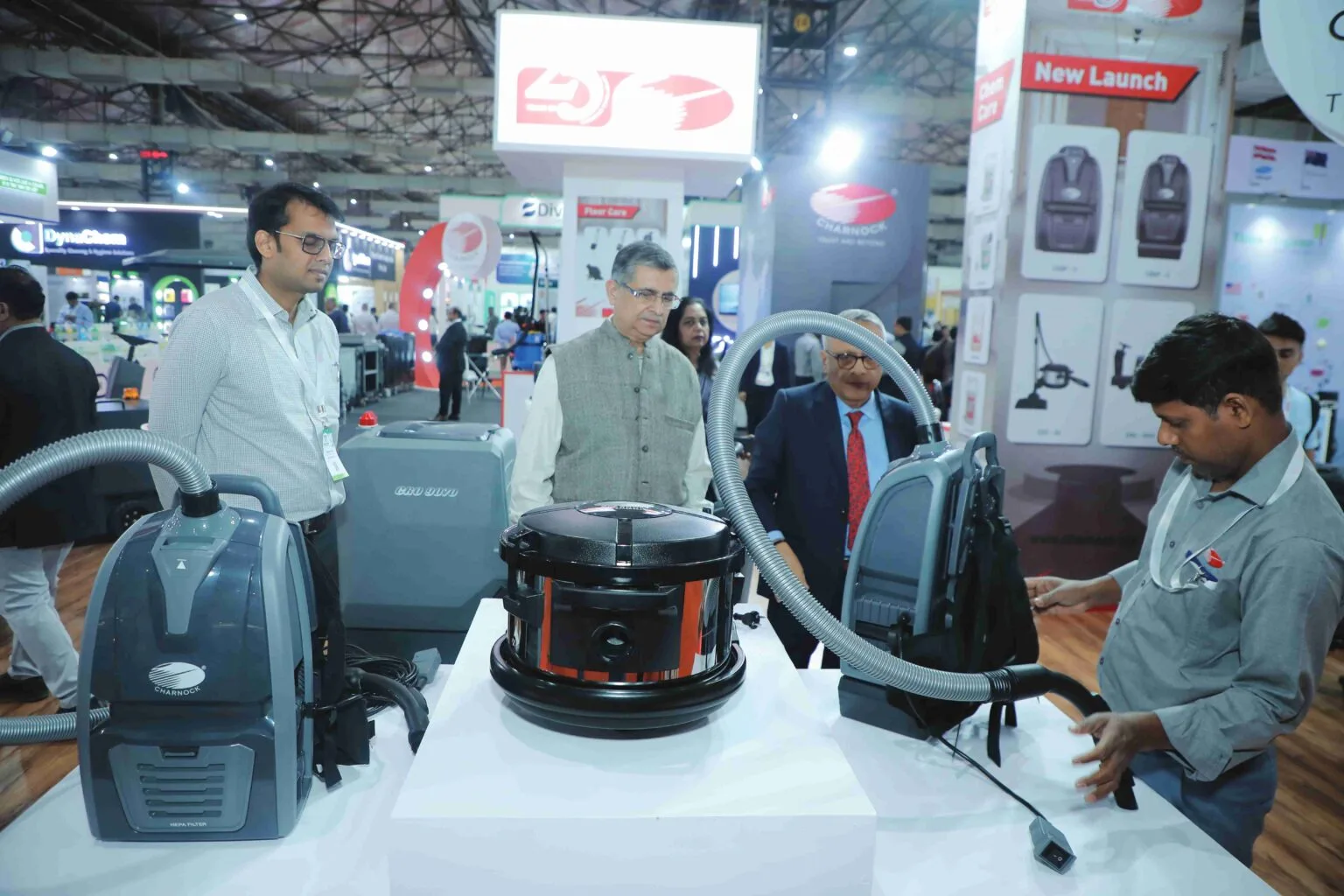
Charnock Equipments stand at Clean India Show 2024
Products 3 min read

New Launches at Clean India Show 2024


Exhibitors at Clean India Show 2024 used the platform to unveil new products across cleaning equipment, chemicals, laundry, dispensers and software.

  • Charnock Equipments Pvt Ltd unveiled a cordless backpack-style cleaner for narrow spaces. This solution makes it easy for the ground-level workforce to reach better and ensure thorough cleaning, as they are not required to exert more, backpacks being easy to carry.
  • columbus Cleaning Machines Pvt Ltd introduced durable sweepers suitable for both indoor and outdoor use.
  • Ecodia Environ Pvt Ltd introduced the Fimap FS90, an industrial compact sweeper ideal for efficiently cleaning both large areas and tight spaces, capable of handling both dust and solid debris.
  • KTV Working Drone launched a unique and first-of-its-kind-in-India façade cleaning drone.
  • Quick Dry Cleaning Software debuted an all-in-one, WhatsApp-integrated POS software, streamlining customer communication, marketing, and support for laundry and dry-cleaning businesses.
  • Reckitt Pro Solutions Pvt Ltd launched a special industrial pack of its flagship Harpic Bathroom Cleaner.
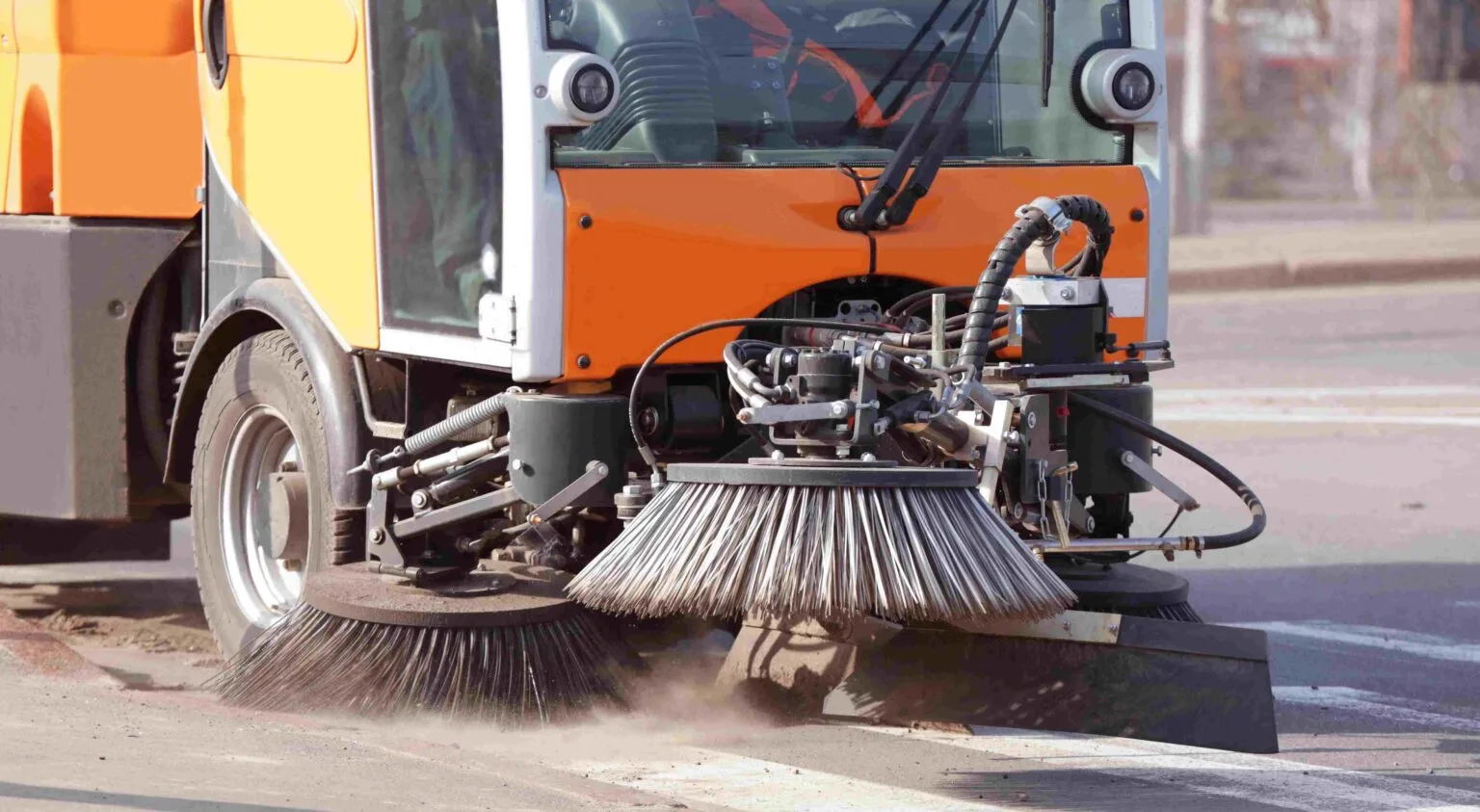
  • Spruce Up Industries Private Limited launched Regenerative Air Sweepers, which are designed in the USA and made in India. They drew a lot of attention from visitors and fellow exhibitors. Right from the design stage, the company focused on four key pillars that make any mechanised road sweeper stand out and offer a hassle-free experience to managers: capable of handling various road types; easy to use, as they require minimal training; resilient, as the machines are equipped to endure diverse climates and conditions and are built to last longer; and, despite their advanced features, cost-effective.
  • Straits Laundry (India) Pvt Ltd unveiled LG's commercial laundry machines and showcased its eco-friendly Wet Pro laundry machines, catering to both startups and established laundries.
  • Emerald Solution introduced the eco-friendly Sakos Mosquito Herbal Repellent Spray.
  • Impressive9 LLP launched its tissue dispenser and displayed its machine and cleaning solutions during the show.
  • Mould Injection Technology Pvt Ltd launched foot-operated, colour-coded pedal bins for hands-free waste disposal, targeted towards healthcare facilities, clinics, malls, and agencies.
  • Launmark India Pvt Ltd launched its consulting company.
  • Labocosmetica Chemicals Pvt Ltd launched its Kitchen Line of cleaning solutions for hotels, restaurants and cloud kitchens. It also presented its solutions pertaining to the housekeeping portfolio.
  • Workstore launched its various ranges of cleaning solutions. Its partners, Fimap and Lindhaus, are industry leaders in professional cleaning equipment, offering innovative solutions that enhance efficiency, hygiene, and sustainability.
  • Alpha Products introduced the Alpha Premium Car Shampoo, offering a quick shine and fresh fragrance, alongside Alpha Dash Shine, a polish for dashboards, leather, and tyres.

Facility management innovations on show at Clean India Expo 2024
Innovation 5 min read

Understanding Innovations Differently: Striking Balance Between Adopting a New Approach and Meeting Client Needs


Facility management (FM) is no longer just about keeping spaces clean; it is about creating sustainable, efficient, and user-friendly solutions that align with modern demands. With rising environmental concerns, cost pressures, and the need for technology, innovation in FM products has become a necessity. Clean India Expo 2024 showcased groundbreaking solutions that address these needs head-on, offering tools and ideas that promise to redefine how FM professionals deliver value. Nandakumar Marar of Clean India Journal caught up with some of the ideators behind these innovations to get a deeper understanding of their offerings.

Innovation is the spice of life; a new thought, a new direction which brings out the smiles on the faces of both ideators and consumers. For the facility management sector, a new way to get routine things done can be refreshing and rewarding. Customers' requirements can shift, depending on what they perceive as possibilities around them. The challenge lies in striking a balance between offering something new and useful, and delivering unique products and services.

The facility management sector, today, is grappling with challenges such as sustainability, cost-efficiency, and the growing demand for advanced technology. Against this backdrop, the Expo brought forth innovations that cater to these pressing needs.

Revolutionising road sweeping

Sumedh Bhoj, co-founder of Spruce Up Industries, explained the journey of designing Stratus EVO2, a road-sweeping machine with a unique design and special features. Teaming up with co-founder and CEO Abhishek Shelar as 25-year-olds, the duo detailed the step-by-step emergence of India's first road sweeper. This innovation comes packed with features like an onboard pressure washer, a litter picker, instant video technician software called Spruce Up Genie, and a redesigned engine placement for easy maintenance.

Sumedh shared: "A year and a half back, we started exporting to the USA, Japan, Australia, and New Zealand. Many clients came back to us requesting a solution for road sweeping. After five years of R&D, working with industry experts and clients, we incorporated four key points: multi-functional capabilities, easy maintenance, durability, and value for money."

Manufactured in Pune, Stratus EVO2 is equipped with Spruce Up Trainpro (regional language videos for operator training) and Spruce Up Genie, which enables instant video diagnosis and minimises downtime. These advancements address the critical need for mechanised, efficient, and reliable road-sweeping solutions.

Precision in cleaning chemicals

Sankha Mitra, Zonal Manager (Sales & Marketing) at Dynachem India, introduced Dynacap, a handy innovation aimed at ensuring precise chemical dosage. The cap, available in nine colour codes for different cleaning applications, is designed to fit onto water-filled bottles. A twist releases the exact amount of chemical needed, ensuring consistency in dilution and reducing wastage.

Mitra noted: "Overuse of cleaning chemicals leads to wastage and higher costs, while under-dilution compromises performance. Dynacap ensures the perfect balance, making it easy for cleaning staff to achieve optimal results every time."

Dynachem plans to start local production in a Faridabad factory by 2025, catering to the Indian market. This innovation resonates with institutions requiring accurate chemical usage, reducing both costs and environmental impact.

Sustainability in washroom hygiene

The urinal block from Praras Biosciences was another standout innovation. Viboli Lepto described the bio block as a game-changer for men's washrooms. "This is a bacterial-based block that eliminates the need for flushing after every use. It removes yellow stains and odours caused by uric acid, reducing water usage significantly."

The product addresses environmental concerns by saving water and preventing the production of ammonia, which causes washroom odours. Additionally, the bio block minimises liquid sewage volume, easing strain on wastewater systems. Designed for high-footfall venues such as hospitals, airports, and offices, this innovation underscores the importance of sustainable hygiene solutions.

Efficient escalator cleaning

Vedant Matta, Sales Director at Charnock Equipments Pvt Ltd, showcased an escalator cleaner with a vertical cleaning attachment. "Escalators are a pain point for facilities, particularly in malls and metro stations, where dirt accumulates on both horizontal and vertical surfaces. Our machine not only handles wet and dry cleaning but also cleans vertical portions with ease," he explained.

The machine's brush pressure control allows tailored cleaning, while its compact design suits various facility needs. Currently imported, the company plans to assemble the machines in India by 2026, making them more accessible to the domestic market.

Vision for the future

As the FM sector continues to evolve, such innovations enable service providers to deliver smarter, cleaner, and more sustainable solutions.

The journey does not end here. Innovations are a promise of a future where technology and sustainability go hand in hand, ensuring that the industry stays ahead of the curve.

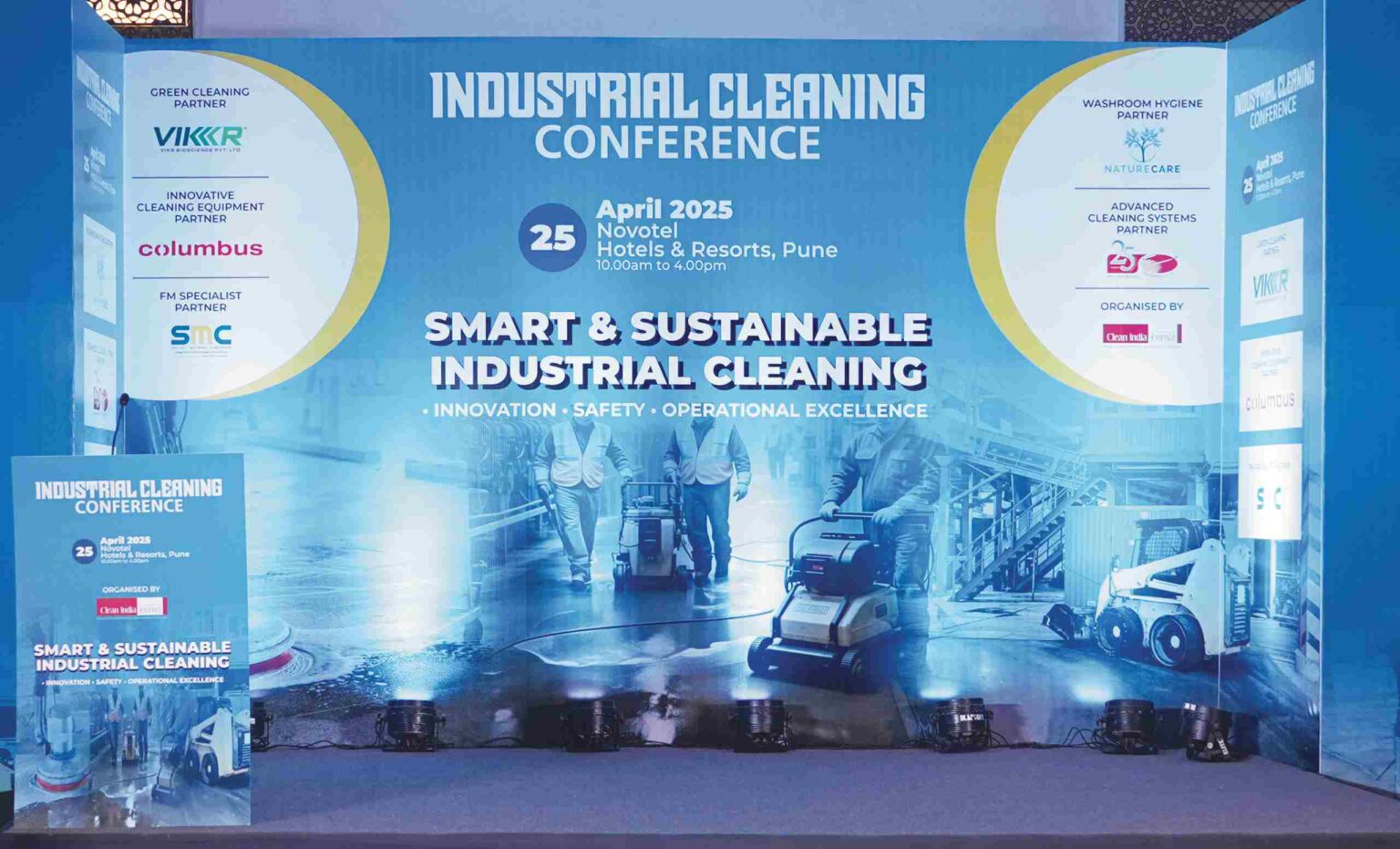
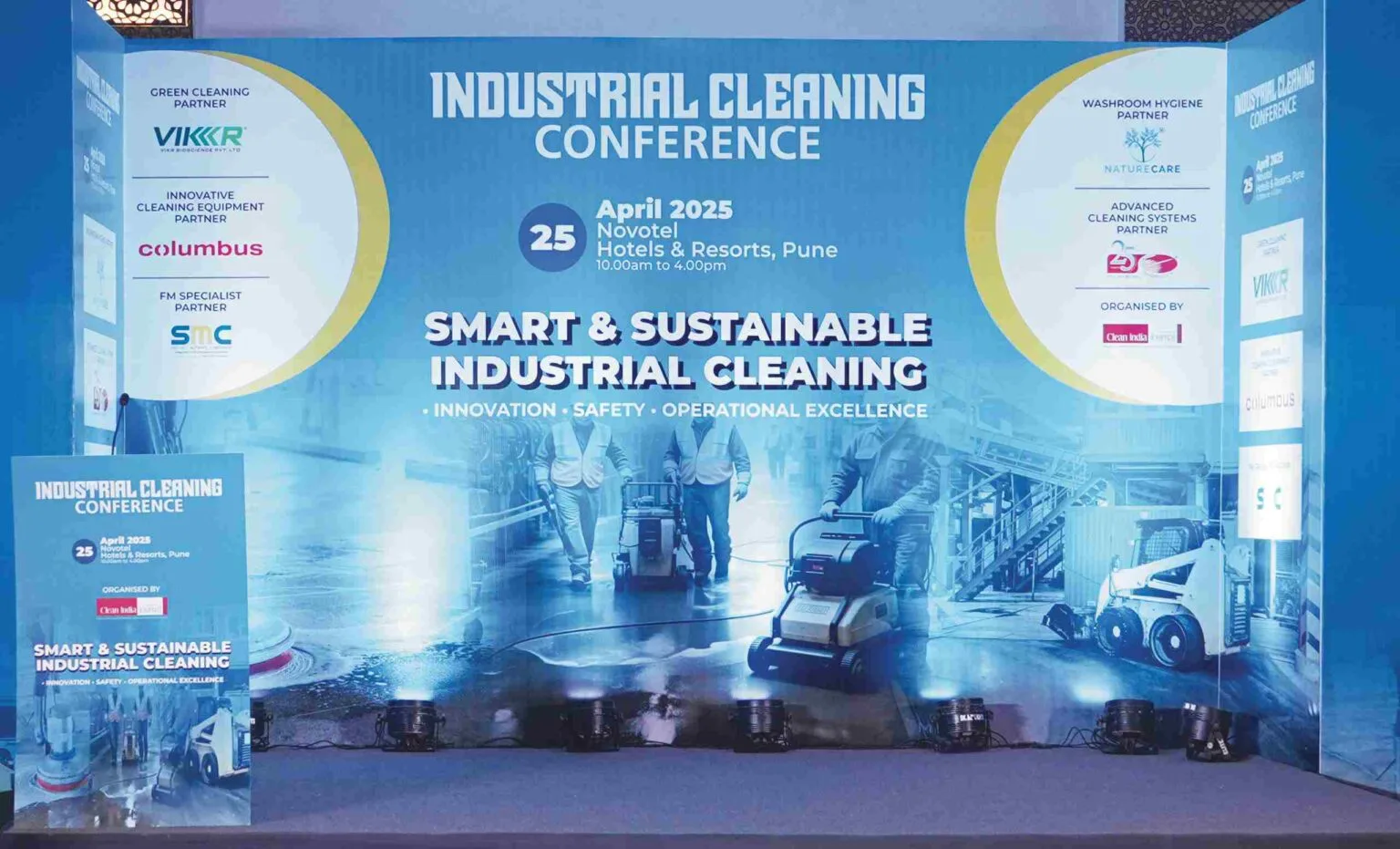
Panel session on automation, AI and robotics at the Industrial Cleaning Conference
Conference 8 min read

Intelligent Maintenance: Automation, AI and Robotics in Indian Industry


As industries increasingly prioritise efficiency, safety and sustainability, the role of automation, artificial intelligence (AI) and robotics in industrial cleaning is undergoing a profound transformation. A recent session at the Industrial Cleaning Conference brought together leading experts to dissect this evolving landscape, exploring how smart technologies are redefining cleanliness on the shop floor.

Anchored by Pankaj Patil, Head – Asset Management, Siemens Limited, and Sandeep Rawal, Deputy General Manager, Motherson Automotive Engineering, the discussion provided a comprehensive overview of the opportunities and challenges in adopting advanced cleaning solutions, emphasising their critical link to operational excellence and environmental responsibility.

There is a critical link between industrial cleaning and maintenance. Dust is a major adversary to electrical systems and manufacturing efficiency. IoT and AI enable smart predictive maintenance, shifting from reactive to proactive upkeep.
— Pankaj Patil

Nexus of cleaning & maintenance

Pankaj Patil set the tone by drawing a direct connection between industrial cleaning and maintenance. "Though working in maintenance for the last 23 years, I am just doing the dust control. Dust is the enemy of electricity and its presence in manufacturing is undesirable. How can we prevent dust from the shopfloor, be it precision manufacturing, food and beverage, or pharma?" he queried.

He elaborated on the far-reaching impact of dust, explaining: "HVAC systems, with filters at the entry of AHU, control dust in the environment. However, dust beyond a certain limit creates high static on the blowers, increasing power consumption. In a power supply system, dust in the panel can lead to fire hazards, short circuits, heating of terminals and impact the reliability of power supply. I was just trying to connect the dots between cleanliness and industry cleaning practices and maintenance."

Automation: from home to industry

Sandeep Rawal from Motherson Automotive Engineering offered a different perspective, highlighting the role of machines and robots in material handling and cleaning. He drew a parallel to the domestic sphere: "Maids for cleaning at home, janitors for offices are difficult to get, so vacuum cleaners or floor scrubbers are pressed into service.

"The requirement for manual handling of these machines remains, availability is less, forcing companies to come out with automated cleaning robots, like a toy car. These robots placed in a room would do the vacuuming, wet scrubbing and so on."

Scaling this up, he noted: "On an industrial shop floor, you don't want a person to handle the cleaning activity. In the western world, people are incentivising and getting points for using robots. Job shortage in India, however, forces educated people to accept mundane activities like cleaning." The discussion then naturally shifted to the use of robots in hazardous environments like boilers or nuclear reactors.

"Manual cleaning is banned in most countries, but in India many users follow conventional practices," he observed, advocating for automated cleaning methods for their reliability, safety, accuracy and repeatability. While acknowledging the initial cost, he emphasised: "Automated industrial cleaning comes at a cost, in the long term, reducing risk and improving safety is beyond anybody's imagination."

It is important to distinguish a client's seriousness for automation. Also, advanced machines require operators who understand dashboards. The focus should be on the value of SLAM technology, adaptive cleaning for customised solutions and predictive maintenance to minimise machine downtime.
— Vedant Matta

Navigating the path to automation

Vedant Matta from Charnock shed light on the considerations when clients inquire about automation. "When people are researching automation and robotics, first distinguish between whether curious or serious and whether the machines can work on the shopfloor," he advised. He also highlighted the operational aspect: "The second aspect is these machines operate on their own; monitoring needs a person who understands a dashboard, even drones used in a facility need a pilot to operate."

Matta underscored the importance of technology, noting: "None of the machines used in India, including the robotic devices, use the SLAM technology (Simultaneous Localisation and Mapping), wherein the robots placed on the shopfloor detect themselves, make a map for themselves and get to work."

He also stressed the need for adaptive cleaning technology in conventional machines, where the machine senses the type of chemical needed, the brush pressure and calibrates itself accordingly. Predictive maintenance was another key point, aimed at reducing machine downtime by predicting the lifespan of consumables like brushes, squeegees, batteries and motors.

Automated cleaning solutions are driven by labour shortages and the need for safer practices, particularly in hazardous environments where manual cleaning is often banned. AI-powered cameras for quality control and material handling help eliminate complete dependence on manual cleaning.
— Sandeep Rawal

Smart shift: AI, IoT & drones

The conversation seamlessly transitioned back to AI, robotics and drones in industrial settings as manufacturing evolves. Pankaj Patil elaborated: "Industrial maintenance was reactive and time-consuming, not so productive. This is where automation comes in.

"IoT makes the equipment smart and connected. The data from IoT sensors, when connected with Cloud, can predict future failures. It detects a pattern, based on that pattern it can predict maintenance events."

He gave an example: "Let us say in one of the utility systems, HVAC, the air sensor installed can measure the temperature gradient, measure the air flow and update about power consumption. The live feed of this asset or machine can be conveyed to the maintenance team; changing parameters can be spotted and be taken as factors for future failure."

Sandeep Rawal explained the application of cameras in AI technology for maintenance and quality control. "Cameras are used for maintenance, for production and for multiple access points. The usage is to find out if the quality parameters are in line with those defined by the end user. In case of a known problem, or a defined problem, a decision can be taken by the machine about whether rejection or tolerance is acceptable or not acceptable. Critical applications like pharma or food can benefit from the use of AI-based solutions."

When asked about the key benefits of shifting to automation, the Siemens spokesperson listed increased productivity, improved safety and increased sustainability.

There is a significant reduction in manpower and improved cleanliness in the last five years with robotics. However, there are ongoing challenges like robots' inability to reach all hard-to-access surfaces and the continuous need to monitor bacterial counts.
— Nilesh P Gokhale

Real-world applications and challenges

Nilesh P Gokhale, Regional FM Lead, AEMA, of Mondelez India Foods Ltd shared their five-year journey with robotic cleaning. "Automated cleaning machines are still not getting to the hard-to-reach surfaces, which needs to be focused on," he admitted. He detailed their operational efficiency: "Three people in shifts manage a factory, cleaned by machines for an area of about 180,000 sq ft; it is all automated and robotic.

"Robots, cameras do not reach the dark spots, a challenge we are facing, though use of manpower has come down considerably and cleanliness levels increased. The score remains down, because cleaning is all about the count of bacteria and viruses found."

Sandeep Rawal, responding to this, drew an analogy to dishwasher usage in India versus Western countries, highlighting cultural adoption hurdles.

Manual intervention is still necessary as machines cannot access all areas. There are cultural barriers to automation adoption in India, particularly for domestic cleaning, and the necessity of automation for safety in hazardous industrial processes and for cleaning at the source is all the more now.
— Sahil Jain

Sahil Jain, Managing Director, columbus, offered his perspective on smart industrial cleaning, acknowledging the current limitations. "Manual intervention is required on the shopfloor, as machines do not access all areas," he stated.

Addressing the dishwasher analogy, he humorously added: "With reference to low dishwasher usage, the kind of food we eat results in dishwashers not being competent enough to clean those oily surfaces. Manual intervention is needed there as well."

He then contrasted cleaning robot usage in Europe and the US, where they are integrated into daily life. "We do not have carpets, believe in opening our windows for clean air to enter," he said of the Indian context. Jain emphasised that automation is crucial where safety is a major concern and in industries like sugar where bagasse is generated, or textiles where a lot of fibre is produced.

He stressed the need for cleaning at the source, making automation essential for dust removal. He concluded by posing a critical question to the community: "Are we ready about technology, about budgets, in terms of user mentality, in terms of training? As far as robotics, we are still behind and need a few years before technology can replace manpower altogether."

Future of industrial cleaning

Reducing manpower is impossible; there are areas where automation becomes a necessity, particularly when safety is involved. In industries where cleaning at source becomes necessary, automation and mechanisation can come in, especially for hard-to-reach areas where automation is essential.

Looking to the future, Pankaj Patil affirmed: "The future of cleaning is in the cloud, robots and industrial drones. Let us not maintain technologies of the past; together we can create smart technologies." Sandeep Rawal echoed this sentiment, confidently stating: "With AI and robots utilised, dependence on manual cleaning will completely be eliminated."

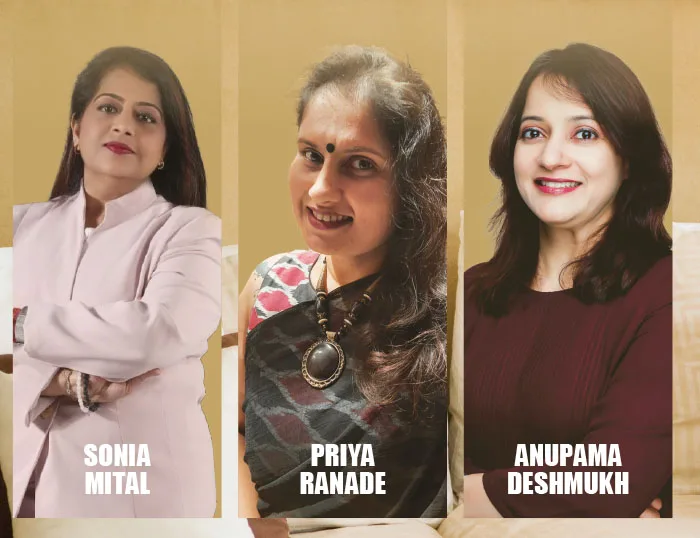
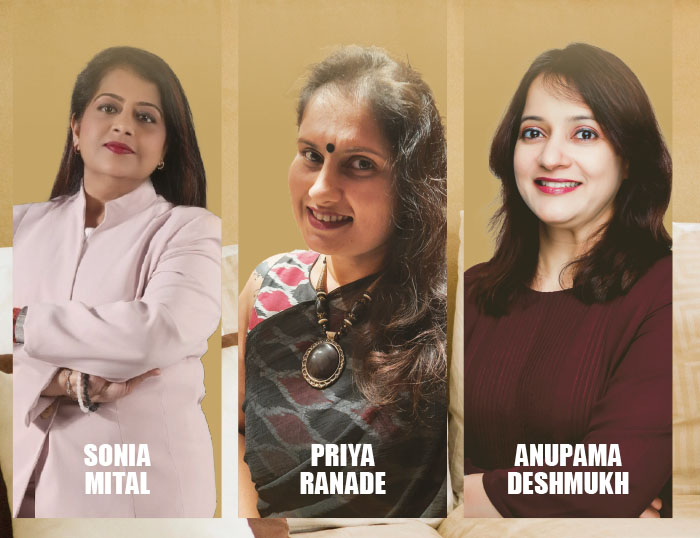
Sonia Mital, Priya Ranade and Anupama Deshmukh, housekeeping professionals, at Rishikesh
Careers 6 min read

Story of Three Women Building Successful Careers on Housekeeping Foundation


Clean India Journal has already spoken so much about housekeeping as a profession in our previous editions. Yet, a new perspective emerged when an all-women team who have been closely associated with housekeeping met at Rishikesh, Uttarakhand. Three professionals — Sonia Mital, Director – Business Operations, Work Dynamics, Jones Lang LaSalle Incorporated; Priya Ranade, BDM and Training Manager at Charnock Equipments Pvt Ltd; and Anupama Deshmukh, Independent Housekeeping Consultant and Trainer, who began their careers in hospitality housekeeping — share some inspiring stories with Editor Mohana M.

A decade ago, the rigmarole of housekeeping in the hospitality industry was considered a daily routine, with the Taj and Oberoi setting unmatchable standards in this labour-intensive role. In fact, housekeeping gained its reputation among those graduating from these and other reputed organisations. However, housekeeping got its recognition mostly within the classy doors of hotels.

Hospitality housekeeping has practically built a solid foundation for those who have successfully got out of the comfort of the hotel environment. In fact, some of the leading professionals in facility management and other managerial posts today have been part of the hospitality industry as housekeeper, chef, front office assistant and even GM.

Years back, while playing the role of housekeeping in the bustling corridors of leading hotels, Sonia, Anupama and Priya honed their skills, gaining the much-needed confidence, preparedness, timeliness and meticulousness. The lessons learnt day after day in housekeeping were a masterclass in their professional development that have become useful tools in their new roles today.

Making a bold move

"Spending years within hotels and then moving out to take up another profession — facility management — was a complete transition," says Sonia. "Working in the facility management space is a completely different experience compared to doing housekeeping in hotels. Initially, it was like leaving behind something and entering an altogether new world! But it was like a schooling in one profession to excel in the next one. I had a significant advantage having the hospitality background. Some of the immediate points that I can list include:"

  • The importance of putting the customer first and never saying no.
  • A strong technical knowledge of cleaning processes and standards.
  • Dealing with multiple surfaces and various cleaning aspects.
  • A higher standard and an eye for detail.
  • Completion of tasks in time.

"Over and above this, hospitality taught me how to manage teams with empathy. Dealing with junior staff taught me to understand and build strong relationships."

Sonia's hospitality roots continue to guide her leadership style — blending empathy, precision and an unbreakable focus on quality in facility management.
— Sonia Mital

Most of this staff come from backgrounds with little or no formal learning. Getting down to teaching and working with them not only builds patience but also builds experience in identifying where things can go wrong.

These skills learnt during the fast pace of hotel work, where services must be delivered quickly, within strict timelines, without errors, have particularly been useful in facility management.

Leveraging the sales edge

Moving on from hotel housekeeping to sales of cleaning products is not just a transition but a total change of profession. "However, it is closely connected," says Priya. In hospitality, cleaning is one of the major roles played by the housekeeper. But at the same time, understanding the products used for cleaning becomes a challenge. In most cases, working on strict timelines seldom leaves time for studying in depth which products should be used for cleaning.

Priya's journey from hospitality to sales has turned her into a bridge between users and technology — combining product knowledge with practical housekeeping insight.
— Priya Ranade

"Now being in the sales end, I have been able to understand the product functions and their suitability for various operations in the hotels and, for that matter, any facility. This gives me an edge as I know exactly what housekeepers need and what exactly will suit their requirements."

In most cases, sales to cleaning professionals are handled by people who do not have hands-on experience in housekeeping. "As a housekeeper, I have the insight of the real needs and requirements of my clients today. I completely understand what housekeepers and facility managers are looking for and can offer the right solution.

"Having the hospitality background also allows me to offer better advice to clients on the practical use of cleaning machines and not just the technical specifications. This helps in building long-term relationships with clients instead of just making a single sale.

"Training is an integral part of housekeeping, and now I can train the sales team to better understand a housekeeper's perspective and needs. Especially, not to oversell a product, which often happens when salespeople are only concerned with meeting their targets." The connection established with customers from sharing the same background makes for a more comfortable working relationship.

Choosing the training path

"My days in hotel housekeeping involved rigorous training, where perfection was the only way forward," says Anupama. Associating with top brands in the hospitality sector gave her a strong foundation in housekeeping.

Moving on from housekeeping to becoming a corporate trainer and consultant was a gradual transition. "Based on the initial experiences, training students in hospitality schools and colleges was the first step." Concentrating more on etiquette and soft skills for the hospitality industry was the starting point. This added a perspective of what areas required more focused training.

The foundation in hospitality has become a stepping stone for Anupama to train professionals across various industries, teaching them the importance of soft skills.
— Anupama Deshmukh

Thereafter, moving on to corporate training for leading companies, "I was teaching managers social and dining etiquette. I also started training staff of different sectors, including banks and hospitals, on customer service. I am continuously honing my skills in training, which all began with my hospitality housekeeping days, especially Taj, which gave me a strong foundation in soft skills and professional etiquette."

This knowledge has helped connect a wide range of people requiring training, right from rural housekeepers to corporate managers and security guards.

The stories of Sonia, Priya and Anupama prove that a career change is not an end but a new beginning. Their experiences show that the skills gained in hospitality — from a relentless focus on the customer to an eye for detail and an empathetic approach to people — are not confined to hotels. They are universal assets that can drive success in any industry.

Enquire Now

Please enable JavaScript in your browser to complete this form.
=