





























Ride-On vs Walk-Behind Scrubber Dryer: Which Do You Need?
Buying a scrubber dryer machine looks simple until you sit down with three quotations. One supplier recommends a ride-on. Another says a walk-behind is all you need. Both sound convincing.
The truth is that neither machine is better. Each one suits a different kind of floor, a different layout, and a different cleaning routine. Pick the wrong one and you either pay for capacity you never use, or your team spends hours pushing a small machine across a floor that’s too big for it.

This guide breaks the decision down into a few plain questions. We’ve drawn on machines and site experiences Clean India Journal has covered, so the examples come from real Indian facilities, not theory.
What a scrubber dryer does
A scrubber dryer cleans a hard floor in one pass. It puts down cleaning solution, scrubs with brushes, and sucks the dirty water back into a recovery tank. The floor is left clean and dry, so people can walk on it straight away.
Both ride-on and walk-behind machines do this same job. The difference lies in how much floor they cover, where they can go, and how much effort they ask of the operator.
Walk-behind scrubber dryers: built for control
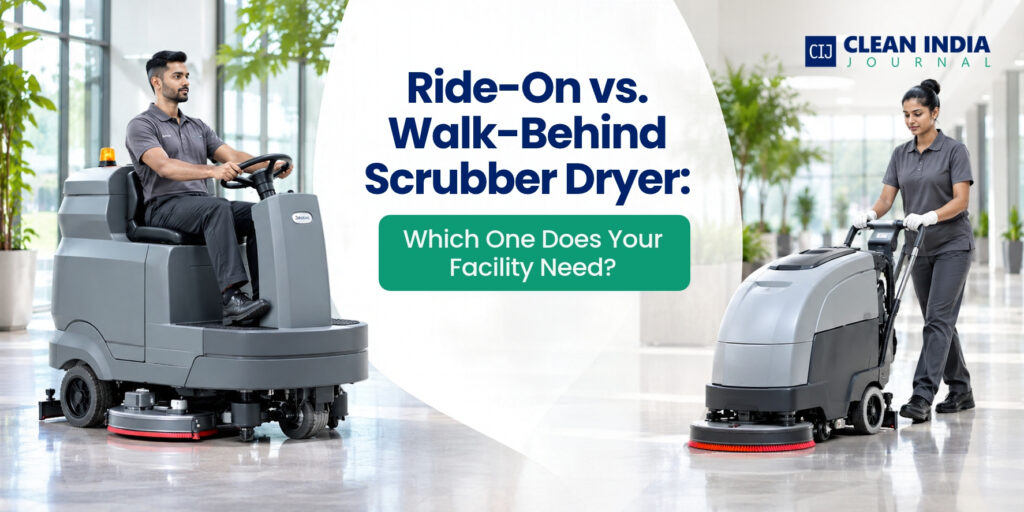
A walk-behind scrubber dryer is pushed or guided by an operator on foot. It’s smaller, easier to turn and easier to store.
Comac describes its walk-behind range as made for daily maintenance in offices, retail stores, hospitals and public facilities. Its L20 model is a good example of the size involved. It suits floors of up to 1,800 sq m, has a 51 cm working width, and the battery version can run for up to two hours on a single charge.
Walk-behinds make sense when:
- Your floor is small to medium-sized and broken up by aisles, desks, beds or shelving.
- You need to clean during working hours, around people.
- Your corridors, doorways or lifts are narrow.
- Storage space is tight.
CIJ’s guide to office cleaning equipment puts it simply: compact and push scrubber driers suit small floors with lots of obstacles, and walk-behind machines are the workhorses for medium to large areas.
Some walk-behinds go even smaller. Charnock’s C235 micro scrubber drier is designed for floors where operators have to work around tables, desks, machinery or beds. Mini foldable scrubber dryers are now also being used to clean under the tightly packed furniture of Indian railway coaches.
Ride-on scrubber dryers: built for scale
A ride-on scrubber dryer carries its operator. It has bigger tanks, a wider cleaning path and longer run times. It’s designed for large, open floors where a walk-behind would take all day.
Look at what the ride-on machines covered by CIJ offer:
- IPC-Tennant S230: a 900 mm scrubbing width, so it covers more ground in fewer passes. It can also climb 30% ramps, which helps in multi-level buildings and basements. Read more
- Charnock CRO 2810: a 250-litre solution and recovery tank, so operators can clean much larger areas before stopping to refill or empty. Read more
- Columbus ARA 80 | BM 100: promoted as doing the job of two other machines, with eight hours of battery time. Read more
Ride-ons make sense when:
- Your floor is large, open, and continuous.
- Foot traffic is heavy, and the floor needs cleaning many times a day.
- You have ramps, basements, or several levels.
- Labour hours are a higher cost than the machine itself.
The brands themselves point ride-ons at airports, metro stations, warehouses, malls, manufacturing plants, and large hospitals.
A real example: one airport, several machines
Airports show why many large sites end up using both types. In a CIJ feature, a training manager from IP Cleaning India explained how different zones get different machines.
Inside the terminal, where foot traffic never stops, ride-on scrubber dryers keep the floors clean and shiny. Outside, large-capacity scrubber dryers handle smooth floors. Carpeted areas inside the terminal need walk-behind and stand-on spray extraction machines instead.
The lesson for any big facility is that you’re rarely choosing one machine for the whole building. You’re choosing the right machine for each zone.
FAQs
- How big is the floor you clean in one go?
Measure the open hard floor, not the whole building. A walk-behind like the Comac L20 is sized for up to 1,800 sq m. Much larger continuous floors point towards a ride-on. - How cluttered is it?
Lots of furniture, beds, or narrow aisles favour a walk-behind. Long open stretches favour a ride-on. - How often does it get dirty?
High-footfall floors that need several cleans a day benefit from a ride-on’s bigger tanks and longer run time. - Can the machine physically get there?
Check door widths, lift sizes, ramps, and where the machine will be stored and charged. - Who will run it?
Ride-ons reduce operator fatigue over long shifts. Walk-behinds are quicker to learn and easier to share across sites.
The bottom line
If your floors are small, busy and full of obstacles, a walk-behind scrubber dryer will serve you better and cost less. If they’re large, open and heavily used, a ride-on will save hours of labour every week. And if your facility has both kinds of space, like most hospitals, malls and airports, plan for a mix.
The best next step is to see the machines side by side. You can explore scrubber dryers from Comac, Columbus, IPC-Tennant, and other brands on CIJ Connect and send an enquiry straight to the supplier.
Ask the expert
Have a question about this article? Put it to the people in it. We pass your details on and they come back to you directly.