


 MCD to Deploy 70 Mechanised Road Sweeping Machines in…
6 Oct 2026
 From Garbage to Governance
5 Jun 2026
 Beyond Bins and Budgets: The Behaviour Shift India Can’t…
21 Mar 2026
 From Waste to Wealth: How Circular Economy Is Reframing…
20 Jan 2026
 Clean India 2030: Transforming Waste Management and Urban Sanitation
18 Dec 2025
 Ride-On vs Walk-Behind Scrubber Dryer: Which Do You Need?
9 Nov 2026
 Housekeeping Chemicals: A Buyer’s Checklist for Hotels and Hospitals
5 Nov 2026
 How to Start a Brush Making Business in India:…
3 Nov 2026
 Washroom Odour Control in High-Footfall Buildings
1 Nov 2026
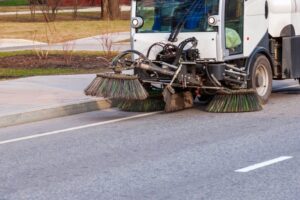
MCD to Deploy 70 Mechanised Road Sweeping Machines in…
6 Oct 2026
 Dry cleaning
Revisiting Healthcare Linen Processing
10 Aug 2026
 Laundry
FROM INDIA TO AMSTERDAM How Sustainability Became the…
10 Jul 2026
 Laundry
Wash. Learn. Predict. Run Itself: The Future of Laundry…
5 May 2026
 Laundry
Digitisation: Restores Time,Improves Processes,Builds Reliability
11 Dec 2025

Tell us about your company. Our advertising desk will come back to you with placement options on CIJ Connect and the readership behind them.
It has reached our advertising desk. We will reply to shortly.
Roots Multiclean Ltd is India's first mechanized industrial cleaning equipment manufacturer, headquartered in Coimbatore and operating for over 30 years. Roots Multiclean is known for professional cleaning machines and equipment designed for commercial, industrial and institutional environments. Our portfolio covers sweepers, scrubbers, commercial and industrial vacuum cleaners, high-pressure jets, carpet cleaners, escalator cleaners, steam cleaners and janitorial products.
With 55,000+ satisfied customers and a presence across 40+ countries on six continents, Roots Multiclean serves major commercial and industrial sectors including cement, paper, airports, railways, commercial offices, retail malls, hospitality, foundries, defence, pharma and automobile industries.

A wide range of solutions across sweepers, scrubbers, vacuum cleaners, high-pressure jets, steam cleaners and janitorial equipment.
Backed by over 30 years as India's first mechanized cleaning equipment manufacturer and a legacy of engineering excellence.
Machines designed to meet demanding cleaning needs across tough and complex Indian operating environments.
Professional equipment built for productivity, reliability and consistent cleaning results across large facilities.
Solutions that support cleaner, greener operations through reduced resource use and improved efficiency.
Suitable for cement, paper, airports, railways, commercial offices, malls, hospitality, foundries, defence, pharma and automobile sectors.
Connect with our experts
Partner with Roots Multiclean for reliable, mechanized cleaning solutions — trusted by 55,000+ customers across 40+ countries.
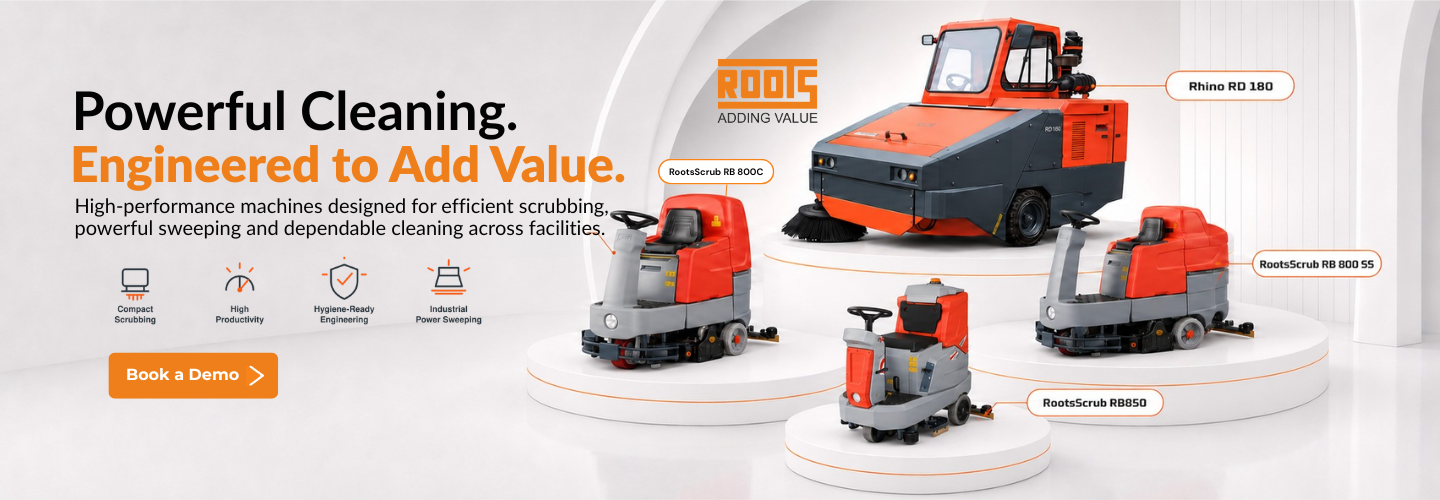
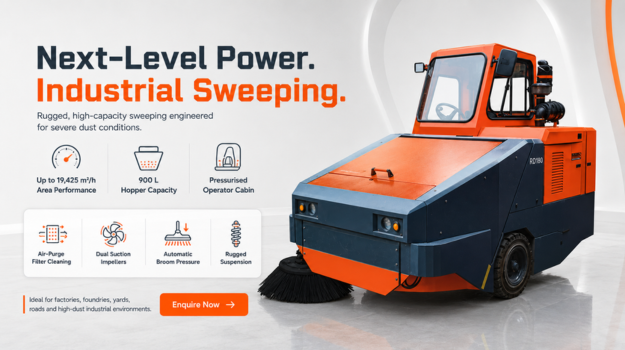
Book a DemoNext-level power, industrial sweeping — rugged, high-capacity sweeping engineered for severe dust conditions.
The Rhino RD 180 is Roots' heavy-duty diesel power sweeper, built for the conditions that defeat ordinary machines: cement, coal and mining operations, ports, foundries and manufacturing yards. Area performance runs to 19,425 m² an hour with one side broom, into a 900 litre hopper, with an air-purge filter cleaning system that keeps the filters working while the machine does. The operator sits in a fully closed, pressurised cabin. From Roots Multiclean Ltd, Coimbatore.
A sequential timer-controlled pulse jet cleans the filters continuously while the machine sweeps. In high dust that removes the job which actually stops a sweeper — pulling filters out to blow them through with compressed air.
Fully closed and pressurised with a mini fan as standard. In cement or coal dust that is not comfort — it is the difference between a shift somebody can work and one they cannot.
On a dusty yard the emptying trip is the interruption, not the sweeping. A hopper this size turns a shift of stop-start runs into extended continuous operation.
Roots publishes descriptive specifications for the RD 180 rather than a numeric table — see build note 3. Sweeping width, engine, fuel capacity, dimensions, weight, gradient and turning radius are not published and are deliberately not estimated here. Request the RD 180 datasheet. Roots' ride-on sweeper range also includes the RB100, RB120 and RD160.
Put an ordinary sweeper into cement, coal or foundry dust and it will work well for an hour. Then the filters load, suction falls away, and the machine is either swept without suction or taken out so somebody can pull the filters and blow them through with an airline — which is a dirty job on a machine that is meant to be saving labour. The RD 180 is designed around that single failure: it cleans its own filters continuously while it works, and it keeps the operator sealed away from what it is picking up.
Sequential timer-controlled air purge cleans class-leading large filters during operation. Roots is explicit that it eliminates the need for maintenance cleaning — no filter removal, no compressed air.
Two impellers rather than one, sized for material that a commercial sweeper would simply push around. Suction is what separates a sweeper from a broom on a fine-dust site.
A hydraulically controlled drive wheel with heavy shock absorbers and suspension, plus an anti-vibration mounted seat. Yards and haul roads are not flat, and an operator who is being shaken all shift covers less of one.
A standard, compact ride-on scrubber drier designed to provide cleanliness combined with safety, comfort and productivity — 850 mm width, 5,525 m²/h and a 1250 mm turning circle.
Explore the Range →Twin counter-rotating cylindrical brushes that sweep and scrub in one pass, with significant water savings — ideal for manufacturing units, warehouses, malls, car parks and airports.
Explore the Range →A top-performing autoscrubber featuring high quality stainless steel (SS304) components and chassis — designed for pharmaceutical, chemical and healthcare facilities.
Explore the Range →Up to 19,425 m² an hour with one side broom. That is roughly four times the coverage of the ride-on scrubbers in this range, which is what a sweeper of this class is for.
As always, treat it as the comparison figure. Real coverage depends on how much of your site is open ground and how often the hopper fills.
Filters. In cement, coal or foundry dust an ordinary machine loads its filters within an hour; suction falls away, and either the sweeping stops working or the machine goes out of service while somebody pulls the filters and blows them through with compressed air.
The RD 180 runs a sequential timer-controlled air purge that cleans the filters during operation. Roots states plainly that it eliminates the need for maintenance cleaning — which is the single most important thing about this machine.
Because the operator is sitting inside a dust cloud the machine is deliberately stirring up. A fully closed, pressurised cabin with a mini fan keeps that air out.
In a cement plant or a coal yard this is not an amenity. It determines whether the shift is workable and whether you are meeting your own exposure obligations.
It holds 900 litres, which Roots specifies as supporting extended operation.
On a high-dust site the emptying trip, not the sweeping, is what breaks up a shift — so hopper volume affects real productivity as much as area performance does.
That is what the hydraulically controlled drive wheel, heavy shock absorbers and suspension are for, with an anti-vibration mounted seat inside the cabin.
Yards, haul roads and port aprons are not flat. An operator being shaken for eight hours covers less ground than the spec sheet suggests, whatever the machine is rated at.
Diesel — unlike the RB850, RB 800 C and RB 800 SS scrubbers in this range, which are battery machines.
Roots cites best-in-class fuel efficiency. For outdoor yards, roads and the areas this machine is built for, diesel is what delivers the runtime and the power; battery machines in this range are for indoor floors.
Roots describes the RD 180 rather than tabulating it, so sweeping width, engine details, fuel capacity, dimensions, weight, gradient and turning radius are not published — and this page does not estimate them.
Request the RD 180 datasheet before specifying, particularly if you need gradient capability for ramps or turning radius for a confined yard.
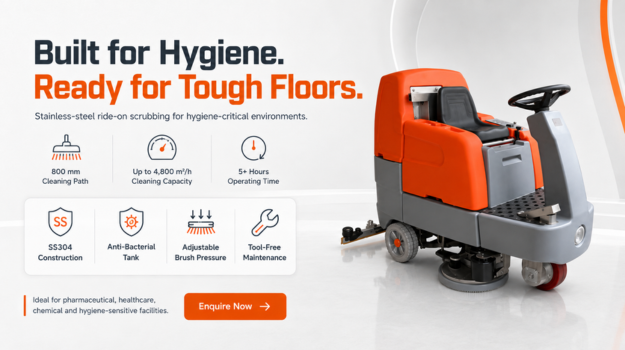
Built for hygiene, ready for tough floors — stainless-steel ride-on scrubbing for hygiene-critical environments.
The RB 800 SS is a top-performing autoscrubber built around stainless steel: the chassis, battery tray, brush deck and squeegee are all SS, so the machine does not stain or rust and can be washed down and maintained like the rooms it cleans. An 800 mm cleaning path covers up to 4,800 m² an hour, and a 24 V / 320 Ah battery runs more than five hours per charge. Specified for pharmaceutical, chemical, healthcare and hygiene-sensitive facilities. From Roots Multiclean Ltd, Coimbatore.
Chassis, battery tray, brush deck and squeegee are all stainless. In a washdown area or a chemical environment, a painted machine becomes the rusting thing in an otherwise clean room.
A 24 V / 320 Ah pack running more than five hours means a full shift on one charge, which is what lets a cleanroom or production area be scheduled around rather than interrupted twice.
Brushes and squeegee lips change without tools, and an in-built code display identifies faults rather than leaving them to be guessed at. Both keep the machine out of a workshop it would have to be decontaminated to leave.
Stainless-specific features as published by Roots for the RB 800 SS; numeric figures from the shared RB 800 platform specification — see build note 3. The range also includes the standard RB 800, the cylindrical-brush RB 800 C and the RB 950. Contact the team for the SS datasheet.
Everything else in a pharmaceutical or food facility is specified for washdown, corrosion resistance and auditability — and then a painted steel scrubber is wheeled in, and it is the one object in the room that rusts, holds residue and cannot be cleaned to the same standard. The RB 800 SS exists to close that gap: stainless chassis, battery tray, brush deck and squeegee, so the machine can be washed down and maintained like the rooms it works in.
Roots specifies stainless as a highly stable material across varying environmental conditions — strong, durable and easy to clean. In a chemical or washdown area that is a working requirement, not a finish.
The squeegee releases rather than bending when it meets a rack leg or a doorframe. On a machine where the squeegee is a stainless part, that is a meaningful repair avoided.
Plant floors are shared with people and forklifts, and production areas are not always brightly lit. Both features are about the machine being seen, not just seeing.
A standard, compact ride-on scrubber drier designed to provide cleanliness combined with safety, comfort and productivity — 850 mm width, 5,525 m²/h and a 1250 mm turning circle.
Explore the Range →Twin counter-rotating cylindrical brushes that sweep and scrub in one pass, with significant water savings — ideal for manufacturing units, warehouses, malls, car parks and airports.
Explore the Range →An efficient, durable and class power sweeper designed to withstand challenging working conditions even in industries with high dust, and provide good sweeping results.
Explore the Range →The chassis, battery tray, brush deck and squeegee — the structural and wet-side components, which is where corrosion starts on a conventional machine.
It matters because in a pharmaceutical or food environment everything else is specified for washdown, and a painted scrubber becomes the one object in the room that rusts and holds residue.
More than five hours on the 24 V / 320 Ah battery — enough for a full shift without an interruption to recharge.
In a controlled area that is worth more than the raw number suggests: taking a machine out mid-shift means a gowning cycle to remove it and another to bring it back.
An 800 mm cleaning path at a theoretical 4,800 m²/h, with 1,100 mm of suction width behind it.
Theoretical is the comparison figure between machines. Real coverage in a plant with equipment, racking and doorways will be lower.
Yes. Standard brush load is 43 kg, with an extra brush load setting of 47 kg for heavier soiling — useful where process residue builds up rather than just foot traffic dirt.
Brushes and squeegee lips change without tools, and an in-built code display system identifies faults rather than leaving them to diagnosis on site.
Both matter in a controlled environment, where taking a machine to a workshop means decontaminating it first and again on return.
It carries a reverse alarm and a head lamp for low-visibility areas, alongside the break-away squeegee mechanism that releases instead of bending on impact.
The alarm and lamp are about the machine being noticed on a shared plant floor, which is where most ride-on incidents happen.
Same platform, three answers. The RB 800 is the standard painted machine. The RB 800 C swaps disc brushes for twin cylindrical ones so it sweeps as well as scrubs, and saves water.
The RB 800 SS is the one to specify when the environment is the constraint — pharmaceutical, chemical, healthcare, washdown. You are buying corrosion resistance and cleanability rather than extra coverage.
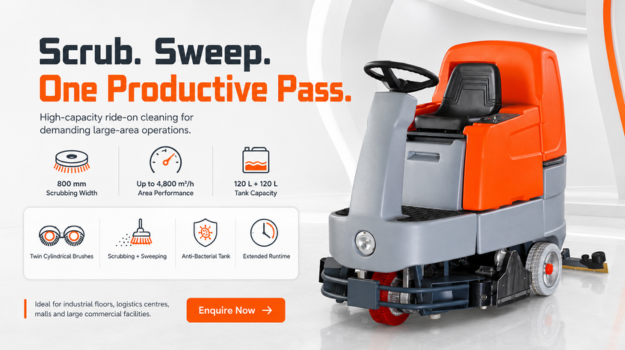
Scrub. Sweep. One productive pass. High-capacity ride-on cleaning for demanding large-area operations.
The RB 800 C runs twin counter-rotating cylindrical brushes rather than discs, which lets it sweep and scrub in the same pass — and delivers significant water savings compared with conventional machines. An 800 mm scrubbing width with 1100 mm of suction gives 4,800 m² an hour, on 120 litre tanks and a 320 Ah battery for long operations. Built for manufacturing units, warehouses, shopping malls, car parks and airports. From Roots Multiclean Ltd, Coimbatore.
Twin counter-rotating cylindrical brushes pick up debris as they scrub. On a floor that needs both, that is one machine and one operator instead of two of each.
Roots states meaningfully lower water use than conventional machines. Cylindrical brushes work wetter-for-longer on less solution, which shows up in refill trips as well as consumption.
Paired with 120 litre tanks, the battery is sized so the limiting factor on a large site becomes the water, not the charge — which is the right way round.
Specifications as published by Roots Multiclean for the RB 800 C. A brochure is available from Roots, and the range also includes the disc-brush RB 800, the stainless steel RB 800 SS and the RB 950. Contact the team for the datasheet matched to your floor type and soil.
On most industrial floors the problem is not only soil but loose debris, and a disc machine has nowhere to put it — so the site sweeps first and scrubs second, two passes with two machines. Counter-rotating cylindrical brushes throw debris forward into a hopper as they scrub, which collapses that into one pass. They also reach into grout lines a flat disc rides over, and they do it on less water: Roots states significant savings against conventional machines.
Two 150 mm rollers at 760 rpm turning against each other, collecting debris rather than displacing it. That is what makes the sweeping function real rather than nominal.
The standard nylon roller brush is specified for thorough cleaning of grout lines — the part of a tiled floor that darkens first and that a flat disc simply passes over.
A stainless steel brush head for durability where water and debris meet, and an in-built code display so a fault is identified rather than guessed at when the technician arrives.
A standard, compact ride-on scrubber drier designed to provide cleanliness combined with safety, comfort and productivity — 850 mm width, 5,525 m²/h and a 1250 mm turning circle.
Explore the Range →A top-performing autoscrubber featuring high quality stainless steel (SS304) components and chassis — designed for pharmaceutical, chemical and healthcare facilities.
Explore the Range →An efficient, durable and class power sweeper designed to withstand challenging working conditions even in industries with high dust, and provide good sweeping results.
Explore the Range →Debris pickup. Counter-rotating cylindrical brushes throw loose material forward into a hopper as they scrub, so the machine sweeps and scrubs in one pass. A disc machine has nowhere to put debris, which is why sites using them sweep first and scrub second.
Cylindrical brushes also reach into grout lines that a flat disc rides over — the RB 800 C ships with a nylon roller brush specified for exactly that.
Theoretical area coverage is 4,800 m²/h across an 800 mm scrubbing width, with 1,100 mm of suction behind it, at up to 6 km/h.
Treat theoretical as the comparison figure. Real coverage drops with turns, obstacles and emptying — though on this machine it drops less than usual, because you are not making a separate sweeping pass.
Roots states significant water savings compared with conventional machines, which is a known characteristic of cylindrical-brush systems.
The saving shows up twice: in consumption, and in refill trips. On a 120 litre tank, using less per square metre means longer between stops as well as a smaller water bill.
The battery is 24 V / 320 Ah — substantially larger than the 200 Ah on the RB 650/750/850 platform, and sized for long operations in large areas.
With 120 litre tanks alongside it, the practical limit on a shift tends to be water rather than charge. Ask for a runtime figure against your own duty cycle.
It is 1750 × 1100 × 1410 mm with a 1.8 m turning radius, and weighs around 600 kg with battery.
That is a substantial machine. Check door widths, turning space at the ends of runs, and lift capacity if it needs to change floors — 600 kg is well beyond a passenger lift's rating in many buildings.
Different brush systems for different problems. The RB 850 uses discs, is more compact (1250 mm turning circle, lift-transportable) and covers 5,525 m²/h on a 200 Ah battery.
The RB 800 C uses cylindrical brushes, so it sweeps as well as scrubs and handles grout better, on bigger tanks and a bigger battery — but it is heavier and needs more room. Choose on whether your floor has loose debris and grout lines, or just soil.
Use the Enquire now button. Floor type matters more than usual with this machine — tell the team whether you have tiled floors with grout, loose debris, or both, since that is exactly what the cylindrical system is for.
Roots also publishes a brochure for the RB 800 C and offers the disc-brush RB 800, the stainless RB 800 SS and the RB 950 on the same platform.
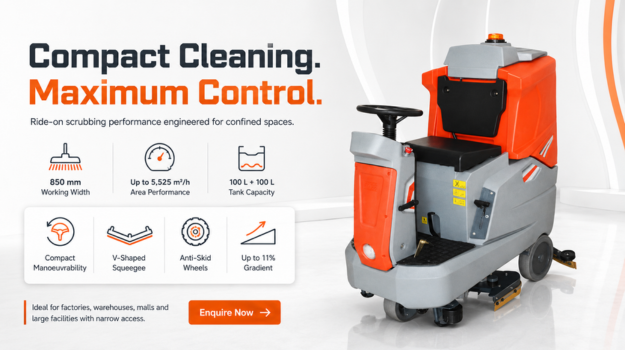
Compact cleaning, maximum control — ride-on scrubbing performance engineered for confined spaces.
The All New RootsScrub RB850 is a standard, compact ride-on scrubber drier built to deliver cleanliness alongside safety, comfort and productivity. An 850 mm scrubbing width and 1070 mm suction path give a theoretical 5,525 m² an hour, on 100 litre fresh and 100 litre dirty water tanks — and it still turns inside 1250 mm and fits in a lift. From Roots Multiclean Ltd, Coimbatore.
A 1250 mm turning circle and dimensions compact enough to transport through lifts. Most machines this wide cannot reach the floors they are bought to clean — this one can.
1070 mm of recovery behind an 850 mm brush path, on a squeegee that follows the machine through turns. Excellent water pickup means the floor is dry behind you, not merely clean.
Built into the tank rather than added as a chemical. It is what makes the machine defensible in a healthcare setting, where the recovery tank is otherwise the dirtiest thing in the building.
Specifications as published by Roots Multiclean for the RB 650/750/850 Standard. The same platform is also offered as the RB 650 (650 mm, 4,225 m²/h) and RB 750 (750 mm, 4,875 m²/h), and in a Premium version — see build note 4. Contact the team for the datasheet matched to your floor area.
Buying a wider scrubber is the obvious way to cover more floor, and it works right up until the machine cannot get where it needs to go — through a service door, into a lift, around a rack end. Then the wide machine cleans the open areas and somebody goes back over everything else with a mop, which is exactly the cost the purchase was meant to remove. The RB 850 is built around that constraint: 850 mm of scrubbing width on a chassis that turns in 1250 mm and transports through lifts.
A 1250 mm turning circle with automatic speed reduction on turns, anti-skid non-marking wheels and a foot brake. The machine slows itself before the operator has to think about it.
Two 436 mm brushes at 180 rpm, plus an additional brush pressure option for dirty floors mid-round. Pressure does work that extra detergent would otherwise have to.
A 24 V / 200 Ah pack drives longer working hours, and an 11% gradient means loading bays and car park ramps stay on the machine's route rather than dividing the site in two.
For long operations in large areas, the RB 800C is the ideal choice for cleaning large spaces such as manufacturing units, warehouses, shopping malls, car parks and airports.
Explore the Range →A top-performing autoscrubber featuring high quality stainless steel (SS304) components and chassis — designed for pharmaceutical, chemical and healthcare facilities.
Explore the Range →An efficient, durable and class power sweeper designed to withstand challenging working conditions even in industries with high dust, and provide good sweeping results.
Explore the Range →Theoretical area coverage is 5,525 m²/h across an 850 mm scrubbing width, at a working speed of up to 6.5 km/h.
Theoretical is the comparison figure between machines, not a shift plan. Turns, obstacles, refills and emptying all come out of the hour, so real coverage on a congested factory floor will be meaningfully lower.
That is the design brief. The turning circle is 1250 mm, and Roots specifies the machine as compact enough to transport through lifts — which matters more than the width figure on a multi-floor site.
It is 1070 mm wide across the squeegee, so check your narrowest service door and your lift car dimensions before ordering. Those are the constraints that catch people out after purchase.
100 litres of fresh water and 100 litres of recovery, on a 24 V / 200 Ah battery pack that Roots specifies for longer working hours.
Runtime depends on your water flow setting and how heavily soiled the floor is. Ask for a figure against your own duty cycle rather than a headline number.
Because the recovery tank is where everything you removed from the floor ends up, sitting warm and wet until someone empties it. In a hospital or a food facility that is a genuine hygiene risk rather than a theoretical one.
Roots builds the anti-bacterial property into the tank itself, which is why they specify the machine as suitable for healthcare facilities.
Gradient capability is 11%, so loading bay and car park ramps stay on the machine's route.
That matters more than it sounds on a multi-level site. A machine that cannot climb divides your floor area into sections that each need separate handling.
Automatic speed reduction while turning, parking brakes, an emergency switch, and non-marking anti-skid rubber wheels with a foot brake system.
The speed reduction is the one that matters day to day — it removes the most common operator error on a ride-on, which is carrying too much speed into a turn.
Same platform, three widths. The RB 650 scrubs 650 mm at 4,225 m²/h; the RB 750 does 750 mm at 4,875 m²/h; the RB 850 does 850 mm at 5,525 m²/h.
Tanks, turning circle, gradient and battery are the same across all three, so the decision is purely about how much open floor you have against how tight your tightest section is. Roots also offers a Premium version of the platform — ask which suits your site.
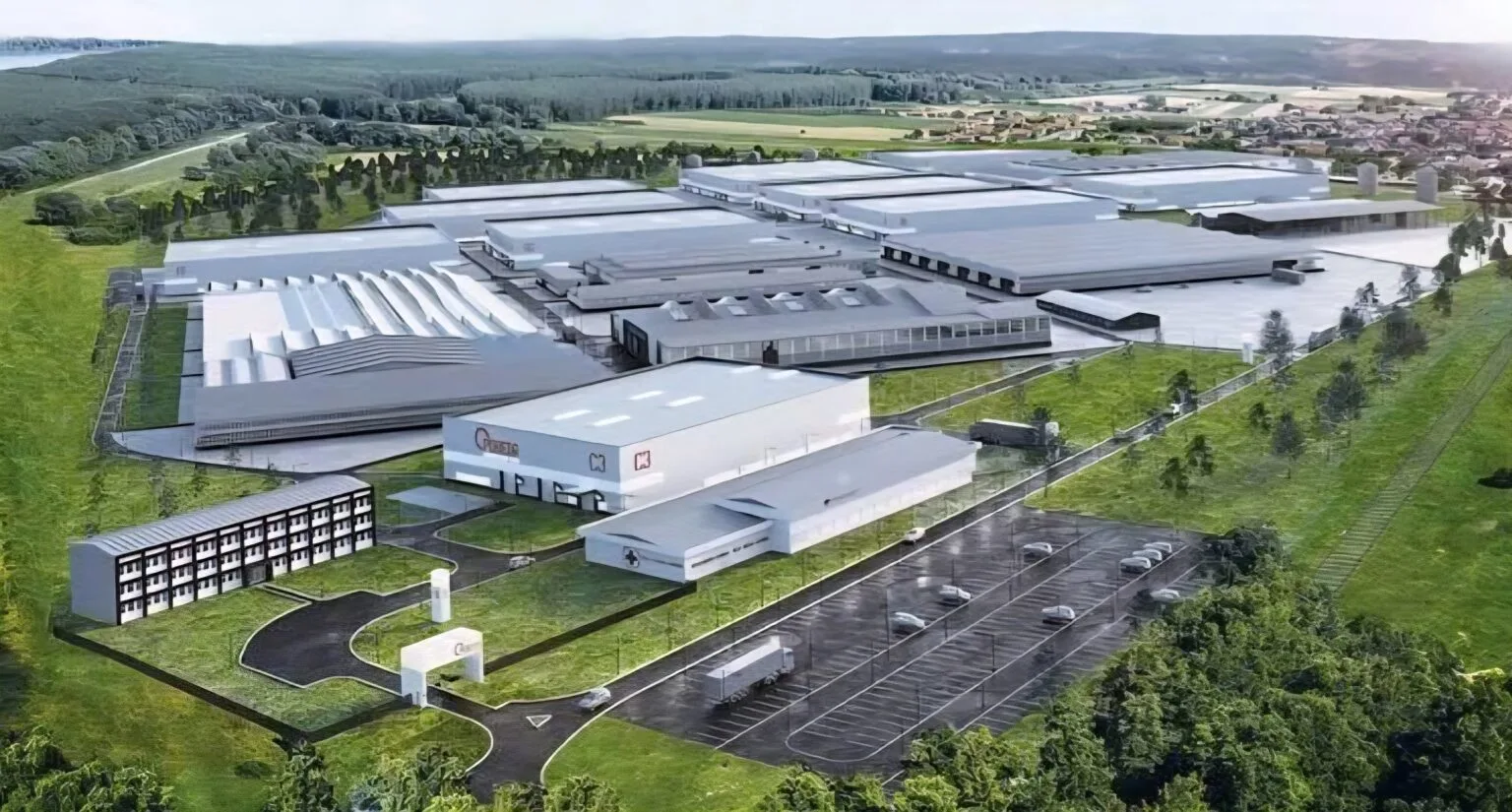
Driving through the calm industrial roads of Coimbatore hardly gives away the rhythmic hum of heavy manufacturing or the hammering within its countless small workshops. Beneath this quiet exterior lies a thriving world of engineering — where small factories, MSMEs and global companies together are reshaping the city's industrial identity. With its deep-rooted ecosystem, skilled workforce and strong network of ancillary industries, Coimbatore is fast emerging as the epicentre of India's cleaning equipment manufacturing revolution.
On a two-day exploration of this industrious city, Mohana M, Editor of Clean India Journal, captures Coimbatore's progressive transformation — its innovative mindset, global collaborations, collective harmony and purposeful drive toward manufacturing excellence. This Focus feature presents insights and perspectives from key industry players, including Roots Multiclean Ltd, Kärcher India, Senvac Extraction Systems Pvt Ltd, Dima Engineering Pvt Ltd, Radiant Enterprises, Aviva Brushes and Suvid Solutions — all of whom are shaping the city's reputation as the country's new powerhouse for cleaning technology.
Few Indian cities embody industrial resilience and reinvention quite like Coimbatore. Once renowned as the "Manchester of South India" for its flourishing textile mills and motor manufacturing, the city has seamlessly transitioned into a modern industrial hub. Today, its strength lies in its diverse network of small and medium enterprises that support large-scale engineering and manufacturing operations with speed, precision and cost efficiency.
The availability of ancillary industries — from casting and sheet metal fabrication to injection moulding, powder coating and machining — ensures that manufacturers rarely have to look beyond the city limits for components. More than 25,000 MSMEs form the foundation of Coimbatore's industrial ecosystem, driving an agile and collaborative production environment. "Here, a man who makes parts for milking machines can also make a vacuum component," said Indrabanu T, Founder and CEO of Radiant Enterprises, a long-time manufacturer. "Every corner has someone who can innovate — that is Coimbatore for you."
The city's rich talent base further strengthens this ecosystem. Premier institutions like PSG College of Technology, Coimbatore Institute of Technology (CIT) and Kumaraguru College of Technology produce thousands of skilled engineers each year, many of whom stay back to join family enterprises or start their own ventures. "Coimbatore has everything — the knowledge, the technical ecosystem, the workmanship," Indrabanu added. "The only challenge is fragmentation. Every workshop does something unique, but they often work in silos. Even so, you will not find such diversity anywhere else."
Strategic location adds another layer of advantage. Proximity to Coimbatore International Airport and major industrial belts like Tirupur, Erode and Salem provides strong logistical connectivity. Easy access to both Chennai and Cochin ports enables smooth movement of goods for export-oriented manufacturers. The cost of operations — from real estate to labour and utilities — remains significantly lower than in metros, giving Coimbatore-based industries a decisive edge.
Supported by government-backed industrial estates such as SIDCO, L&T and ELGi, and bolstered by the collaborative spirit of associations like CODISSIA, the city has built an ecosystem where innovation, skill and efficiency converge. For cleaning equipment manufacturers, this combination of legacy engineering expertise and forward-looking enterprise has turned Coimbatore into an unmatched base for building world-class technology — right from concept to completion.
Coimbatore's long association with engineering excellence continues to define its industrial journey. The city that once built India's textile machinery and motor industry has now turned its focus to developing cleaning and maintenance equipment. What began as a few early efforts has today grown into a steady ecosystem of manufacturers producing high-performance cleaning machines for industrial, commercial and municipal use.
"Textiles are getting replaced with cleaning equipment," said N Venkatesh, Proprietor, Aviva Brushes, a local entrepreneur. "If we had a port here, exports would have been phenomenal. But with Cochin so close, the advantage is still strong."
The shift shows how Coimbatore's traditional engineering strength is supporting the next wave of manufacturing. Companies here are not just assembling parts but developing components, systems and complete product ranges too. From precision machining to fabrication, most requirements are met locally, creating shorter supply chains and better control over quality.
As India's first mechanised cleaning equipment manufacturer, Roots Multiclean Ltd helped set the base for this transformation. "We established the technological and industrial foundation for this sector," said Varun Karthikeyan, Managing Director. "Over time, we have trained technicians, developed local vendors and inspired ancillary manufacturers to grow with us."
German company Kärcher, which began local manufacturing in Coimbatore in 2015, further strengthened the city's position on the global map. "Apart from the excellent ecosystem, the city offers complete infrastructure and a skilled workforce for businesses to thrive," said Prashanth Srirangam, Senior Director, Kärcher India. "Local manufacturing supports the government's Make in India and Swachh Bharat initiatives and enables us to contribute to the country's drive for cleanliness and sustainability."
For newer entrants like Senvac Extraction Systems Pvt Ltd and Suvid Solutions, the city provides both a base and an advantage. "The region's engineering talent, strong supply chain and manufacturing infrastructure make Coimbatore an ideal base for building world-class equipment," said Sengamuttu Ditto, Managing Director of Senvac.
Vidhyasekar K, Director – Business Development, Suvid Solutions, added: "Compared to cities like Mumbai or Chennai, the cost of operations is far lower here. And the best part — you can source almost all components locally. This kind of support network is rare."
Coimbatore's strength lies in its diversity — in the hundreds of small and medium workshops that quietly contribute to larger manufacturing goals. Every unit adds value, whether in casting, machining, fabrication or finishing. Together, they form a living network of collaboration, sometimes unorganised yet remarkably efficient.
"Coimbatore has everything — the knowledge, the technical ecosystem, the workmanship," said Indrabanu, who has been associated with the region's industrial growth for decades. "The challenge is that it is fragmented. Every shop does something unique, but they work in silos. You will not find such diversity even in Ludhiana."
This unspoken interdependence forms both the city's strength and its limitation. The close-knit network ensures flexibility, local sourcing and quick turnaround, but the absence of consolidated platforms and specialised tooling units can slow down innovation. "We do not have high-precision tool manufacturers for certain parts like rotors. For those, we still depend on imports," he adds. "If someone invests seriously, Coimbatore can easily become a global hub for cleaning machinery."
The possibilities are immense. The cleaning and hygiene sector is expanding rapidly across industrial, institutional and infrastructure segments, and Coimbatore's manufacturers are already supplying not just to domestic markets but to international buyers.
With continued investment in research and development, technology upgradation and greater collaboration among local manufacturers, the city is well placed to lead the next phase of India's manufacturing story — where 'Made in Coimbatore' becomes a mark of quality, innovation and engineering pride.
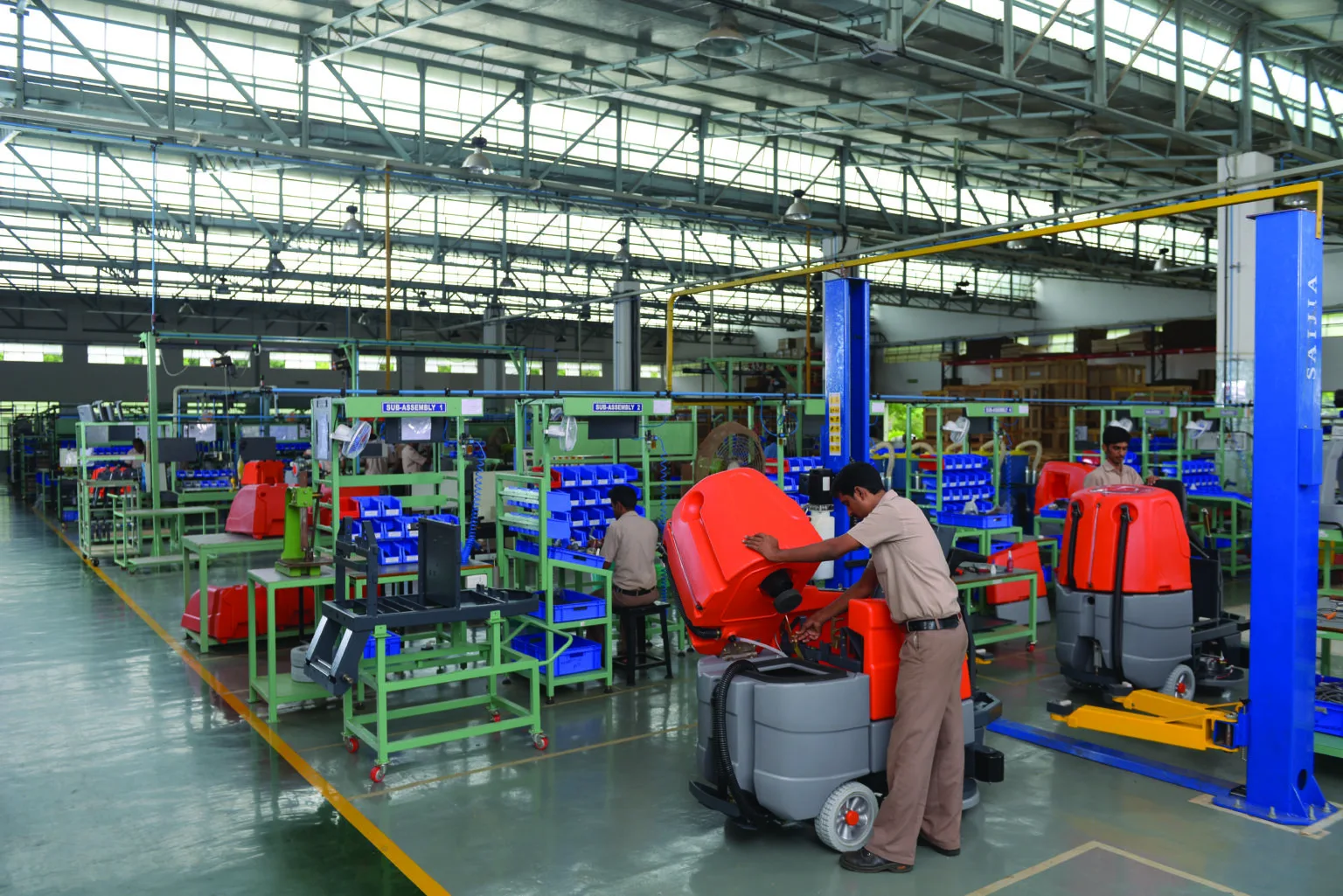
In this exclusive interaction with Clean India Journal, Varun Karthikeyan, Managing Director of Roots Multiclean Ltd, shares how the company's roots in Coimbatore helped shape India's cleaning technology landscape. Beyond manufacturing world-class cleaning machines, Roots played a pioneering role in developing a robust local supply chain that powers the country's cleaning equipment segment.
Our family has been rooted in Coimbatore for over five generations. My father, K Ramasamy, began his entrepreneurial journey here more than 50 years ago by founding Roots Industries Ltd. When he expanded into cleaning equipment manufacturing in 1992 by establishing Roots Multiclean Ltd, Coimbatore's established engineering culture and industrious environment supported that vision.
Often called the 'Manchester of South India', Coimbatore is known for its manufacturing heritage, a reliable supply chain, and a skilled workforce. The city's ecosystem — supported by strong ancillary industries, reputable technical institutions, and a stable climate for manufacturing — provided a good foundation for Roots' growth. Over the years, we have expanded our various group operations in and around Coimbatore, leveraging the city's entrepreneurial spirit and industrial infrastructure to create products competitive at both domestic and international levels.
Coimbatore has steadily grown as a significant manufacturing centre over the years. What began as a hub for textiles and pumps evolved into a diversified centre for automotive components, machine tools, and now, cleaning technology. Roots has played a vital role in this transition. As India's first mechanised cleaning equipment manufacturer, we helped establish the technological and industrial foundation for this sector. We have been instrumental in building an entire ecosystem — training skilled technicians, developing local vendors, and inspiring ancillary manufacturers to grow with us.
Roots began with simple cleaning machines like basic push sweepers and steadily grew its product line over the years to include a diverse array of industrial cleaning solutions such as scrubbers, sweepers, high-pressure washers, industrial and commercial vacuum cleaners, carpet cleaners, city sweepers, and even specialised equipment like runway sweepers. This broadening portfolio is driven by continuous investment in research and development to meet evolving customer needs across sectors including manufacturing, healthcare, hospitality, railways, defence and more.
We proudly serve over 30,000 customers across the country and export our products to more than 40 countries globally.
Our approach to growth prioritises quality, durability, and reliability backed by strong after-sales service rather than rapid or aggressive expansion. This focus on sustained quality and service excellence has won us customer trust and helped build long-term relationships in both the domestic and international markets.
"'Make in India' has encouraged localisation and technology integration, but the ecosystem for advanced components and technical knowhow still needs time to mature. Nevertheless, India's growing focus on hygiene, urban sanitation, and infrastructure is steadily strengthening domestic demand."
— Varun Karthikeyan
India's cleaning equipment manufacturing sector has made steady progress, though it continues to face a mix of opportunities and challenges. The country's emphasis on self-reliance under initiatives such as 'Make in India' encouraged manufacturers to localise production and improve technology integration. However, the industry is still evolving, as several core components and high-end technologies are still imported. Also, the availability of an extensive vendor base and technical knowhow takes time to mature. That said, India's growing emphasis on hygiene, urban sanitation and public infrastructure is gradually strengthening domestic demand for cleaning solutions.
Needed for the site to work - security, load balancing and remembering this choice. No tracking.
Google Analytics, and the record of which pages you saw before sending a form. Tells us what to publish more of.
Lets us measure our campaigns and show Clean India Journal advertising to people who have visited before.
Embedded video and other conveniences. Switching this off may stop some embeds loading.
Enter for all results · Esc to close