






































Security Beyond Silos
A 483-page practitioner’s doctrine by three industry veterans reframes corporate physical security as an integrated enterprise risk, not a guard-and-gadget function. Essential reading for CSOs, FM heads and boards.
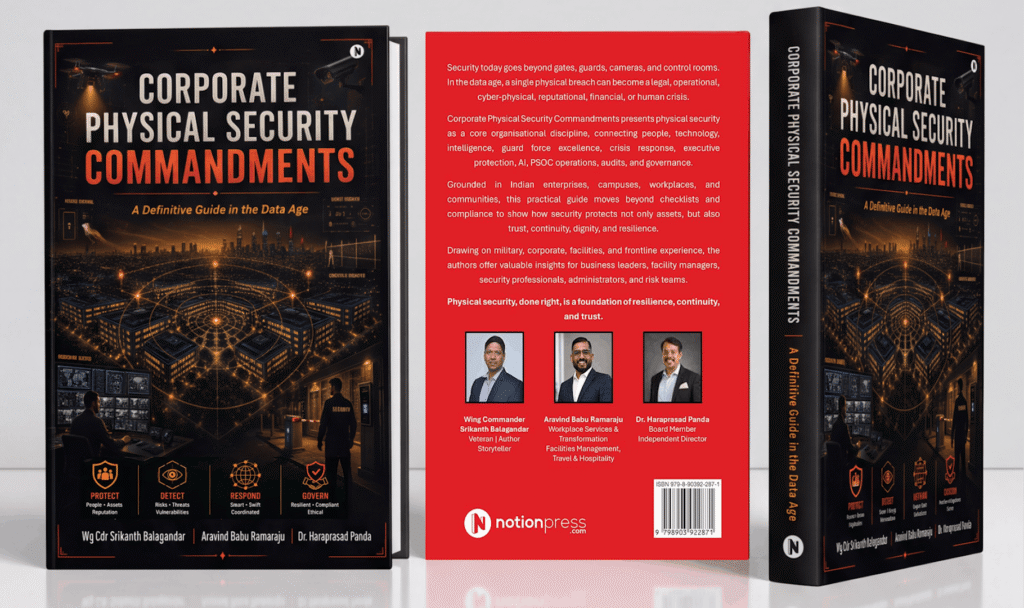
Book: Corporate Physical Security Commandments — A Definitive Guide in the Data Age

Authors: Wg Cdr Srikanth Balagandar, Aravind Ramaraju & Dr Haraprasad Panda
Reviewed by: Clean India Journal
In an era where organisations spend more than ever on guards, cameras, access systems and sensors, yet incidents continue to occur in the gaps between investments, ‘Corporate Physical Security Commandments’ arrives as a much-needed corrective. This is not an academic textbook or a vendor catalogue. It is a 483-page doctrine with 23 chapters, 134 field caselets and over 90 figures written by practitioners, for practitioners.
The book is born from a gap the authors — an Air Force veteran turned corporate security leader, a built-environment and security services expert, and a 25-year veteran of corporate real estate across Pharma and IT — saw repeatedly. Each function did its part reasonably well, but nobody owned the whole. Guards sat in one silo, the SOC in another, FM in a third, vendors and law enforcement outside the boundary. The result was blind spots and a false sense of preparedness. Their central thesis is compelling: Security is not the sum of its components; it is the quality of their connection.
Lessons
The caselets are the heart of the book. A missed tailgate at 3:20 am, a compromised badge reader in a Pune distribution centre, a social media signal that predicted a labour unrest, a cloned credential caught in nine seconds. Each is placed where concept meets reality.
Five lessons emerge consistently. First, integration beats investment — most failures were not due to missing controls, but controls not talking to each other. Second, accountability cannot be outsourced — a vendor contract does not transfer liability, as the detailed PSARA and global standards analysis shows. Third, discipline drifts — standards erode weeks after audits, making undeclared assurance critical. Fourth, every incident must close the loop through triage, chain of custody and CAPA. Fifth, dignity itself is a security control — security that disrespects people eventually loses their cooperation.
Anticipatory
The book’s treatment of technology is balanced and mature. It traces the shift from forensic CCTV to anticipatory security, where cameras, access data and sensors flag tailgating, unattended objects and unusual movement in real time.
Chapters on sensors, PSOC as the enterprise nerve centre, drones and robotics, and transport security with route intelligence are practical. Two standout chapters are on measurement — moving from counting activities to four layers of outcome intelligence — and on applied analytics and AI, including ethics of surveillance.
Crucially, the authors warn against tech romanticism. Technology amplifies the operating model underneath.

Non-Negotiable
A foundational argument is that physical and digital threats are now simultaneous and mutually reinforcing. Every camera and smart lock is a networked device and a potential entry point. Conversely, many cyber breaches begin physically — an unescorted visitor in a data room or a rogue device in a meeting room.
The book’s chapter on cyber-physical convergence introduces the ‘blended breach’ and proposes a fusion model — Cyber SOC, Physical PSOC and Corporate Intelligence Unit sharing data and playbooks — with a converged identity where badge and network access tell one consistent story.
FM Custodian
The strongest convergence, the authors argue, is between physical security and facility management, in four areas. Design: CPTED principles show lobbies, loading bays and parking decide security long before a guard is posted. Systems: BMS, access, fire safety and lifts run on shared networks. Vendors: With dozens of service partners bringing people inside, the book’s Vendor Lifecycle Security Model and Third-Party Risk Grids are essential. People: Housekeeping, technicians, front office and drivers are in every corner daily — the most under-used sensor network. The book reframes guard force as disciplined workforce, not headcount.
The Takeaway
For boards, it reframes security as fiduciary responsibility with a quarter-by-quarter transformation roadmap. For CSOs, it offers a unified operating system and language, and a push for structured public-private partnerships with law enforcement. For FM leaders, it builds confidence to claim a seat at the design, vendor and crisis table.
Simple, actionable advice: Pick caselets relevant to your site and run tabletop exercises with security, FM and IT together.
‘Corporate Physical Security Commandments’ is that rare book that speaks to the board, the CSO, the facility manager and the officer at the gate in one coherent voice.
Ask the expert
Have a question about this article? Put it to the people in it. We pass your details on and they come back to you directly.