
































India’s Brush Manufacturing Opportunity

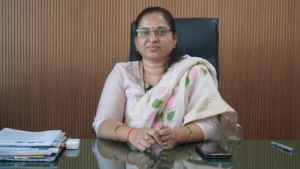
From everyday household cleaning to organised retail and exports, brush manufacturing is emerging as an accessible small-industry opportunity, writes Rajiv Sanghavi, Managing Director, BORGHI India. Every Indian household uses brushes and brooms regularly, making cleaning tools a category with steady, recurring demand.
One of the sector’s biggest attractions is the comparatively modest capital requirement. A commercially viable brush manufacturing unit can be established with an investment of about ₹50 lakh to ₹1 crore, covering machinery, initial raw material stock and working capital.

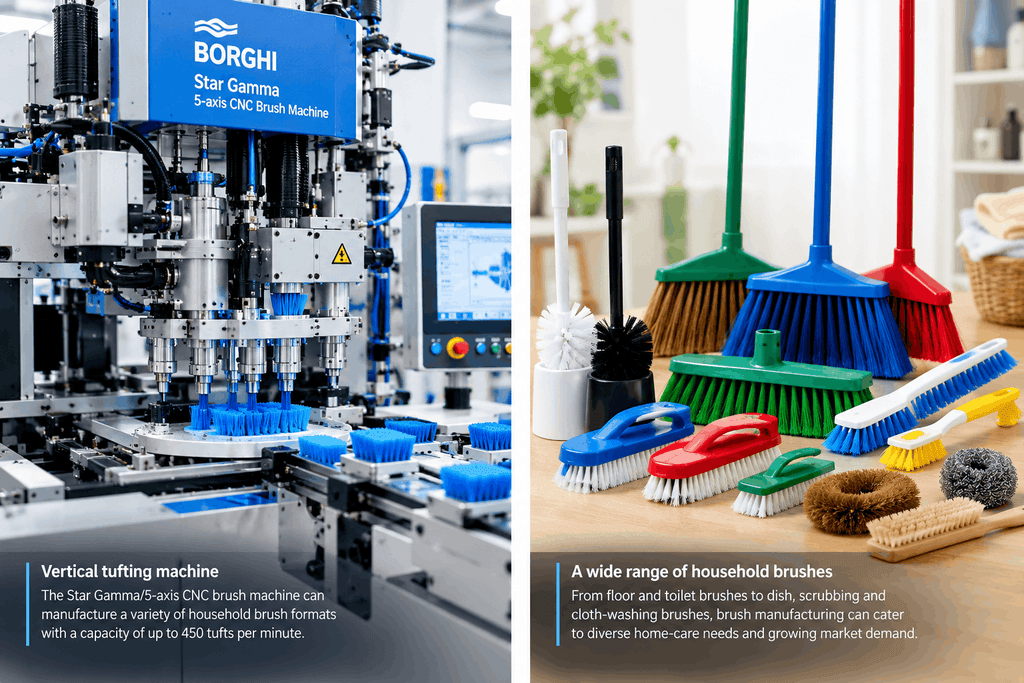
At the heart of the operation is a vertical tufting machine. The document highlights the Star Gamma/5-axis CNC brush machine configuration, equipped with one filling tool and one drill, with production capacity of up to 450 tufts per minute. It can manufacture several household brush formats, including flat brushes with radial or upright filling, round-head toilet brushes and double hockey toilet brushes.
The investment can also cover a finishing line comprising Roto Trim for trimming and Roto Flag for flagging, besides an air compressor and servo stabiliser. Initial raw materials include PP and PET filament, natural fibres such as Palmyra and Cocoa, metal wire, handles and packing materials.
Steady Demand
The opportunity rests on the everyday nature of the product. India has more than 300 million households, with each household using multiple types of brushes, including floor, toilet, dish, scrubbing and cloth-washing brushes. Since these products wear out and are routinely replaced, demand is recurring rather than dependent on discretionary spending.
The source also points to the resilience of cleaning products during economic downturns. As consumers continue to maintain their homes, brushes remain essential. At the same time, the movement from unorganised retail towards modern trade, regional supermarkets and e-commerce is creating opportunities for branded products with better finish, durability and aesthetics.
Tier 1 and Tier 2 cities are identified as particularly promising markets for toilet brushes and premium broom segments. There is also scope for exports to South Asia, the Middle East and Africa, along with import substitution in specialty household and semi-industrial brushes.
“India has over 300 million households, with each household using multiple types of brushes”— Rajiv Sanghavi Managing Director, BORGHI India
Compact Setup
Unlike many manufacturing activities requiring large premises and complex utilities, brush production can begin in around 3,000sq.ft. A typical layout can allocate approximately 500sq.ft. for the tufting machine, 200sq.ft. for finishing, 100sq.ft. for the compressor and stabiliser, 600sq.ft. for raw materials, 700sq.ft. for finished goods and packing, 400sq.ft. for quality control and administration, and about 500sq.ft. for aisles and utilities.
The compact footprint can help control rent and speed up commissioning. As production grows, another machine or an adjacent unit can be added without fundamentally changing the business model.
Lean Workforce
Automation is another factor lowering the entry barrier. The operation can start with three to four people: one machine operator, one finishing and quality-control operator, and one or two people handling packing and stores.
CNC-controlled automation and Industry 4.0 software with alarm diagnostics can help operators identify and locate faults. The source notes that prior brush-industry experience is not essential for the machine operator, while the finishing operator oversees trimming, flagging, beating and quality checks.
Product Expansion
A brush business need not remain limited to a few household products. With different tooling and carriages, the same manufacturing infrastructure can support a wider portfolio of cleaning and hygiene products. The proposition is therefore one of gradual diversification, allowing an entrepreneur to build a broader presence in the home-care category over time.
For existing manufacturers of plastic household products, the opportunity can be even more compelling. Companies making buckets, containers, bottles, tubs, storage boxes, kitchenware, houseware or food packaging may already possess several resources that overlap with brush production.
Natural Fit
Existing PP procurement relationships can extend to brush handles and related components. Established buyers such as hardware retailers, wholesalers, supermarkets and online marketplaces can also provide ready distribution channels. Existing industrial sheds, three-phase power, compressors and material-handling equipment can reduce additional infrastructure expenditure.
There is also a direct connection with injection moulding because brush handles are plastic components. Manufacturers already working with moulding processes can extend their capabilities to handle moulds. Existing GST, factory licensing, EPF/ESIC and banking arrangements may further reduce administrative duplication.
For first-time entrepreneurs as well as established household-product manufacturers, the brush manufacturing model presents a combination of relatively low entry investment, limited space, a lean workforce and opportunities for product diversification. With technical support and training forming part of the proposition, the sector offers a structured route into manufacturing while serving a product category used every day and can scale as volumes and networks grow.
Highlights
• Investment opportunity of ₹50 lakh to ₹1 crore
• Production possible within a 3,000sq. ft. facility
• Lean operation requiring just 3–4 people
• CNC tufting capacity of up to 450 tufts per minute
• Scope to diversify into cleaning and hygiene products
• Export and import-substitution opportunities for Indian manufacturers