













Focus
The Chemical Evolution of Professional Cleaning
Twenty years ago, professional cleaning in India was largely unorganised and price-led, . Chemicals were often generic and undifferentiated, manufacturing was fragmented across small,
Read More



 MCD to Deploy 70 Mechanised Road Sweeping Machines in…
6 Oct 2026
 From Garbage to Governance
5 Jun 2026
 Beyond Bins and Budgets: The Behaviour Shift India Can’t…
21 Mar 2026
 From Waste to Wealth: How Circular Economy Is Reframing…
20 Jan 2026
 Clean India 2030: Transforming Waste Management and Urban Sanitation
18 Dec 2025
MCD to Deploy 70 Mechanised Road Sweeping Machines in…
6 Oct 2026
 Back Office to Bedside Healing
18 Sep 2026
 The Future of Vehicle Cleaning and Detailing: Innovation and…
24 Nov 2025
 Cleaning, Hygiene & Maintenance for the Wellness Industry
24 Nov 2025
 Top 10 Cleaning and Facility Management Trends
24 Nov 2025
 Dry cleaning
Revisiting Healthcare Linen Processing
10 Aug 2026
 Laundry
FROM INDIA TO AMSTERDAM How Sustainability Became the…
10 Jul 2026
 Laundry
Wash. Learn. Predict. Run Itself: The Future of Laundry…
5 May 2026
 Laundry
Digitisation: Restores Time,Improves Processes,Builds Reliability
11 Dec 2025
Tell us about your company. Our advertising desk will come back to you with placement options on CIJ Connect and the readership behind them.
It has reached our advertising desk. We will reply to shortly.
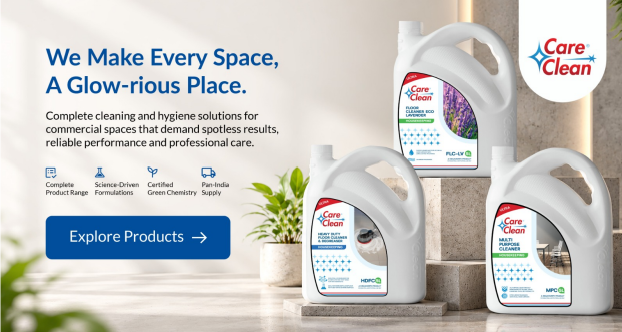




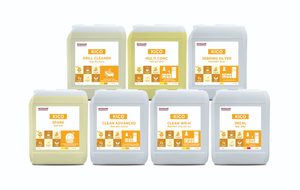
CareClean by Megamorph delivers professional cleaning and hygiene solutions for commercial, institutional and industrial environments. Its product portfolio spans floor and surface care, kitchen cleaning, restroom hygiene, infection control, laundry care and air care. Designed for a range of cleaning applications, the portfolio helps businesses select suitable solutions for their everyday cleaning and maintenance requirements.
With manufacturing facilities in Bengaluru, CareClean serves businesses through a professional product range that includes concentrated formulations and multiple pack sizes. The company information supplied highlights green certification, in-house research and development, quality control, stability testing, automated production and OEM/private-label manufacturing capabilities. From hospitality and healthcare to education, manufacturing, logistics and public spaces, CareClean aims to help professional teams maintain consistent cleaning routines. Its focus is on making product selection easier, supporting practical applications and providing businesses with a broad portfolio from a single cleaning solutions partner.

Explore professional cleaning solutions from a manufacturer whose supplied company profile highlights GC-Mark and DQS green certification.
Access floor, surface, kitchen, restroom, laundry, air care and infection-control products through one professional cleaning range.
In-house R&D, quality control and stability testing support product development and consistent manufacturing processes.
Two manufacturing plants and stated annual production capacity support the supply needs of professional and institutional buyers.
A pan-India supply approach helps businesses source professional cleaning products for their operational requirements.
OEM and private-label manufacturing capabilities offer businesses an opportunity to explore customised product and brand requirements.
Connect with our hygiene experts

In this candid conversation with Clean India Journal, Niyati Purohit (CEO) and Ashwin Suresh (MD) share the inspiring journey of building CareClean—from a small marketing consultancy to a ₹100 crore manufacturing brand. They talk about entrepreneurship, challenges of working as a husband-wife duo, scaling a business, and the future of the cleaning industry in India.
Watch the full storyTwenty years ago, professional cleaning in India was largely unorganised and price-led, . Chemicals were often generic and undifferentiated, manufacturing was fragmented across small,
Read MorePartner with Care Clean for safe, effective and complete hygiene solutions.
Book a Demo
Specially formulated to clean effectively
Removes tough stains, clears limescale, eliminates stubborn odours, and clings tightly to surfaces due to its thick gel formula for deeper action.
Highly concentrated economy formula (requires low usage amount) engineered to dissolve soap scum, hard water limescale, and fatty acid deposits.
Explore More →An eco-friendly, high-performance floor wash that lifts stubborn stains and provides a long-lasting, calming lavender fragrance.
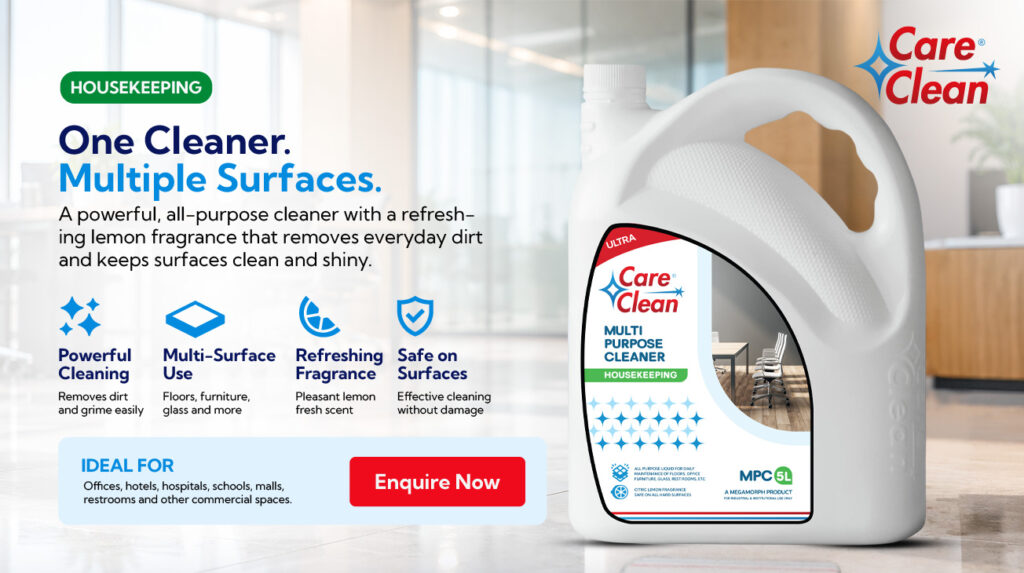
Explore More →An all-in-one everyday cleaner that easily cuts through daily dirt and grime while leaving behind a refreshing lemon scent.
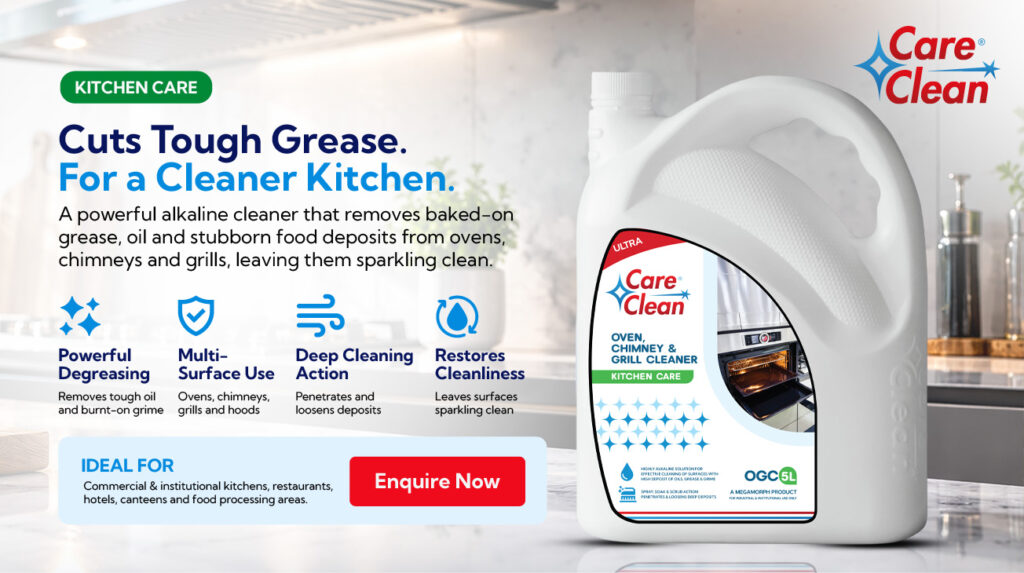
Explore More →A powerful, deep-cleaning alkaline degreaser that penetrates, loosens, and strips away baked-on grease, heavy oils, and stubborn carbon deposits.
Explore More →Long-lasting water-based aerosol alternative that targets and controls unpleasant odours to maintain a hygienic environment.
Explore More →
Non-staining formulation that is safe
Long-lasting water-based aerosol alternative that targets and controls unpleasant odours to maintain a hygienic environment.
Highly concentrated economy formula (requires low usage amount) engineered to dissolve soap scum, hard water limescale, and fatty acid deposits.
Explore More →An eco-friendly, high-performance floor wash that lifts stubborn stains and provides a long-lasting, calming lavender fragrance.
Explore More →An all-in-one everyday cleaner that easily cuts through daily dirt and grime while leaving behind a refreshing lemon scent.
Explore More →A powerful, deep-cleaning alkaline degreaser that penetrates, loosens, and strips away baked-on grease, heavy oils, and stubborn carbon deposits.
Explore More →Removes tough stains, clears limescale, eliminates stubborn odours, and clings tightly to surfaces due to its thick gel formula for deeper action.
Explore More →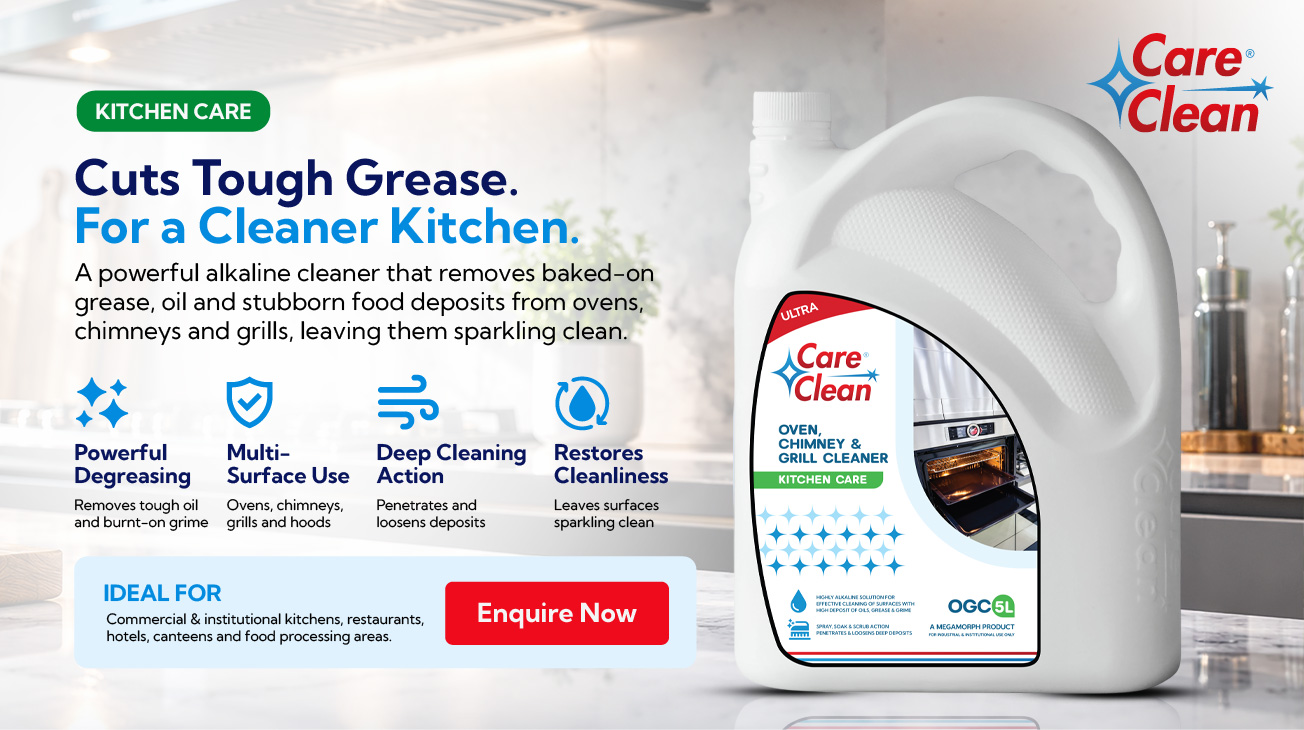
Designed for heavy-duty kitchen hardware
A powerful, deep-cleaning alkaline degreaser that penetrates, loosens, and strips away baked-on grease, heavy oils, and stubborn carbon deposits.
Highly concentrated economy formula (requires low usage amount) engineered to dissolve soap scum, hard water limescale, and fatty acid deposits.
Explore More →An eco-friendly, high-performance floor wash that lifts stubborn stains and provides a long-lasting, calming lavender fragrance.
Explore More →An all-in-one everyday cleaner that easily cuts through daily dirt and grime while leaving behind a refreshing lemon scent.
Explore More →Long-lasting water-based aerosol alternative that targets and controls unpleasant odours to maintain a hygienic environment.
Explore More →Removes tough stains, clears limescale, eliminates stubborn odours, and clings tightly to surfaces due to its thick gel formula for deeper action.
Explore More →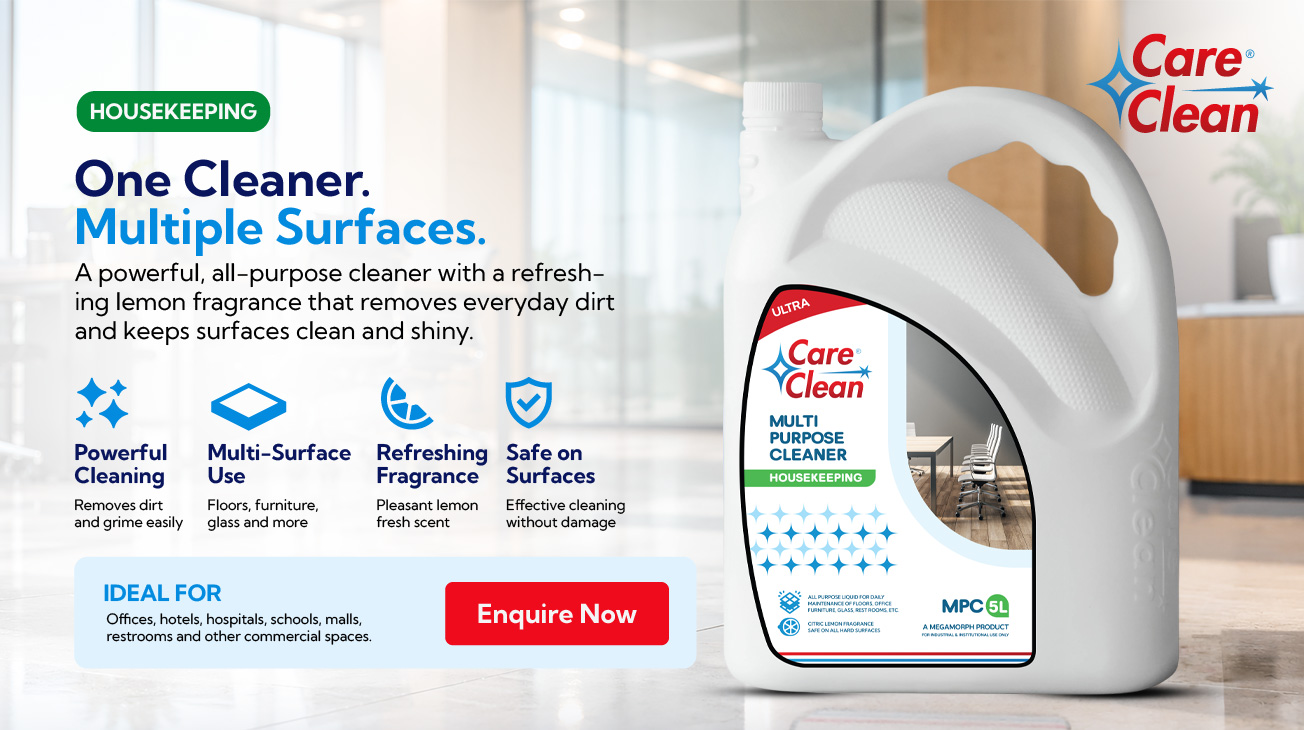
Multi-surface safe, making it highly versatile
An all-in-one everyday cleaner that easily cuts through daily dirt and grime while leaving behind a refreshing lemon scent.
Highly concentrated economy formula (requires low usage amount) engineered to dissolve soap scum, hard water limescale, and fatty acid deposits.
Explore More →An eco-friendly, high-performance floor wash that lifts stubborn stains and provides a long-lasting, calming lavender fragrance.
Explore More →A powerful, deep-cleaning alkaline degreaser that penetrates, loosens, and strips away baked-on grease, heavy oils, and stubborn carbon deposits.
Explore More →Long-lasting water-based aerosol alternative that targets and controls unpleasant odours to maintain a hygienic environment.
Explore More →Removes tough stains, clears limescale, eliminates stubborn odours, and clings tightly to surfaces due to its thick gel formula for deeper action.
Explore More →
Gentle but tough formulation safe for premium flooring.
An eco-friendly, high-performance floor wash that lifts stubborn stains and provides a long-lasting, calming lavender fragrance.
Highly concentrated economy formula (requires low usage amount) engineered to dissolve soap scum, hard water limescale, and fatty acid deposits.
Explore More →An all-in-one everyday cleaner that easily cuts through daily dirt and grime while leaving behind a refreshing lemon scent.
Explore More →A powerful, deep-cleaning alkaline degreaser that penetrates, loosens, and strips away baked-on grease, heavy oils, and stubborn carbon deposits.
Explore More →Long-lasting water-based aerosol alternative that targets and controls unpleasant odours to maintain a hygienic environment.
Explore More →Removes tough stains, clears limescale, eliminates stubborn odours, and clings tightly to surfaces due to its thick gel formula for deeper action.
Explore More →
Deep cleaning and daily maintenance of high-traffic commercial restrooms.
Highly concentrated economy formula (requires low usage amount) engineered to dissolve soap scum, hard water limescale, and fatty acid deposits.
An eco-friendly, high-performance floor wash that lifts stubborn stains and provides a long-lasting, calming lavender fragrance.
Explore More →An all-in-one everyday cleaner that easily cuts through daily dirt and grime while leaving behind a refreshing lemon scent.
Explore More →A powerful, deep-cleaning alkaline degreaser that penetrates, loosens, and strips away baked-on grease, heavy oils, and stubborn carbon deposits.
Explore More →Long-lasting water-based aerosol alternative that targets and controls unpleasant odours to maintain a hygienic environment.
Explore More →Removes tough stains, clears limescale, eliminates stubborn odours, and clings tightly to surfaces due to its thick gel formula for deeper action.
Explore More →
Green is the new word. "The demand for environment-friendly products is a must in today's landscape. However, the term 'green' is often used without a comprehensive understanding of the entire product and its application," says Niyati Purohit, Director & CEO, Megamorph Marketing Pvt Ltd.
The cleaning industry is on a learning curve, striving to strike a balance between product efficacy and operational budgets. We need to delve deeper to understand green products and their functions within set contexts. This will help harness the potential of green solutions.
The supply chain for these green raw materials is still developing, leading to higher costs for end products. Balancing effectiveness with budget constraints becomes difficult and it results in misconceptions within the industry. It is thus crucial to address these challenges collaboratively, fostering innovation and sustainable practices at affordable prices for all stakeholders.
There are two vital aspects to consider: the composition of the product itself and its packaging. In this context, some of the differentiating factors include:
With packaging innovation, the focus shifts towards reducing plastic usage and promoting recyclability.
Our latest endeavour, the 'ProDrop' range, exemplifies this commitment. These super concentrates not only use 65% less plastic than standard five-litre cans but also feature built-in dosing systems for enhanced convenience. Priced thoughtfully to align with the operational budgets of the Indian cleaning industry, the 'ProDrop' range holds the CII GreenPro certification, signifying our dedication to sustainability and excellence.
While transitioning to eco-friendly cleaning products and supplies, firstly look for third-party certifications to ensure adherence to stringent environmental standards. Additionally, consider adopting concentrated formulations to curtail packaging waste and lower transportation emissions.
Evaluate equipment upgrades and initiate recycling programmes for waste management alongside water conservation initiatives.
At CareClean, we advocate a strategy of continual improvement, aiming for a 1% enhancement each month. These incremental advancements yield significant changes over the course of a year, fostering sustainability.

For decades, India was viewed largely as an import-driven market for cleaning equipment and chemicals. Today, that narrative is undergoing a decisive shift. India is no longer just consuming global technologies — it is increasingly designing, manufacturing and exporting them.
As global supply chains realign and the cleaning industry searches for resilient, cost-effective and scalable production bases, India is emerging as a compelling answer. Backed by strong economic growth, progressive policy direction, expanding trade access and a rapidly maturing manufacturing ecosystem, the country is positioning itself as a strategic hub for global cleaning manufacturing.
For international players, the opportunity is no longer limited to market entry. It is about building in India, partnering in India and exporting from India.
India continues to be the fastest growing major economy, with GDP growth projected in the range of 6.5–7 per cent. This growth is being actively supported by policy, with the Union Budget maintaining a strong focus on infrastructure and manufacturing. Capital expenditure has crossed ₹11 lakh crore, driving expansion across highways, airports, rail networks and urban infrastructure.
For the cleaning industry, this expansion is transformational. Every new infrastructure asset brings with it a need for mechanised cleaning systems, sanitation technologies and maintenance solutions, creating a robust and sustained domestic demand base.
At the same time, national missions are converging in their impact. As Neeraj Sharma, CEO, Cleanverse Global Pvt Ltd, observes: "Make in India is no longer just a policy initiative but a strong movement towards self-reliance, innovation and global competitiveness. We need to see Make in India and Swachh Bharat simultaneously, as both policies are complementing each other."
This alignment is critical. It ensures that manufacturing growth is not isolated, but directly linked to urban development, public health and sustainability.
"India's strength lies in building machines for real conditions — robust, practical and engineered for the environments they actually operate in."
— Neeraj Sharma
The Indian cleaning industry is now at an inflection point. Long recognised as an import-heavy sector, it is rapidly transforming into an export-oriented manufacturing ecosystem.
Industry observations increasingly reflect a growing confidence among manufacturers — that there is little that cannot be produced locally. The rise of domestic capabilities, supported by a strong ancillary ecosystem of component manufacturers and suppliers, has reduced dependence on imports and improved production agility.
Equally significant is the rise of contract manufacturing, which has expanded rapidly in recent years. This model is enabling global brands to leverage Indian manufacturing without large capital investments, while also supporting private labelling and joint venture opportunities.
Together, these developments are creating a flexible, scalable and globally aligned manufacturing base.
India's recent trade strategy is reinforcing this transition. Agreements such as the India–UAE CEPA and the India–Australia ECTA, along with ongoing negotiations with the UK and European Union, are opening new pathways for exports.
These agreements are reducing tariff barriers, simplifying regulatory processes and improving market access. For the cleaning industry, this means products manufactured in India can reach multiple global markets with greater competitiveness and efficiency.
India is thus evolving into a multi-market export hub, bridging developed and emerging economies.
India offers a rare combination — a rapidly expanding domestic market alongside a growing export footprint.
The professional cleaning and hygiene segment is estimated to be growing at 10–12 per cent annually, driven by urbanisation, regulatory focus and increased mechanisation. At the same time, the broader chemical industry is projected to reach USD 300 billion by 2030, while engineering exports have already crossed USD 100 billion.
Within this ecosystem, Indian cleaning manufacturers are expanding their presence across the Middle East, Africa, Southeast Asia and Australia, gaining acceptance for their ability to deliver reliable, cost-effective and increasingly compliant solutions.
A defining strength of Indian manufacturing lies in its application-driven approach.
Cleanverse Global emphasises that machines must be designed for the environments in which they operate. "Dust levels, terrain and operational intensity demand equipment that is robust and easy to maintain," the company notes.
Its focus on localisation further strengthens this capability. "By sourcing spares and key components locally, we reduce dependency on imports and strengthen the domestic supply chain."
Equally important is its emphasis on field-driven innovation. "The most valuable insights come from the ground. Continuous feedback from municipalities and facility management teams allows us to refine machines and improve productivity."
This ability to design for demanding conditions makes Indian products particularly relevant for emerging markets worldwide.
Indian manufacturers are also demonstrating a growing sophistication in export strategy.
Megamorph Marketing Pvt Ltd's journey from a regional player to a national brand reflects this shift. Its approach to exports is not limited to market expansion, but extends to product re-engineering.
"Our approach to export has always been optimistic," says Ashwin Suresh, MD. "We are working on making formulations more export-friendly. Shipping water is expensive, so we are focusing on super-concentrated products."
He adds: "Even though our formulations are developed for the Indian market, we have always kept global benchmarks in mind in terms of safety and regulation. That is why we are able to export to markets like Australia and Qatar."
Megamorph also highlights a broader industry transition — from operational efficiency to market positioning. Increased investments in branding, sales and visibility signal a maturing industry that is ready to compete globally.
"Exporting efficiency starts with product design — super-concentrated formulations make Indian products far more viable globally."
— Ashwin Suresh
As environmental regulations tighten globally, particularly in Europe, sustainability is becoming a critical differentiator.
VIKR Bioscience Pvt Ltd is at the forefront of this shift. "Sustainability is not just a corporate buzzword — it is the core engineering principle behind every product we manufacture," states Bharat Panchal, Founder.
Its enzyme-based, non-toxic formulations are designed to deliver high performance while meeting stringent environmental standards. With solutions ranging from odour neutralisers and non-corrosive cleaners to microbial treatments for sewage systems, the company is aligning with global ESG expectations.
By providing detailed technical documentation and supporting private-label manufacturing, VIKR Bioscience is positioning itself as a strong partner for international distributors seeking compliant and sustainable solutions.
"Sustainability is not a buzzword — it is the core engineering principle behind every product we manufacture."
— Bharat Panchal
In the equipment segment, Indian manufacturers are increasingly aligning with international benchmarks in quality and compliance.
Cosmic Healers Pvt Ltd exemplifies this evolution. With CE-certified machines and successful exports such as its Gobbler litter-picking machine to Qatar, the company is demonstrating that Indian equipment can compete on the global stage.
"Success today demands precision, sustainability and international compliance," states Dr JPS Bakshi, Founder & MD.
Its focus on high-grade materials, rigorous testing and performance validation ensures reliability across diverse operating conditions. Certification, as it emphasises, "acts as a global passport", enabling Indian machinery to meet stringent international standards.
The integration of digital diagnostics and predictive maintenance further reflects a shift towards intelligent, technology-driven solutions.
"In global markets, certification is not a formality — it is a passport that builds trust and enables acceptance."
— Dr JPS Bakshi
India's strength lies in the convergence of multiple factors that few markets can offer simultaneously. A large domestic demand base ensures that products are continuously tested and refined. Cost competitiveness is supported by engineering depth and a skilled workforce. Localisation of supply chains enhances resilience, while growing alignment with global standards ensures export readiness.
At the same time, manufacturers are demonstrating a clear ability to adapt products for international markets — whether through formulation innovation, certification or sustainability compliance.
Perhaps most importantly, the industry mindset is evolving. Indian companies are no longer operating solely as manufacturers. They are investing in branding, innovation and global partnerships, signalling a shift from backend production to frontline global participation.
India stands at a pivotal moment. The fundamentals are firmly in place — economic growth, policy support, manufacturing capability and expanding global access.
The transition from import dependence to export capability is already underway. Industry voices reflect confidence, adaptability and ambition. What remains is scale — and that, too, is rapidly building.
For the international cleaning community, the opportunity is clear. India offers not just efficiency, but strategic advantage.
It is no longer a peripheral player. It is becoming central to how the global cleaning industry will manufacture, innovate and grow.
The future of the cleaning business will not just include India — it will increasingly be built from India.
Ashwin Suresh, Managing Director, Megamorph Marketing Pvt Ltd, speaks on how cleaning chemicals in India moved from generic formulations to certified, science-led manufacturing.
Twenty years ago, professional cleaning in India was largely unorganised and price-led. Chemicals were often generic and undifferentiated, manufacturing was fragmented across small, informally run units, and cleaning itself was treated as a cost line rather than a discipline — bought on lowest quote, not on outcome or safety. Documentation, traceability and quality systems were the exception, not the norm.
Today, that has flipped. Cleaning has become a measurable, audited function. Large FMCG and institutional buyers now expect their chemical suppliers to run under certified quality systems — Megamorph itself is currently certified through BRCGS PCH Issue 4 (Higher Level) across its units — and the market has organised around scale, compliance and formulation science rather than just price.
It is a shift from what cleans to how it is made, proven and sustained at scale.
As a chemicals manufacturer, the sharpest change has been in customer expectations. The shift has been from 'visibly clean' to 'provably hygienic and safe'. Buyers now ask for evidence: formulation data, compliance certificates, batch traceability, and consistent performance at volume — not just a clean-looking result. Sustainability has entered the selection criteria decisively. Concentrate formats, safer chemistries, and reduced plastic and transport footprint are now part of the purchase decision, not add-ons.
The bar has moved from 'does it clean' to 'can you prove it, consistently, at volume'.
In a post-pandemic world where hygiene is linked to safety, brand reputation and ESG reporting, chemistry is no longer invisible. It is audited.
"Large FMCG and institutional buyers now expect their chemical suppliers to run under certified quality systems."
— Ashwin Suresh, Managing Director, Megamorph Marketing Pvt Ltd
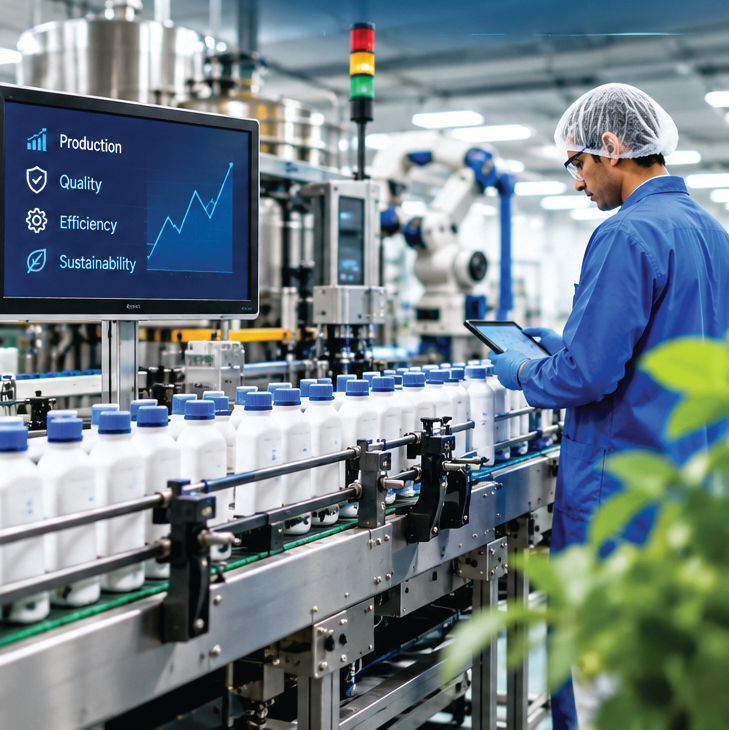
For manufacturing specifically, automation and sustainability will move together, not separately. On the shop floor, that means larger, more automated mixing and packaging lines to hold consistency at scale as volumes grow, alongside a continued push toward concentrate formats, safer chemistries and lower water and plastic footprint per unit produced.
AI and robotics will matter more visibly on the equipment and facility-services side — smart dosing, usage monitoring, robotic cleaning in large institutional spaces. But even there, the underlying enabler will be the same thing driving change in chemicals: data and traceability becoming table stakes across the value chain, not a differentiator reserved for the largest players.
In a market once scattered across equipment, chemicals, facility services and end users with very little shared vocabulary, Ashwin Suresh credits Clean India Journal for providing continuity.
"CIJ has been the connective tissue for an industry that was otherwise scattered. By consistently covering technology, compliance and best practice for two decades, it gave the market a common reference point for what 'professional' cleaning actually looks like," he said.
That common reference point, he says, gave organised, quality-led players like CareClean a platform to be seen and benchmarked, rather than competing purely on price in a fragmented, invisible market.
Megamorph's association with Clean India Journal goes back to 2012, when CareClean took a 10 sq m stall at the Clean India Show — modest at the time, but one of the bigger stalls for a brand its size then. "Since that first edition, Clean India Journal and the Clean India Show have consistently given us a platform to connect with the industry — not just customers, but peers and counterparts, to exchange notes on trends and where the industry was headed. That relationship has stayed a genuinely important part of CareClean's growth story."
The most memorable touchpoint, however, was the Housekeepers' Summit organised in Sri Lanka. "It was a unique platform. CareClean showcased in front of housekeepers from multiple countries, with interactive games and innovations we planned specifically for that audience. It remains one of our most memorable touchpoints with the industry CIJ has built," he said.
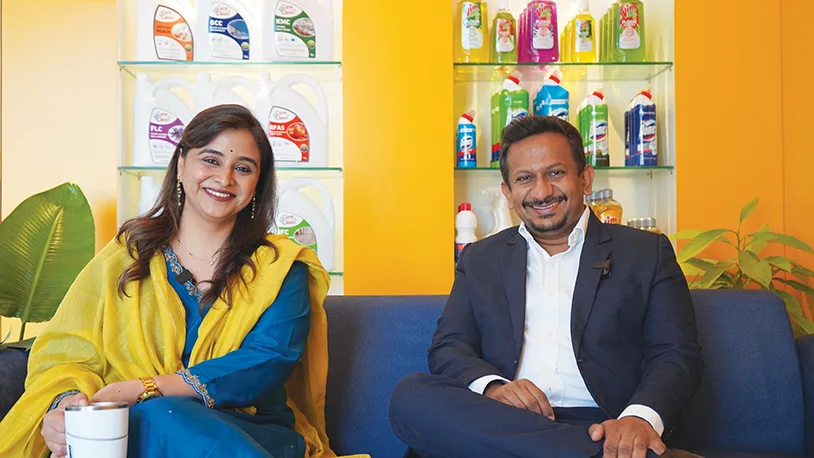
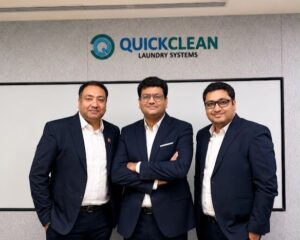
Niyati Purohit, Chief Executive Officer, and Ashwin Suresh, Managing Director of Megamorph Marketing Private Limited, share the journey of their home-grown brand, CareClean, with Clean India Journal. In this candid discussion, they reflect on 13 years of evolution, the complexities of husband-wife partnerships in business and their strategic transition from marketing consultants to industrial manufacturers.
Ashwin: We initially intended to assist Micro, Small and Medium Enterprises (MSMEs) with marketing. We consulted for a company manufacturing cleaning chemicals and found we were marketing their products effectively. However, with the passage of time, we realised that controlling manufacturing and quality is essential for marketing success. Operations are the critical part of this control. We decided to pivot and take end-to-end control over our brand, CareClean, by managing both manufacturing and marketing.
Niyati: I grew up around factories as my parents ran a pharmaceutical manufacturing unit in Indore. The process of creating a product is an exciting experience. One must have trust in the process to believe in the final product presented to the market. While we debate significantly before making decisions, once a path is chosen, it is a joint commitment.
Niyati: In the beginning, many people assumed I was only present because of my husband. Even in meetings, individuals would look at Ashwin to answer questions I had asked. It bothered me. I had to instruct our employees to respect the position I held rather than responding based on my age or gender. Over 13 years, those who worked closely with me understood my contribution. While such biases still exist today, they no longer affect me because I am confident in the value I bring.
Ashwin: Men often dominate spaces by nature, but a man can do much to ensure a woman receives the respect she deserves. I have been conscious of when to step in and when to voluntarily step out. If I were to contradict her or debate a decision in front of the team, it would undermine her authority. We have structured our work to avoid this. Once the results of her decisions became visible to everyone, the respect followed naturally. Today, most people turn to her first because they know she holds the ultimate responsibility.
Ashwin: Our first sale came from a lead at the Clean India exhibition. A company from Ahmedabad called us and transferred the money. In our first year, the total turnover was ₹3,000. In the second it was ₹1 lakh. Today, we are ending the year at approximately ₹100 crore and our projection for the next year is ₹250 crore. It has been a 13-year journey of incremental steps and monumental growth, particularly as cleanliness awareness increased during the pandemic.
Niyati: We started with only four people. In the early days, we took the orders, packed the material and dispatched them ourselves. Some customers even noted that we delivered materials in a personal car. We celebrated every small win, including the first month of sales, with a cake. Launching a brand when large multinational corporations were already established was a significant challenge.
Niyati: The industry saw the performance of CareClean products and wanted similar formulations for their own brands. They saw that we operate in a partnership mode with transparency and established systems. It was not just about buying a formulation; it was about trust.
Ashwin: India is a country of 1.4 billion people. No single brand can rule the entire market. Manufacturing requires a specific attitude and level of professionalism that is often missing in small-scale family businesses. Once we implemented high standards for quality and safety, larger brands saw the value in associating with us. We are the custodians of their products, and we take this responsibility seriously.
Ashwin: Being a husband and wife is more difficult. You can run a company with intelligence and hired talent, but a relationship is only managed by the two people involved. It requires maturity that cannot be taught in school. Mistakes in business are far easier to correct than mistakes made at home.
Niyati: I find being co-partners easier because the roles and decision-making matrices are defined. At home, emotions are raw and you drop your professional walls, which can be more difficult to handle. However, Ashwin is very self-assured and gives me the space to lead, when necessary, both at work and at home.
Ashwin: We have built a strong team to take care of CareClean so that it is not dependent solely on us. We have a pan-India sales team of 22 people. While we are responsible for building the entire organisation, CareClean remains our priority for marketing and recruitment spends. We have reached a stage where we can let the brand blossom under the guidance of industry experts.
Niyati: My stress is often self-induced because I seek perfection in operations, which is difficult to achieve. However, spending time with my daughter helps me reset. On the shop floor, I am known for being vocal. I have a low tolerance for avoidable mistakes where a defined process was simply forgotten or ignored.
Ashwin: I recently conducted training for the team on handling stress. We cannot reduce the work because we are growing rapidly. We expect high performance but not 16-hour days. My stress originally came from financial debt and mortgages, which was a foreign concept to my family. Once I became grounded in my decisions and accepted that defeats are part of the process, the stress became manageable.
Ashwin: We have transitioned from a regional player in the South to growing in the West and East. Our vision is to bring CareClean to a point where it represents 50% of our total business. We are very customer-centric; our formulations are driven by what the Indian market requires. We are now investing heavily in marketing and bringing agencies on board to ensure our voice is heard in the larger market.
Niyati: We have identified the segments where we want to play. We kept a low profile for a few years while the market matured, but now we are ready to take a leap.
Ashwin: CareClean brings excitement and a sense of brand identity to the company. While Megamorph provides the manufacturing foundation, CareClean allows us to engage in marketing and innovation. You will see the brand in a new light very soon.
Needed for the site to work - security, load balancing and remembering this choice. No tracking.
Google Analytics, and the record of which pages you saw before sending a form. Tells us what to publish more of.
Lets us measure our campaigns and show Clean India Journal advertising to people who have visited before.
Embedded video and other conveniences. Switching this off may stop some embeds loading.
Enter for all results · Esc to close