

































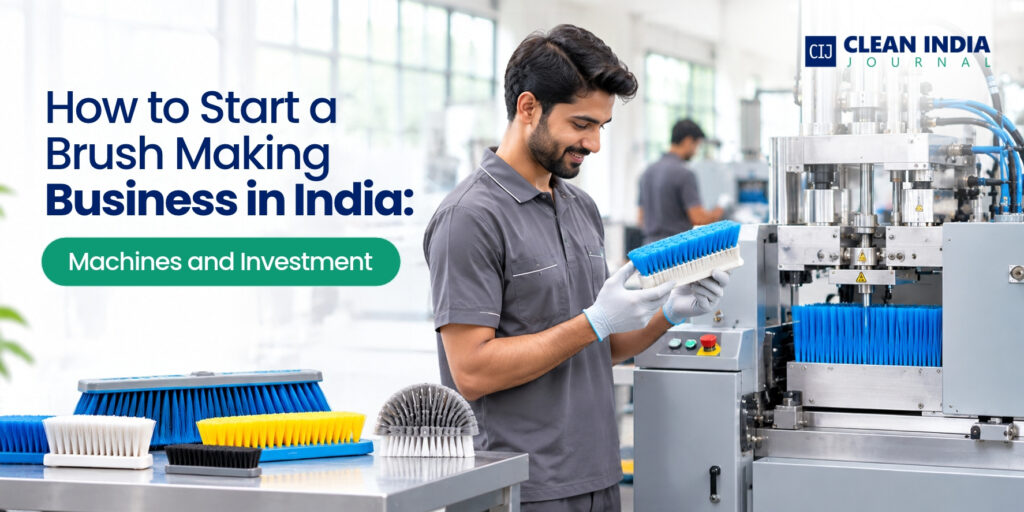
How to Start a Brush Making Business in India: Machines and Investment
Think about how many brushes your home goes through in a year. A toilet brush, a few cloth-washing brushes, a tile brush, a broom or two. Now multiply that by every household in India.
That steady, repeat demand is what makes a brush-making business worth a serious look. Brushes wear out and get replaced, so customers keep coming back. And as Clean India Journal has reported, the opportunity now extends beyond households to organised retail and exports.

The good news is that you don’t need a huge factory or years of industry experience to start. Here’s a step-by-step look at what it takes, based on what CIJ has published about setting up a brush unit in India.
Step 1: Decide which brushes you’ll make
Start with your product list, because it decides your machine, your raw materials, and your buyers.
Household brushes alone cover a wide range. In a CIJ article on the tufting process, Borghi Brush Machinery lists toilet brushes in round, single hockey and double hockey shapes, cloth-washing brushes, tile cleaning brushes, and lobby brooms.
Starting with a few household items and adding more later keeps things simple. Toilet brushes and flat brushes make a practical first range, because the machine described below can make several of these formats.
Step 2: Choose your brush-making machine
The heart of the unit is a vertical tufting machine. This is the machine that inserts the bristle tufts into the brush body.
The set-up described in CIJ’s brush manufacturing article uses a 5-axis CNC tufting machine with one filling tool and one drill. It can produce up to 450 tufts per minute. A single machine can make:
- Flat brushes with radial or upright filling
- Round-head toilet brushes
- Double hockey toilet brushes
When you speak to machine suppliers, ask which brush formats the machine can handle, what the tufting speed is, and how easily you can switch between products. That flexibility matters a lot when you’re small.
As your orders grow, you can add a second machine or an adjacent unit without changing how the business works.
Step 3: Plan your investment
According to Clean India Journal, a commercially viable brush manufacturing unit can be set up with an investment of about ₹50 lakh to ₹1 crore. That figure covers three things:
- Machinery, mainly the tufting machine.
- Initial raw material stock.
- Working capital to run the unit until payments start coming in.
If you already run a manufacturing business, your costs may be lower. Existing industrial sheds, three-phase power, compressors, and material-handling equipment can all reduce what you need to spend on new infrastructure.
Step 4: Find the right space
Brush making doesn’t need a large site or complicated utilities. Production can begin in around 3,000 sq ft. The space covers the tufting machine and raw material storage, and also leaves room for finishing and packing.
If you already have an industrial shed with three-phase power, you may be able to start inside it.
Step 5: Source your raw materials
CIJ lists the initial raw materials as:
| Material | Used for |
| PP and PET filament | Synthetic bristles |
| Natural fibres such as Palmyra and coco fibre | Natural-bristle brushes and brooms |
| Metal wire | Holding the tufts in place |
| Handles | Brush bodies and grips |
| Packing materials | Retail-ready packaging |
Synthetic bristles are popular for good reason. Borghi points out that they work on both wet and dry surfaces, and resist acid, oils, heat, and bacteria, which gives them a longer life. They also stand up to abrasion, rust, and chemicals, and stay flexible enough to reach into tight spaces.
If you already buy PP (polypropylene) for another product, those supplier relationships can extend to brush handles and other components.
Step 6: Build a small team
One of the most attractive things about this business is how lean it can be. A unit can start with just three to four people:
- One machine operator. Prior brush-industry experience isn’t essential for this role.
- One finishing and quality-control operator, who oversees trimming, flagging, beating, and quality checks.
- One or two people for packing and stores.
Finishing steps like trimming and flagging decide how your brush looks and feels in the customer’s hand, so give that role real attention.
Step 7: Think about where you’ll grow
Once your first range is running smoothly, there are a few natural ways to grow:
- Make your own handles. Brush handles are plastic parts, so the business links directly with injection moulding. If you already have moulding capacity, you can produce handles in-house.
- Add related products. CIJ notes there’s scope to diversify into other cleaning and hygiene products.
- Look beyond India. There are opportunities both in exports and in replacing imported brushes with Indian-made ones.
Is a brush-making business right for you?
It’s a strong fit if you want a manufacturing business with:
- Everyday products with repeat demand
- A modest space and a small team
- An investment of about ₹50 lakh to ₹1 crore
- Room to grow into retail, exports, and related cleaning products
It makes even more sense if you already run a plastics or injection moulding unit, because you can share the space, power, equipment, and suppliers.
Ready to take the next step? Read CIJ’s full brush manufacturing opportunity report, then explore cleaning equipment and supplier contacts on CIJ Connect.
Ask the expert
Have a question about this article? Put it to the people in it. We pass your details on and they come back to you directly.