

































Industrial Cleaning in India: 4 States Driving New Growth
From Bihar’s emerging manufacturing hubs and Odisha’s steel corridors to West Bengal’s industrial revival and Tamil Nadu’s high-tech factories, a new wave of investments is creating opportunities for industrial cleaning in India. But the requirements are changing. Industrial housekeeping is moving beyond sweeping and washing floors to specialised cleaning, contamination control, mechanised maintenance, hazardous waste management and environmental compliance. The question is whether India’s professional cleaning industry is prepared to capture this emerging market, writes Samaresh Acharya, Special Correspondent, Clean India Journal.
India’s industrial map is undergoing a transformation. While established manufacturing centres such as Maharashtra, Gujarat and Karnataka continue to attract investments, a parallel industrial expansion is taking shape across eastern and southern India.

Bihar is attempting to move beyond its traditional agricultural economy. Odisha is consolidating its position as a major steel, aluminium and mineral-processing destination. West Bengal is seeking fresh momentum through manufacturing, chemicals, energy and logistics.
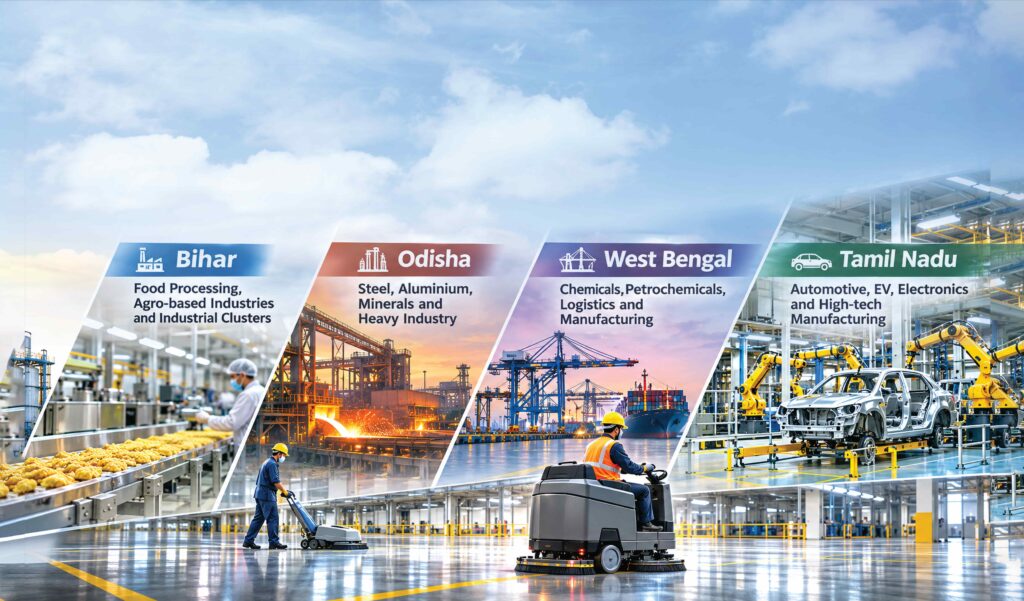
Tamil Nadu, already among India’s leading industrial states, is entering another phase of expansion driven by electric vehicles, electronics, automotive manufacturing and semiconductor-related industries. These developments are reshaping the landscape of industrial cleaning in India, creating demand for specialised cleaning services, advanced equipment and skilled industrial housekeeping teams.
For the professional cleaning industry, these developments represent much more than additional factories requiring housekeeping services. They signal a growing market for industrial cleaning services in India, specialised equipment and integrated facility management solutions. This shift is widening the scope of industrial cleaning in India, from routine housekeeping to process-specific cleaning and maintenance.
Every manufacturing facility creates an ecosystem of cleaning requirements. Production floors must remain free of dust, oil and debris. Machinery requires periodic degreasing. Warehouses need mechanised sweeping. Food-processing facilities demand stringent hygiene and sanitation. Electronics factories require controlled environments, while steel and power plants need heavy-duty industrial vacuuming and specialised equipment.
The opportunity extends beyond factory gates to industrial townships, administrative offices, canteens, transport terminals, warehouses and worker accommodation. These wider requirements are also expanding the role of industrial cleaning in India within integrated facility management contracts.
The emerging opportunity is not simply about cleaning more industrial space. It is about cleaning increasingly complex industrial environments that require specialised industrial cleaning solutions in India, trained personnel and appropriate equipment. In this context, industrial cleaning in India is becoming a specialised operational requirement rather than a routine support function.
Bihar: Industrial Cleaning in India’s Emerging Manufacturing Hub
With new manufacturing investments and industrial infrastructure projects, Bihar could become an emerging market for industrial cleaning in India, particularly in food processing, power generation and industrial warehousing.
One significant development is the proposed Integrated Manufacturing Cluster at Gaya, near Dobhi, in the Amritsar-Kolkata Industrial Corridor.
According to the National Industrial Corridor Development Corporation (NICDC), the cluster will cover approximately 1,670 acres and aims to attract investments worth ₹16,524 crore, potentially generating more than 1.09 lakh jobs.
The project has received environmental clearance, although its investment and employment figures remain projections rather than realised outcomes. If these manufacturing plans progress, they could add to demand for industrial cleaning in India, especially around industrial estates and supporting infrastructure.
The Bihar government’s investment portal also reflects growing interest in food processing, general manufacturing, plastics, renewable energy and healthcare. Importantly, proposed investments must be distinguished from projects that have received approvals or begun operations.
Food Processing: A Growing Market for Industrial Cleaning in India
Food processing could become an important driver of Bihar’s industrial cleaning market. It also illustrates how industrial cleaning in India must respond to sector-specific hygiene requirements, rather than rely on one standard cleaning approach. The state’s agricultural base supports opportunities in rice milling, dairy processing, fruit processing, packaged foods, grain storage and cold-chain operations.
Unlike conventional manufacturing, food-processing facilities demand cleaning systems that address microbiological contamination, food residues, grease, moisture and pest infestation. Cleaning contractors serving these facilities will require food-contact-safe chemicals, appropriate detergents, sanitisation procedures, controlled chemical dosing and documented cleaning schedules.
Production lines, conveyor belts, storage tanks, packaging areas and drainage systems must be cleaned according to the contamination risks associated with each operation. For cleaning equipment manufacturers, opportunities include industrial wet-and-dry vacuum cleaners, scrubber-dryers, steam-cleaning equipment and high-pressure washing systems.
Power Projects and Heavy-Duty Industrial Cleaning
Another important development is the proposed 2,400 MW ultra-supercritical thermal power project at Pirpainti in Bhagalpur district. Adani Power announced in August 2025 that it had received a Letter of Intent for the project, involving an estimated investment of approximately $3 billion. The company indicated that the first generating unit would be commissioned within 48 months of the appointed date.
Once operational, such a facility would require an entirely different category of industrial cleaning in India. This segment of industrial cleaning in India depends on risk-assessed equipment selection, trained operators and clearly documented safety procedures. Coal-handling systems generate combustible dust and deposits. Boiler areas, turbine halls, conveyors and maintenance workshops require specialised cleaning procedures. Industrial vacuum systems, mechanised sweeping equipment and suitable high-pressure cleaning technologies would be essential.
However, combustible coal dust cannot be treated like ordinary housekeeping dust. Collection equipment must be selected according to the relevant dust-explosion risk assessment, with appropriate controls for ignition sources and hazardous locations.
Bihar’s opportunity: The first major demand may emerge from food-processing plants, warehouses and industrial estates, followed by specialised cleaning contracts in power generation and larger manufacturing facilities.
Odisha: Industrial Cleaning Opportunities in Heavy Industries
Odisha offers a much larger market for heavy-duty industrial cleaning. The state already has an extensive industrial base in steel, aluminium, mining, power generation and associated downstream manufacturing. Its next phase of growth is being shaped by further investments in integrated steel plants, industrial parks, petrochemicals and mineral-based industries.
A major example is the proposed 13.2-million-tonne-per-annum integrated steel plant of JSW Group at Dhinkia, near Paradip. On May 27, 2026, the Odisha government reported the commencement of construction work for the project.
The project illustrates the scale of industrial cleaning demand that can emerge from a single manufacturing complex. It also shows why industrial cleaning in India is increasingly linked to plant operations, equipment maintenance and occupational safety.
Steel Plants: Specialised Industrial Cleaning and Housekeeping
An integrated steel plant typically includes raw-material handling areas, coke-related operations, furnaces, casting facilities, rolling mills, workshops, warehouses and utilities. Each presents a different cleaning challenge.
Raw-material yards and conveyor systems generate considerable dust. Rolling mills accumulate oil, grease and metallic residues. Furnace surroundings require carefully planned removal of industrial deposits, often under shutdown or controlled-access conditions.
Odisha’s expanding steel, mining and petrochemical industries are strengthening the demand for industrial cleaning in India, particularly for heavy-duty equipment, mechanised cleaning and specialised plant maintenance. Dust suppression, spill containment and safe collection of metallic residues are equally important.
For cleaning contractors, such facilities can offer opportunities for recurring industrial cleaning and maintenance contracts, planned shutdown cleaning and specialised industrial waste-handling services. These services are becoming an important part of the wider industrial cleaning in India market.
Paradip’s Potential: Petrochemical and Industrial Cleaning
Odisha’s industrial development plans also identify the Paradip Petroleum, Chemicals and Petrochemicals Investment Region, the Paradip Plastic Park and downstream industrial opportunities in steel and aluminium.
The state’s investment promotion agency identifies additional opportunities around Angul, Kalinganagar, Jharsuguda, Rourkela and Dhamra. Petrochemical facilities create demand for controlled cleaning of processing equipment, pipelines, storage areas and maintenance infrastructure.
However, chemical processing environments require a much higher degree of technical competence than ordinary housekeeping. For providers in industrial cleaning in India, this creates a need for specialised training, chemical knowledge and site-specific safety systems. Cleaning chemicals must be compatible with process materials. Equipment may need explosion-protection certification, and personnel must understand chemical exposure risks, confined-space entry and hazardous waste procedures.
Environmental Cleaning and Waste Management
Odisha’s industrial expansion also raises important questions about environmental management. Industrial dust, wastewater, sludge and contaminated residues cannot simply be washed into drains or transferred to ordinary municipal waste streams.
Cleaning companies capable of integrating industrial housekeeping with environmental compliance, safe waste segregation and mechanised dust control will have a competitive advantage.
Odisha’s opportunity: Heavy-duty cleaning equipment, industrial vacuuming, mechanised sweeping, plant shutdown cleaning, dust suppression and specialised maintenance services could form the backbone of demand.
West Bengal: Manufacturing Revival Opens New Doors
West Bengal has a long industrial history, particularly in engineering, steel, chemicals, power generation and port-based manufacturing. While industrial growth has faced challenges over the years, investments in energy infrastructure, petrochemicals, logistics and manufacturing are creating opportunities for industrial cleaning service providers.
The Haldia industrial region remains particularly significant because of its concentration of chemical, petrochemical, energy and port-related activities. In March 2026, Syama Prasad Mookerjee Port signed an agreement with East Horizon Private Limited for a floating storage and regasification unit at Haldia Dock Complex.
The proposed project involves an investment of approximately ₹260 crore and is intended to strengthen LNG-handling infrastructure.
Haldia’s Specialised Industrial Cleaning Market
LNG and petrochemical infrastructure requires a combination of conventional facility maintenance and highly specialised industrial cleaning. Administrative buildings, control rooms, warehouses and workshops require regular housekeeping.
Process areas, however, involve strict safety protocols. Cleaning operations near hydrocarbon-handling facilities must account for ignition hazards, equipment compatibility, controlled access and site-specific operating procedures. The opportunity is therefore likely to favour service providers with trained personnel, appropriate equipment and strong safety credentials.
West Bengal’s emerging industrial pipeline also includes projects associated with steel, power generation and chemical manufacturing.
Industry project trackers have identified developments involving JSW Energy at Salboni, Damodar Valley Corporation at Raghunathpur and Haldia Petrochemicals at Haldia. However, project values, construction progress and commissioning schedules require confirmation from the respective developers before being treated as operational capacity.
The developments also highlight how industrial cleaning in India is expanding beyond conventional factory housekeeping to include petrochemical maintenance, port cleaning and specialised facility management.
Ports and Logistics: Opportunities for Industrial Facility Management
Industrial growth also creates demand for logistics infrastructure. Cargo terminals, container-handling areas, warehouses, truck-parking facilities and transport corridors require regular cleaning. Mechanised sweepers can address extensive paved areas, while industrial vacuum systems help control dust inside enclosed warehouses. Oil spills, cargo residues and contaminated runoff require separate handling procedures.
For facility management companies, logistics parks can provide comparatively accessible entry points into industrial cleaning because their requirements are often less technically complex than those of chemical-processing plants. Such contracts are another route through which industrial cleaning in India can expand into large-scale logistics and warehousing operations.
West Bengal’s opportunity: Petrochemical cleaning, warehouse housekeeping, port maintenance, power-plant cleaning and mechanised facility management could become important growth segments.
Tamil Nadu: Industrial Cleaning in High-Tech Manufacturing
Tamil Nadu presents perhaps the most technologically demanding industrial cleaning opportunity among the four states. Unlike emerging industrial regions dominated by basic manufacturing, Tamil Nadu has a diversified ecosystem covering automobiles, electronics, engineering, textiles, footwear, electric vehicles and advanced manufacturing.
The next wave of investments is expected to increase demand for precision cleaning, controlled-environment maintenance and automated housekeeping systems. This will further shape the direction of industrial cleaning in India as manufacturers place greater emphasis on process quality and contamination control. This is likely to create new opportunities for industrial cleaning equipment manufacturers and specialised service providers.
Automotive Manufacturing and Precision Cleaning
A prominent example is Tata Motors and its passenger-vehicle manufacturing facility at Ranipet. The facility, inaugurated in 2026, represents an investment of approximately ₹9,000 crore and is associated with Jaguar Land Rover manufacturing. Its planned annual production capacity is between 2.5 lakh and 3 lakh vehicles.
Automotive factories have complex cleaning requirements. Body shops generate metallic dust and welding residues. Paint shops demand stringent contamination control. Assembly lines require clean, dry floors, while maintenance areas accumulate lubricants, oils and grease. Even microscopic dust particles can affect paint finishes, making cleaning an important contributor to product quality.
This creates demand for industrial vacuum systems, scrubber-dryers, filtration equipment, specialised cleaning chemicals and trained housekeeping teams. These requirements are pushing industrial cleaning in India towards more precise, technology-led maintenance practices.
EV Manufacturing Creates New Cleaning Requirements
Another example is VinFast, which has established an electric-vehicle manufacturing facility at Thoothukudi. In December 2025, the company announced plans for a further $500-million investment to develop production lines for electric buses and electric two-wheelers.
The existing facility has an initial annual capacity of 50,000 vehicles, with expansion planned to 1.5 lakh units.
Electric-vehicle manufacturing introduces additional cleaning considerations, particularly in battery-related operations. Battery assembly environments require strict controls over dust, moisture and foreign-particle contamination.
Depending on the process, facilities may need controlled-humidity cleaning, specialised vacuum systems and cleaning agents compatible with sensitive electrical components. Cleaning personnel also need training in electrical safety, battery-related hazards and contamination prevention.
Electronics and Semiconductors: The Need for Controlled-Environment Cleaning
Tamil Nadu’s semiconductor-related investment pipeline offers another emerging opportunity. In June 2026, authorities approved a proposed ₹115.20-crore investment by Kinesis Semiconductor Wire Solutions India at MEPZ SEZ, Tambaram. Other announced projects include semiconductor equipment manufacturing, reliability testing and specialised surface-treatment capabilities.
In such facilities, cleanliness is not judged merely by the appearance of the floor. Airborne particles, electrostatic discharge, chemical residues and contamination of sensitive surfaces can affect manufacturing quality. Cleanroom-compatible vacuum systems, approved wipes, specialised mopping equipment and controlled cleaning procedures become necessary.
Where cleanrooms are used, cleaning must conform to the facility’s required cleanliness classification and contamination-control protocols. This is a highly specialised segment of industrial cleaning in India, where procedures and equipment must match the sensitivity of the manufacturing process.
Tamil Nadu’s opportunity: Precision cleaning, automotive plant maintenance, electronics manufacturing hygiene, controlled-environment housekeeping and specialised equipment servicing are likely to command increasing attention.
The expansion of manufacturing across these four states signals a changing market for industrial cleaning in India. The future of industrial cleaning in India will depend on the industry’s ability to deliver safe, measurable and technically appropriate solutions across different manufacturing sectors. As industrial facilities become more specialised, cleaning companies, equipment manufacturers and facility management providers will need to adapt their services, technologies and workforce capabilities to meet these emerging requirements.
Ask the expert
Have a question about this article? Put it to the people in it. We pass your details on and they come back to you directly.