






















The Human Cost of Hospitality: Housekeeping Staff Retention

Housekeeping in Malaysia is no longer just a manpower issue. Since Covid-19, it has become the intersection of labour shortages, changing employee expectations, rising guest expectations, technology, sustainability and commercial pressure. In an exclusive conversation with Clean India Journal, Ava Tan, President 2026-27, Malaysia Association of Housekeepers (MAHIR), shares why housekeeping staff retention is the real crisis, why technology is a partner and not a replacement, and why hospitality cannot be measured by occupancy and online ranking alone.
The biggest change in the last two to three years is the pressure on the people who remained after the pandemic. Many employees were retrenched or moved to other industries during this period. When business returned, many did not come back. Some chose regular hours, some joined the gig economy, and some took lower-paying but less stressful jobs. This has contributed to the growing hotel staff shortage across the hospitality sector.

People do not leave an industry only because of salary. Sometimes they leave because they are tired.
Yet operations returned to full speed. A guest checks out at noon, and the next expects a perfect luxury room at 2 pm. Housekeeping gets two hours. The guest rightly expects perfection and should not need to know whether there are 20 or 40 room attendants on duty. Efficient hotel room turnaround has become increasingly challenging as teams manage demanding schedules with limited manpower.
When Low Rates Cost More
In major cities, hotels compete by lowering rates — the easiest way to capture share. But somebody pays for that lower rate. Often, it comes back to operations: reduce payroll, reduce manpower, reduce training, reduce supplies, increase productivity, and then expect five-star service. That mathematics eventually does not work.
“The real worry is when hospitality starts becoming viewed primarily as a revenue-generating building, rather than a service business operated by people who are passionate about taking care of people”— Ava Tan President 2026-27, MAHIR
Hotels should compete through value, service and experience, not price alone. In hospitality in Malaysia, maintaining service standards while managing operating costs requires hotels to invest in their people rather than rely solely on cost-cutting measures.
Reviews Are Intelligence, Not Luxury
Online reputation is enormously influential, but running a hotel according to rankings has its own risks. In luxury hospitality, hotels serve heads of state, royalty, diplomats and celebrities for whom discretion is part of the service. They may never write a review. They simply return. Sometimes, the greatest compliment a luxury hotel receives will never appear online.
Staff should not be pressurised to collect positive reviews.
Retention Crisis
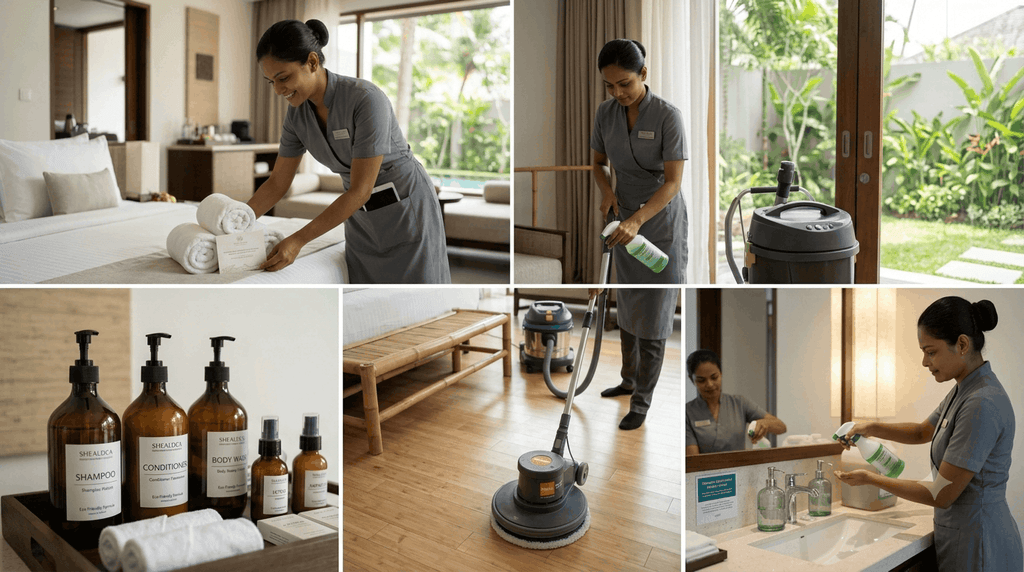
Housekeeping remains physically demanding. Malaysia’s minimum wage is RM1,700, but pay alone does not answer the question. Malaysia depends on foreign workers for certain roles while facing quotas and levies. The remaining staff feel sandwiched between productivity demands and guest expectations.
Technology helps but has not solved the shortage. Although housekeeping technology can improve efficiency, automation alone cannot address the challenges associated with recruitment, employee satisfaction and long-term retention.
The solution is to make housekeeping easier to enter, more attractive to stay in, and more productive to work in.
Five suggestions are:
- Professionalise housekeeping as a career with a clear path from attendant to director.
- Build the pipeline with hospitality schools through real mentorship, not just by using interns to fill gaps.
- Create flexible models like part-time pools and return-to-work programmes.
- Redesign the job to remove wasted effort.
- Treat retention as seriously as recruitment.
If 10 people resign and we recruit 10 new people, we have not solved the manpower problem. We have merely replaced it.
Sustainability Is Behaviour
Sustainability must go beyond amenities. Housekeeping consumes chemicals, water, electricity and linen. Practical examples matter, like TASKI Twister diamond pads that use water and mechanical action to reduce chemical dependence.
Purchasing should ask not just, “How much does this machine cost?” but “How much will this machine consume in five years — electricity, water, chemicals and maintenance?” The cheapest machine to buy is not necessarily the cheapest to operate. This matters in Malaysia, where approximately 92% of Peninsular Malaysia’s 2025 electricity mix came from coal and natural gas. Every kilowatt-hour avoided has an environmental impact.
Real sustainability is behaviour. Putting up a ‘Go Green’ poster does not change anybody. If I explain that doubling the chemical does not make the room twice as clean — it simply increases cost and environmental impact — I am beginning to change understanding.
Productivity Without Quality
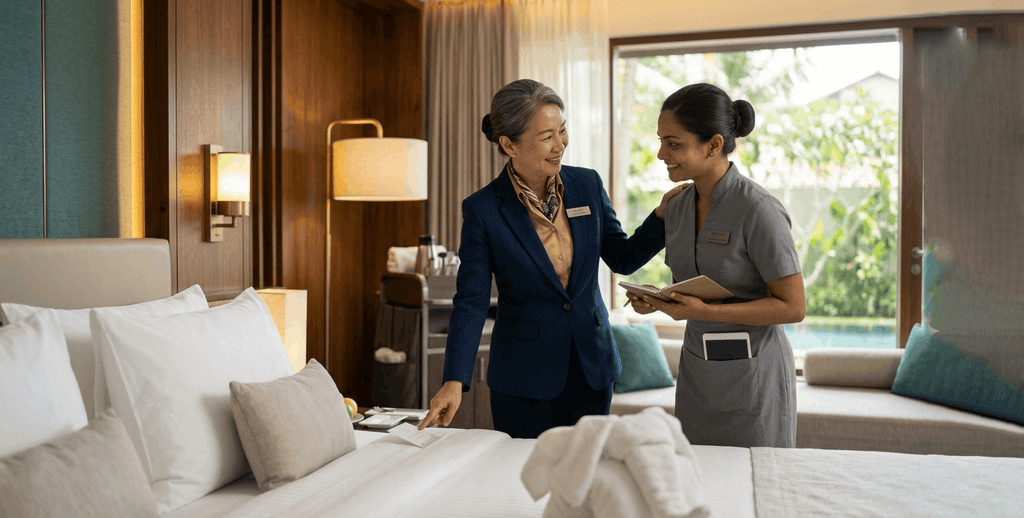
Five years ago, housekeeping was often managed by a fixed number. Today, that no longer works. A checkout is different from a stayover, a suite from a standard room, and a family of four from a single business traveller. Measurement must become smarter.
Effective hotel room turnaround depends on understanding these differences, allocating the right resources and setting realistic productivity targets. Technology and data can help housekeeping managers plan workloads more accurately, but performance measurement must also account for cleanliness and service quality.
Productivity without quality is simply producing mistakes faster.
Future of Housekeeping
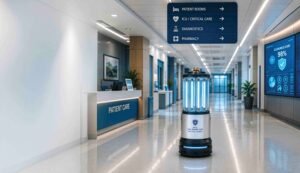
Looking ahead, housekeeping will become more data-driven and automated. Developments like the full-scenario robot-serviced hotel being developed in Shenzhen for an early 2027 opening are worth watching.
However, the future of housekeeping technology will depend on how effectively it supports employees, reduces repetitive tasks and improves operational efficiency. For hotels facing a persistent hotel staff shortage, automation may help ease the workload, but it cannot replace the human judgement and care that define hospitality.
A hotel is not merely a building containing rooms that generate revenue. Beautiful hotels can be built anywhere. Luxury furniture can be purchased. Technology can be installed. Robots may eventually clean the rooms. But hospitality still comes from the feeling we create for another human being.