








 CIJConnect Bot-enabled WhatsApp today at 4:00 PM.
Keeping up with international demands, the Indian eco-friendly cleaning market is on an upswing, writes Clean India Journal’s, Principal Correspondent, Manka Behl.
For many Indian makers of cleaning chemicals and household cleaners, sustainability used to be a marketing layer: a ‘green’ SKU or a recycled-label on the side of a pack. Today it has become a commercial imperative.

Overseas buyers, especially in Europe and large multinational procurement teams, are no longer satisfied with slogans. They want documented chemistry, measurable resource savings and proof that workers and supply chains meet global social and environmental standards. For Indian manufacturers, meeting those tests is now the difference between staying local and winning international contracts.
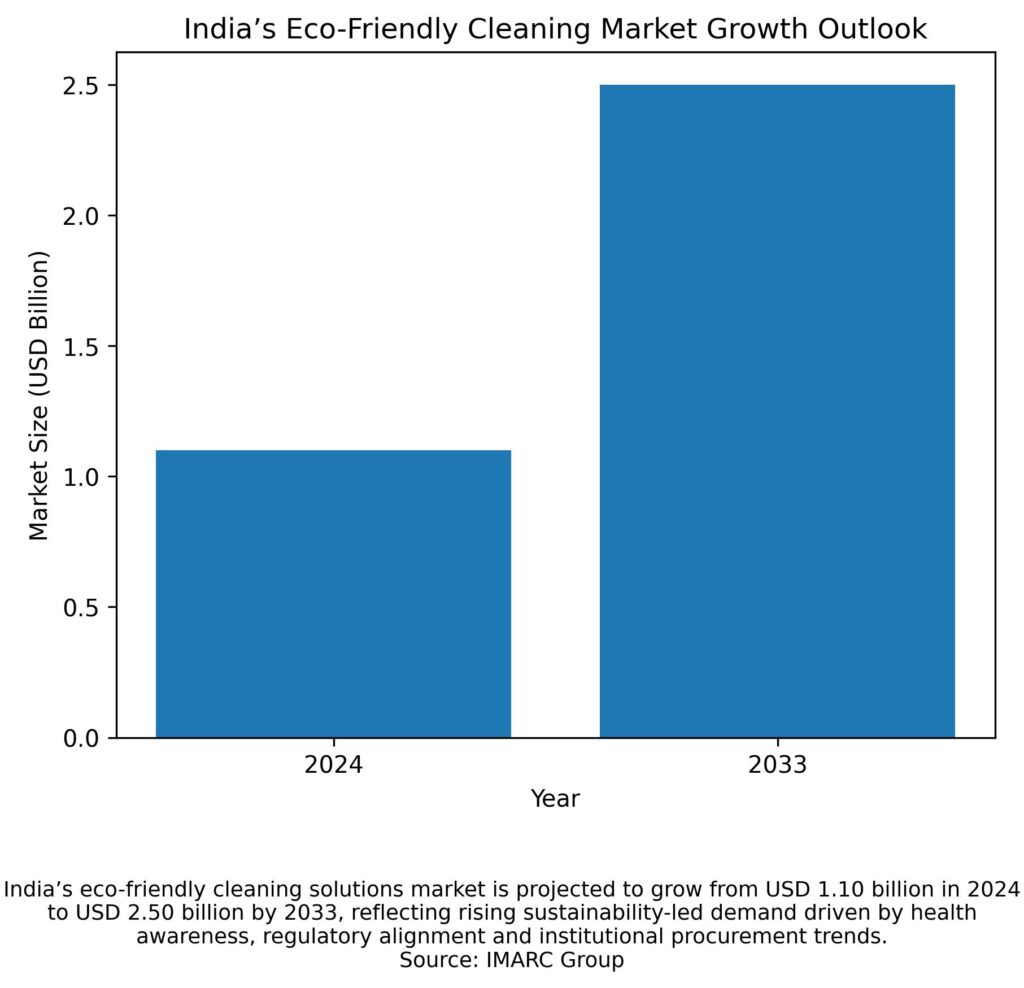
Market signals are clear — India’s eco-friendly cleaning market is growing fast. According to market research firm IMARC Group, India’s eco-friendly cleaning solutions market reached $1.10 billion in 2024, driven by rising environmental awareness, health sensitivity and a shift towards sustainability. IMARC projects the market to grow to $2.50 billion by 2033, at a compound annual growth rate (CAGR) of 9.60% during 2025–2033.
Compliance First
For Indian cleaning-product manufacturers looking to access global markets, sustainability has become less about positioning and more about permission. In export destinations such as the European Union, regulatory frameworks like REACH (Registration, Evaluation, Authorisation and Restriction of Chemicals) and tightening criteria for ecolabels raised the bar for ingredients and labelling — a reality that Indian formulators cannot ignore if they want to ship to European Union tenders.
Ingredient safety, traceability and labelling are now scrutinised at the supplier-screening stage itself. Procurement teams routinely ask for comprehensive safety data sheets, provenance documentation for surfactants and solvents, and third-party test results. Products that cannot meet these requirements are often filtered out before commercial discussions even begin.
This shift has begun to reshape how Indian manufacturers approach sustainability. Rather than treating compliance as a downstream adjustment, some large domestic players are building it into core manufacturing strategy. Godrej Consumer Products, for instance, has embedded sustainability into corporate planning, publishing climate and plastic-reduction targets and investing in cleaner production practices aimed at aligning parts of its portfolio with global buyer expectations. The focus is no longer on selective ‘green’ offerings, but on systemic readiness for regulated markets.
Industry-wide data suggests this approach is becoming mainstream rather than exceptional. A 2024 study by Price waterhouse Coopers (PwC) India found that 93% of Indian manufacturers now prioritise sustainability within their business strategy, with investments in energy efficiency and renewable energy increasingly linked to competitiveness and long-term growth. The findings indicate a broader recognition that sustainability capabilities are closely tied to market access, particularly in export-oriented sectors.
Global demand trends reinforce this recalibration. Zion Market Research projects the global green cleaning products market to grow at a compound annual rate of 14.1% between 2025 and 2034, driven by tighter chemical regulations, environmental concerns and health awareness. As this segment expands, sustainability is fast becoming a baseline qualifier rather than a differentiator—especially in institutional and regulated markets.
For Indian cleaning-product manufacturers supplying international buyers, this growth underscores the need to align formulations, ingredient profiles and disclosures with evolving global norms, not merely consumer preferences.
These expectations are translating directly into manufacturing practices. According to IMARC Group, demand for eco-friendly cleaning solutions in India is being driven largely by institutional and B2B buyers, where environmental compliance and documentation form a formal part of supplier evaluation. This has sharpened focus on how manufacturers demonstrate sustainability through measurable practices such as product safety controls, operational transparency and process efficiency—particularly within export-linked and multinational supply chains.
Domestic regulation has further reinforced this shift. Under India’s Business Responsibility and Sustainability Reporting framework mandated by the Securities and Exchange Board of India, listed chemical manufacturers are required to disclose information related to product responsibility, environmental impact and risk management. While the framework does not prescribe formulation changes, it has increased scrutiny around chemical safety and environmental reporting, effectively familiarising Indian companies with the kind of disclosure discipline expected in global markets.
Together, these forces are redefining sustainability from a communications exercise into a gatekeeping mechanism. For Indian cleaning-product manufacturers, compliance is no longer the
end goal — it is the entry point to global trade.
Davos Dialogue
Sustainability is also gaining prominence in global manufacturing conversations at policy and industry forums.
At the recently-held World Economic Forum in Davos, industry leaders and policymakers discussed the role of sustainability in long-term competitiveness and economic resilience, particularly in the context of global supply chains. Gopal Agrawal, Chief Executive Officer of Anupam Rasayan India Limited, participated in a lunch dialogue hosted by Confederation of Indian Industry (CII), highlighting how sustainability is influencing global business decisions.
“While Anupam Rasayan has built its reputation over the last 40 years on quality and reliability, sustainability has increasingly become our ‘hook to win’ in global markets. Customers today are not only evaluating products and pricing, but also the values and long-term commitments of their partners,” said Agrawal.
Anupam Rasayan, a specialty chemical manufacturer supplying global markets, has outlined sustainability-linked initiatives in recent years, including the signing of three memorandums of understanding with the Government of Gujarat in 2023 for afforestation across 150 hectares in the Narmada, Tapi and Surat districts, targeting the plantation of over 1.66 lakh trees under the state’s Green Belt Development Drive.
Gradual Gains
Sustainability disclosures by listed Indian chemical manufacturers suggest that improvements in resource efficiency are underway, even if progress remains incremental. Company filings and sustainability reports point to higher adoption of renewable energy, increased recycling of process water and gradual improvements in production efficiency across manufacturing units. While these changes are not uniform across the sector, they indicate a shift towards lower-impact operations that global buyers increasingly expect from suppliers.
This trend is visible in disclosures made under India’s Business Responsibility and Sustainability Reporting framework, mandated by the Securities and Exchange Board of India. An early review of BRSR filings from chemical and specialty chemical companies shows that many manufacturers have begun reporting energy mix, water usage and waste management data in greater detail than before. Although the framework does not prescribe performance targets, it has increased transparency around how companies manage environmental risks—an area closely examined by international customers during supplier evaluations.
Upstream manufacturers are also beginning to position resource efficiency as part of long-term competitiveness rather than short-term compliance. Speaking at the World Economic Forum in Davos, Agrawal stated that nearly two-thirds of the company’s current energy requirements are met through renewable sources, with a stated goal of transitioning to 100% renewable energy by 2027. The company’s disclosures reflect a broader push among export-oriented chemical manufacturers to reduce dependence on conventional energy sources.
Export Gatekeepers
Packaging is emerging as a critical test of sustainability credentials. Global buyers and European policy frameworks are increasingly favouring reuse and refill models over single-use plastic, creating pressure on suppliers to rethink packaging formats. This shift has opened up opportunities for Indian manufacturers to offer concentrated products, refill packs and take-back systems as part of an export-ready proposition.
Research by The Energy and Resources Institute has highlighted the potential of refill and reuse models to significantly reduce plastic consumption in India’s fast-moving consumer goods and home-care sectors. While much of this work has focused on domestic waste reduction, it also underscores India’s capacity to support circular packaging systems—capabilities that align closely with the expectations of international buyers seeking lower-plastic supply chains.
Global Position
India’s cleaning and chemical manufacturing ecosystem continues to draw strength from long-standing advantages: deep chemical expertise, large-scale production capacity and a domestic market sizeable enough to test and refine sustainable product lines before they are taken overseas.
What is changing is how these strengths are being leveraged. When manufacturers combine scale with audited environmental management systems, internationally recognised certifications and circular packaging models, the value proposition shifts—from simply being cost-competitive to being globally credible.
That transition is already visible across parts of the sector. As Agrawal rightly put it – “Embedding sustainability at scale—across states and at the national level—could significantly shape India’s standing as a global manufacturing hub. Our country can position itself as a preferred global manufacturing destination, driving investments, strengthening supply chains, and enabling long-term economic growth. Sustainability is not just good ethics; it is good business. Those who integrate it into their strategy today will lead tomorrow’s global economy.”