





































Manufacturing Facility Management: 7 Key Priorities for Factories

Manufacturing facility management goes beyond housekeeping. Sudhir Mani Sahay, Chief Operating Officer, Allied Resource Management Services India Pvt. Ltd, explains why solution design, safety alignment and business continuity are central to facility management in factories.
Manufacturing facility management is a different ball game altogether. Unlike commercial offices, where the environment is controlled and predictable, factories bring complexity, volatility and operational risks into every shift. At Allied Resource Management Services, our experience across diverse industrial segments has taught us that success in industrial facility management depends on how well we understand the manufacturing process itself.

The biggest challenge in manufacturing is that one size never fits all. SOPs for pharmaceutical, automobile and food processing plants are completely different. Add multiple shifts, continuous operations, frequent statutory changes, wage variations, accessibility of industrial clusters for ground teams and maintenance of cleaning equipment inventory, and it demands segment-specific orientation and planning.
Zero Disruption: Ensuring Business Continuity
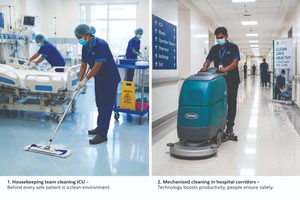
Cleaning and maintenance must never affect plant uptime. We schedule activities in close coordination with production teams, preferably during non-production hours or planned shutdowns, supported by preventive maintenance, trained manpower and strict safety procedures.
We prioritise the scope of work into must-have, good-to-have and optional activities to manage unforeseen breakdowns or absenteeism. Customised Business Continuity Plans (BCPs) for festivals, COVID-like disruptions and other business-as-usual exceptions are essential to ensure uninterrupted operations.

Smarter FM: The Role of Technology
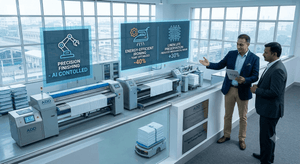
Robotics is ideal for repetitive cleaning tasks, while AI enables predictive maintenance by identifying potential issues early. Digital tools help track attendance, maintenance schedules, complaints, energy consumption and service quality in real time.
Technology is making industrial facility management more transparent, productive and efficient. It also enables service providers to monitor performance, identify gaps and improve operational control.
The Future of Facility Management in Factories
As plants become more automated, facility management will move from traditional housekeeping towards automated systems. These will include usage-based sensors for high-footfall areas, remote monitoring, electronic inventory systems for stock control and predictive maintenance.
Such developments will help ensure asset reliability, consistent methodologies, safety and business continuity. Documented SOPs will also serve as reference material for new joiners, ensuring standardised service delivery. Ultimately, infrastructure performance can be monitored and maintained with minimal human intervention.
“As plants become more automated, FM will move from traditional housekeeping to automated systems.”— Sudhir Mani Sahay Chief Operating Officer, Allied Resource Management Services India Pvt. Ltd
Skilling Gap in Industrial Facility Management
There is a clear gap between the demand for and supply of skilled manpower with the right mindset. Sourcing employees in remote industrial belts is challenging due to local, social and political factors, while employee retention remains another concern.
We are focusing on multi-skilled employees, regular training, automation and a strong backfill funnel to improve productivity and reduce manual dependency.
What Manufacturing Clients Want from FM Providers
Manufacturing clients today look beyond cost. The real differentiator is QACA — Quality Assurance and Compliance Assurance.
Key performance indicators (KPIs) include business continuity, consistency in service delivery, safety performance and a zero-accident culture, statutory compliance, service quality and customer satisfaction, energy and water efficiency, sustainability and waste management, response and resolution time, and technology adoption with reporting transparency.
For manufacturing organisations, these parameters are essential when evaluating facility management partners and ensuring that FM services remain aligned with production requirements.
Opportunities and Challenges in Manufacturing Facility Management
India’s manufacturing growth story, driven by Make in India, Production Linked Incentive (PLI) schemes, increasing industrial investments, automation and a growing focus on sustainability, will create significant opportunities for facility management providers over the next three to five years.
The biggest opportunities will be in technology-enabled FM, integrated facility management models, energy management, specialised industrial cleaning — including cleanroom, food-grade and precision cleaning — and predictive maintenance.
At the same time, challenges will persist. Skilled manpower shortages, rising operating costs, the need for continuous technology investments, an evolving regulatory landscape and increasing client expectations will test the resilience of FM providers.
Those who can blend people, processes and technology while staying deeply aligned with manufacturing outcomes will be best placed to grow.
Ask the expert
Have a question about this article? Put it to the people in it. We pass your details on and they come back to you directly.