









 CIJConnect Bot-enabled WhatsApp today at 4:00 PM.
Automation Heavyweights

With most visitors showing a rising appetite for digitised, AI-enabled workflows, the interest around IPC-Tennant (IP Cleaning India Pvt. Ltd) products made immediate sense.

At its booth, the company’s centrepiece was the India launch of the X6 Rover — an autonomous scrubber-drier designed for large, high-traffic environments such as airports, hospitals, warehouses, and industrial sites.
“This product features Gen-4 AI-driven navigation — two generations ahead of most autonomous cleaning units presently available in the country. This enables the robot to map spaces, reroute intelligently around obstacles, pause when required, and complete tasks without human intervention. It is equipped with self-docking and self-charging systems, allowing uninterrupted operational cycles,” said Sanjay Ravikumar, the branch manager of Karnataka region.
Another notable aspect of the X6 Rover is its privacy-protected mapping camera. “While AI systems require spatial imaging for navigation, we are offering a blurred-image mode, ensuring layouts are captured without exposing identifiable details. All data remains encrypted within IPC’s secure cloud environment,” added Ravikumar.
Experience Counts
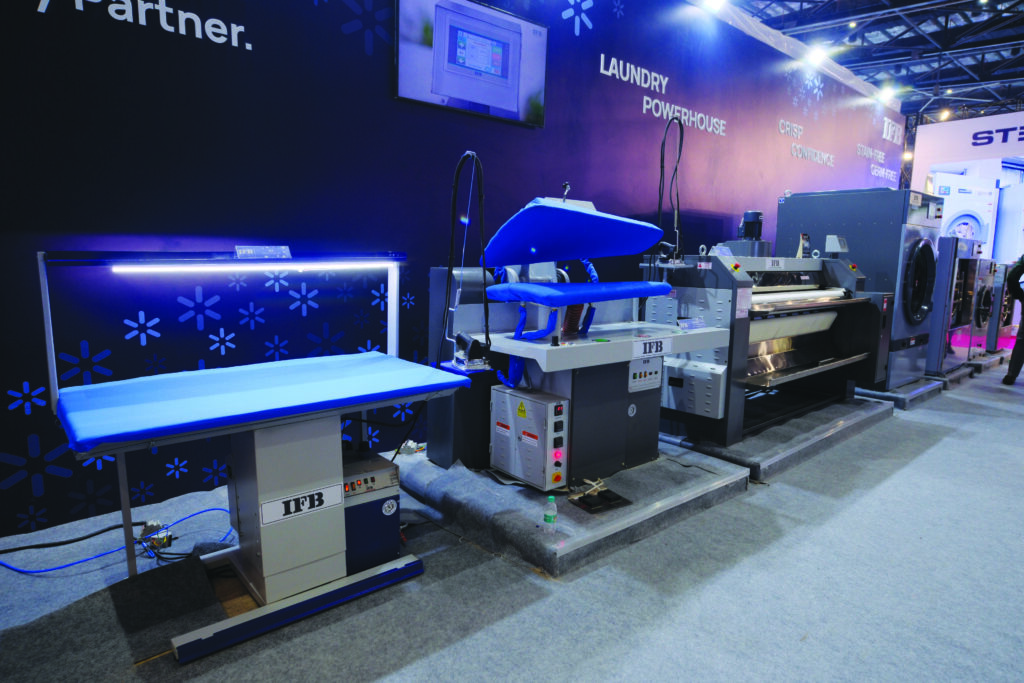
The exhibition also featured legacy engineering firms such as Stefab (Stefab India Ltd), whose decades of manufacturing experience continue to shape the backbone of India’s commercial laundry ecosystem.
One of the country’s oldest laundry equipment manufacturers, the company was founded in 1975 by Deepak Hora. Stefab began producing these machines domestically, building on an even earlier family background in the trade dating back to the 1960s.
Today, the company manufactures a wide range of equipment at its New Delhi facility, including washer-extractors, dryers, flatwork ironers, folders, stacker machines, spotting units and vacuum finishing tables.
According to the company, the most significant shift in recent years has been the Indian customer’s growing focus on quality, energy efficiency and long-term operating costs. “While price sensitivity remains, buyers increasingly evaluate technical specifications, water and power consumption, and overall return on investment,” said Zehen Arora, sales director at Stefab.
Marking Its Debut
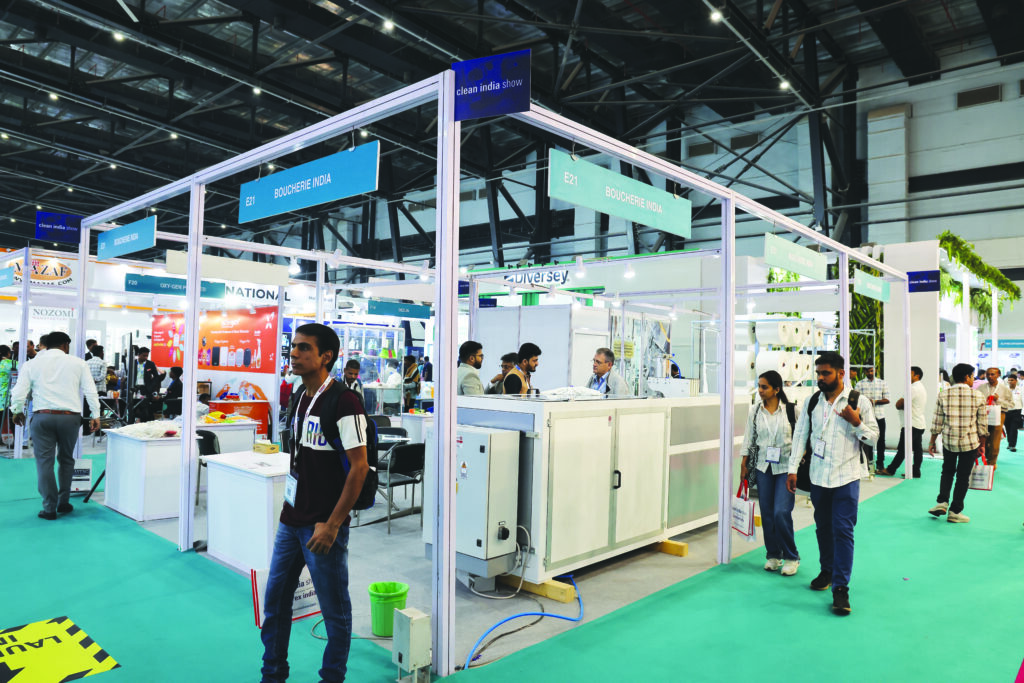
The show marked Boucherie (Machine Boucherie (I) Pvt. Ltd)’s first-ever participation in the country, introducing its non-woven and microfiber machinery to the Indian market. “This is our first exhibition in India,” said Sandro Monti, a representative of Italy-based Toscana Non Tessuti.
During the interaction, the representative shared that Boucherie has been exploring a new strategy for India. “We are looking at the possibility of forming a joint venture in India, discussions are underway,” he said.
The representative noted that there is a big opportunity for their machinery. “We have the technology; we just need to adjust according to what India needs. Even though India is a complex market with different languages and mentalities, the response from people has been encouraging,” he added.
He explained that their machinery segment includes components for nonwoven and microfiber production, and that India’s expanding manufacturing ecosystem makes it a promising destination.
Describing the three-day exhibition as very high in terms of engagement, the company representatives said they got a chance to interact with high-quality people who showed serious interest in raw materials as well as machinery. “Visitors were technically knowledgeable and understood the quality differences among machines. They were prepared to discuss new technologies and evaluate them,” he added.
The representatives informed that the company has been a regular participant in cleaning exhibitions in Europe and the USA, and chose Clean India Show because of India’s evolving market potential. “We decided to come to this expo because we see a good opportunity here. India has changed very fast—in mentality and in economy—making it an attractive market for us,” they added.
Two Decades Strong
Bengaluru-based Charnock Equipments Pvt. Ltd stood out as one of Clean India Show’s longest-standing participants. Associated with the exhibition right from the very first edition, the company showcased its latest innovations and expanding solutions portfolio this year.
The company launched two new machines – a Wide Area Carpet Vacuum machine and a low-height single disc machine. “The carpet vacuum machine is a unique solution designed for large carpeted areas; it covers about 8000 to 10,000 square feet per hour. The single disc machine has been developed specifically for railway coaches and interior cleaning applications, the low-height design allows it to reach tight spaces where conventional machines cannot operate. Both products have already been supplied to several customers in India,” informed Vedant Matta, Director – sales at the company.
The company has been continuously adapting to shifting industry dynamics. “We customise products based on specific client requirements and broader market needs, ensuring relevance in a rapidly evolving sector. We are growing at a healthy pace, and we aim to achieve 3X growth in the next five years,” Matta added.
Five New Made-in-India Machines
Long before ‘Make in India’ became a national mission, Punjab-based Cosmic Healers Private Limited had already made it a practice. The company, which has been developing and manufacturing indigenous cleaning machines for years, emphasised this legacy at the Clean India Show 2025, where it presented its battery-operated machines built specifically for local needs.
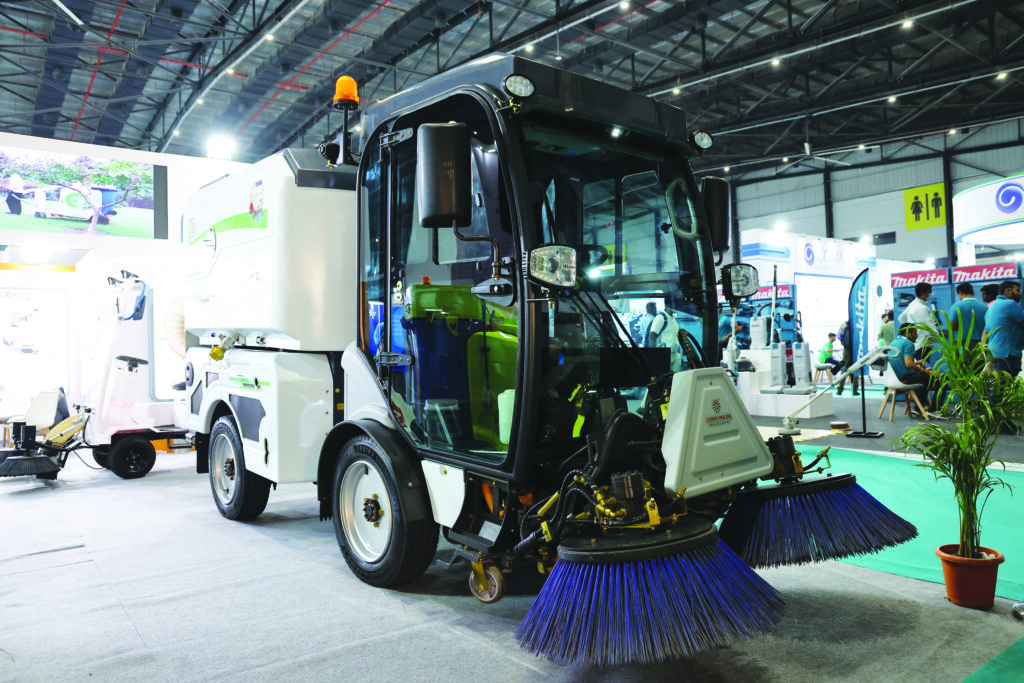
The firm showcased its flagship litter-picker ‘Gobbler’ which has a ride-on and walk-along versions. The clear showstopper of the stall, Gobbler is described by the company as ‘India’s first indigenously manufactured battery-operated litter picker’ with a high-power suction mechanism and an inbuilt water tank and filtration system. “It is designed to collect everything from disposable cups and cigarette butts to leaves and plastic wrappers and can hold 240 litres of waste; the Gobbler Pro (ride-on) variant is built for longer coverage, and it can cover large areas in a single shift,” informed the company representatives.
Other innovations that were on display was a multi-utility scooter ‘Moppy’ – a three-wheeled, ride-on electric mopping scooter with interchangeable attachments for dry mop, wiper and brush. With up to 8-hour runtime and a 4-hour charge time, Moppy is best-suited for airports, malls, hospitals and large campuses where silent, efficient floor cleaning is required.
The company officials also highlighted another battery-operated water-jetting machine ‘Volley’, which has a 500-litre water tank, high-pressure jetting capability and a quoted runtime of 4–6 hours per charge.
According to Tarandeep Singh, vice president, client services at Cosmic Healers, the development of battery-operated machines began well before the rise of modern EV vehicles. “The concept, manufacturing and design have been refined over many years, and today the company has deployed more than 300–350 machines across various regions. These machines are already in use by several municipal bodies including Navi Mumbai Municipal Corporation and Pune Corporation,” said Singh.
Singh highlighted that the batteries are fully manufactured in India. “Unlike older EV technologies, these are maintenance-free batteries which are easily available,” he added.