




























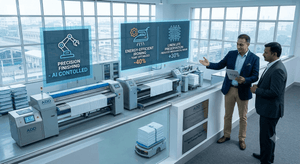








Predictive Maintenance: How Smart Factories Prevent Breakdowns

Predictive maintenance is transforming industrial facility management, shifting the focus from reactive repairs to proactive equipment monitoring. In conversation with Clean India Journal, Monel Desai, Head Administration, Zydus Lifesciences Limited, discusses how automation, AI and connected technologies are reshaping industrial operations and what organisations and service providers should prepare for in the future.
A decade ago, most facility management teams measured success by how quickly they could respond when something went wrong. A chiller breakdown, compressor failure, electrical fault or housekeeping issue would trigger a series of activities aimed at restoring normal operations as quickly as possible.

Today, however, leading manufacturers are asking a different question: What if these problems could be prevented before they occur?
Powered by sensors, data analytics, artificial intelligence (AI) and connected systems, a new generation of smart factories is emerging. These facilities can monitor their own operational health, identify potential risks and alert maintenance teams before disruptions occur. This shift towards predictive maintenance is changing how industrial facilities manage equipment, resources and daily operations.
Predictive Maintenance: From Reactive to Proactive Maintenance
For many years, industrial maintenance followed two primary approaches. The first was reactive maintenance, where equipment was repaired only after a failure. The second was preventive maintenance, where machinery was serviced at fixed intervals, regardless of its actual operating condition.
Although preventive maintenance was a significant improvement, it often resulted in unnecessary interventions and wasted resources. Equipment functioning perfectly well would undergo servicing simply because a scheduled maintenance date had arrived.
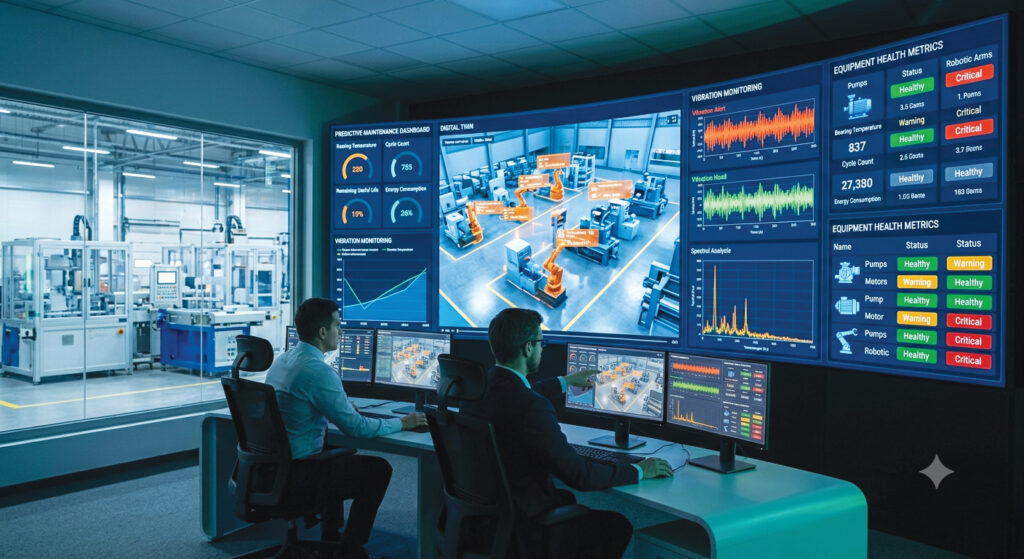
Predictive maintenance changes this approach. Sensors installed on motors, pumps, chillers, conveyors and utility systems continuously monitor parameters such as vibration, temperature, pressure, energy consumption and operating patterns.
When these systems detect unusual variations, maintenance teams receive alerts well before a potential breakdown. This allows organisations to schedule repairs based on actual equipment conditions rather than fixed timelines, reducing downtime and improving asset performance.
How Data and Analytics Prevent Equipment Failures
A well-known example of predictive maintenance comes from the aviation industry. Modern aircraft engines are equipped with thousands of sensors that continuously transmit operational data. Airlines can identify component deterioration before an aircraft even lands, allowing maintenance teams to prepare replacement parts in advance.
The same principle is increasingly being adopted in manufacturing facilities.
For instance, a facility monitoring its air-compressor network may detect subtle pressure variations that indicate an emerging leak. Instead of waiting for production performance to deteriorate, maintenance teams can resolve the issue proactively.
Similarly, vibration monitoring can identify bearing wear in rotating machinery weeks before a complete failure occurs. By analysing equipment performance data, organisations can make informed maintenance decisions, minimise unexpected breakdowns and improve operational continuity.
“One of the lesser-discussed but highly impactful developments in facility management is sensor-based cleaning”— Monel Desai, Head Administration, Zydus Lifesciences Limited
Smart Factory Technology and Real-Time Monitoring
Modern factories are becoming increasingly connected. Traditionally, facility managers depended on physical inspections and periodic reports to understand operational performance. Today, digital dashboards provide real-time visibility into activities across an entire industrial site.
Facility managers can monitor utility consumption, HVAC performance, water usage, equipment health, energy efficiency indicators, maintenance status and safety alerts through integrated digital systems.
This level of visibility is particularly valuable in large manufacturing campuses, where thousands of assets operate simultaneously.
By combining smart factory technology with predictive maintenance systems, organisations can identify operational inefficiencies, monitor equipment conditions and take corrective action before minor issues develop into major disruptions.
Sensor-Based Cleaning: Making Facility Management Smarter
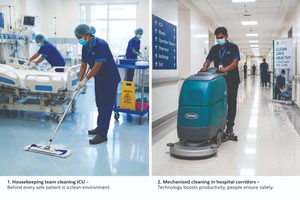
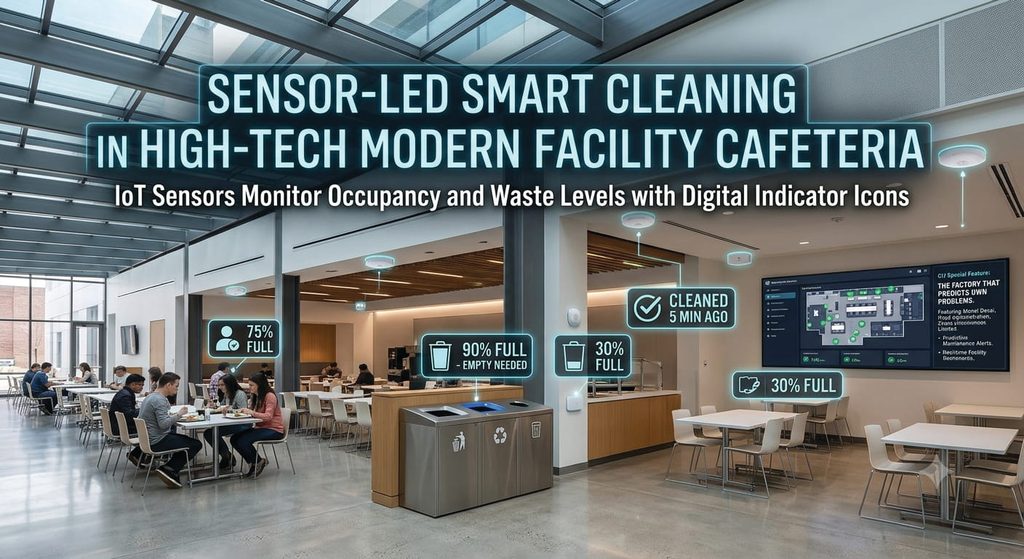
One of the lesser-discussed but highly impactful developments in facility management is sensor-based cleaning.
Many organisations still follow fixed cleaning schedules. Washrooms, cafeterias, corridors and common areas are serviced at predetermined intervals, whether they require attention or not.
However, leading airports, commercial buildings and industrial facilities are increasingly adopting smart cleaning systems that use occupancy and usage data.
Consider a manufacturing cafeteria that serves more than 1,000 employees daily. Instead of requiring housekeeping teams to follow rigid cleaning schedules, occupancy sensors can identify areas experiencing the highest footfall and indicate where cleaning is needed immediately.
Similarly, waste bins equipped with level sensors can alert housekeeping teams when they need emptying, eliminating unnecessary collection rounds.
The result is improved cleanliness, better resource utilisation and more efficient deployment of manpower. Rather than replacing people, technology enables employees to focus their efforts where they create the greatest value.
What Smart Factories Can Teach Facility Managers
Some of the world’s most advanced manufacturers have already demonstrated the potential of predictive technologies.
Manufacturers operating smart factories use connected equipment and digital twins to monitor operations in real time. These systems can simulate equipment performance, identify process deviations and recommend corrective actions before operational issues occur.
These developments highlight an important principle: the earlier a problem is detected, the lower its potential impact on business operations.
For industrial facility managers, the next step is to move beyond conventional maintenance practices and understand how automation, sensor-based monitoring and data analytics can improve operational efficiency.
As factories become increasingly intelligent, predictive maintenance will play a critical role in reducing equipment downtime, optimising resources and creating more efficient industrial environments.
The future of facility management will not simply be about responding to problems faster. It will be about identifying them before they happen.