









 CIJConnect Bot-enabled WhatsApp today at 4:00 PM.
India’s approach to waste management has undergone a structural transformation. Driven by stricter judicial oversight, national policy updates, and technological interventions, the country is shifting away from reactive dumping toward a enforced circular economy.
The defining developments shaping India’s waste management landscape highlight key reforms across policy, enforcement, urban engineering, and green market dynamics.

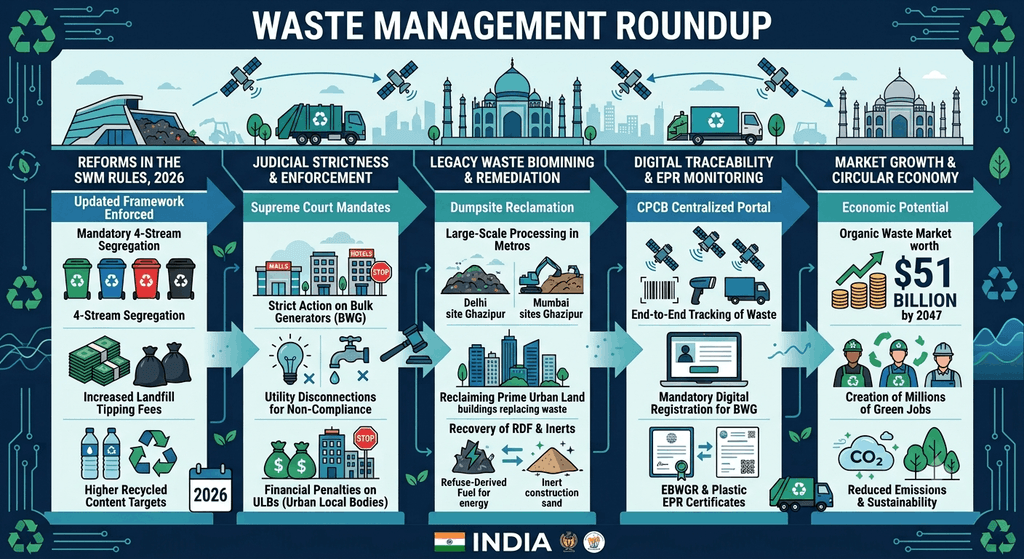
1. The Rollout of the Solid Waste Management Rules, 2026
Replacing the decade-old 2016 framework, the Union Ministry of Environment, Forest and Climate Change (MoEFCC) notified the Solid Waste Management (SWM) Rules, 2026.
• Mandatory 4-Stream Segregation: The national framework officially upgraded the traditional two-bin model into a mandatory four-stream segregation at source: Wet (organic), Dry (recyclable paper, plastic, metal), Sanitary (diapers, hygiene products), and Special Care (domestic hazardous items).
• Strict Restraints on Landfills: Landfills are now restricted to non-recyclable, non-energy recoverable, and inert materials. Higher landfill tipping fees are levied on urban local bodies (ULBs) for sending unsegregated waste to sanitary landfills to disincentivize dumping.
2. Supreme Court Mandates & Bulk Waste Generator (BWG) Accountability
The Supreme Court of India reinforced that access to a clean, unpolluted environment is a constitutional right under Article 21, shifting non-compliance from an administrative lapse to a serious legal infraction.
• Digital Traceability: Bulk Waste Generators — including large residential complexes, commercial malls, hotels, and IT parks — are required to process wet waste on-site or obtain Extended Bulk Waste Generator Responsibility (EBWGR) certificates.
• Polluter Pays Principle: The Apex Court directed the MoEFCC and the Central Pollution Control Board (CPCB) to establish a structured, transparent mechanism for environmental compensation. Local administrations and dedicated enforcement teams hold statutory powers to disconnect utility services (such as water and electricity) and levy severe financial penalties on non-compliant entities.
3. Accelerated Dumpsite Remediation & Biomining
India’s mega-cities are aggressively targeting legacy waste mounds:
• Reclaiming Urban Land: Across major dumpsites — such as Delhi’s Bhalswa, Okhla, and Ghazipur landfills — biomining operations have processed tens of millions of metric tonnes of legacy waste.
• Material Recycling: Refuse-Derived Fuel (RDF) recovered from legacy waste is being channeled into cement kilns and waste-to-energy plants, while fine soil and inerts are utilized for road sub-base construction, allowing cities to reclaim hundreds of acres of high-value municipal land.
4. Digital Oversight via CPCB Centralized Portal
To eliminate illegal dumping and data manipulation, the CPCB rolled out a unified Centralized Online Portal.
• Real-Time Tracking: The digital platform tracks every stage of the solid waste pipeline—from doorstep collection and Material Recovery Facility (MRF) sorting to transportation, landfill diversion, and biomining progress.
• Auditing & Compliance: All waste processors, ULBs, and BWGs must submit quarterly returns and third-party environmental audit reports directly through the portal.
5. Escalated EPR Frameworks & E-Waste Scaling
Extended Producer Responsibility (EPR) compliance has deepened across specialized waste streams:
• Plastic Waste: Plastic Waste Management Amendment Rules progressive targets mandate that brands and packaging manufacturers incorporate higher percentages of recycled plastic content in rigid and flexible packaging.
• Electronics & Data Centers: With India’s digital and AI infrastructure expanding rapidly, updated E-Waste targets require electronics manufacturers and cloud infrastructure operators to safely recycle up to 70% of end-of-life hardware through authorized recyclers. India’s waste management ecosystem is evolving from fragmented, informal collection into an integrated compliance economy. Fueled by stringent judicial mandates, digital governance, and resource recovery models, the nation is laying the operational groundwork for sustainable, zero-waste urban centers.