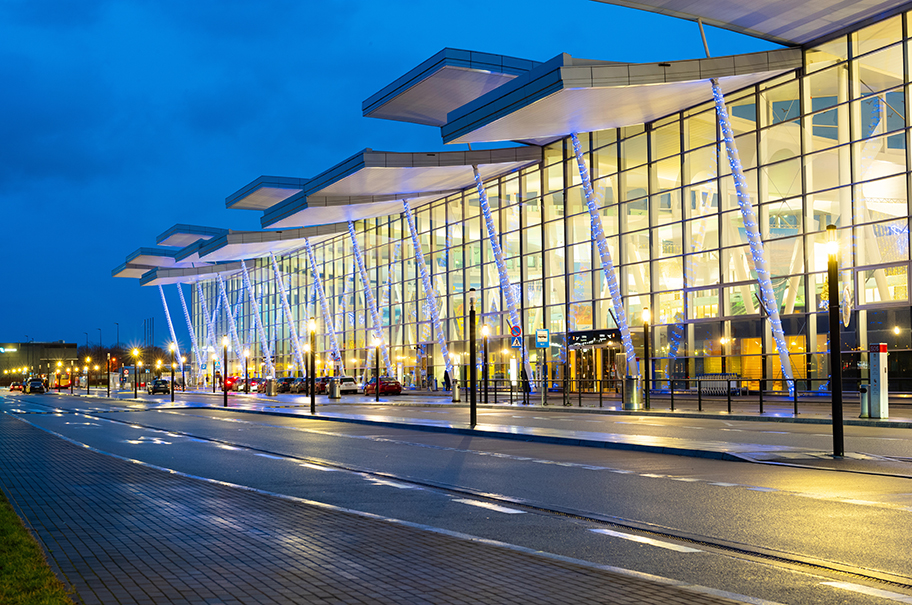
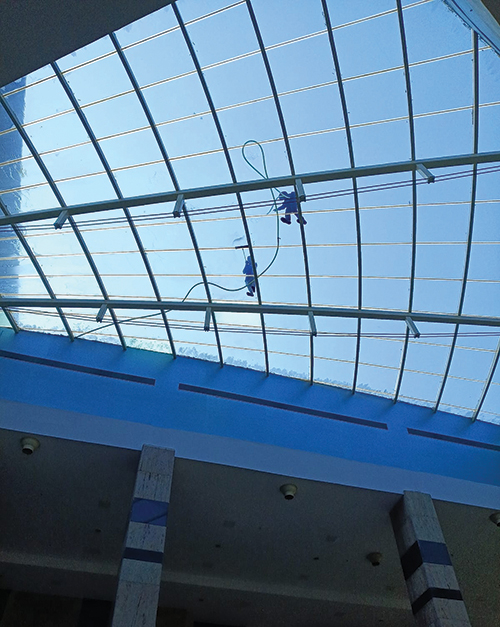
The glass facades of modern airports are not merely architectural statements and components that must withstand extreme heat, monsoon cycles and the unique chemical stresses of an airfield. Maneesha Mattas, CEO, PSM Facility Management shares with Clean India Journal, multiple facets for successful façade cleaning in airports.
The number of operational airports in India has surged to 164 as of early 2026. More than 1.2 million square metres of glass and ACP (Aluminium Composite Panel) surfaces are currently under maintenance across the country.
The environmental toll on these structures is significant. Statistics indicate that untreated glass in high-pollution zones can lose up to 20% of its light transmission over five years due to the “pitting” effect. In an airport environment, this is exacerbated by jet engine exhaust. Aviation fuel combustion releases nitrogen oxide and sulphur dioxide that, when combined with moisture, form a persistent, corrosive film. With major Indian terminals often featuring over 50,000sqm of glazing, the maintenance demand is massive.
Mindset of Precision
Façade maintenance requires a specialised mindset. In aviation infrastructure, every operational activity has a direct bearing on safety and institutional reputation.
“Airport facade maintenance requires a fundamentally different mindset. It is not driven by speed or scale, but by precision, discipline and alignment with aviation protocols,” said Maneesha.
The professional ethos in a live aviation environment must be built upon a zero-disruption philosophy. This is critical because airports operate continuously with minimal tolerance for any interference. Execution schedules are carefully aligned with passenger movement patterns and airside sensitivity to ensure that operational continuity remains uncompromised.
“In environments where the margin for error is minimal, consistency, preparation and respect for process remain the most reliable indicators of professional excellence” – Maneesha Mattas
Specialised Training
Working at heights in a high-security aviation zone requires more than just technical skill. It requires psychological readiness and specific certifications. In India, the gold standard for these operatives is the IRATA (Industrial Rope Access Trade Association) certification.
Level 1: Basic rope access and functional safety under direct supervision
Level 2: At least 1,000 logged hours of experience, capable of complex rigging
Level 3: Supervisor level, taking complete responsibility for site safety and rescue-at-height procedures
“Personnel deployment is limited to trained and certified facade operatives with prior exposure to airport environments. Access protocols, confidentiality norms and behavioural standards are rigorously enforced,” she adds.
Security Clearance
Unlike commercial real estate, airport façade cleaning involves navigating the strict regulations of the Bureau of Civil Aviation Security (BCAS). Every technician must undergo thorough background verification to obtain an Airport Entry Permit (AEP), which includes police verification and mandatory AVSEC (Aviation Security) training.
“Technical skill alone is insufficient; understanding the operational rhythm of an airport is equally critical.”
Technical Rigour
Safety is another pillar where the industry follows rigorous Indian standards. Compliance is not optional; it is the baseline for every operation.
“Compliance with DGCA airside safety guidelines, along with individual airport operator SOPs and approved Method Statements, forms the baseline for execution,” said Maneesha.
Discipline Must
Sustainability is becoming a key metric. Modern façade management integrates controlled water usage and pH-neutral, biodegradable chemicals to prevent tarmac contamination. In airside zones, where aircraft taxi, a zero-spillage approach is strictly enforced. Inappropriate methods or chemicals can compromise long-term performance, making environmental responsibility a core part of the execution.
“Environmental responsibility is embedded into execution practices, through controlled water usage, biodegradable chemicals, and responsible waste handling,” said Maneesha.
Case Study
In tropical climates like India, airports such as Mumbai (Terminal 1C) and Delhi (Terminal 3) utilise advanced solar control glass to manage massive heat gain. These ‘selective’ coatings allow visible light in while reflecting infrared heat.
The Challenge: In tropical environments, high humidity and temperature variations (24°C to 45°C) can lead to surface corrosion if minerals from hard water are allowed to dry on the glass. Further, aviation carbon can chemically bond with these coatings, leading to a permanent hazy appearance if not cleaned with precision.
The Solution: Use of demineralised (DI) water with low TDS (Total Dissolved Solids) is mandatory to prevent salt deposits.
pH Neutrality: Strict use of pH-neutral agents to avoid etching the delicate low-E or solar-control layers.
Thermal Shock Prevention: Cleaning is strictly scheduled for night or early morning hours to avoid ‘thermal shock’, which occurs when cold water hits glass heated by the tropical sun.
Advanced Risk Assessment
Airports are sites with constantly changing variables. A site-specific Risk Assessment and Method Statement (RAMS) is central to façade operations. This document identifies hazards such as wind load impacts, aircraft movement interfaces and glass breakage risks. What distinguishes effective risk management is the clarity of control measures, escalation protocols and emergency preparedness.
“Clear communication structures are established with Airport Operations, Engineering, Safety and CISF teams. Daily toolbox talks and pre-job briefings ensure alignment, reinforce hazard awareness and clarify responsibilities before work commences,” opines Maneesha.
Pre-Shift Checklist
To ensure zero error, a rigorous daily protocol is followed before any technician ascends. This checklist acts as the final barrier against operational risk:
Wind Speed Monitoring: Works are suspended if speeds exceed 20 knots
PPE Verification: Inspection of full-body harnesses, double lanyards, and anti-slip footwear
Anchor Point Testing: Certification check for all fixed building anchors
Exclusion Zone Setup: Physical barricading of the drop zone to protect ground-level passengers
Tool Tethering: Ensuring every handheld tool is physically attached to the operative.
The process is as much about communication as it is about cleaning. Dedicated site supervisors oversee quality control, ensuring section-wise inspections for glass clarity and finish uniformity. As the Indian aviation sector continues to soar, the focus remains on the professional excellence of those behind the scenes.
Standard
Focus Area
Application in Airports
IS 3696
Safety Code for Scaffolds and Ladders
Stability for reaching lower-level façades.
IS 4130
Safety Code for Maintenance/Demolition
Protocols for heavy maintenance on building exteriors.
NBC 2016
National Building Code
Overarching framework for structural safety in India.