







Focus
The Robot Is Ready. Is India?
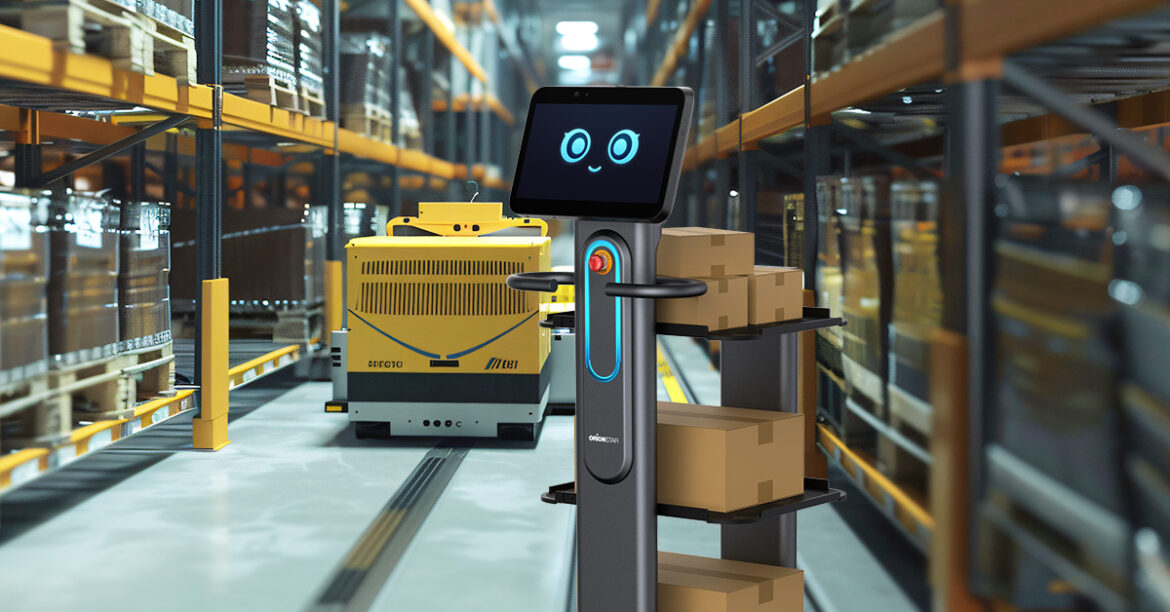
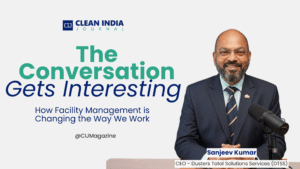
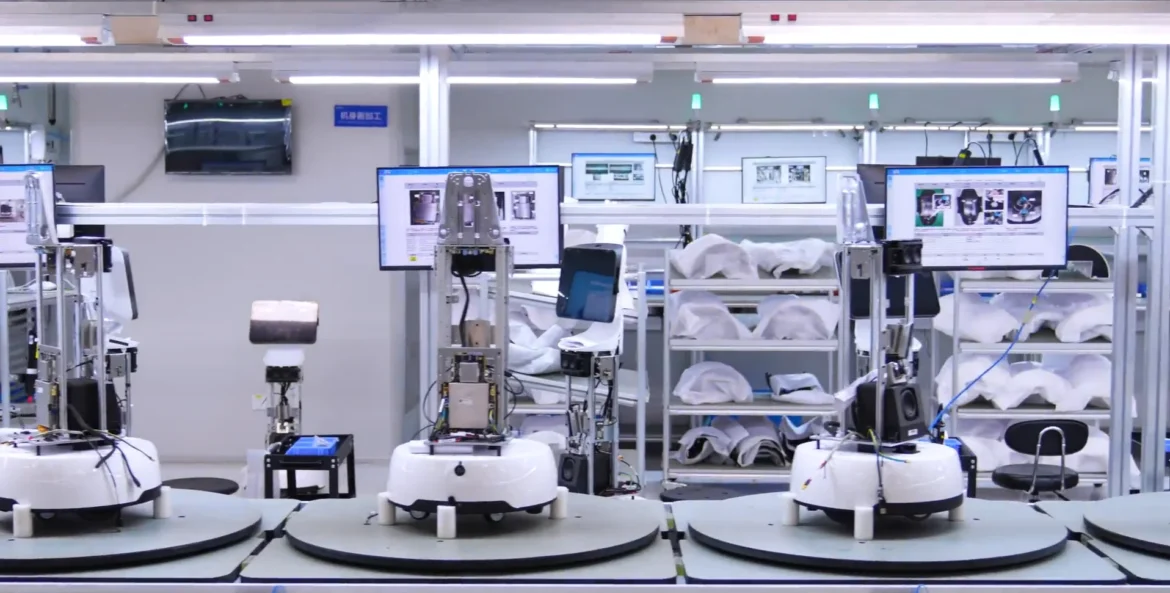
Industry experts Steven Yu, Divya Ramraika and Anil Sathe discussed how robotics, AI and automation are gradually reshaping India’s facility management and cleaning sectors, ...
Read More
 From Garbage to Governance
5 Jun 2026
From Garbage to Governance
5 Jun 2026
 Beyond Bins and Budgets: The Behaviour Shift India Can’t…
21 Mar 2026
Beyond Bins and Budgets: The Behaviour Shift India Can’t…
21 Mar 2026
 From Waste to Wealth: How Circular Economy Is Reframing…
20 Jan 2026
From Waste to Wealth: How Circular Economy Is Reframing…
20 Jan 2026
 Clean India 2030: Transforming Waste Management and Urban Sanitation
18 Dec 2025
Clean India 2030: Transforming Waste Management and Urban Sanitation
18 Dec 2025
 Mumbai Enforces Strictest Pollution Control Restrictions
17 Dec 2025
Mumbai Enforces Strictest Pollution Control Restrictions
17 Dec 2025
 The Future of Vehicle Cleaning and Detailing: Innovation and…
24 Nov 2025
The Future of Vehicle Cleaning and Detailing: Innovation and…
24 Nov 2025
 Cleaning, Hygiene & Maintenance for the Wellness Industry
24 Nov 2025
Cleaning, Hygiene & Maintenance for the Wellness Industry
24 Nov 2025
 Top 10 Cleaning and Facility Management Trends
24 Nov 2025
Top 10 Cleaning and Facility Management Trends
24 Nov 2025
 Inside India’s Drain Cleaning Crisis: What Must Change
21 Nov 2025
Inside India’s Drain Cleaning Crisis: What Must Change
21 Nov 2025
 Semiconductor Fabs: Can FM Cut Through The Sustainability Paradox?
21 Nov 2025
Semiconductor Fabs: Can FM Cut Through The Sustainability Paradox?
21 Nov 2025


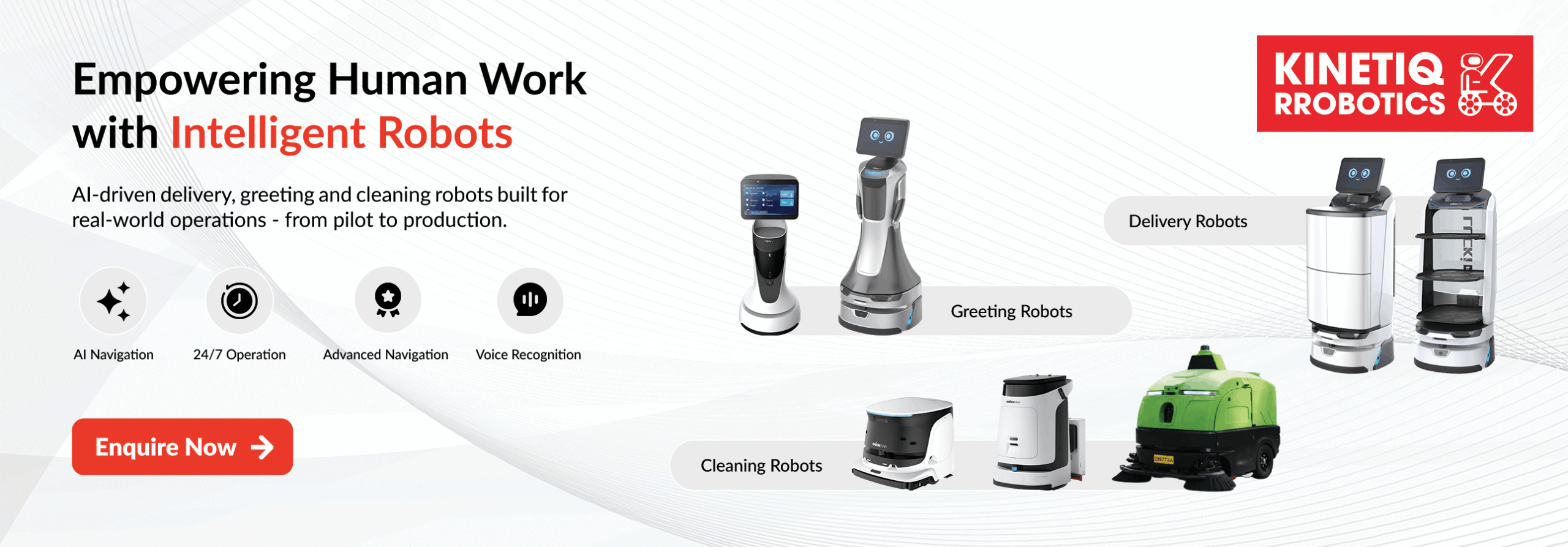
Kinetiq RRobotics is an AI-driven robotics company empowering human work with intelligent delivery, greeting and cleaning robots. Kinetiq is known for building autonomous robotic solutions designed for hospitals, hotels, airports and industrial environments. Our portfolio covers delivery robots, greeting robots, cleaning robots and customized AI-driven automation solutions.
Kinetiq RRobotics has been deploying real-world robotics solutions across the country, serving customer segments such as hospitals, hospitality, airports, industrial facilities and institutions — backed by proven case studies and proof-of-concept (POC) engagements.

A wide range of solutions across delivery robots, greeting robots, cleaning robots and customized automation systems.
Solutions that optimise human effort and resource use, supporting smarter and more efficient operations.
Backed by advanced AI and robotics engineering, built to empower human work through intelligent automation.
Robots engineered to perform reliably across demanding real-world operations in hospitals, hotels, airports and industry.
Autonomous systems built for productivity, reliability and consistent performance across complex operational environments.
Suitable for hospitals, hotels, airports, industrial facilities and institutions seeking intelligent automation.
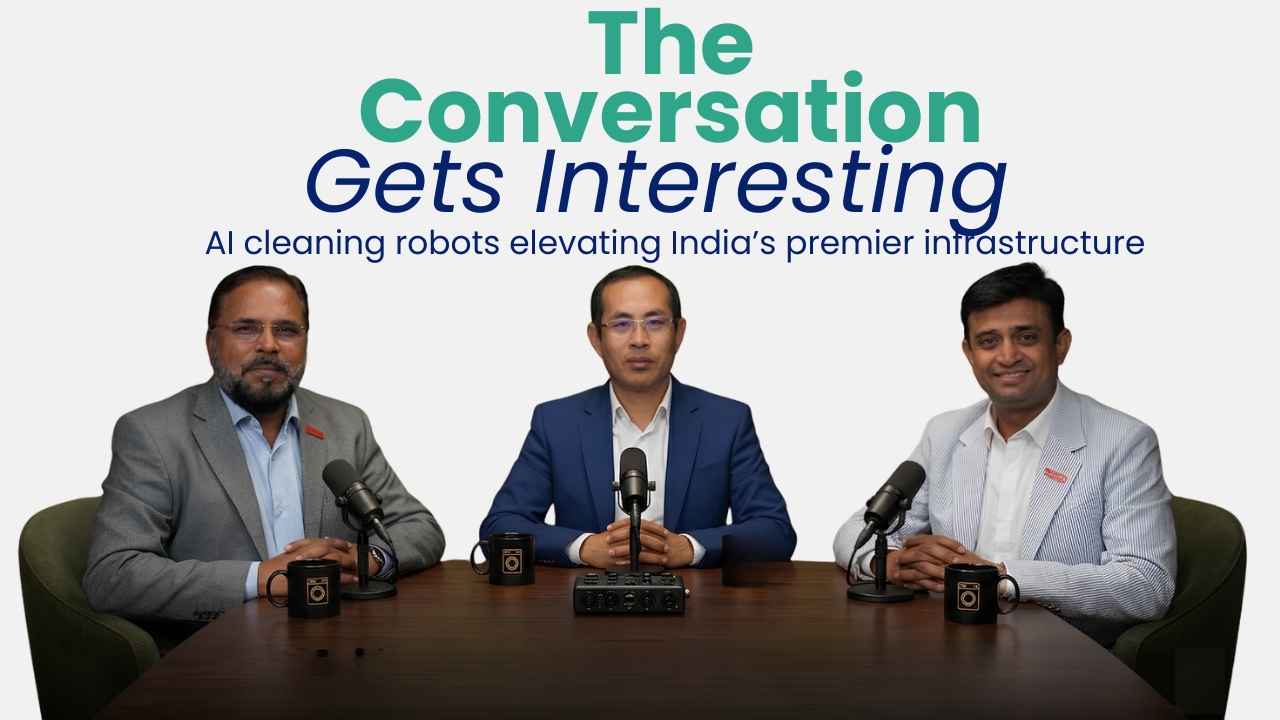
India’s robotics market is expanding rapidly and is projected to reach **$7.38 billion in the next few years**. But is India ready to adopt advanced technologies such as robotics, automation and artificial intelligence at scale? Why are international companies increasingly choosing India as a destination for expansion and manufacturing? And perhaps the biggest question of all: *Will robots replace human jobs in the future?* In this podcast, we explore the rapid growth of robotics and automation in India, the factors attracting global investment, and the evolving relationship between humans and machines. The discussion also provides valuable insights into cleaning robots—how they work, where they are being used, and the benefits they offer across industries such as manufacturing, healthcare, airports, malls, commercial buildings and facility management.
Watch Full VideoPartner with Kinetiq RRobotics for AI-driven delivery, greeting and cleaning robots — trusted across hospitals, hotels and airports for real-world results.
Book a Demo
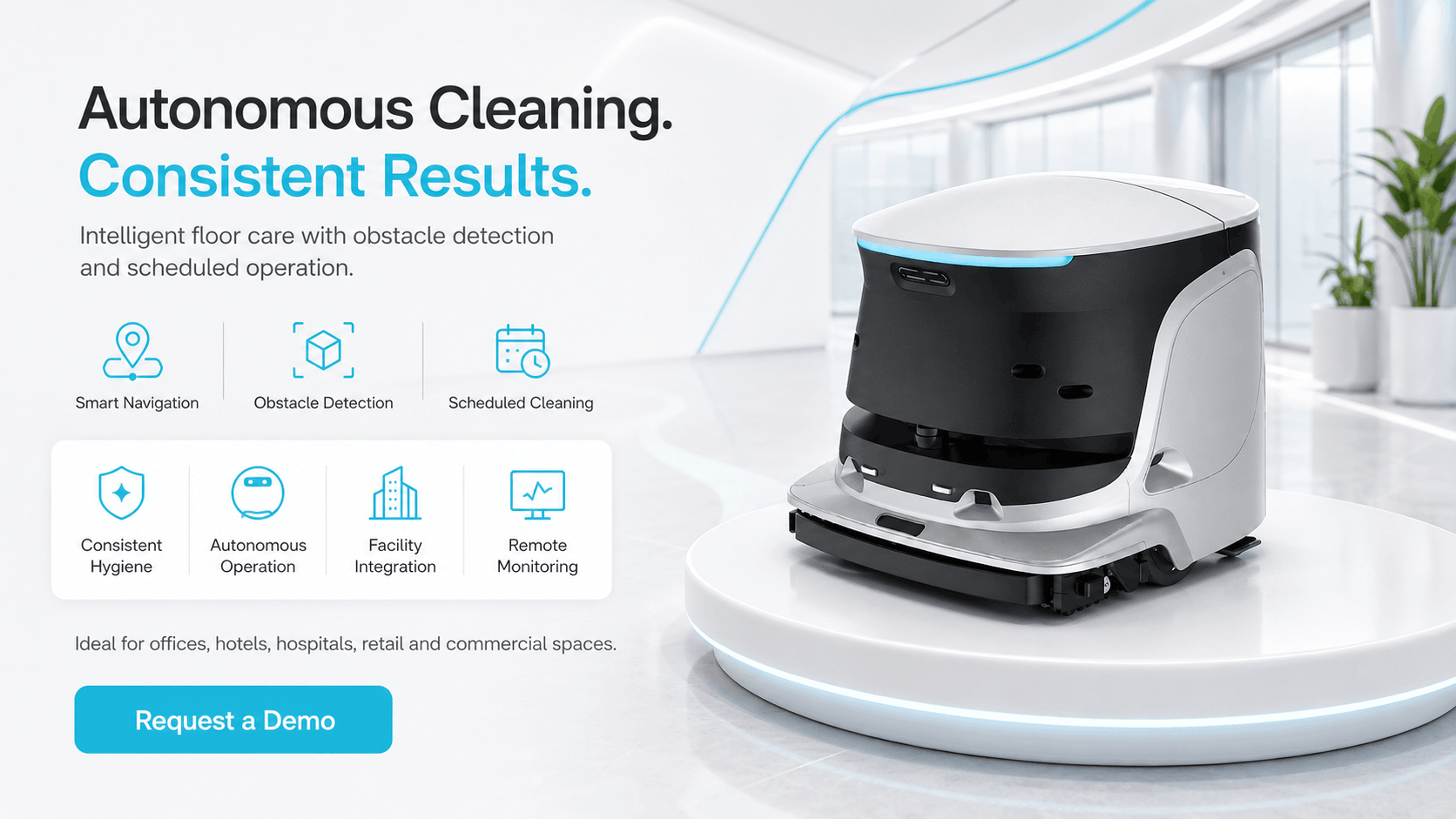
Autonomous cleaning, consistent results — intelligent floor care with obstacle detection and scheduled operation.
Maintaining a large floor traditionally takes a fleet: single-disc machines, vacuums, scrubber dryers, sweepers. The CleaniBot series handles those applications in a single unit. It maps the space in real time, detects dirt as it happens and responds with precise water and detergent dosing, so no area is skipped and spill zones get priority. Lithium-ion power with fast charging keeps it working, and every pass is logged.
Scrubbing, vacuuming and mopping in a single machine — and it can run dual operations, so a pass that would need two machines needs one. Less capital, less storage, less handover between operators.
Because dosing responds to detected dirt rather than running at a fixed rate, every drop is accounted for. On a large site that is millions of litres a year, and a smaller chemical invoice.
Manual cleaning misses spots and struggles to keep up with spills in a food court. The robot maps as it goes, so every square metre is cleaned to the same standard and high-traffic zones get extra priority.
Kinetiq RRobotics Pvt. Ltd builds custom robotic solutions for diverse facility needs, so configuration varies by deployment. Contact the team for a specification sheet matched to your site.
Conventional floor care is a plan applied to a building: this route, this often, this much detergent — regardless of what actually happened on the floor that day. The result is overlap in some places and missed spots in others, and no record of either. The CleaniBot series inverts that. It maps the space as it works, detects dirt as it happens, doses only what the situation needs, and documents every pass. Cleaning stops being a repetitive job performed without a plan and becomes a standardised, measurable process.
The robot maps accurately as it moves and detects soiling as it appears, responding autonomously rather than waiting for the next scheduled pass.
Predictive path planning lets it work safely alongside people during peak hours, and it cleans and dries wet areas systematically rather than reactively — which directly reduces slip-and-fall risk.
Real-time figures on water and detergent consumption, and a record of when every area was cleaned — feeding sustainability reporting and carbon tracking rather than sitting in a logbook.
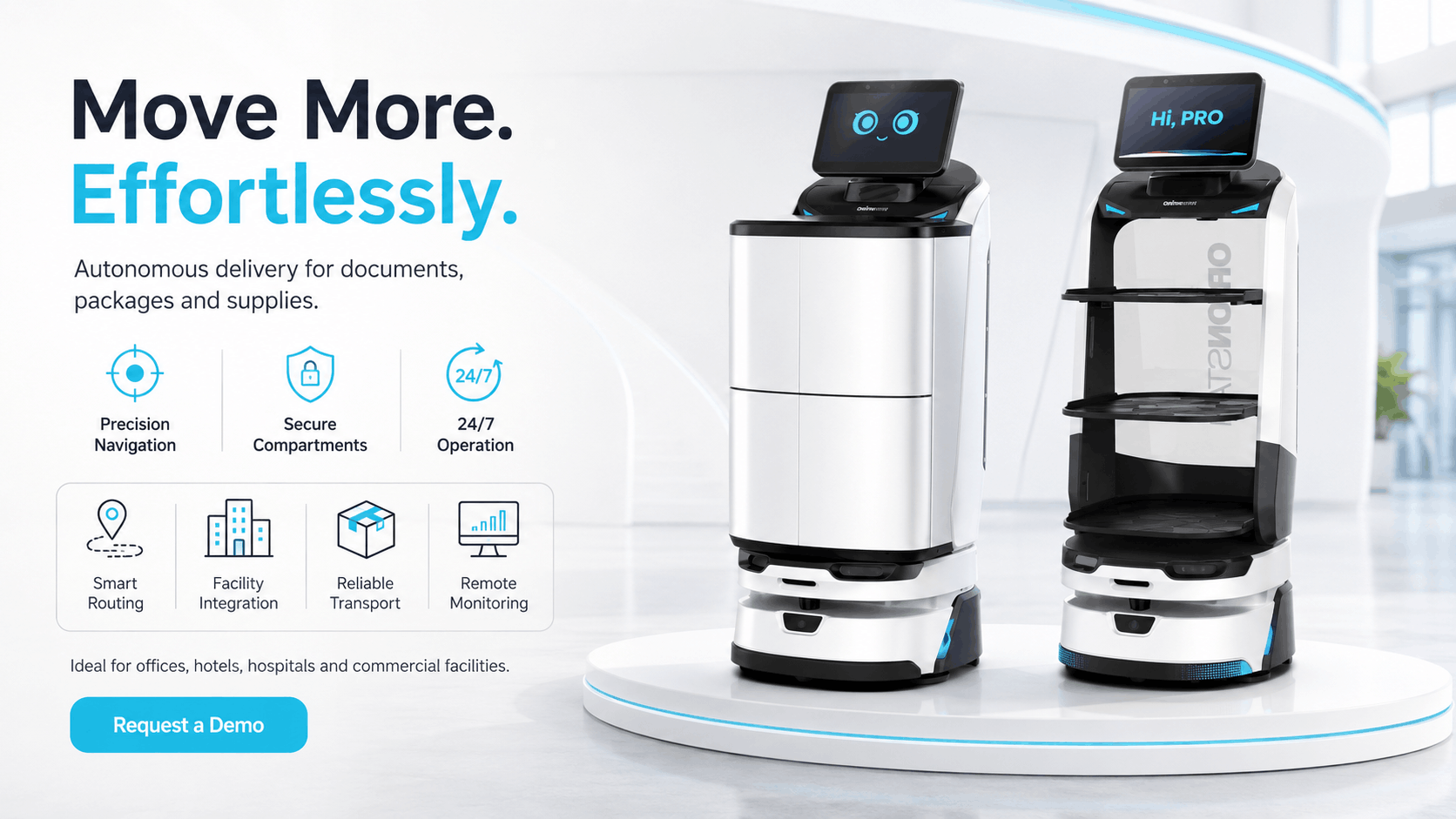
Autonomous transport of documents, packages and supplies throughout your facility, with precision navigation and secure compartments.
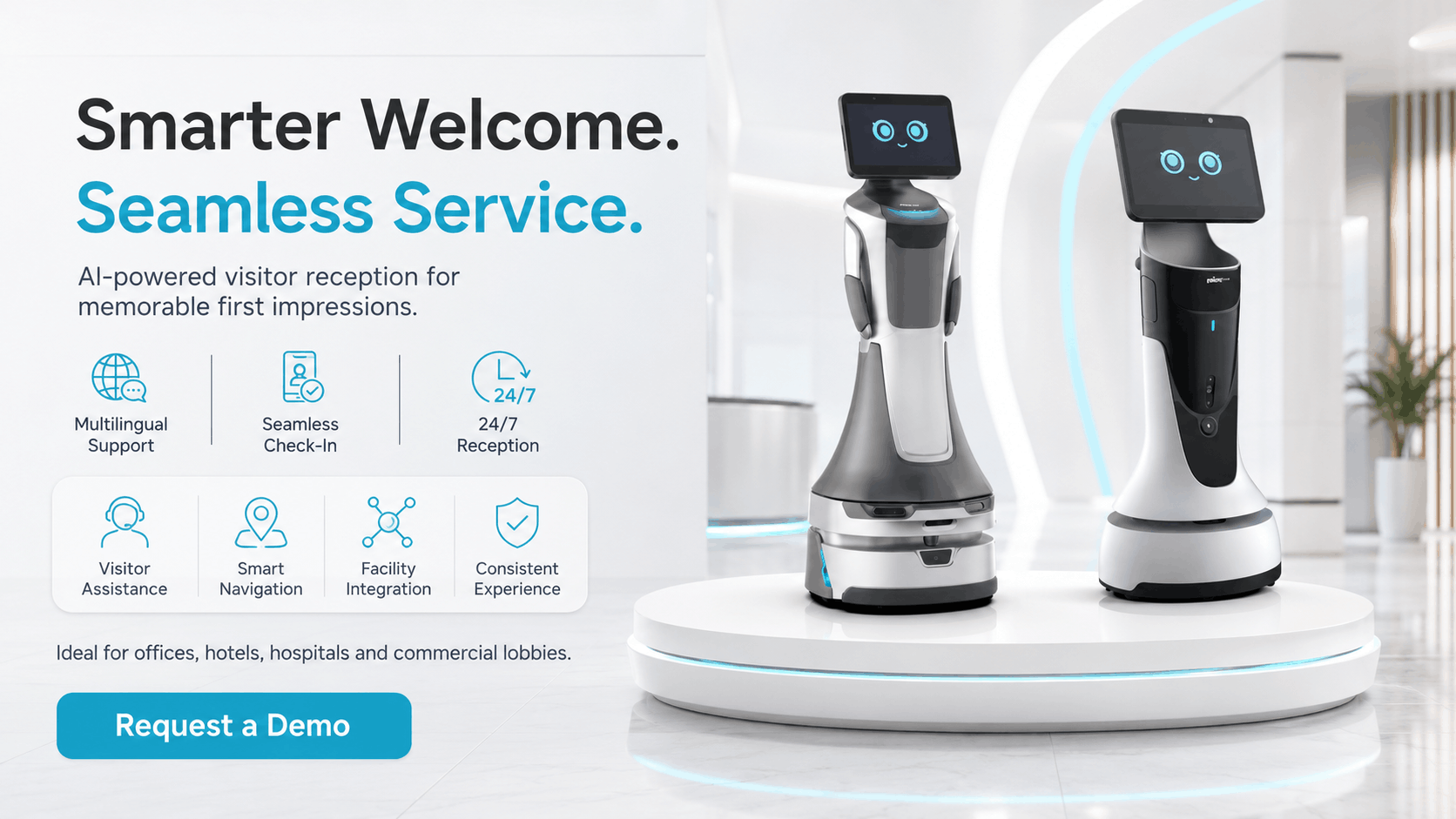
Explore the Range →Create memorable first impressions with AI-powered visitor reception, multilingual support and seamless check-in experiences.
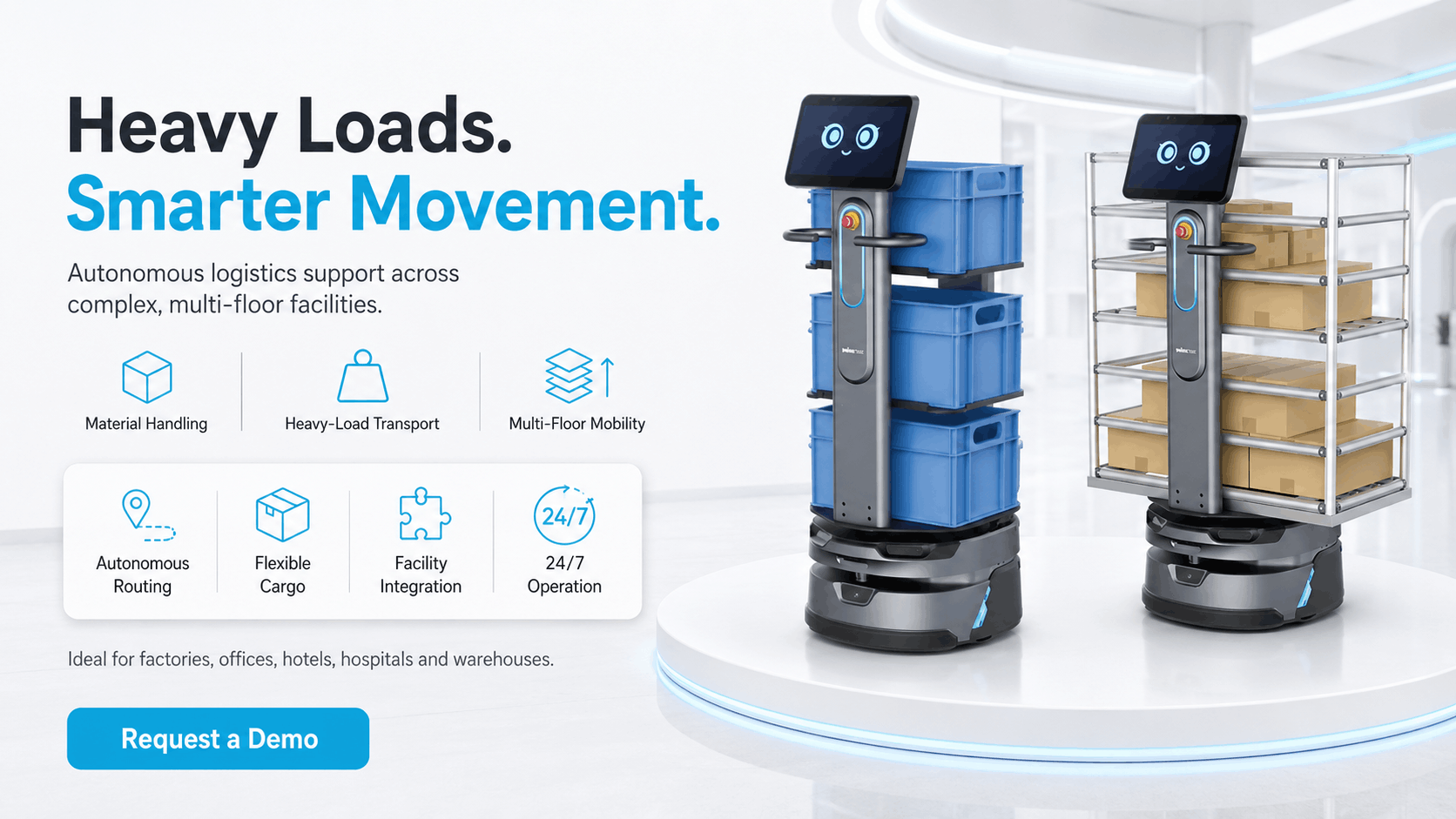
Explore the Range →Effortless material handling and logistics support, capable of transporting heavy loads across multiple floors and complex environments.
Explore the Range →For floor care, largely yes. The current standard on a large site is a combination of four or five products — single-disc machines, vacuums, scrubber dryers, sweepers. The CleaniBot series handles those applications in one unit, and can run dual operations such as scrubbing and vacuuming together.
What it does not replace is edge work, detailing and the judgement calls. Plan it as the machine that covers the open floor, freeing your team for everything else.
Kinetiq quotes approximately 3,500 to 4,000 m² per hour for a 30-litre unit. The lithium-ion battery supports fast charging, and a three-hour charge allows extensive operation.
Exact runtime depends on the model and the cleaning mode. Ask the team to confirm the figures for the unit that suits your floor area.
Kinetiq is careful here, and so are we. They describe the standard achieved as remarkably close to hospital grade but not strictly hospital grade, because the detergents used differ.
For corridors, lobbies, waiting areas and general circulation space in a healthcare setting, it delivers consistency that manual cleaning struggles to match. For clinical areas with specific disinfection protocols, discuss the requirement with the team rather than assuming coverage.
Yes — that is a deliberate design goal. LiDAR and 3D cameras give dynamic obstacle avoidance and predictive path planning, so the robot operates safely during peak hours rather than only at night.
It also cleans and dries wet areas systematically rather than reactively, which reduces slip-and-fall incidents — one of the most common liability risks in a high-footfall building.
By stopping the overlap. Conventional cleaning repeats a fixed route with a fixed dose regardless of what is actually on the floor. The robot detects dirt and applies only what that area needs.
Kinetiq describes this as the thumb rule for autonomous robot cleaning. On a large international terminal it translates to millions of litres saved annually, supporting ESG goals while lowering operating expenditure.
Different floor areas can be defined in the software, so the robot adapts its behaviour and accessories to the surface it is on.
It is fundamentally designed for flat floors. It can detect potholes and damaged flooring and navigate around them, but badly uneven ground is not its environment. Worth flagging your floor conditions early.
Every action is documented, creating audit-ready digital logs that help demonstrate compliance with standards such as ISO 41001 and ASQ cleanliness benchmarks — and feed sustainability and carbon reporting with real consumption data.
Start with a proof of concept. Kinetiq has run POC deployments across sectors and offers flexible models including pay-as-you-use and Robotics-as-a-Service. Use the Request a demo button to arrange one.
Heavy loads, smarter movement — autonomous logistics support across complex, multi-floor facilities.
An autonomous robot built for the physical jobs that quietly consume a shift: moving crates, stock, supplies and waste from one end of a building to the other. It carries heavy loads across multiple floors and complex environments, routes itself around obstacles, and takes flexible cargo — open shelving, crates or trolleys — depending on what you need to move. Every trip it makes is a trolley run a person does not have to make.
Built to carry meaningful weight rather than parcels — stock, catering supplies, maintenance kits, crates. This is the machine for the loads a person would otherwise push on a trolley.
Designed to work across multiple floors and complex layouts, so a delivery to the fourth floor does not need a person to accompany it in the lift.
Open shelving, crates or containers — the load configuration adapts to what you actually move, rather than forcing your goods into a fixed compartment.
Kinetiq points to thousands of manual trolley trips removed per day in large sites — which directly reduces musculoskeletal injuries and manpower attrition, two of the biggest hidden costs in facility logistics.
Kinetiq RRobotics Pvt. Ltd builds custom robotic solutions for diverse facility needs, so configuration varies by deployment. Contact the team for a specification sheet matched to your site.
Moving waste from one end of a terminal to the disposal point is a real job that nobody lists on a job description. So is walking duty-free stock to a shop, or catering supplies to a gate, or a maintenance kit three floors up. Individually they are trivial. Across a large site they add up to thousands of manual trolley trips a day — and to two costs that rarely appear in a budget line: musculoskeletal injuries and manpower attrition. The Porter Robot exists to absorb precisely this category of work.
The robot can move shop to shop collecting waste and take it to the disposal point without manual intervention — one of the least visible and most physically punishing jobs on any large site.
It plans its own path and reroutes around obstructions rather than stopping — necessary in a working building where corridors are full of people, trolleys and stacked deliveries.
The robot can accompany an operator along a route, carrying the load while the person does the task — useful where the job needs judgement but the weight does not need a human back.
Autonomous transport of documents, packages and supplies throughout your facility, with precision navigation and secure compartments.
Explore the Range →Create memorable first impressions with AI-powered visitor reception, multilingual support and seamless check-in experiences.
Explore the Range →Maintain impeccable hygiene standards with intelligent floor cleaning, obstacle detection and scheduled autonomous operation.
Explore the Range →Weight and cargo. The Delivery Robot carries documents, packages and supplies in secure enclosed compartments — it is built for items that need to arrive sealed.
The Porter Robot is built for heavy loads on flexible cargo — open shelving, crates, containers. If the job is currently done with a trolley, this is the machine. If it is currently done by hand-carrying an envelope, that is the Delivery Robot.
It is specified for heavy loads across multiple floors and complex environments, and Kinetiq builds custom configurations for specific facility needs.
Maximum payload depends on the configuration supplied. Tell the team what you actually move — crate weight, trolley loads, stock volumes — and they can confirm what fits.
Multi-floor operation is part of what this robot is designed for. In practice it depends on your lifts: whether they can be integrated, and whether access control allows a robot to call and ride one.
This is worth resolving early rather than late. Share your building setup and Kinetiq can confirm what is possible before you commit to anything.
The physical, repetitive ones. Kinetiq's airport deployments cover waste collection shop to shop and delivery to the disposal point, duty-free and retail stock movement, catering supplies, and maintenance kit delivery.
In a hospital, hotel or factory the equivalents are linen and supply runs, stores to department transfers, and waste consolidation. All of it currently done on a trolley by someone walking.
Two costs that rarely appear as a line item: musculoskeletal injuries and manpower attrition. Kinetiq describes both as major hidden cost drivers in facility logistics, and removing thousands of manual trolley trips a day addresses both directly.
Add to that the fact that most facility management teams already run at 80 to 85 per cent of the headcount they need. The robot does not remove people you have — it covers work you are currently short-staffed for.
It navigates on onboard sensors, LiDAR and cameras — not internet commands. Kinetiq call the belief that robots stop without Wi-Fi the single biggest myth in the category. Connectivity gives you remote monitoring, not movement.
When something blocks its path it detects the obstruction, takes another route and continues, rather than parking until a person moves it.
Start with a proof of concept on your own floor. Kinetiq has run POC deployments across sectors, and offers flexible commercial models — pay-as-you-use and Robotics-as-a-Service — rather than capital purchase only.
Use the Request a demo button to arrange one. For a logistics robot especially, a fortnight on your real routes answers more than any specification sheet.
Smarter welcome, seamless service — AI-powered visitor reception for memorable first impressions.
An AI-driven reception robot that greets visitors, answers their questions in their own language, and walks them to where they need to go. Voice recognition is quick and fluid, the screen responds in multiple languages, and the robot can lead a visitor directly to a meeting room, a counter or a table using its Follow Me function. It takes the repetitive half of front-desk work — directions, wayfinding, first contact — so your reception team can handle the half that genuinely needs a person.
Language is the most common barrier at a reception desk. The robot recognises speech quickly and responds on screen and aloud in multiple languages, so a visitor gets an answer instead of a gesture.
Visitor registration handled at the point of arrival rather than in a queue, giving a consistent record of who came in and when — without a person transcribing it.
Rather than describing a route, the robot plans the optimal path and physically leads the visitor to the meeting room, gate, counter or table. Nobody gets lost following a robot.
Kinetiq RRobotics Pvt. Ltd builds custom robotic solutions for diverse facility needs, so configuration varies by deployment. Contact the team for a specification sheet matched to your site.
A reception desk is judged on its worst moment, not its average one — the queue at check-in, the visitor whose language nobody speaks, the 2am arrival. Those are exactly the moments a robot handles identically every time. Kinetiq's greeting units launched at Clean India Show 2025 greeting visitors with a cheerful hello, screens lighting up with multilingual responses and voice recognition quick enough to hold a real exchange. The point is not novelty: it is removing the pressure from human information desks so staff can deal with the situations that actually need them.
Quick enough to feel like a conversation rather than a kiosk, with responses appearing on screen as well as spoken — so it works for a visitor who would rather read than listen.
The robot plans an optimal route and walks the visitor to their destination — a boarding gate, a lounge, a meeting room or a restaurant table — instead of pointing down a corridor.
The same unit can collect crowd density and air quality data as it moves, feeding building systems with information about how the space is actually being used.
Autonomous transport of documents, packages and supplies throughout your facility, with precision navigation and secure compartments.
Explore the Range →Effortless material handling and logistics support, capable of transporting heavy loads across multiple floors and complex environments.
Explore the Range →Maintain impeccable hygiene standards with intelligent floor cleaning, obstacle detection and scheduled autonomous operation.
Explore the Range →The robot is multilingual and responds in real time, both on screen and aloud. Kinetiq positions this specifically at language barriers in travel and hospitality, where a visitor and a front desk often have no shared language.
The exact language list depends on configuration — ask the team to confirm the set for your site before you commit.
The units can be integrated with platforms such as ChatGPT, which is what allows open-ended questions — real-time flight information, directions to a washroom or smoking zone, even local tourism tips — rather than a fixed menu tree.
Kinetiq describe this as an integration the robots can support, so treat it as a configuration option to specify rather than something present by default.
It takes them. The Follow Me function has the robot plan the optimal route and lead the visitor directly to their destination — a boarding gate, a lounge, a meeting room, or in restaurant settings, their table.
This is the difference that matters in a large building. Directions get forgotten twenty metres later; being walked there does not.
Not to navigate. Like all Kinetiq robots it is an Autonomous Mobile Robot — it moves using onboard sensors, LiDAR and cameras, not internet commands. Kinetiq call the belief that robots stop without Wi-Fi the single biggest myth in the category.
Connectivity is needed for the parts that genuinely are online: live information lookups, integrations and remote monitoring.
Kinetiq's stated philosophy is to amplify human capability. In practice the robot absorbs the repetitive share of front-desk work — directions, first contact, check-in, wayfinding — which reduces pressure on human information desks rather than removing them.
The judgement calls, the difficult visitor, the situation that does not fit a script: those still need a person, and that person now has time for them.
Kinetiq points to measurable outcomes in airport deployments: sites using digital wayfinding and interactive service robots have reported higher retail dwell time and improved satisfaction scores, both of which correlate with commercial revenue.
In a hotel or office lobby the equivalent is a consistent arrival experience and a front desk that is not queueing — plus a reliable record of who checked in and when.
Expect attention. Across Kinetiq's proof-of-concept deployments the first hour is reliably chaotic — crowds, phones, photographs — before the robot settles into being a normal part of the space.
Start with a POC. Kinetiq also offers flexible models such as pay-as-you-use and Robotics-as-a-Service rather than capital purchase only. Use the Request a demo button to arrange one.
Move more. Effortlessly. Autonomous delivery for documents, packages and supplies.
An AI-driven service robot that transports documents, packages and supplies across your facility on its own — navigating precisely, carrying items in secure compartments, and running around the clock with remote monitoring. It integrates with existing facility infrastructure rather than requiring you to rebuild around it, and it exists to take the repetitive trips off your team so they can spend their time where judgement and a human touch actually matter.
LiDAR and 3D cameras map the space continuously, so the robot plans its own route and holds it accurately — in corridors that are rarely empty and layouts that rarely stay still.
Items travel enclosed rather than on an open tray, which is what makes the robot usable for documents, pharmacy items and anything that should not be picked up in transit.
It works the night shift and the lunch rush equally, and every run is visible remotely — so the question "was that delivered?" has a logged answer rather than a phone call.
Kinetiq RRobotics Pvt. Ltd builds custom robotic solutions for diverse facility needs, so configuration varies by deployment. Contact the team for a specification sheet matched to your site.
Most facility management teams in India run at 80 to 85 per cent of the headcount they actually need. That gap does not show up as unfilled roles — it shows up as fatigue, and as the small repetitive jobs that get postponed. Ferrying a file to the third floor, running supplies to a ward, moving a package from reception: individually trivial, collectively a significant share of a shift. The delivery robot exists to absorb exactly those, which is why Kinetiq describe the goal as amplifying human capability rather than replacing it.
The robot scans and interprets its surroundings continuously, detecting people, trolleys, chairs and walls, then adjusting its path before it reaches them rather than after.
Blocked corridors are normal, not exceptional. When something is in the way the robot takes another route and carries on, rather than parking until a human intervenes.
Remote monitoring turns delivery from something people remember into something the system records — what moved, when, and on which route. Quantified operations rather than anecdotal ones.
Create memorable first impressions with AI-powered visitor reception, multilingual support and seamless check-in experiences.
Explore the Range →Effortless material handling and logistics support, capable of transporting heavy loads across multiple floors and complex environments.
Explore the Range →Maintain impeccable hygiene standards with intelligent floor cleaning, obstacle detection and scheduled autonomous operation.
Explore the Range →No, and Kinetiq call this the single biggest myth about robots in facilities. This is an Autonomous Mobile Robot — it navigates using onboard sensors, not internet commands.
Connectivity is what gives you remote monitoring and reporting. It is not what makes the robot move.
Documents, packages and supplies, in secure enclosed compartments. At Clean India Show 2025 the delivery units ran with tray shelves carrying cups, chips and chocolates through a crowded hall.
In practice the useful cases are the repetitive ones: files between floors, pharmacy and supply runs, amenities to guest rooms, stock from a back store to a counter. Exact payload capacity depends on configuration — the team can confirm for your use case.
It reroutes. LiDAR and 3D cameras detect people, trolleys, chairs and walls, and the robot takes a detour and continues rather than stopping until someone moves.
That matters more in India than the specification suggests, because crowded corridors and shifting layouts are the normal operating condition, not the edge case.
Yes, at first — and Kinetiq are refreshingly direct about it. Across roughly 20 to 25 proof-of-concept deployments, the first hour is reliably chaotic: crowds gather, phones come out, everyone wants a photograph.
It settles. Once the novelty passes the robot becomes part of the furniture and gets on with the job. Some sites help this along with simple signage and a short briefing to staff.
Kinetiq's stated philosophy is to amplify human capability, and the operational reality supports it: most facility management teams already run at 80 to 85 per cent of required headcount.
The robot absorbs repetitive, low-value trips so the existing team can spend time on work that needs judgement and a human presence. Deployments also tend to create new roles — robot supervisors, fleet managers, automation coordinators — rather than remove them.
The robots are designed for seamless integration with existing facility infrastructure, and Kinetiq builds custom robotic solutions for specific facility needs.
Multi-floor operation and integration with lifts and access systems depend on your building. Share your setup and the team can confirm what is possible before you commit to anything.
Start with a proof of concept. Kinetiq has run POC deployments across sectors, and also offers flexible commercial models — pay-as-you-use and Robotics-as-a-Service — rather than capital purchase only.
Use the Request a demo button to arrange one. A POC on your own floor answers the fit question better than any specification can.
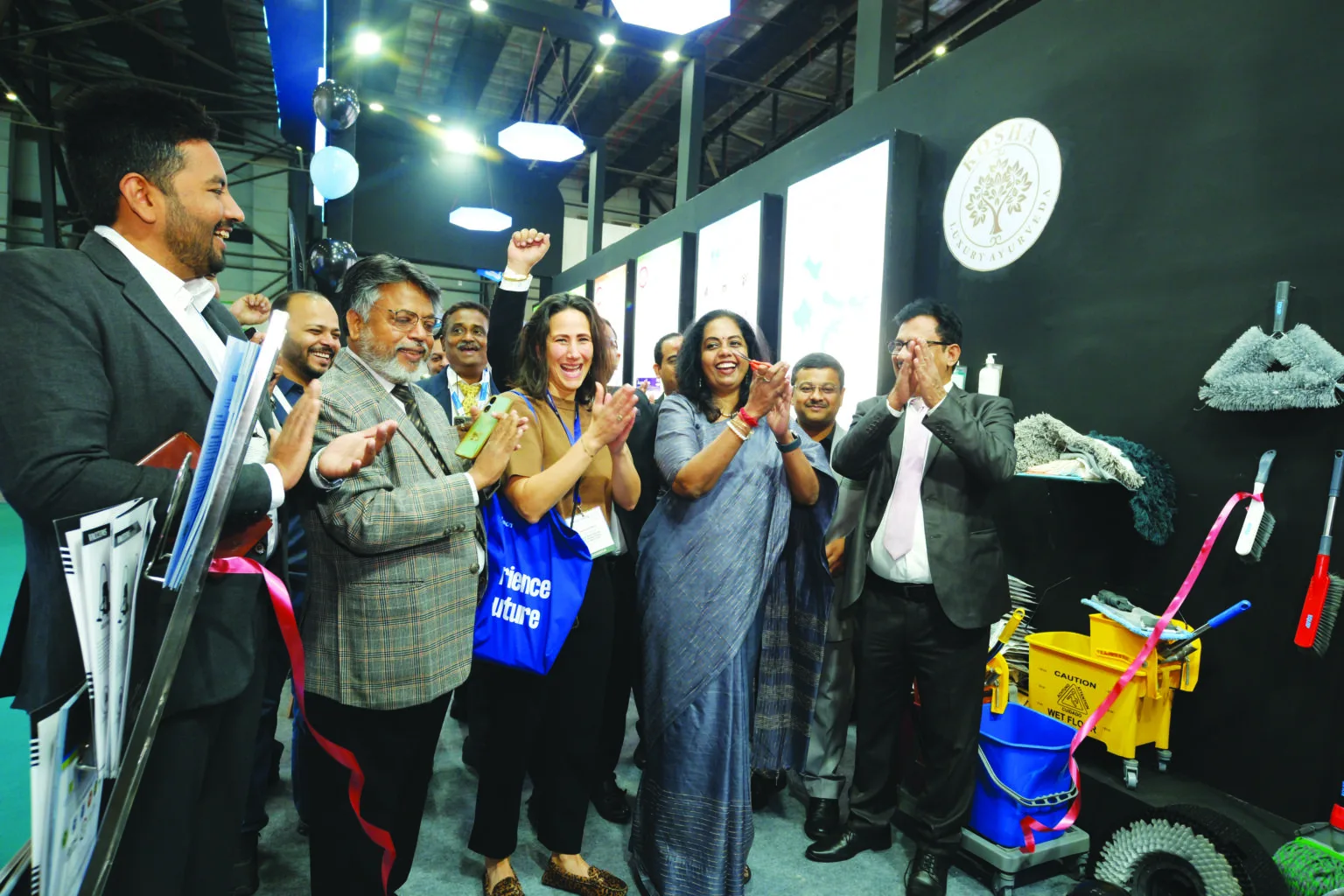
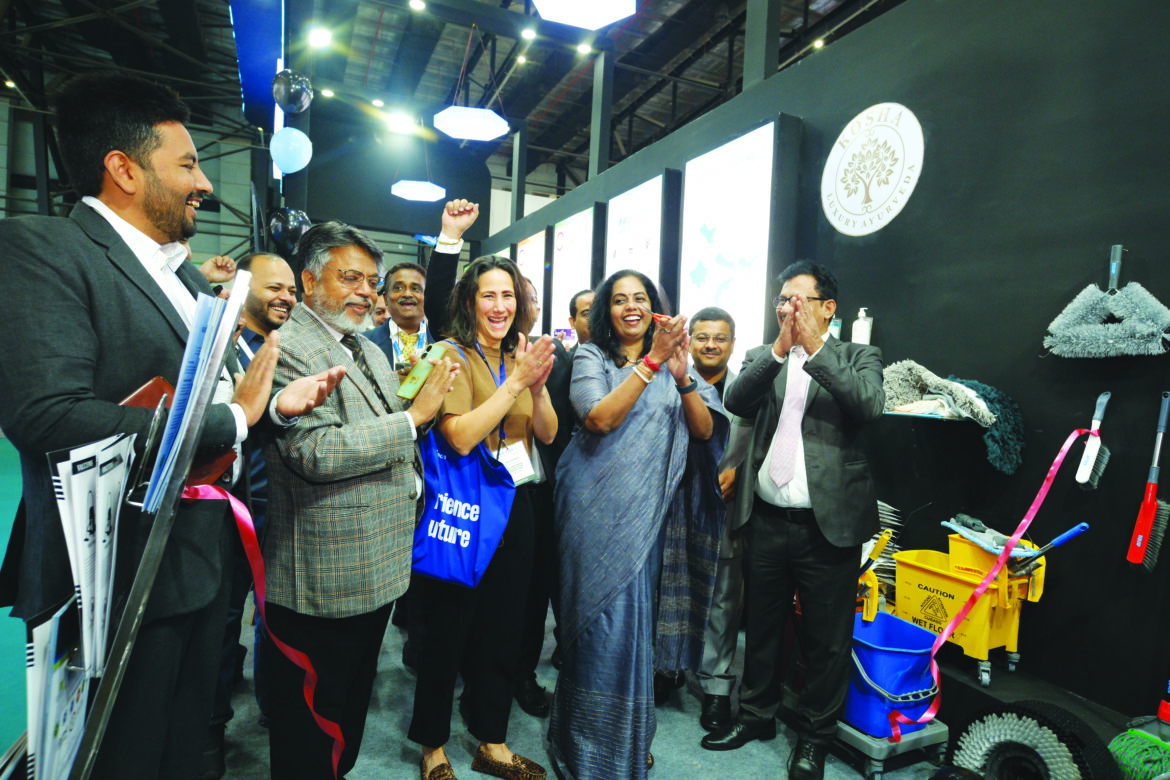
The Clean India Show 2025 offered a glimpse into how technology, robotics, AI and digital platforms are transforming the cleaning and facility management landscape in India.
At the Kinetiq RRobotics (Star Engineers India Pvt. Ltd) booth, the future quite literally looked back at you. Newly launched AI greeting robots stood at the entrance, ready with a cheerful “Hi” as visitors approached, their screens lighting up with multilingual responses and quick, fluid voice recognition.
You could talk to them, ask them questions, even watch them process information in real time. Not far from them rolled a group of delivery robots, their tray shelves neatly stacked with cups, chips and chocolates, gliding through the crowd like friendly attendants.
The mix of warmth and automation at the stall made it one of the most striking examples of how robotics is being designed not just to work — but to engage, assist and coexist with people.
“Rather than replacing people, these robots are meant to complement human labour by taking over repetitive, low-value tasks.”
The company’s immediate target segments include hospitality, corporate offices, pharma and food manufacturing, where human presence is restricted, as well as warehousing and e-commerce fulfilment.
If the robotics pavilion revealed automation in motion, a short walk away the focus shifted to the quieter strength of smart engineering. Stas Chem Technologies Pvt. Ltd, a 40-year-old group rooted in chemical manufacturing, brought a different kind of innovation to the exhibition — BLACK, the company’s newly launched brand for cleaning tools and machinery.
The lineup included around 12 freshly introduced machines and three additional product lines, with multiple SKUs planned under each category. The new launches include single disk scrubbing and polishing machine, advanced vacuum cleaners and scrubber driers.
“All machines are assembled in-house and all development labs, quality control processes and compliance certifications are maintained internally,” said Ayush Saxena, Director at Stas Group.
Amid the heavy-duty machines, the exhibition also revealed discoveries unfolding in a quieter digital space – like a digital map of India’s loos, stitched together through AI, rewards and a simple idea called World of Loo (WOLOO).
WOLOO stood out at the exhibition as a digital ecosystem built to solve one of India’s most persistent challenges – clean and reliable public sanitation, especially for women.
Founded by Manish Kelshikar, the company’s journey began in 2019 with an intention to create safe, hygienic, women-friendly washrooms.
“We started with building our own washrooms called the ‘women’s powder room’. The first of these spaces opened in Mumbai,” said senior manager Shreya Kumbhavdekar.
For exhibitors and visitors navigating the complexities of housekeeping, laundry services, sanitation contracts, or multi-site maintenance, Zoho FSM (Zoho Corporation Pvt. Ltd)’s digital intervention was easily understood. Its core idea is simple: Bring every moving part of a service operation onto one integrated system.
As the team explained, many small and mid-sized cleaning businesses today still coordinate technicians through informal channels — mostly WhatsApp messages, scattered notes, and manual scheduling.
“The result is predictable with missed slots, double-booked staff, delayed assignments, and no visibility into what is happening in the field. We fill this gap,” they said.
Built as a mobile-friendly, multilingual platform, available in Hindi and over 25 languages, Zoho FSM enables businesses to schedule, assign, track, invoice and close jobs from a single ecosystem.
The platform supports both Android and iOS, with a web interface for back-end teams, making it accessible to operations of every scale.
One of its standout capabilities is intelligent dispatching — the system allows managers to assign technicians based on proximity, skill set, availability, and potential scheduling conflicts.
“On-the-ground staff can update job status, upload images, and collect customer feedback directly through the app, creating a complete record of every visit,” the team members explained.
According to the Zoho team, the steady footfalls not only brought leads and sign-ups, but rich conversations with cleaning businesses of all kinds.
Many visitors, they noted, were openly relieved to discover that such a platform existed, because they had long been juggling operations manually without realising a dedicated solution could streamline everything.
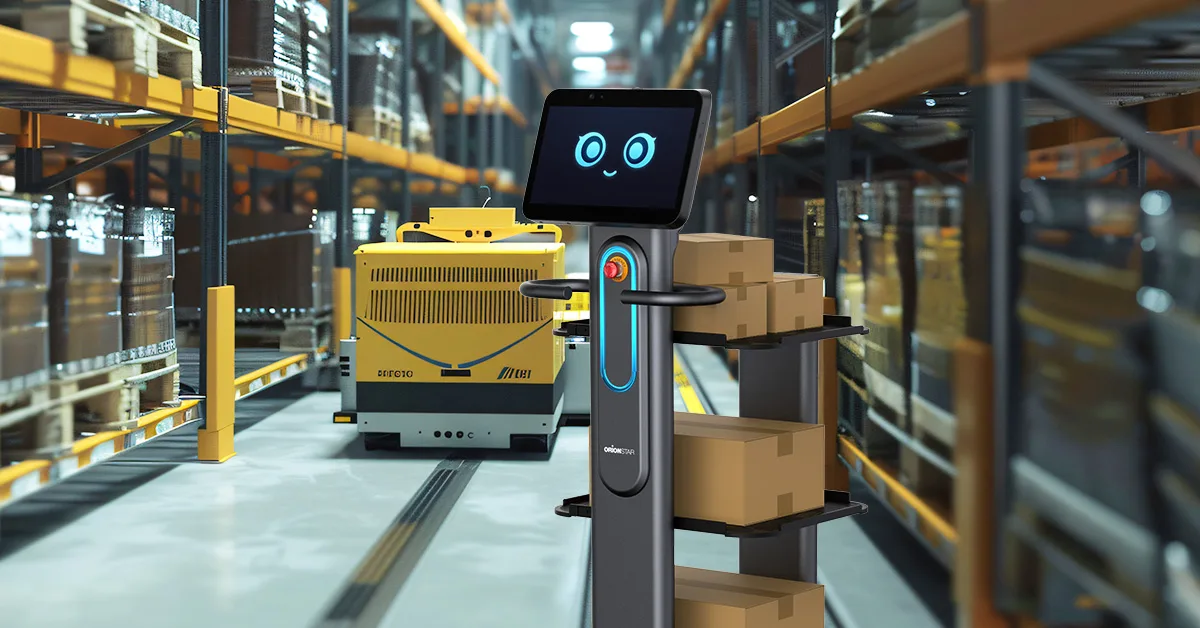
As India builds a technology-led future for its aviation sector, the focus is shifting toward sustainable and secure operations that can manage this rapid scaling. Keerthana Sundar, Special Correspondent, Clean India Journal, explores how autonomous robots are redefining the standards of hygiene and passenger experience at airports, in conversation with Anil Sathe, Chief Growth Officer, Kinetiq Rrobotics Pvt. Ltd.
Imagine an airport terminal where a multilingual AI guide assists a lost traveller, or an entertainment-enabled robot distracts a restless child during a flight delay. Whether it is broadcasting real-time security reminders or ensuring floors are cleaned based on real-time dirt detection, these machines are the new nervous system of the modern airport.
A. Airports are defined by constant footfall. Traditionally, maintaining these spaces requires a fleet of equipment: single-disc vacuum cleaners, scrubber dryers and sweeping machines. This combination of four or five different products is the current standard.
However, the new range of Kinetiq AI-driven autonomous robots, specifically our Kinetiq cleaning Robots like CleaniBot S55 & CleaniBot C5, can handle all these applications with a single unit, as it has good back-up with Lithium Ion Battery & has fast charging mechanism.
The core advantage is real-time mapping. In a high-traffic area, our robots perform an accurate mapping of the space in real-time. This is the most important factor: The robot detects dirt as it happens and responds autonomously with precise water & detergent dosing.
In an environment as vast as an airport, manual cleaning often misses spots or struggles to keep up with spills in food courts. AI ensures every square metre is cleaned to the same standard. This creates audit-ready digital logs that help airports demonstrate compliance with global hygiene and safety standards such as ISO 41001 (Facility Management) and ASQ cleanliness benchmarks.
We are achieving a level of hygiene that, while not strictly ‘hospital grade’ due to the different detergents used, is remarkably close to it. No area is skipped; spill zones and high-footfall areas receive extra priority.
A. While AI-driven cleaning is a relatively new entry to the market, the thumb rule for Autonomous Robot cleaning it saves up to 25% to 30% in water and detergent usage.
For large international terminals, this translates into millions of litres of water saved annually — supporting ESG goals while directly lowering operating expenditure.
This is because you are no longer performing a repetitive, overlapping job without a plan; you are standardising the process. Every drop is accounted for, and the robot only applies what is necessary based on the data it collects.
A. These robots are designed to complement the airport aesthetic—they are sleek and professional, fitting perfectly into an airport setting. Powered by lithium-ion batteries, they feature fast-charging capabilities; a three-hour charge allows for extensive operation.
For example, a 30-litre robot can cover approximately 3,500 to 4,000 square metres per hour.
Crucially, they use Light Detection and Ranging (LiDAR) and 3D cameras for dynamic obstacle avoidance and predictive path planning.
This reduces slip-and-fall incidents, one of the most common airport liability risks, by ensuring wet areas are cleaned and dried systematically rather than reactively.
This allows them to operate safely during peak hours rather than just at night. They are not just cleaning; they are learning the environment every day through AI to optimise their routes.
They can even perform dual operations, such as scrubbing and vacuuming, or dedicated mopping, ensuring high productivity in totality.
“Imagine a worker that never gets tired, slashes costs by 30% and makes your customers twice as happy. These AI robots handle the grunt work so your team can focus on the ‘human touch’ that keeps travellers coming back!” – Anil Sathe
A. Language barriers are a significant hurdle in global travel. Multilingual greeting robots can bridge this gap. These units can be integrated with platforms such as ChatGPT to provide real-time flight information, directions to smoking zones or washrooms, and even local tourism tips.
We also feature a ‘Follow Me’ function, where the robot leads a passenger directly to their destination, such as a specific boarding gate or an airport lounge.
They can also be used for ‘Smart Restaurant’ solutions within the terminal. A robot can autonomously plan the optimal route and lead customers to their target table.
This creates a premium, futuristic first impression and reduces the pressure on human information desks.
Airports using digital wayfinding and interactive service robots have reported higher retail dwell time and improved passenger satisfaction scores, which directly correlate to increased non-aeronautical revenue.
A. The LuckiBot acts as a mobile IoT sensor. It collects data on crowd density, air quality and traffic flow, feeding this into the airport’s Smart Control Room.
This data can also integrate with airport digital twins, enabling planners to simulate passenger movement, optimise queue layouts, and proactively redesign bottlenecks.
This enables predictive maintenance and energy optimisation, effectively becoming the ‘nervous system’ of the terminal. It can also be linked with advertising screens to increase exposure for merchants’ promotions or integrated with tax refund systems to display rules to passengers.
A. The biggest challenge is the ‘excitement factor’. Passengers, particularly children, are enamoured with the machines. It is quite common for people to stop the robots for selfies or even try to place children on them. We have seen families put their toddlers on autonomous robots because it looks fun.
While this shows the technology is being welcomed, we need a ‘co-working’ mindset where the public respects the robot’s workspace.
Forward-looking airports are already introducing robotic usage guidelines, signage, and public awareness programs to normalise human–robot collaboration. It requires patience from the buyers, sellers and public.
As we adapt, these robots will move from being ‘celebrities’ to being standard co-workers in the terminal ecosystem.
A. This is a vital point. Robots are not here to take jobs; they are here to eliminate the ‘dirty, dull and dangerous’ tasks. Most Facility Management companies currently operate at 80% to 85% of their required manpower. This gap leads to fatigue and stress.
By deploying robots to handle repetitive floor care or waste transport, we allow human staff to focus on tasks that require a human touch, judgment and empathy.
We are also creating new career paths for engineers to maintain and manage these robotic fleets. Facility teams are being upskilled into roles such as Robot Supervisors, Fleet Managers, and Automation Coordinators —creating a future-ready workforce.
We are not removing people; we are empowering them to work more efficiently.
A. The CarryBot is designed for the niche, physical tasks that are often overlooked. Consider waste management: transporting garbage from one end of a massive terminal to the disposal point is a significant job.
CarryBot can act as a garbage collector, moving from shop to shop to collect waste and deliver it to the last mile without manual intervention.
It can also handle duty-free stock movement, catering supplies and maintenance kits, removing thousands of manual trolley trips per day.
This significantly reduces musculoskeletal injuries and manpower attrition — two major hidden cost drivers in airport logistics operations.
A. Sustainability is about more than just conserving electricity. It is about measurable resource management. With robots, you have real-time data on water and detergent consumption.
You are supporting the human ecosystem by reducing staff fatigue. Every action is documented — This data enables sustainability reporting, carbon tracking, and continuous improvement —turning cleaning and logistics into measurable business intelligence.
You know exactly when a floor was cleaned or when waste was moved. This accountability helps airports reduce their carbon footprint and optimise their staff deployment year-on-year.
A. We are not just selling a product; we are providing an automation roadmap. Our robots are modular and upgradeable, designed to scale as terminals expand.
They integrate into future smart-city systems and run on low energy. As airports become ‘self-learning’ through the data these robots collect, they will be able to redesign layouts and predict congestion more effectively than ever before.
In the future, airports will not just be smart — they will be self-optimising, where robots continuously learn, adapt, and redesign operations in real time.

India’s infrastructure-led growth is creating a ripple effect that is steadily reshaping the cleaning ecosystem. While the Union Budget stops short of direct policy triggers, the scale of new assets — from airports to industrial hubs — is set to drive long-term demand for maintenance, mechanisation and automation. The opportunity is clear but gradual, shaped by cost, skills and adoption realities. Clean India Journal’s Manka Behl spoke to industry experts on how the sector is evolving alongside this shift.
The country’s Union Budget, presented earlier in the year by Finance Minister Nirmala Sitharaman, doubles down on a familiar ambition — build bigger, build faster, and build across sectors. From high-speed rail corridors and logistics networks to industrial clusters and urban expansion — the blueprint for growth is firmly anchored in infrastructure.
But as cranes rise and concrete spreads, a quieter, less visible layer of this growth story is beginning to come into focus: What happens after the build is complete?
For India’s cleaning ecosystem, the Budget does not offer direct policy triggers. Yet it sets in motion a chain reaction. Every airport terminal, warehouse, hospital, metro station or industrial hub being planned today becomes, eventually, a space that must be cleaned, maintained and managed — not occasionally, but continuously.
The result is a sector that sits just outside the spotlight of policy, but increasingly at the centre of execution.
Industry voices suggest that the opportunity is real, expanding and inevitable — but also gradual, uneven and shaped by on-ground realities of cost, scale, skills and adoption.
As infrastructure creation accelerates, a key theme emerging from the industry is the need to align construction with long-term upkeep.
“India’s strong push toward infrastructure creation through record capital expenditure is undoubtedly a positive step for economic growth. However, while we are building world-class transport networks, logistics hubs, airports, industrial parks, and urban infrastructure at an unprecedented pace, the conversation around long-term maintenance of hygiene and cleanliness at these locations is still evolving,” says Vedant Matta, Director-Sales of Charnock Equipments Pvt Ltd.
Vedant points out that globally, infrastructure planning integrates mechanised cleaning, facility management and predictive maintenance at the design stage. “In India, however, maintenance technologies are often introduced only after the asset becomes operational,” he says.
This, he notes, can lead to inefficiencies, higher costs and faster deterioration of public infrastructure. “As the country expands its asset base, there is a growing need to embed modern cleaning technologies, smart facility management systems, and data-driven maintenance planning into infrastructure projects from the outset. This will not only extend the lifespan of assets but also ensure hygiene, safety, and sustainability in high-footfall environments such as airports, metro stations, hospitals, and public buildings,” adds Vedant.
“As the country expands its asset base, there is a growing need to embed modern cleaning technologies, smart facility management systems, and data-driven maintenance planning into infrastructure projects from the outset.”
— Vedant Matta
According to Sahil Jain, Managing Director of Columbus Cleaning Machines Pvt Ltd, the cleaning industry will not see an immediate spike, with most benefits expected to accrue over the long term. “The government’s focus on infrastructure development, civic spending and smart cities is expected to create opportunities over time. However, cleaning is not something which has come into direct focus as infrastructure projects will not generate immediate demand. But once they get commissioned, that will obviously add something to the industry segment,” says Jain.
In the near term, increased public capital expenditure could provide indirect support. “When they increase the public capital expenditure, it basically also acts as an impetus to the private sector infrastructure development,” adds Sahil.
According to him, this expansion is expected to create demand for cleaning services and systems. “If you have more warehouses, you will obviously need scanning machines, cleaning manpower, cleaning systems in place,” he adds.
“The government’s focus on infrastructure development, civic spending and smart cities is expected to create opportunities over time. However, cleaning is not something which has come into direct focus as infrastructure projects will not generate immediate demand. But once they get commissioned, that will obviously add something to the industry segment.”
— Sahil Jain
As infrastructure scales up, the cleaning ecosystem is being pushed to evolve alongside it.
Vedant highlights that India’s cleaning ecosystem has historically been labour-intensive, largely because labour availability made manual cleaning economically viable. However, the scale and complexity of infrastructure being created today — large airports, metro systems, industrial corridors, logistics parks, and mega manufacturing facilities — are fundamentally changing operational requirements.
“The Union Budget’s continued focus on infrastructure expansion and rising capital expenditure is reinforcing the creation of large, high-footfall public and industrial assets that demand far more efficient and standardised maintenance practices. In such environments, manual cleaning alone is no longer sufficient. Facility operators increasingly require mechanised cleaning equipment, automation, and productivity-driven solutions to maintain large areas efficiently while meeting higher standards of hygiene and safety,” says Vedant.
The Budget positions robotics and AI as “core productivity drivers”. According to Anil Sathe, Chief Growth Officer at Kinetiq RRobotics, adoption on the ground is evolving in phases. “The mid-market is still evaluating, but the shift from ‘cost’ to ‘capability’ has clearly begun. There is a marginal shift in the outlook towards robots as productivity and efficient tools. However, large enterprises in India have already moved from discussion mode to piloting robots to measuring productivity and efficiency gains,” says Anil.
He adds that with millennials in decision-making roles gradually handing over to Gen Z, “we will witness a paradigm shift in the use of AI and robotics in the coming years and this will be very fast”.
On India’s ambition to become an automation execution hub, Anil believes that the country is “on the cusp,” with talent and adaptability already in place. However, he emphasises that policy support, infrastructure consistency and hardware localisation will be critical to scaling that vision.
However, Anil emphasises that the ecosystem will need to adapt, with greater focus on application-level and technician-focused training to support large-scale deployment and maintenance of robotics. “We have the necessary skill set available in the country, and with proper government funding and initiatives, this can be realised into the workforce seamlessly,” he says while underlining the need to align training with real-world operational requirements.
“India is on the cusp and a boost due from government policy and initiatives would be a major step in the right direction. India has the talent and adaptability to become an automation execution hub.”
— Anil Sathe
As infrastructure expands and policy direction supports technology adoption, the shift toward mechanised and robotic solutions is becoming more visible — though it remains closely tied to economics and real-world viability.
Vedant notes that while the budget may not directly legislate mechanisation, its broader policy direction — supporting infrastructure growth, manufacturing and technology adoption — “creates the right ecosystem for this transition”. “As the scale of assets increases, the economics naturally begin to favour machine-assisted cleaning systems that improve productivity, reduce dependence on large labour pools, and ensure consistent quality,” he says.
For Charnock Equipments Pvt. Ltd., Vedant describes this as a “significant inflection point”, adding that it will accelerate the adoption of mechanised cleaning across sectors.
At the same time, Anil highlights that adoption — especially in robotics — is evolving alongside funding access and business models. “MSMEs will adopt and will see a shift towards automated solutions as more local and government funding and initiatives are made accessible to the robotics sector. The market will evolve through Capex-led investments, but the real trigger will come from flexible models such as pay-as-you-use (PAYU) and Robotics-as-a-Service (RaaS),” he explains.
However, the transition is still strongly influenced by return on investment. While AI is already widely used in computing and design, Anil points out that robotic cleaning solutions still lag due to ROI constraints. “Once the price differential between mechanised and robotic solutions breaches approximately 40%, we will witness a shift towards robotic cleaning solutions. For wider adoption, robots need to deliver a clear 12–18-month payback. When the monthly cost aligns with 1.5–2 manpower equivalents, the decision becomes much easier,” adds Anil.
Early signals of this shift are already visible. “The budget has improved intent and enquiry levels. We are seeing more serious conversations, especially at leadership levels, though conversions still depend on ROI clarity. With infrastructure expanding, this shift towards AI and robotic solutions is beginning to reflect in sales funnels, supported by measurable data from proof-of-concept deployments across sectors,” says Anil.
Adoption is also likely to vary by sector. “Healthcare, food and pharma and education will lead adoption because hygiene is non-negotiable. In these environments, the value of consistency and compliance is immediate and measurable. At the same time, airports are already among the fastest and largest adopters of robotics, driven by large infrastructure players such as Adani, Grandhi Mallikarjuna Rao (GMR) and Gunupati Venkata Krishna Reddy (GVK),” says Anil.
While the Union Budget continues to emphasise strengthening the country’s manufacturing ecosystem and industrial supply chains, industry voices suggest that the path toward localisation remains gradual and constrained by current market realities.
Vedant notes that the policy direction presents a significant opportunity for the professional cleaning equipment industry. “However, the current consumption volumes of mechanized cleaning machines in India do not justify the costs associated with producing completely indigenous equipment and are acting as a deterrent for Original Equipment Manufacturer (OEMs) like us to operate full scale end to end manufacturing units in India,” he says.
At present, certain high-end machines and critical components are still largely imported, particularly those involving advanced electronics, specialized motors, fleet management and automation technologies.
For now, import dependence remains significant. Matta explains that certain high-end machines and critical components continue to be largely imported, particularly those involving advanced electronics, specialised motors, fleet management and automation technologies.
A similar reality exists in robotics. Shares Anil, “India still lacks the infrastructure and capabilities for mass-scale production of robotics… and we have very few indigenous products in the market.”
However, he highlights that the country has strong software capabilities and skilled manpower, which are currently playing a key role in adapting robotics solutions for the domestic market. “We are on the right track to take a big leap,” he adds.
At the same time, access to policy incentives remains uneven. Sahil points out that manufacturing incentives are largely designed for large-scale industries, particularly sectors such as pharmaceuticals and electronics. “For a country as big as India, the cleaning machines industry is still very small. They give PLIs and incentives to big companies and the others like us where investments are lower generally do not get a lot of incentives from the government,” he says, noting that such benefits are typically linked to investments running into thousands of crores and large-scale employment generation.
Matta, however, sees a long-term shift underway. As domestic demand becomes more predictable, he says, there will be increasing incentives for localisation, supply chain development and technology investment within India. “For us, the opportunity lies in gradually strengthening local manufacturing while combining global technology with Indian engineering and cost efficiencies,” he says.
Over time, he adds, this could help reduce dependence on imports and position India not just as a large consumer market, but also as a competitive manufacturing hub for professional cleaning equipment.
As the Budget continues to emphasise infrastructure, industrial expansion and services, industry experts stress on the combination of policy direction, workforce readiness and operating models that will shape the future of the cleaning and automation ecosystem.
Vedant feels that if one policy direction has the potential to significantly transform the professional cleaning industry, it is the government’s continued emphasis on large-scale infrastructure and industrial development through sustained capital expenditure. He adds that India’s flagship initiative, “Swacch Bharat Abhiyan,” should gradually move towards the use of mechanised cleaning equipment to ensure more efficient and effective maintenance of cleaning standards across the country.
Vedant also highlights the growing importance of economic clusters such as manufacturing zones, logistics parks and integrated commercial hubs. “The development of these clusters will create significant opportunities for automated and industrial cleaning equipment. These environments operate on the synergy of vast built-up areas, high operational intensity and continuous movement of goods and people, all of which require consistent and efficient maintenance,” he says.
Anil emphasises that the next phase of growth will be driven by partnerships rather than standalone product sales. “The future lies in partnerships — especially with integrated facility management and facility management companies — where robotics is embedded into service delivery rather than sold as standalone products,” he says.
Anil added that companies are increasingly adopting a multi-point go-to-market approach, combining direct and indirect sales while working closely with facility management firms, which he described as “a great catalyst in this growth process.”
At the same time, workforce capability remains central to this transition. Matta is of the strong view that training and skill development will be absolutely critical as the industry moves towards mechanisation.
The Budget’s focus on linking education to employment in service sectors is therefore a positive step, creating opportunities for an influx of fresh manpower and structured skill development programmes.
According to Vedant, these can help workers transition from manual roles to machine operators, supervisors and facility management professionals, improving not just efficiency but also safety and long-term career prospects. “Ultimately, the future of the professional cleaning industry in India will depend not only on advanced equipment, but also on a well-trained workforce capable of operating and maintaining these technologies effectively,” he says.
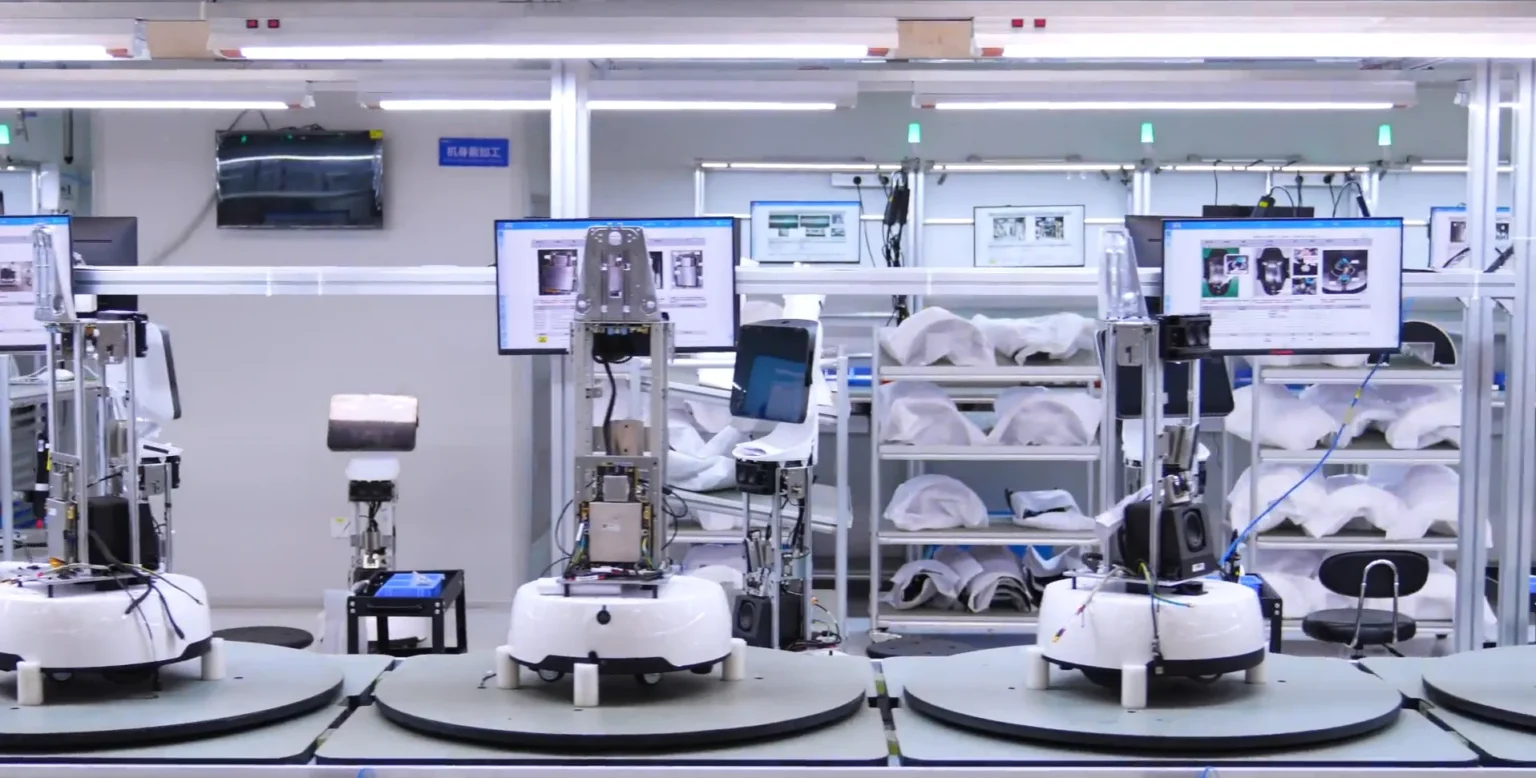
Industry experts Steven Yu, Divya Ramraika and Anil Sathe discussed how robotics, AI and automation are gradually reshaping India’s facility management and cleaning sectors, while addressing operational efficiency, workforce shortages and the realities of deploying robots in complex Indian environments.
The first hour is usually chaos. People gather around, pull out their phones, click selfies and watch the robot move through the corridor like a celebrity entering the building.
But once the excitement settles, the machine quietly gets to work — cleaning floors, avoiding obstacles, mapping spaces and becoming what industry experts call the “101st worker” inside the facility. And that, perhaps, is where India’s robotics story is beginning.
It was this transition — from curiosity to operational support — that formed the centre of a recent discussion hosted by Clean India Journal featuring Steven Yu, Senior Vice President at OrionStar; Divya Ramraika, Managing Director at Kinetiq Rrobotics Pvt. Ltd; and Anil Sathe, Chief Growth Officer at Kinetiq Rrobotics Pvt. Ltd.
The discussion explored how robotics, AI and automation are gradually reshaping India’s facility management and cleaning sectors while addressing labour shortages, operational efficiency and the realities of deploying robots in complex Indian environments.
At the heart of the discussion was a question both simple and significant: “Why India?”
For Steven Yu, the answer came from years of observing the Indian market evolve. Before entering the robotics business nearly a decade ago, he had worked with Indian telecom companies during the country’s mobile phone boom — an experience that revealed both the scale of the Indian market and its willingness to embrace technology rapidly.
“That was when I realised India is truly a vast market,” he said, recalling how quickly Indian consumers adapted to mobile technology. He now sees a similar shift unfolding in robotics.
According to Steven, changing workforce patterns and growing labour shortages are creating the right conditions for automation-led solutions, particularly in repetitive sectors such as cleaning and facility management.
“Doing the same work every day is not ideal for human beings. This is where machines can contribute,” he observed, adding that younger generations are increasingly unwilling to take up repetitive labour-intensive work.
At the same time, he rejected the common perception that robots are designed to replace workers.
“Robots are tools to help people work more efficiently,” he said, explaining that workers can instead learn to operate robotic systems and move into newer roles.
India’s infrastructure story is growing faster than its operational systems can keep pace with. For robotics companies entering the country, that gap between expansion and execution is emerging as one of the biggest opportunities for automation-led technologies.
Divya Ramraika highlighted what he described as a “huge vacuum” in the country.
“While infrastructure growth has accelerated, advanced automated cleaning systems are still relatively new in the Indian market. At the pace with which our country is developing, we need robots for our large infrastructures,” he said.
For now, he believes partnerships with global robotics companies remain the fastest route to adoption while helping India gradually build local manufacturing and software capabilities.
Robots operating in neat, predictable environments is easy. The real engineering challenge begins in India — where crowded hallways, moving trolleys, heavy footfall and constant interruptions are part of the everyday landscape.
Divya said the company is investing heavily in software capabilities that allow robots to map and understand operational spaces more intelligently.
“Dedicated software teams train the robots to identify where they need to move, which areas require cleaning and which zones are designated for service operations,” he explained.
Equipped with LiDAR systems, cameras and sensing technologies, the robots continuously scan and interpret their surroundings while functioning.
“If there is some obstruction, it can stop, take a detour through another route and continue the work,” he said.
Rather than stopping permanently, the robots are programmed to reroute themselves and continue operations with minimal interruption. The systems can detect moving humans, chairs, walls and other obstacles before responding through automated navigation adjustments.
According to Divya, Indian public spaces are precisely where robotic systems can be most effective.
“In airports, malls and hospitals, the robots operate through predefined cleaning routes while revisiting areas periodically depending on footfall and operational requirements,” he explained.
The systems are also equipped with AI-enabled visual detection capabilities that help identify localised dirt, spills and garbage in real time.
The cleaning industry has traditionally depended on manpower-heavy operations, but the pressure points are becoming increasingly visible.
As workforce shortages deepen and facilities become more complex to manage, the conversation is gradually shifting from manpower availability to operational efficiency, accountability and real-time data.
Having witnessed the shift from manual cleaning to mechanised systems since joining the industry in 2007, Anil Sathe described autonomous robotics as the next logical progression.
“The journey from mechanised cleaning to autonomous robotics is now beginning,” he said.
Contrary to the perception that India has abundant manpower, Anil argued that labour shortages are already becoming a major operational challenge.
“If companies require 100 people, very often only 80 are available,” he explained, adding that those 80 workers are then expected to complete 100% of the work.
This growing manpower gap within facility management has created what he described as an operational vacuum — one that robotics and AI-driven systems are beginning to address through “robotic co-working”.
“Most of the top leadership is looking forward to this type of innovation where they can handle efficiencies properly,” he observed.
According to him, once organisations begin understanding efficiency management through automation, robotics could emerge as one of the industry’s biggest focus areas.
Anil pointed out that while large workforces are already deployed across the cleaning industry, most operations still lack measurable quantification.
“With robotics and AI, every process can be quantified,” he explained.
Facility management companies traditionally evaluate operations through square-foot coverage, but robotics takes that further by generating real-time operational data and measurable performance insights.
The shift, according to experts, is no longer only about replacing manual effort with machines. It is increasingly about visibility, consistency and measurable operational outcomes.
For many, the biggest concern around robotics in India is not the technology itself, but whether machines can realistically function amid crowded corridors, unstable connectivity and constantly moving public spaces.
According to the experts, however, most of those fears are built more on perception than reality.
Addressing one of the biggest misconceptions around robotics, Anil said, “People think robots stop because Wi-Fi is not available or internet is not available. That is one of the biggest myths.”
The systems function as AMRs — Autonomous Mobile Robots — operating through sensors and navigation technologies rather than internet-based commands.
“Whether it is a delivery robot or a cleaning robot, each machine is equipped with multiple sensors that continuously monitor movement and surroundings,” he explained.
At the same time, he acknowledged that introducing robots into facilities comes with an adjustment phase because people are still adapting to working alongside machines.
“The most exciting thing that happens is everybody wants a selfie with the robot,” he remarked.
Having overseen nearly 20 to 25 proof-of-concept deployments across India, Anil described this initial excitement as a “good chaos” that accompanies almost every implementation.
“Our first job is to take this one hour of excitement in a positive way,” he said, adding that once the novelty fades, the robot gradually becomes part of the workforce.
India’s challenge is not just scale, but unpredictability. Floors vary, layouts shift constantly and public spaces rarely stay still long enough for automation to function in perfectly controlled conditions.
Steven Yu said navigation technology and hardware systems are evolving rapidly to handle increasingly complex environments.
“Currently, the navigation algorithms solve most of the problems. We are now introducing 3D LiDAR-based systems for smoother and more intelligent movement around obstacles,” he said.
When asked how the robots would respond to potholes or damaged flooring, the experts clarified that while the systems can detect potholes and navigate around them, they are fundamentally designed for flat surfaces.
The software can also identify different floor types within the same property.
“You can define that one area has wooden flooring and another has marble flooring. Accordingly, the robot can take decisions and use suitable accessories while cleaning,” they explained.
As robotics adoption expands, the conversation is also shifting toward sustainability, battery ecosystems and long-term manufacturing ambitions.
Talking about water recycling, Steven informed that OrionStar currently offers two categories of cleaning robots.
“In one category, dirty water is collected separately and discharged after use. The second category — expected to enter India later this year — will feature water recycling technology,” he said.
According to him, the system filters dirty water internally, removes solid particles and recirculates treated water back into the cleaning process, functioning similarly to an STP-based recycling mechanism.
The robots currently operate with water tank capacities of around 35 litres for standard office applications, while larger machines ranging from 25 litres to 45 litres are also available.
The discussion also turned to lithium battery systems, which experts admitted is becoming an important subject within India’s growing electronics ecosystem.
“The robots currently use lithium batteries manufactured according to European standards,” Steven said, adding that future localisation of battery manufacturing in India remains part of the long-term roadmap.
Needed for the site to work - security, load balancing and remembering this choice. No tracking.
Google Analytics, and the record of which pages you saw before sending a form. Tells us what to publish more of.
Lets us measure our campaigns and show Clean India Journal advertising to people who have visited before.
Embedded video and other conveniences. Switching this off may stop some embeds loading.
Enter for all results · Esc to close