

















Aim is to achieve frictionless washrooms at airports
In the high-stakes environment of global travel, where millions of passengers traverse terminals daily, the humble washroom has emerged as a battleground for health, safety and brand reputation. With India’s aviation sector projected to handle nearly 430–440 million passengers this year, the pressure on sanitation infrastructure is at an all-time high.

Hygiene is no longer just about a visible sheen; it is about the sophisticated integration of technology and fluid management. Central to this evolution is the liquid dispensing system — a silent soldier that dictates the hygiene standards of an airport.

Pruthvi Sanghavi, Director, HPC Enterprises Pvt. Ltd shares with Keerthana Sundar, Special Correspondent, the salient features of liquid dispensing systems utilized in high traffic areas such as airports.
The logistical challenge of maintaining airport washrooms varies significantly by the category of the city. As of 2026, the disparity in infrastructure reflects the rapid but uneven growth of Indian aviation:
1) Metro Hubs (Delhi, Mumbai, Bengaluru): A typical metro airport like Delhi’s T3 or Mumbai’s T2 manages over 200 to 300 washroom blocks. In these “cities within cities”, a single washroom may see over 5,000 users per day. This high frequency needs high-capacity, automated liquid dispensing systems that can function without failure for thousands of cycles.
2) Tier 2/3 Regions: Smaller airports typically house 15 to 40 washroom blocks. While the footfall is lower, the challenge lies in maintenance consistency and the transition from manual to automated systems. Recent mandates from the Airports Authority of India (AAI) have pushed for a standardized hygiene protocol across these regions to ensure a seamless “touchless” experience.
Manufacturer Insights
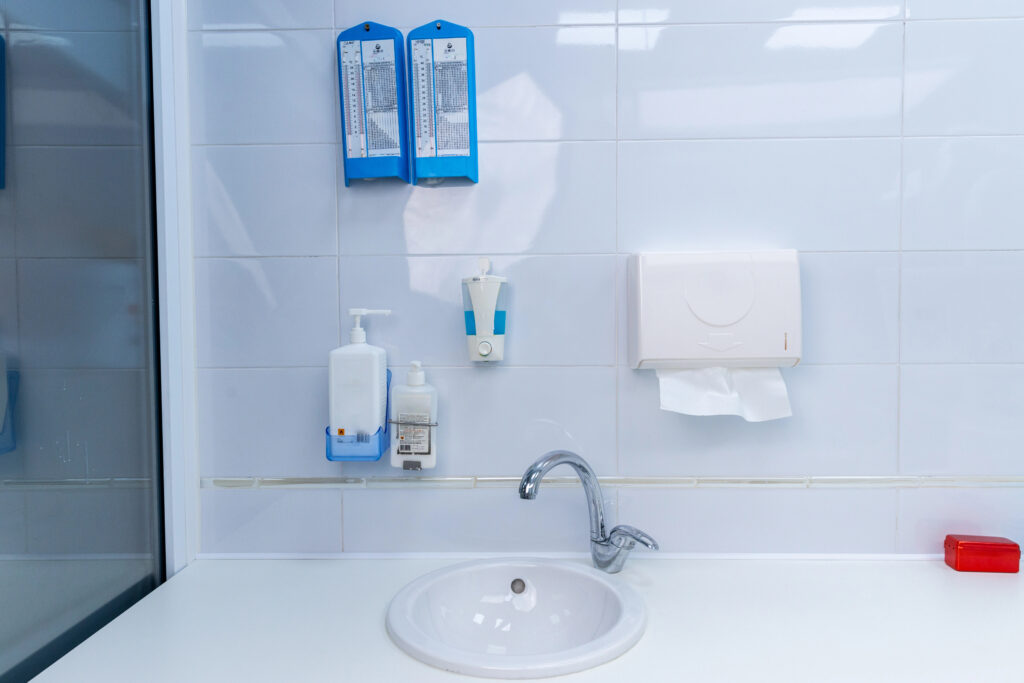
Pruthvi said that that the transition to modern systems is driven by more than just aesthetics. “Hygiene in public spaces like airports is fundamentally about breaking the chain of transmission. Every time a passenger touches a manual pump, the risk of cross-contamination spikes. The focus should be to move toward ‘No-Touch’ or infrared-based systems that not only protect the user but also provide the airport operator with better control over consumption.”
Pruthvi emphasizes that the “system” is not just the dispenser on the wall, but the entire fluid logistics behind it. “For an airport, downtime is the enemy. If a soap dispenser is empty or leaking, it doesn’t just look bad—it is a service failure. We advocate for centralized or large-capacity reservoir systems that feed multiple dispensers, reducing the frequency of refills and
the labour cost associated with constant monitoring,” she said.
Data Driven Hygiene
The shift toward advanced dispensing systems is backed by compelling data regarding cost, waste
and health.
According to 2025 aviation audits, washroom cleanliness is a top three factor influencing passenger satisfaction scores (ASQ). Airports that implemented automated liquid soap and sanitizer systems reported a 22% increase in user satisfaction.
Advanced Dispensing Technology
In 2026, the definition of a “dispensing system” has expanded. It now includes:
1. Automated Soap Units: Utilizing foam technology, which uses up to 50% less liquid than traditional gels by aerating the soap.
2. Sanitizer Wall Stations: Strategically placed at gate entries and exits, integrated into the terminal’s architectural design.
3. Fragrance Fluid Control: Automated systems that dispense odour-neutralizing fluids at set intervals.
“The viscosity of the liquid is the heartbeat of the system. We design our systems to handle varying thicknesses. If a dispenser isn’t calibrated for the specific liquid—whether it’s a high-viscosity gel or a thin foam—it leads to clogs or leaks. This reliability is what keeps a Tier 1 airport running smoothly during peak hours,” said Pruthvi.
| Feature | Manual Dispensing | Automated Systems |
| Cross-Contamination | High (Direct contact) | Near Zero (Sensors) |
| Soap Wastage | 20% – 30% (Over-pumping) | < 5% (Controlled) |
| Maintenance Need | High (Individual) | Low (Centralized) |
| Water Reduction | Baseline | Up to 35% Savings |
Smart IoT Integration
Modern airport washrooms are now “talking” to facility managers. By embedding IoT (Internet of Things) sensors into liquid dispensers, airports can track real-time usage data.
- Predictive Refill Alerts: Instead of staff checking every hour, the system sends a notification to a central dashboard when a reservoir hits 15% capacity.
- Traffic Flow Monitoring: By tracking how many times a dispenser is activated, management can deduce which washrooms are the busiest and reroute cleaning staff dynamically.
Sustainability & Waste
Large-scale liquid systems are significant contributors to an airport’s “Green Goals”. By moving away from individual small plastic soap cartridges and toward bulk-fill centralized reservoirs, airports can reduce plastic waste by over 40% annually.
“Sustainability isn’t just a buzzword. By providing high-durability hardware that lasts 10+ years, we can prevent the ‘use-and-throw’ cycle of cheap plastic dispensers. We must see our systems as long-term assets that minimize environmental footprints,” said Pruthvi.
Regulation & Compliance
The Airports Economic Regulatory Authority (AERA) has recently proposed linking airport tariffs to service quality. This means that dirty toilets or malfunctioning facilities could lead to financial penalties for airport operators. For metro airports handling over 20 million passengers annually, this has turned hygiene into a performance metric.
Real World Implementation
Despite the benefits, the transition is not without hurdles:
- Initial Capital Costs: Automated systems can cost 3X to 5X more than manual units upfront
- Vandalism Resistance Needs: High-traffic areas require dispensers made of durable materials such as Grade 304 Stainless Steel
- Power Supply Management: Ensuring a constant power source for thousands of sensors requires dedicated maintenance schedules.
Future Clean Standards
As India’s targets soar within the global aviation market, the washroom is a sophisticated hub of fluid engineering. To effectively achieve these goals, it is clear that the future lies in centralization, automation and precision.
The goal for 2026 and beyond is a “frictionless” washroom — where the passenger never has to touch a surface and the operator never has to worry about waste. By investing in high-quality liquid dispensing systems, Indian airports are building a world-class travel experience.
” The primary defense in a high-traffic washroom is the formulation itself. We must focus on the antibacterial properties of our dispensing liquids or lotions. This will ensure that we are not just washing away visible dirt but actively reducing the microbial load on the skin.” — Pruthvi Sanghavi