


























Married To The Business: Niyati and Ashwin
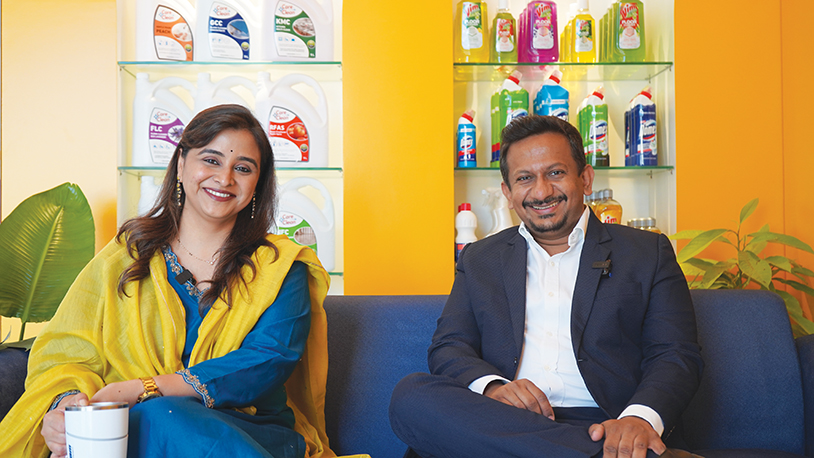
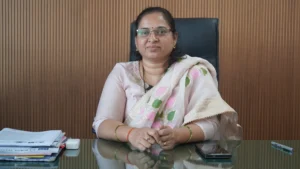
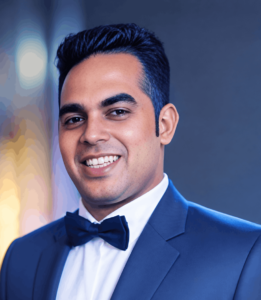
Niyati Purohit, Chief Executive Officer, and Ashwin Suresh, Managing Director of Megamorph Marketing Private Limited, share the journey of their home-grown brand, CareClean with Clean India Journal. In this candid discussion, they reflect on 13 years of evolution, the complexities of husband-wife partnerships in business and their strategic transition from marketing consultants to industrial manufacturers.
How Megamorph moved from marketing to manufacturing
You started Megamorph with a vision for marketing and distribution. How did the transition into a manufacturing organisation occur?

Ashwin: We initially intended to assist Micro, Small, and Medium Enterprises (MSMEs) with marketing. We consulted for a company manufacturing cleaning chemicals and found we were marketing their products effectively. However, with the passage of time, we realised that controlling manufacturing and quality is essential for marketing success. Operations are the critical part of this control. We decided to pivot and take end-to-end control over our brand, CareClean, by managing both manufacturing and marketing.
Whose idea was it to move into manufacturing?
Niyati: I grew up around factories as my parents ran a pharmaceutical manufacturing unit in Indore. The process of creating a product is an exciting experience. One must have trust in the process to believe in the final product presented to the market. While we debate significantly before making decisions, once a path is chosen, it is a joint commitment.
Challenges as a woman entrepreneur
As a woman entrepreneur starting at 25, what challenges did you face?
Niyati: In the beginning, many people assumed I was only present because of my husband. Even in meetings, individuals would look at Ashwin to answer questions I had asked. It bothered me. I had to instruct our employees to respect the position I held rather than responding based on my age or gender. Over 13 years, those who worked closely with me understood my contribution. While such biases still exist today, they no longer affect me because I am confident in the value I bring.
How did you support Niyati in establishing her authority?
Ashwin: Men often dominate spaces by nature, but a man can do much to ensure a woman receives the respect she deserves. I have been conscious of when to step in and when to voluntarily step out. If I were to contradict her or debate a decision in front of the team, it would undermine her authority. We have structured our work to avoid this. Once the results of her decisions became visible to everyone, the respect followed naturally. Today, most people turn to her first because they know she holds the ultimate responsibility.
First sale and contract manufacturing
How did you feel after your first sale?
Ashwin: Our first sale came from a lead at the Clean India exhibition. A company from Ahmedabad called us and transferred the money. In our first year, the total turnover was ₹3,000. In the second it was ₹1 lakh. Today, we are ending the year at approximately ₹100 crore and our projection for the next year is ₹250 crore. It has been a 13-year journey of incremental steps and monumental growth, particularly as cleanliness awareness increased during the pandemic.
Niyati: We started with only four people. In the early days, we took the orders, packed the material and dispatched them ourselves. Some customers even noted that we delivered materials in a personal car. We celebrated every small win, including the first month of sales, with a cake. Launching a brand when large multinational corporations were already established was a significant challenge.
Why did you decide to enhance the business through third-party contract manufacturing while building your own brand?
Niyati: The industry saw the performance of CareClean products and wanted similar formulations for their own brands. They saw that we operate in a partnership mode with transparency and established systems. It was not just about buying a formulation; it was about trust.
Ashwin: India is a country of 1.4 billion people. No single brand can rule the entire market. Manufacturing requires a specific attitude and level of professionalism that is often missing in small-scale family businesses. Once we implemented high standards for quality and safety, larger brands saw the value in associating with us. We are the custodians of their products, and we take this responsibility seriously.
Partnership, focus and handling stress
Is it difficult to be business partners or a married couple?
Ashwin: Being a husband and wife is more difficult. You can run a company with intelligence and hired talent, but a relationship is only managed by the two people involved. It requires maturity that cannot be taught in school. Mistakes in business are far easier to correct than mistakes made at home.
Niyati: I find being co-partners easier because the roles and decision-making matrices are defined. At home, emotions are raw and you drop your professional walls, which can be more difficult to handle. However, Ashwin is very self-assured and gives me the space to lead, when necessary, both at work and at home.
Does focus on other brands distract you from CareClean?
Ashwin: We have built a strong team to take care of CareClean so that it is not dependent solely on us. We have a pan-India sales team of 22 people. While we are responsible for building the entire organisation, CareClean remains our priority for marketing and recruitment spends. We have reached a stage where we can let the brand blossom under the guidance of industry experts.
How do you handle the stress of deadlines and high expectations?
Niyati: My stress is often self-induced because I seek perfection in operations, which is difficult to achieve. However, spending time with my daughter helps me reset. On the shop floor, I am known for being vocal. I have a low tolerance for avoidable mistakes where a defined process was simply forgotten or ignored.
Ashwin: I recently conducted training for the team on handling stress. We cannot reduce the work because we are growing rapidly. We expect high performance but not 16-hour days. My stress originally came from financial debt and mortgages, which was a foreign concept to my family. Once I became grounded in my decisions and accepted that defeats are part of the process, the stress became manageable.
CareClean’s goals for the next few years
What are the objectives for CareClean over the next 2-3 years?
Ashwin: We have transitioned from a regional player in the South to growing in the West and East. Our vision is to bring CareClean to a point where it represents 50% of our total business. We are very customer-centric; our formulations are driven by what the Indian market requires. We are now investing heavily in marketing and bringing agencies on board to ensure our voice is heard in the larger market.
Niyati: We have identified the segments where we want to play. We kept a low profile for a few years while the market matured, but now we are ready to take a leap.
Ashwin: CareClean brings excitement and a sense of brand identity to the company. While Megamorph provides the manufacturing foundation, CareClean allows us to engage in marketing and innovation. You will see the brand in a new light very soon.