





























Autonomous Cleaning Hits the Inflection Point
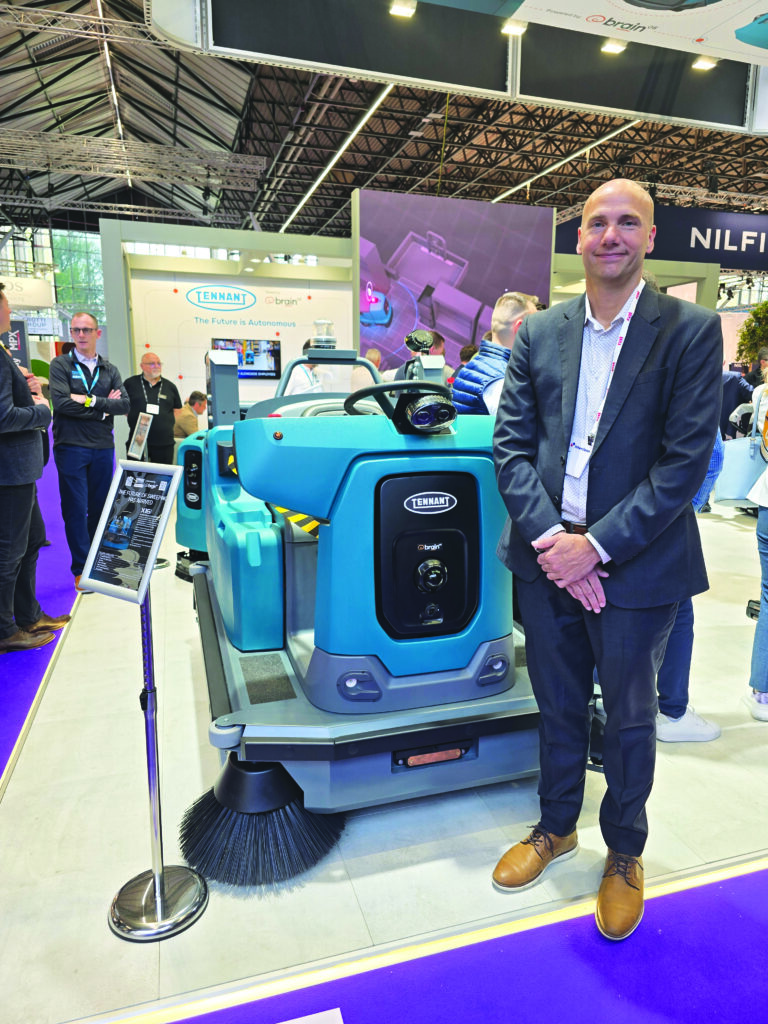
From early-stage experimentation to a full-scale industry shift, autonomous cleaning is no longer a futuristic add-on — it is fast becoming the backbone of modern facility management. In this conversation with Pat Schottler, Senior Vice President, Robotics – Tennant Company, Clean India Journal’s Editor Mohana M unpacks how advances in AI-driven navigation, falling technology costs, and evolving customer expectations are converging to create a tipping point. While markets like India are still navigating the transition, the focus is shifting from labour substitution to delivering consistent, measurable cleanliness that directly impacts business outcomes.
Q: Tennant has introduced “BrainOS” by Brain Corp. Could you elaborate on what exactly this means?

A: Tennant Company is a partner of Brain Corp in the field of robotics. Brain provides the autonomous navigation operating system that lives on Tennant machines. We have been partnered with Brain for eight years now, and we believe they offer best-in-class industrial navigation.
When you combine that with Tennant Company’s market leading legacy in floorcare, we have a unique ability to support customers throughout the entire product life cycle. We think we have the perfect combination: a really strong floor care brand with a strong go-to-market presence, combined with the technology leadership of Brain Corp. We believe no one else brings that unique combination to the table.
Q: Speaking of autonomous cleaning, where did Tennant start, and where are you now?
A: That’s a great question because we have been on a significant journey. We sold our first cleaning robots back in 2018. We were lucky enough to win a very large customer right out of the gate, but at that time, the market was still in its infancy. Customers did not quite know what to think about robotics yet. The technology was not yet fully capable in the dynamic environments we operate in, and it was still quite expensive.
Consequently, the ROI (Return on Investment) was difficult for our customers to justify. We did not yet know how big robotics was going to be. From that start in 2018, I would say that just one to two years ago, we began to see a very different perspective on the cleaning market. We started to pick up on an increasing appetite for customers to really adopt robotics — not just for pilots or demonstrations, but to actually change the way they clean.
We saw a shift in technology capability with the emergence of AI in a more broad-based way. We also saw the cost of technology start to come down to the point where the ROI began to make sense for a large group of customers. Fast forwarding to today, from where we were 18 to 24 months ago, we think we are at a significant tipping point in the industry. Now, large customers, small customers, easy applications, and hard applications are all starting to figure out how to apply robots to their cleaning.
The tailwind we are seeing in the market now is unlike anything we have experienced before. The technology is now extraordinarily capable. The machines operate more autonomously and require less operator dependence, allowing more value to be created for our customers. We believe we are at the point where we have the opportunity to lead what is likely to be a massive disruption in this industry. We are now “all in.” We believe this is the future of cleaning; it is no longer just a niche segment of the market.
” Robotic cleaning is no longer about replacing labour — it is about delivering consistency, elevating standards, and redefining the value of clean.“
Q: Great. Regarding this journey, India is perhaps currently in that stage where there is more “fancy” or experimental buying happening. What kind of awareness should a consumer have when they are looking to pick up an autonomous machine?
A: That’s a great point. I think India is a little earlier in the journey. One thing we have learned is that the tendency for sellers — and initially for buyers — is to focus exclusively on the reallocation of labour. Simple ROI calculations usually say: “I’m going to take a person who used to clean the floors manually, put a robot in, save those two hours”, and move that labour elsewhere. In a locale where labour is less expensive and more available, that can be a hard sell.
But what’s missing in that ROI — and what we have come to value considerably — is the reality that spaces are often not being cleaned as well or as often as customers would like. This is because labour is difficult to find and can be inconsistent. A human does not always do the job as consistently as software or a robot.
There is a tremendous amount of value in that consistency. If you are in retail, a clean store really matters; there is a direct correlation between how clean your store is and how much revenue you generate. It is less about labour reduction and more about ensuring a consistently clean store in a way only robotics can achieve. My encouragement for markets early in the adoption phase would be to look beyond just the labour reallocation story and look at the additional ways robotic cleaning creates value.
Q: Is it true for robotic machines you need “perfect” floors? In the Indian context, we are not always going to find that level of floor quality.
A: In my opinion, it depends on the product and the brand you are working with. There are many competitors in the floor care space that focus on “clean-to-clean” — meaning smooth, even floors with light debris. That can definitely be the case for them. However, at Tennant Company, that’s not our focus. Our legacy is in industrial, heavy-duty cleaning. We focus on floors that are really dirty, uneven, or create unique cleaning challenges. We think Tennant’s legacy in cleaning is uniquely well-suited for the most demanding applications. While there are some robots out there that require a very smooth floor to function, Tennant offers a more diversified array of products.
Q: While you mentioned the floors are fine, is it true that the type of robot India requires is still not quite here? Let me put it this way: if I use a machine, I need a large open space. Most corporate spaces today are very congested. Is not there a possibility the robot will bang into those corners? How do we get over that?
A: From a space perspective, I do not see that as a barrier to adoption in India for a couple of reasons. One, the technology is getting very good at navigating through populated spaces. Secondly, even in the most populated spaces, there is usually an opportunity to clean when there are fewer people, such as early in the morning or late in the evening. We have noticed most of our customers take advantage of these lower-congestion periods to deploy the robot.
So, I think it is possible for India. The main thing I go back to for India is that because of the cost and availability of labour, there has to be a broader focus on the holistic value of robotic cleaning. That means valuing cleaner spaces and more consistent results. If customers can start to recognise that, it will be the best opportunity to accelerate adoption in the country.