





























Cleaning Industry Transformation: India’s Shift to Smart Cleaning

From manual housekeeping to a technology-driven profession, India’s cleaning industry transformation has been quiet but profound. Tony Chazhoor, CEO, India Subcontinent, IPC-Tennant, reflects on two decades of change, mechanisation and what must happen next for the industry to truly become professional.
Progress Report: The Professionalisation of Cleaning
In the mid-2000s, professional cleaning in India was largely fragmented, labour-intensive and often perceived as a low-skilled support activity. Most facilities depended on basic tools such as brooms, mops, buckets and non-standardised chemical products. Cleaning contracts were awarded almost exclusively based on cost, with little attention paid to productivity, hygiene outcomes, safety or environmental impact.

Today, the industry has evolved into a highly organised and rapidly growing sector that serves airports, hospitals, manufacturing facilities, smart cities, IT parks, retail spaces, educational institutions and public infrastructure. Cleaning is no longer viewed as a hidden operational expense. It has become a strategic function directly linked to health, safety, customer experience, regulatory compliance and sustainability.
Boardrooms that once viewed cleaning as a routine necessity have begun recognising its direct influence on employee well-being, public health and business continuity.
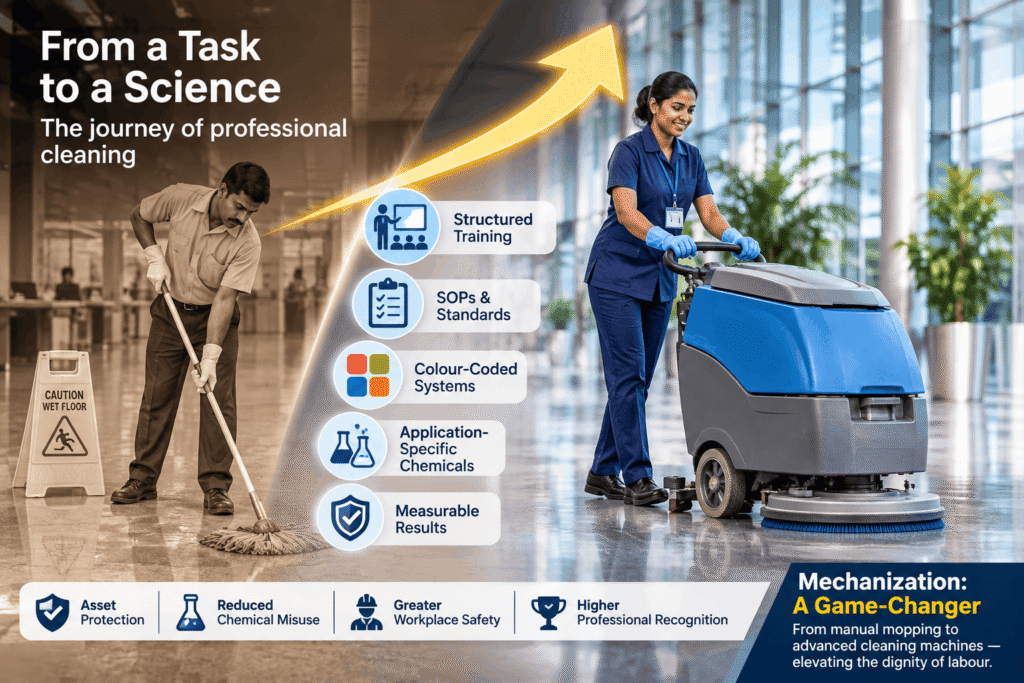
While mechanisation is often the most visible aspect of the industry’s evolution, the real revolution began with the professionalisation of cleaning practices. The introduction of structured training programmes, SOPs, colour-coded cleaning systems and application-specific chemical solutions transformed cleaning from a task into a science. Organisations started adopting measurable cleaning standards instead of subjective assessments.
This shift brought multiple benefits. Facilities were able to protect expensive surfaces and assets more effectively, reduce chemical misuse, improve workplace safety and deliver more consistent cleaning outcomes. Equally important, cleaning personnel gained access to better training, higher skills and greater professional recognition.
Turning Point: The Rise of Mechanised Cleaning
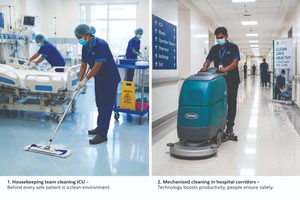
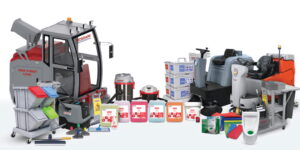
If there is one development that has fundamentally changed the profession, it is the widespread adoption of cleaning machines. The transition from manual mopping to mechanised floor care through scrubber-dryers, sweepers, high-pressure systems and industrial vacuum solutions represented a defining moment for the industry.
Airports, metro stations, railway terminals, shopping malls, manufacturing plants and large commercial complexes became early beneficiaries of this shift. However, the most important impact was human rather than technological. Mechanisation elevated the dignity of labour.
“For the cleaning industry, the future is not just mechanised. It is autonomous, connected, sustainable and intelligent.”— Tony Chazhoor CEO, India Subcontinent IPC-Tennant
Machine Cleaning: The Shift Towards Autonomous Cleaning Robots
While mechanisation defined the last decade, autonomous cleaning robotics will define the next. Around the world, the cleaning industry is moving beyond machine-assisted cleaning to machine-directed cleaning. India is now entering that phase.
Autonomous scrubber robots equipped with LiDAR navigation, advanced sensors, AI-enabled obstacle avoidance and cloud connectivity are beginning to transform the way large facilities are maintained.
They improve efficiency, consistency, traceability and resource utilisation while allowing human teams to focus on supervision, detail cleaning, customer interaction and specialised services.
Next Decade: Intelligent and Sustainable Cleaning Systems
India faces critical challenges related to water conservation, environmental stewardship and operational efficiency. Future cleaning systems must therefore do much more than clean effectively; they must also minimise resource consumption.
The future belongs to intelligent, connected and sustainable cleaning ecosystems.
Profession Reimagined: The Future of India’s Cleaning Industry
The Indian cleaning industry has travelled an extraordinary distance in a relatively short period. The next chapter will not simply be about better machines. It will be about intelligent machines working alongside trained professionals to create healthier, safer and more sustainable environments.
Clean India Journal: A Catalyst for Industry Transformation
For over two decades, Clean India Journal has served as far more than a trade magazine. It has been a powerful platform for education, networking, advocacy and industry development.
It brought global best practices, emerging technologies, industry case studies and expert insights to Indian stakeholders. Through its editorial initiatives, exhibitions, forums and the popular Clean India Show, it created a common platform where manufacturers, service providers, facility managers, consultants and end-users could learn from one another.
For countless organisations, including ours, participation in Clean India events has represented an opportunity not just to showcase innovation but to contribute to the collective advancement of the industry.