





























Cleaning Industry in India: From Manpower to Measurable Impact

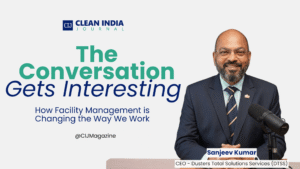
From fragmented manpower to integrated, technology-enabled solutions, the last two decades have redefined the cleaning industry in India. Sanjeev Kumar, CEO, Dusters Total Solutions Services Pvt. Ltd., reflects on how the industry has moved from routine cleaning to sustainability, hygiene and employee experience, and why workforce dignity will define its next chapter.
Cleaning Industry in India: From Manpower to Professional Services
Over the past 15–20 years, the cleaning industry in India has evolved from a largely fragmented, manpower-driven sector into a more organised, professional and technology-enabled industry. The focus has shifted from routine cleaning to integrated solutions centred on sustainability, hygiene, infection control and measurable service outcomes, with growing emphasis on workplace safety and employee experience.

Pandemic Sparks Shift: Changing Customer Expectations
The pandemic was a turning point, highlighting the critical role of cleaning professionals in maintaining hygiene and supporting essential services.
Beyond service delivery, the industry plays an important socioeconomic role by creating formal employment opportunities for people transitioning from agriculture and informal work into the services economy. Training, upskilling, dignified employment and social security are increasingly important to this transition.
Labour reforms, including the four Labour Codes that took effect in November 2025 and the Central Rules notified in May 2026, reinforce the focus on worker welfare and compliance, while state-level minimum-wage revisions influence service delivery economics.
At DTSS, we see the next phase as an opportunity to integrate technology, sustainability and workforce development to create greater value for customers and society.
The pandemic permanently elevated hygiene awareness, making sanitisation, handwashing and preventive practices part of everyday operations. Meanwhile, the growth of the gig economy has intensified workforce attrition, making attraction and retention critical industry priorities.
With younger generations entering the workforce, employers must go beyond wages to offer better welfare, appealing uniforms, skill development, mechanisation and improved working conditions.
Career Challenge: Making Cleaning an Attractive Profession
Despite India’s abundant workforce, making cleaning careers attractive remains a challenge. The talent pipeline is also evolving. Facility management is moving beyond its traditional association with hotel management, with educational institutions increasingly incorporating facility management-related courses into their curricula.
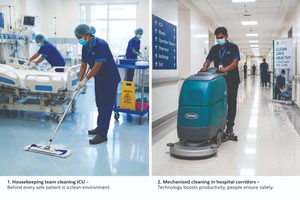
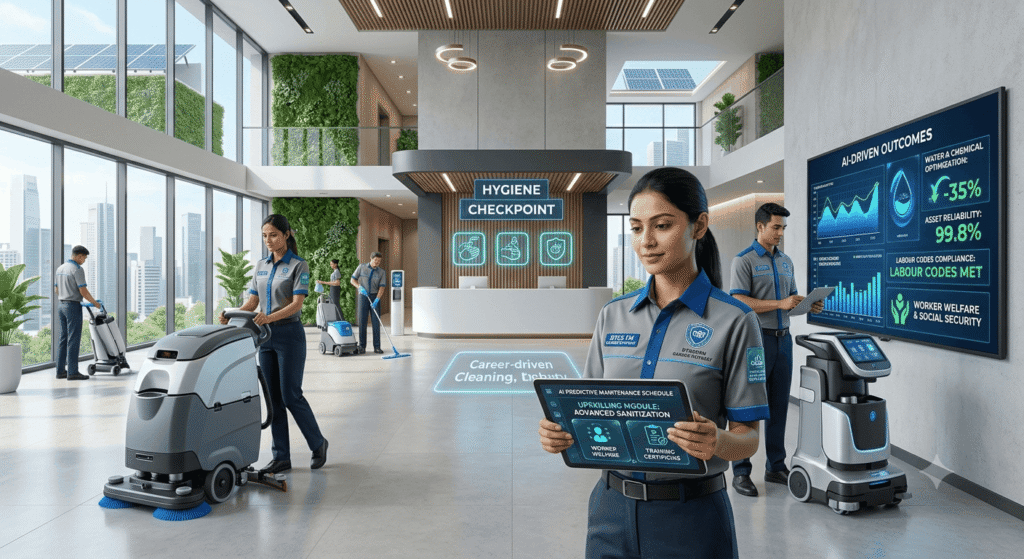
At the same time, customers expect measurable outcomes in service quality, resource efficiency and sustainability. Technology and mechanisation are becoming essential to address workforce constraints while improving productivity and supporting greener operations.
“Automation and mechanisation will improve cleaning precision while optimising water and chemical consumption.”— Sanjeev Kumar CEO, Dusters Total Solutions Services Pvt. Ltd.
Future Steps: AI, Robotics and Sustainable Facility Management
The next decade will be defined by the strategic convergence of AI, robotics, automation and sustainability. Together, they can reshape facility management into a more intelligent, efficient and outcome-driven industry.
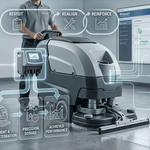
Automation and mechanisation will improve cleaning precision while optimising water and chemical consumption. AI will enable predictive maintenance, helping identify potential equipment failures before they disrupt operations. Robotics will automate repetitive and labour-intensive tasks, improving consistency and productivity.
The strategic opportunity lies in integrating these capabilities into a unified service delivery model where technology drives measurable outcomes in asset reliability, resource efficiency, service quality and cost optimisation.
Organisations that combine digital intelligence with skilled people and sustainable practices will be better positioned to build operational resilience and deliver long-term customer value.
Clean India Journal: A Connecting Thread Across the Industry
Clean India Journal acts as a connecting thread across the industry, bringing together perspectives from service providers, CEOs, directors, technology and chemical vendors, and other stakeholders.
“It distils these diverse viewpoints into insights that help the industry learn and evolve collectively. Its coverage spans facility management, hospitality, laundry, machinery, chemicals, sustainability and policy developments, combining industry news, data, innovations and thought-provoking advertisements and visuals. This holistic perspective helps readers understand developments beyond their own segments.
“Unlike digital content that can quickly disappear in the constant flow of information, a physical magazine offers a tangible, lasting reference that readers can revisit. Clean India Journal therefore serves as both a knowledge resource and a platform for connecting stakeholders, sharing best practices and advancing professionalisation across the industry.
“CIJ has been a valuable knowledge partner for DTSS, connecting industry stakeholders and bringing diverse perspectives, innovations and best practices onto a common platform. We also leverage its content through our internal Wisdom Hub, which has completed 44 sessions with 102 presentations, engaging 50+ attendees and fostering continuous learning.
“Our association has provided a platform to showcase DTSS’s capabilities and success stories, including the Puducherry Government Hospital model and our OpEx-led solutions, demonstrating how we translate initial soft services discussions into scalable, multi-location service solutions for clients.
“Equally inspiring are the frontline success stories featured, including Fransiska Barla and Supervisor Sumathi, celebrating employee growth and leadership,” said Sanjeev Kumar.