









 CIJConnect Bot-enabled WhatsApp today at 4:00 PM.
There is huge money to be made out of municipal solid and liquid waste as per a report of the central government. Waste is set to increase in coming years as the urban population is growing. However, without waste segregation at source, no progress can be made. In this report, Clean India Journal’s Manka Behl analyses the report and voices expert views
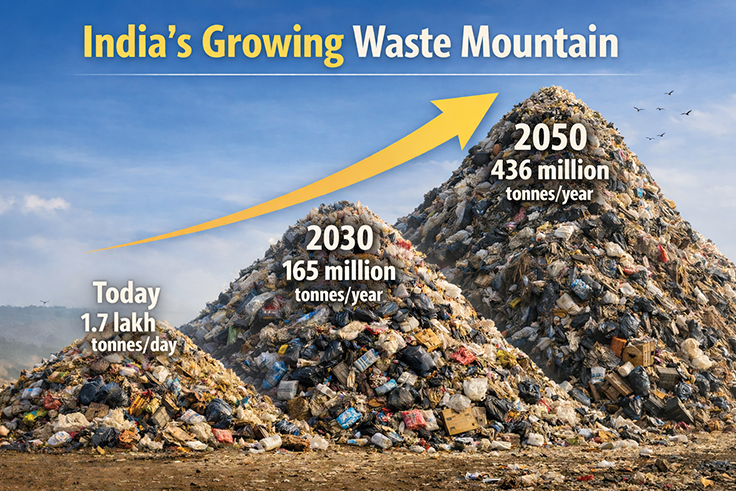
India generates over 1.7 lakh tonnes of municipal solid waste every day, but only about 54% of it is scientifically treated or processed, according to the Central Pollution Control Board (CPCB).

That remaining share of untreated waste is where the circular economy debate begins. Government assessments show that nearly 50% of the country’s municipal solid waste is organic, while a substantial share consists of recyclable dry materials such as plastic, paper and metal—waste streams that are largely being lost to dumping and landfilling.
The Math behind the Mess
According to a recent report by Ministry of Housing and Urban Affairs on ‘Circular economy in municipal solid and liquid waste’, recovering value from these streams could generate significant economic returns. “As the urban population is expected to grow to 600 million by 2030 and to 814 million by 2050, India is set to generate 165 million tonnes of waste by 2030 and 436 million tonnes by 2050,” the report states.
It also highlights that the annual greenhouse gas emissions from municipal solid waste are expected to go up to 41.09 million tonnes by 2030. Even as circular economy–based approaches are positioned as central to achieving the 2030 Sustainable Development Goals (SDGs), the overall data makes it clear that circular economy has moved beyond theory and is emerging as a practical response to India’s waste treatment gap.
It is against this backdrop that circular economy pathways—ranging from waste segregation, resource recovery to policy enforcement and technology adoption—came into focus at the Clean India Show, where experts examined how
India’s waste streams can be converted into economic and environmental assets. Speaking at the show, Dr Milind Kulkarni, Chairman and Director of Prakruti Education and Research Foundation, outlined the challenges and opportunities involved in shifting towards a circular economy.
Stressing on the importance of regulatory frameworks in driving compliance, the expert stated that noting that environmental action often gains traction when supported by legal and financial accountability. “Unfortunately, our solid waste management rules are just rules; they do not have strong legislative backing,” said Dr Kulkarni.
Cashing In
Defining waste as resources that are simply in the wrong place, Dr Kulkarni highlighted that the economic potential of the circular economy is estimated at `10–15 lakh crore. Government estimates underline the scale of this opportunity.
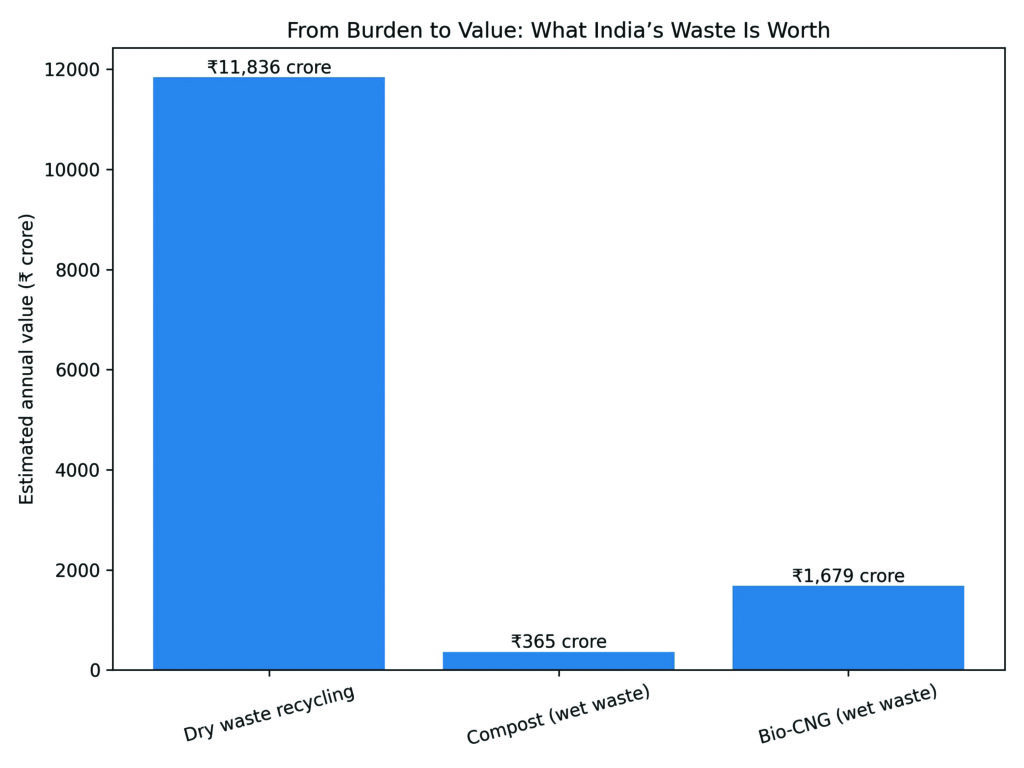
According to the report, dry waste recycling alone has the potential to generate ₹11,836 crore annually, while value recovery from wet waste through compost and Bio-CNG could add more than `2,000 crore each year. The report further estimates that, under a circular economy scenario, recovery of recyclable materials such as plastics, paper, metals and textiles could unlock daily value exceeding `46 crore.
Talking about the recovery potential, Dr Kulkarni said, “Achieving it is possible with recycling of paper, e-waste and heavy metals. Today, rare earth elements—used in mobile phones and electronic devices—are increasingly critical. These rare earths are largely controlled by China, and any disruption in supply can have serious economic consequences. This is why e-waste recycling is extremely important. Instead of mining rare earths from the ground, they can be recovered from discarded mobile phones and electronic waste,” – Dr Kulkarni said.
Green Jobs
Beyond value recovery, the shift towards a circular economy is also emerging as a significant source of employment, particularly across waste management and recycling value chains.
This employment potential is being backed by government skilling efforts, with the Ministry of Environment, Forest and Climate Change stating that over five lakh youth have been trained under the Green Skill Development Programme, including in waste management and recycling-related roles. NITI Aayog, the primary national planning authority, has also identified the circular economy as a labour-intensive growth pathway, particularly across recycling, repair and waste management value chains, noting its potential to generate large-scale urban employment.
As per the report, circular economy interventions in municipal solid waste management alone could generate nearly 58 lakh man-days of employment every year, spanning activities such as segregation, recycling, composting and waste-to-energy operations.
Drawing attention to the employment potential of circular economy practices, Dr Kulkarni said, “Many recycling companies are generating a large number of jobs – as high as three lakhs.”
Waste To Energy
Waste-to-energy is emerging as a key component of India’s circular economy strategy, with the country currently having over 200 MW of installed capacity from municipal solid waste–based projects.
Highlighting its benefits, Dr Kulkarni said, “Waste-to-energy not only reduces landfill dependence but also enables the recovery of energy from materials that cannot be recycled. Municipal corporations are processing hundreds of tonnes of plastic every day to generate energy. Energy is a valuable resource.”
The expert further stated that separating bio-waste can generate bio-gas which can be further used to generate electricity. “In Goa, the authorities have found a way to do this without depending on water. They compress the wet waste after which the solid part of it reduces significantly. While the solid portion is converted into compost, the remaining liquid is used to generate biogas. This is the approach we need to follow,” said Dr Kulkarni.
Innovations The Way
Similar innovation-driven approaches are being adopted in other cities too. “In Mumbai, the major problem is of mixed waste. However, if you look at cities like Indore and Ahmadabad, they have been comparatively successful in segregating waste into wet and dry categories which addressed a lot of their problems.
A housing society in Panaji has implemented an innovative segregation model that goes beyond conventional wet and dry waste separation. “In this society, waste segregation happens at a much more detailed level. The dry waste is segregated into as many as 16 different categories. When municipal workers or authorised vendors collect the waste, each category is recorded separately. At the end of the month, the housing society receives money based on this segregation. When there is a financial incentive, people ensure that segregation is done properly,” said Dr Kulkarni.
Stating that innovation plays a major role in waste management, the expert said, “More than 60,000 patents have been granted between 2016-2022, and around 90% of them are related to waste management and circular economy. Segregation remains a major challenge, and technologies such as AI-driven segregation systems and robotic sorting are being developed to address this issue.”
Government Policies Driving Change
Government policies, the expert noted, has played a central role in shaping India’s waste management framework over the past decade. “The launch of the Swachh Bharat Mission in 2014 marked a turning point, followed by the notification of the Solid Waste Management Rules in 2016. These rules mandate segregation of waste at source, composting of wet waste and recycling of dry waste,”
he said.
He also referred to the Plastic Waste Management Rules, notified in 2016, which introduced the concept of Extended Producer Responsibility (EPR). “Under EPR, manufacturers are required to take responsibility for the waste generated by their products even after sale. For instance, producers of thermocol and other packaging materials are obligated to collect and recycle the material they introduce into the market, failing which it poses serious environmental hazards. Plastic manufacturers are required to declare production volumes, sales to brand owners and retailers, and recovery mechanisms on the Central Pollution Control Board’s portal, creating a system of accountability,” explained
Dr Kulkarni.
As a result of these regulatory frameworks, institutions and housing societies are increasingly being compelled to adopt proper waste management practices, the expert added.
What We Can Do
Looking at the road ahead, the basic approach remains clear according to Dr Kulkarni —segregation at source, composting of wet waste, recycling of dry waste, and safe disposal of hazardous waste. “A good organisation ensures that the majority of its wet waste is composted and dry waste is recycled, with only a small fraction going to landfills. In contrast, a bad organization will not compost at all and just pick up valuable materials,” he said.
Suggesting what citizens can do at the household level, Dr Kulkarni emphasized that segregation must begin at the source. “Ideally, homes and societies should have separate containers for different waste streams. Wet waste should be disposed of daily, while dry waste such as plastic and metal can be stored and handed over to authorised collectors. When done properly, this system allows resources to be recovered and reduces the burden on landfills,” he added.
Amid the absence of a strong force of law to enforce segregation, education and awareness assume critical importance. Dr Kulkarni pointed out that many citizens are still unaware of authorised recyclers for items such as old mobile phones, electronic waste or used clothes.

Drawing from his own experience, Dr Kulkarni stated that many housing societies and institutions have successfully implemented segregation and composting systems. “Such examples demonstrate that waste management systems are most effective when responsibility is shared among citizens, waste workers and government agencies, rather than being passed on or disputed. Sustainable cities emerge not from isolated interventions but from sustained collaboration and collective ownership of waste management practices,” the expert said.