









 CIJConnect Bot-enabled WhatsApp today at 4:00 PM.
Parliamentary panel proposes hotel-tariff cap on private hospital room rent — what it means for hospital hygiene and billing
India’s private healthcare system is once again under scrutiny — not over the quality of medical treatment but over the rapidly rising cost of accessing it. The Department-related Parliamentary Standing Committee on Health and Family Welfare, chaired by Prof. Ram Gopal Yadav, has recommended that room charges in private hospitals in large metropolitan cities should not exceed the average tariff of three-star hotels in the vicinity of the hospital. The recommendation appears in the committee’s 176th Report, titled “Affordability and Accessibility of Healthcare Facilities in Public and Private Sector,” presented to the Rajya Sabha and laid before the Lok Sabha on 7 August 2026. Samaresh Acharya, Special Correspondent, Clean India Journal, analyses the impact of the recommendation on the already suffering hygiene practices.

The Parliamentary Standing Committee’s proposal is significant because room rent often goes beyond being merely the cost of accommodation. In many hospitals, the room category can influence the charges levied for associated services, making the choice of a room an important determinant of the final bill. The committee has therefore called for urgent rationalisation.
The paradox
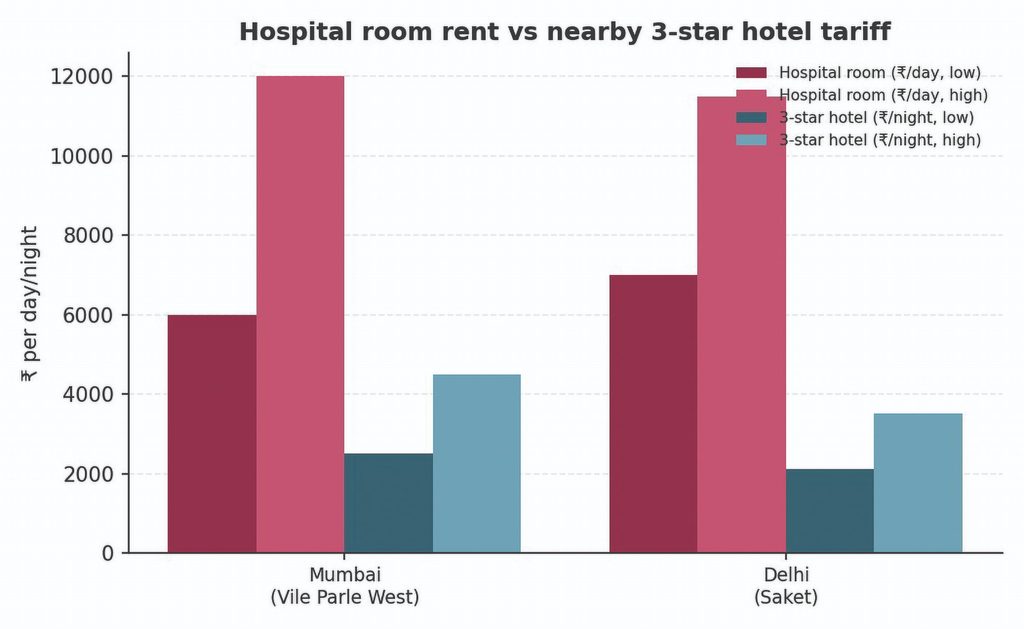
The committee’s recommendation draws attention to an uncomfortable contrast: patients frequently pay substantially more for a hospital room than for a room at a reasonably rated hotel located nearby.
The 176th Report cites two examples. At Nanavati Max Hospital in Mumbai’s Vile Parle West, a single private room reportedly costs between ₹6,000 and ₹12,000 a day, while three-star hotels in the surrounding area charge approximately ₹2,500 to ₹4,500 a night. At Max Super Speciality Hospital in Saket, Delhi, private rooms range from ₹7,000 to ₹11,500 per day, compared with ₹2,100 to ₹3,500 for nearby three-star hotel accommodation.

Of course, a hospital room cannot be treated as identical to a hotel room. Hospitals require infection-control infrastructure, clinical supervision, emergency preparedness, specialised cleaning, linen management and other services that hotels do not provide. Recognising this distinction, the committee has not suggested that the entire cost of hospitalisation should be restricted to hotel tariffs.
Instead, the committee has proposed a clearer separation: the basic room charge should be benchmarked against the prevailing three-star hotel tariff, while resident doctor cost, nursing cost, consumable disposables, meal charges and laundry charges can be added to that base.
The committee names laundry, along with resident doctor, nursing, consumable and meal charges, as costs that can be added to the base room tariff. Housekeeping and routine disinfection are not addressed as a separate line item in the recommendation — an omission this analysis argues should be corrected, given the genuine operational cost these services carry.
From a hygiene and facility-management perspective, this distinction is particularly important. A hospital room carries additional cleaning and infection-prevention responsibilities. High-touch surfaces must be disinfected, biomedical waste segregated, contaminated linen safely handled and rooms subjected to defined cleaning protocols. These legitimate costs need transparent recognition. The larger question is whether patients should pay an unexplained premium simply because a room is located inside a hospital.
The table below sets out what typically separates a hospital room’s cost base from a hotel room, and why the two cannot be benchmarked on rent alone.
Transparency needed
The committee’s proposal could improve affordability, but its real effectiveness will depend on how hospitals structure the remaining components of their bills.
The danger of a simple room-rent cap is that hospitals could shift costs elsewhere. If the basic room tariff is reduced but charges for nursing, consumables, laundry, administration or other services rise without transparent norms, the patient’s total bill may remain virtually unchanged.
This makes standardised and transparent billing as important as the proposed tariff ceiling.
Every hospital should ideally provide patients with a clear breakup of costs at the time of admission: room rent, nursing, doctor visits, diagnostics, medicines, consumables, meals, housekeeping and linen services. Patients should know not only what they are paying but also why they are paying it.
For example, hospital laundry is not comparable to ordinary commercial laundry. A sheet or napkin contaminated with blood or body fluids requires careful collection, segregation, washing, thermal or chemical disinfection and safe transport.
Similarly, housekeeping involves trained personnel, approved disinfectants, equipment and protocols. Such services create genuine operational costs — but transparency can distinguish necessary hygiene expenditure from arbitrary or inflated billing.
This is where professional facility management assumes greater importance. Hospitals that invest in efficient housekeeping systems, mechanised cleaning, centralised linen management, proper inventory control and resource-efficient laundry operations may be better positioned to control costs without compromising infection prevention.
The challenge, therefore, is not merely to make hospitals cheaper. It is to make healthcare billing more rational, measurable and accountable.
Healthcare expenditure
The committee’s observations on overall healthcare expenditure underline the much bigger problem. According to National Sample Survey data cited in the 176th Report, covering January–December 2025, average hospitalisation expenditure was ₹6,631 in government hospitals, compared with ₹50,508 in private hospitals.
The difference becomes even more revealing in childbirth-related expenditure: average out-of-pocket medical spending was cited at ₹37,630 in private healthcare facilities, against ₹2,299 in public facilities.
These numbers explain why regulating room charges, though important, can only be one part of the solution.
Private hospitals often argue that they bear substantial costs relating to technology, skilled manpower, infrastructure and round-the-clock clinical readiness. That argument has merit, particularly for advanced tertiary and critical-care facilities. However, patients also face serious concerns about excessive billing, unnecessary diagnostics and steep charges for routine procedures. A robust regulatory framework must therefore protect both quality healthcare and financial accessibility.
The committee has rightly linked affordability with the need to expand capacity in government hospitals. More beds, specialist doctors, diagnostics and better-quality public healthcare can reduce the excessive dependence on expensive private facilities. In effect, the best long-term check on unreasonable pricing is not regulation alone but a strong and competitive public healthcare system.
Important lesson
For the cleaning and hygiene sector, the debate offers an equally important lesson. Cost rationalisation must never mean cutting corners on infection prevention. Reduced expenditure on cleaning staff, disinfection, laundry or waste management may appear economical initially but can result in far greater costs if hospital-acquired infections increase.
The parliamentary committee’s three-star hotel benchmark is, therefore, best viewed as a starting point for reform rather than a complete solution. If implemented carefully, it could bring greater discipline to hospital room pricing. But meaningful affordability will require transparent billing, scrutiny of linked charges, efficient hospital operations and significantly stronger public healthcare infrastructure.
Healthcare should certainly not be treated like a hotel business. What the transparency argument ultimately demands is a bill that shows patients exactly what they are paying for — room, care and hygiene, each accounted for on its own terms.
| Cost driver | Hospital room | Hotel room |
| Disinfection standard | High-touch surface disinfection, defined cleaning protocols per shift | Routine housekeeping |
| Linen handling | Contaminated linen segregated, thermally or chemically disinfected, tracked | Standard commercial laundering |
| Waste management | Biomedical waste segregation and safe disposal | General waste only |
| Staffing | Trained housekeeping and nursing personnel on rotation | Housekeeping staff, no clinical training |
| Infrastructure | Infection-control systems, emergency readiness, clinical supervision | Standard hotel infrastructure |
| Consumables | Gloves, disinfectants, PPE, medical-grade supplies | Toiletries, minibar, standard amenities |