

Saturday, September 5, 2026
 - 
Afrikaans
 - 
af
Albanian
 - 
sq
Amharic
 - 
am
Arabic
 - 
ar
Armenian
 - 
hy
Azerbaijani
 - 
az
Basque
 - 
eu
Belarusian
 - 
be
Bengali
 - 
bn
Bosnian
 - 
bs
Bulgarian
 - 
bg
Catalan
 - 
ca
Cebuano
 - 
ceb
Chichewa
 - 
ny
Chinese (Simplified)
 - 
zh-CN
Chinese (Traditional)
 - 
zh-TW
Corsican
 - 
co
Croatian
 - 
hr
Czech
 - 
cs
Danish
 - 
da
Dutch
 - 
nl
English
 - 
en
Esperanto
 - 
eo
Estonian
 - 
et
Filipino
 - 
tl
Finnish
 - 
fi
French
 - 
fr
Frisian
 - 
fy
Galician
 - 
gl
Georgian
 - 
ka
German
 - 
de
Greek
 - 
el
Gujarati
 - 
gu
Haitian Creole
 - 
ht
Hausa
 - 
ha
Hawaiian
 - 
haw
Hebrew
 - 
iw
Hindi
 - 
hi
Hmong
 - 
hmn
Hungarian
 - 
hu
Icelandic
 - 
is
Igbo
 - 
ig
Indonesian
 - 
id
Irish
 - 
ga
Italian
 - 
it
Japanese
 - 
ja
Javanese
 - 
jw
Kannada
 - 
kn
Kazakh
 - 
kk
Khmer
 - 
km
Korean
 - 
ko
Kurdish (Kurmanji)
 - 
ku
Kyrgyz
 - 
ky
Lao
 - 
lo
Latin
 - 
la
Latvian
 - 
lv
Lithuanian
 - 
lt
Luxembourgish
 - 
lb
Macedonian
 - 
mk
Malagasy
 - 
mg
Malay
 - 
ms
Malayalam
 - 
ml
Maltese
 - 
mt
Maori
 - 
mi
Marathi
 - 
mr
Mongolian
 - 
mn
Myanmar (Burmese)
 - 
my
Nepali
 - 
ne
Norwegian
 - 
no
Pashto
 - 
ps
Persian
 - 
fa
Polish
 - 
pl
Portuguese
 - 
pt
Punjabi
 - 
pa
Romanian
 - 
ro
Russian
 - 
ru
Samoan
 - 
sm
Scots Gaelic
 - 
gd
Serbian
 - 
sr
Sesotho
 - 
st
Shona
 - 
sn
Sindhi
 - 
sd
Sinhala
 - 
si
Slovak
 - 
sk
Slovenian
 - 
sl
Somali
 - 
so
Spanish
 - 
es
Sundanese
 - 
su
Swahili
 - 
sw
Swedish
 - 
sv
Tajik
 - 
tg
Tamil
 - 
ta
Telugu
 - 
te
Thai
 - 
th
Turkish
 - 
tr
Ukrainian
 - 
uk
Urdu
 - 
ur
Uzbek
 - 
uz
Vietnamese
 - 
vi
Welsh
 - 
cy
Xhosa
 - 
xh
Yiddish
 - 
yi
Yoruba
 - 
yo
Zulu
 - 
zu
Our Products
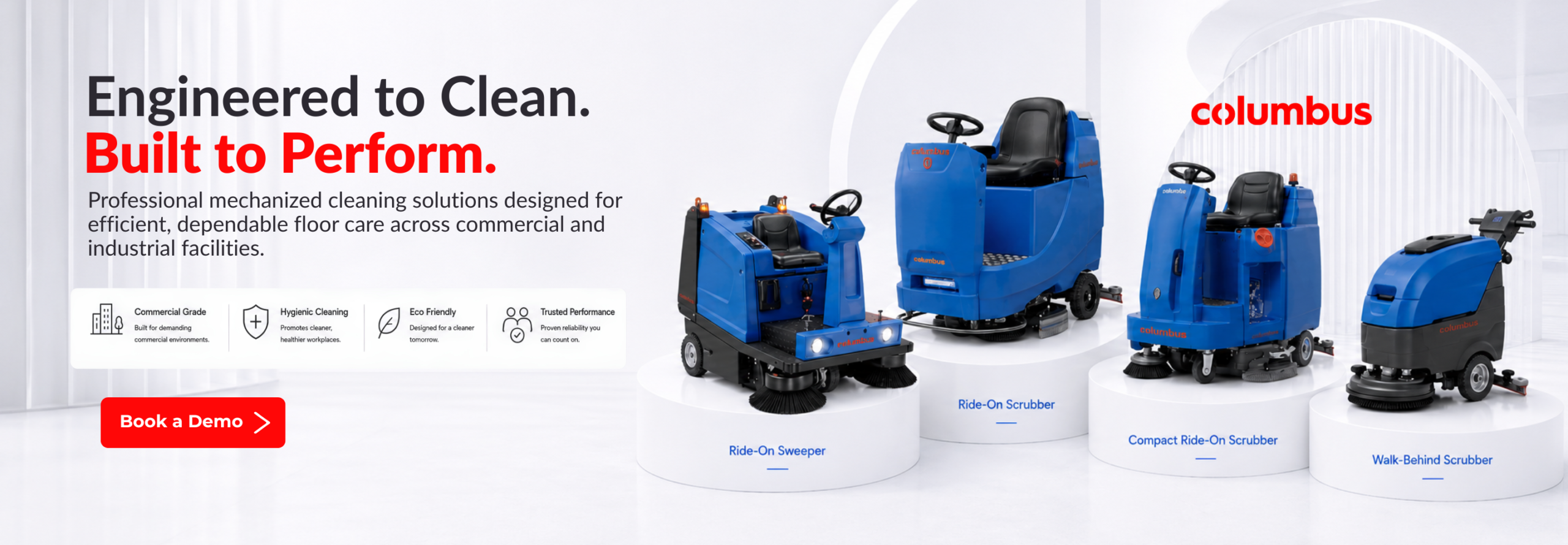
Professional Cleaning Machine Range
About Us
German Engineering Excellence for Professional Cleaning

Columbus brings decades of German engineering heritage to professional and industrial cleaning. Developed and produced in Stuttgart by G. Staehle GmbH u. Co. KG, Columbus machines are built on a philosophy of minimalist engineering, tough materials and sustainable, long-lasting use — helping cleaning teams work faster and more efficiently across commercial, institutional and industrial environments.

The product portfolio includes scrubber dryers (walk-behind and ride-on), sweepers (walk-behind and ride-on), single disc machines (low speed, high speed, excenter and thermopad variants), industrial vacuum cleaners (dry, wet and ATEX-rated), commercial upright and wet & dry vacuum cleaners, spray extraction machines and escalator & walkway cleaning equipment. Every machine is engineered for durability, ease of operation and consistent cleaning performance across indoor and outdoor spaces.

Clean India Show by Clean India Journal

Columbus also drives the shift toward autonomous cleaning, partnering with leading robotics brands such as Gausium through its PHILON Centre of Excellence — bringing together robotics development, integration and sales to help organisations automate everyday cleaning tasks and boost efficiency. Columbus supports customers through dedicated advice & training, flexible financing solutions and ongoing technical service, ensuring machines deliver reliable performance over their full working life.

Why Columbus
Capabilities & Strengths That Set Us Apart

Minimalist Engineering

Innovation with a clear focus — Columbus machines are designed with precision engineering that keeps operation simple without compromising performance.

Built to Last

Tough materials and rugged construction mean Columbus machines are made to endure demanding daily use across commercial, industrial and institutional sites.

Wide Product Range

A complete floorcare lineup — scrubber dryers, sweepers, single disc machines, industrial and commercial vacuums, spray extraction and escalator cleaning equipment — for varied cleaning applications.

Sustainable by Design

True sustainability lies in endurance — Columbus is part of the EUnited Cleaning "Green Cleaning" initiative and has been recognised with an EcoVadis sustainability award, reflecting its commitment to responsible manufacturing.

Robotics & Autonomous Cleaning

Through its PHILON Centre of Excellence and partnerships with robotics leaders like Gausium, Columbus develops and integrates autonomous cleaning and service robots to help businesses reduce workload and improve efficiency.

Dedicated Service

Customer support is a matter of character — Columbus backs its machines with advice & training, financing solutions and hands-on technical assistance to ensure long-term, reliable performance.

Enquire Now

Connect with our cleaning solutions experts

Please enable JavaScript in your browser to complete this form.
Our Perspectives
Latest Insights

Ready to Upgrade Your Cleaning Operations?

Partner with Columbus for professional and industrial cleaning machines — scrubber dryers, sweepers, single disc machines, vacuums and spray extraction systems — backed by over 50 years of German engineering heritage and dedicated advice, training and technical support.

Request a Free Demo

Subscribe For Download Our Media Kit

Get notified about new articles

Shopfloor Cleaning: Matching Machines to Industrial Needs
Industry Cleaning 6 min read

Shopfloor Cleaning: Matching Machines to Industrial Needs


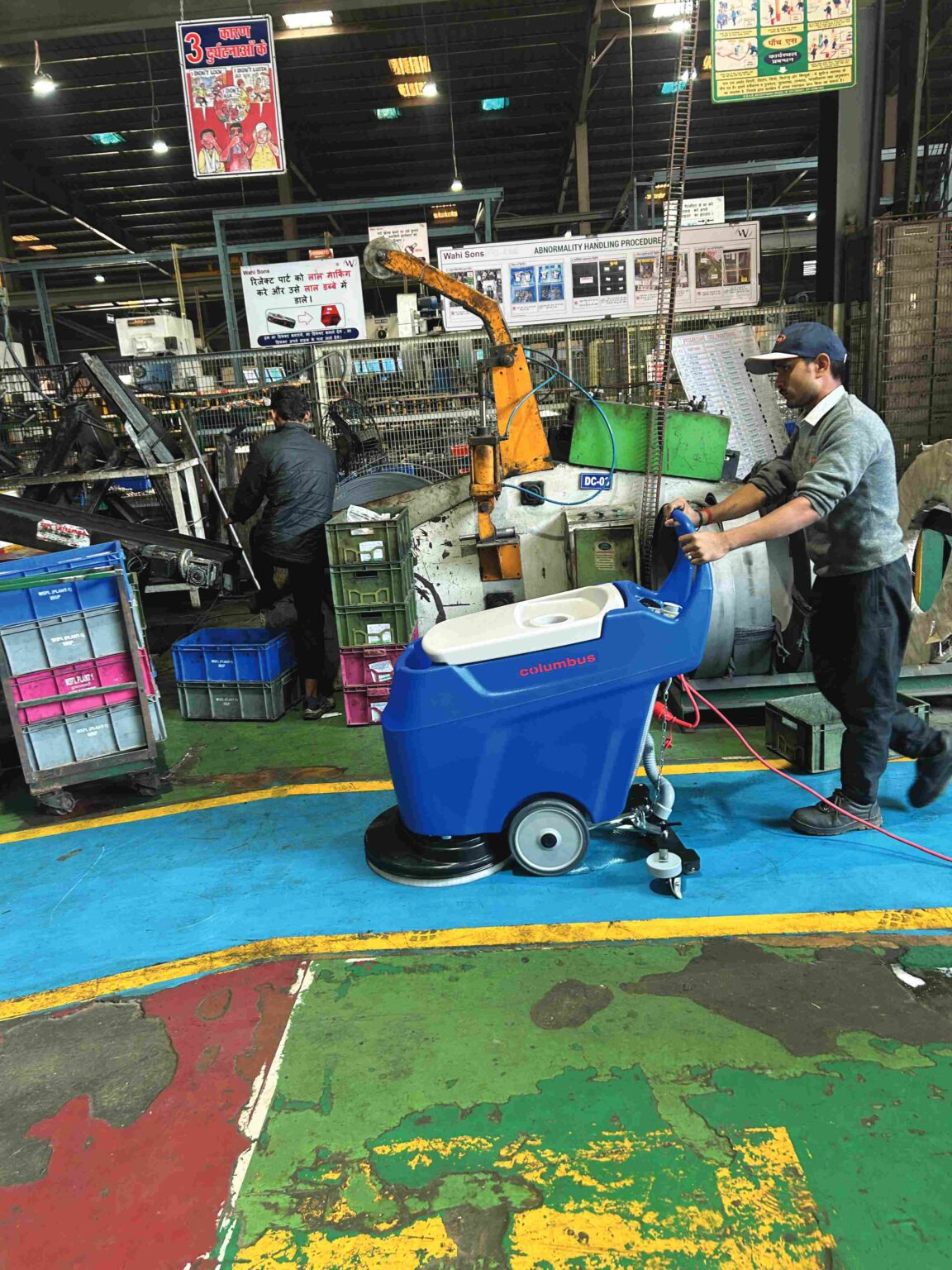
In terms of cleanliness, what has been the norm for international MNCs for years, is now being adapted even by MSMEs besides corporates in India. There is a growing understanding of the need to maintain clean shopfloors.

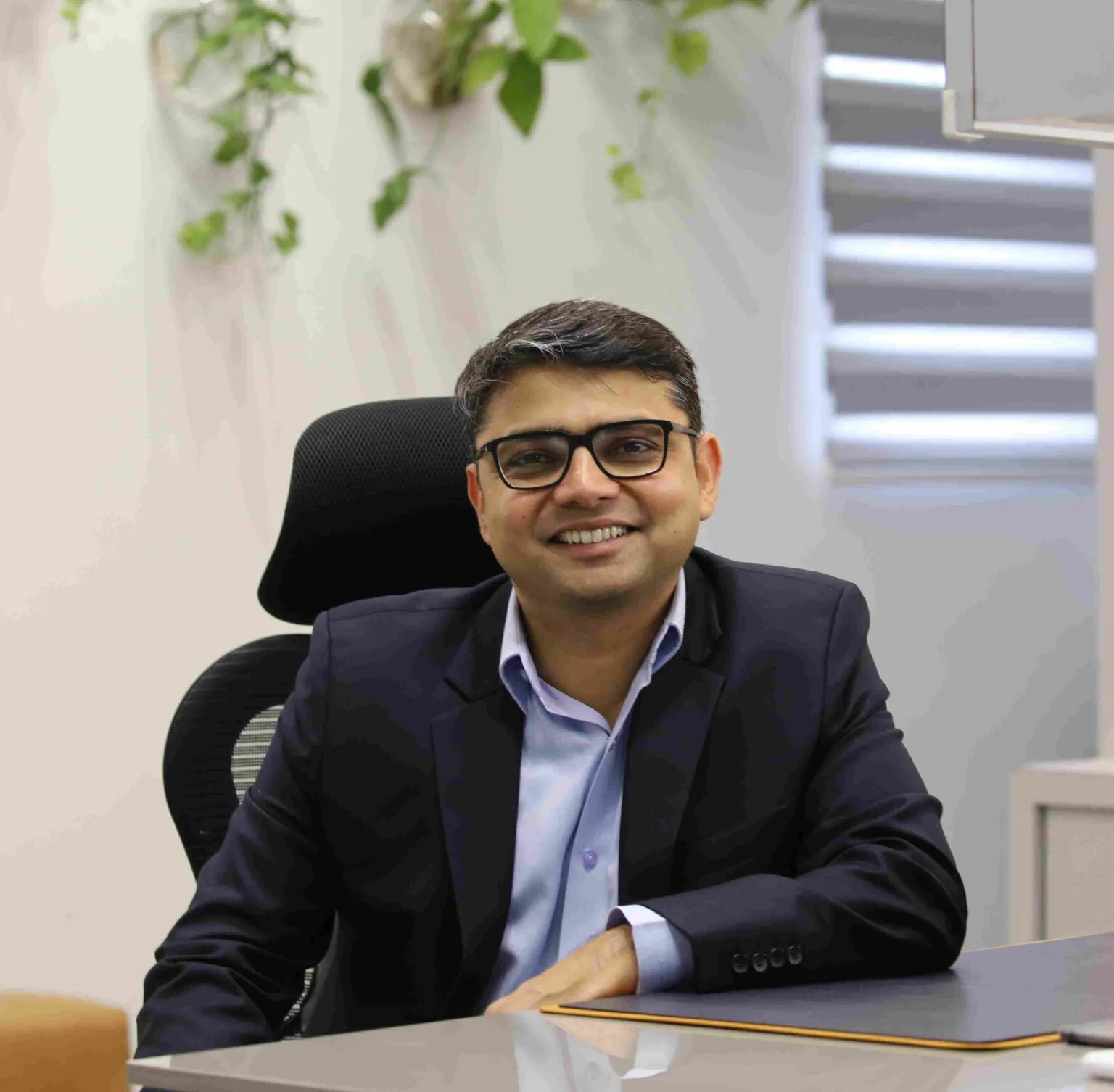
Sahil Jain, Managing Director, columbus Cleaning Machines Pvt. Ltd, elaborates on how the impact of maintaining clean spaces could help in the elimination of visual and distractive clutter; enable efficient access to materials; create positive mental impact for a sense of calm and productive mood and maintain a professional attitude.

Selecting the right cleaning machine depends on factors like floor type, debris type, area size, and budget. A one-size-fits-all approach does not work in industrial cleaning.
— Sahil Jain

Cleaning machines used in shopfloors

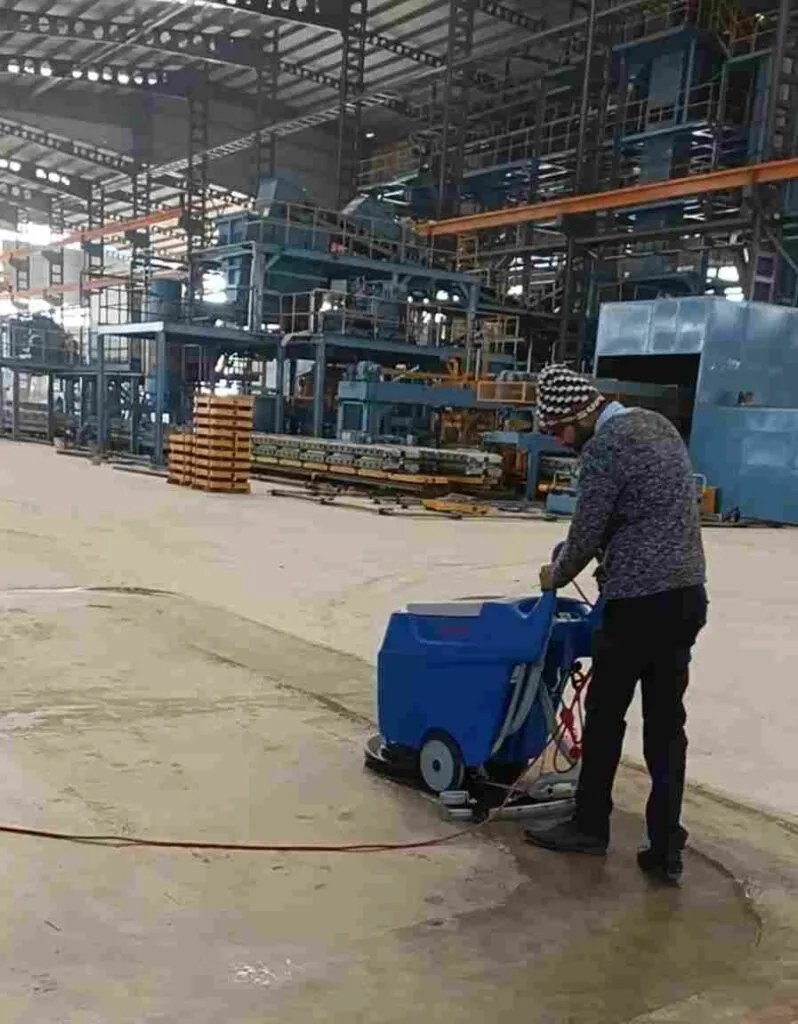
In industrial shopfloors, the type of floor cleaning machine needed depends on factors like the floor material, the type of dirt or debris present, and the size of the space. Here’s a breakdown of cleaning machines commonly used in industrial settings and the tasks they are best suited for:

  1. Floor Sweepers: Sweepers are used to collect and remove dry debris such as dust, dirt, metal shavings, and small trash. They are ideal for quickly covering large, open spaces or concrete and asphalt floors.
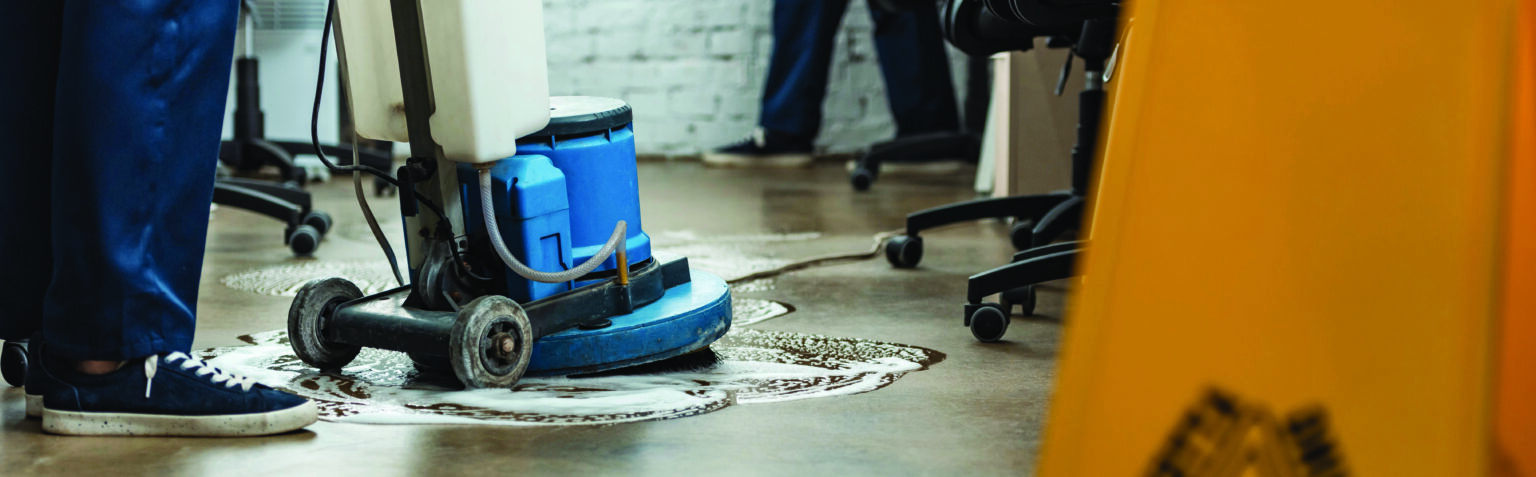
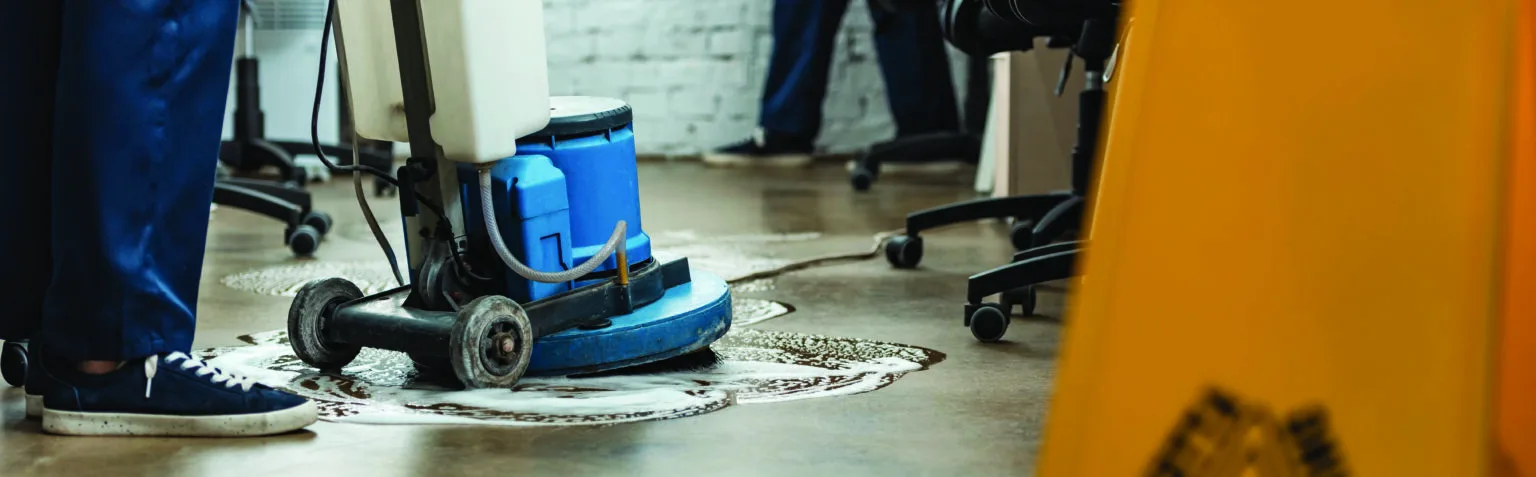
  2. Scrubber Dryers (Walk-Behind or Ride-On): Scrubbers use water, detergent, and rotating brushes to deep-clean floors, breaking down dirt and grime. They are excellent for sticky messes, oils, grease, and other substances that require deeper cleaning. Essential in factories or production areas where floors are exposed to oils, grease, food production residue, or manufacturing byproducts. Ideal for concrete, tile, or sealed floors.
  3. Industrial Vacuum Cleaners: Designed to capture fine dust and debris that sweeping or scrubbing machines might miss, especially in areas with limited access for scrubbers. Some models handle both dry and wet debris, making them versatile. Perfect for environments with fine powders such as wood dust, metal dust, or chemical powders, or in areas that require a high level of cleanliness, such as clean rooms, electronics factories, or hazardous material zones. HEPA-filtered vacuums are particularly effective in industries where air quality is crucial.
  4. Pressure Washers: High-pressure water jets blast away dirt, grease, and other tough contaminants. They’re ideal for cleaning stubborn stains or heavily soiled areas. However, they are not suitable for areas with a high risk of water damage, such as certain machinery, electrical systems, or environments with hazardous substances. They can also damage sensitive flooring, such as epoxy-coated floors commonly found in pharmaceutical companies or wooden flooring.
Industrial shopfloor cleaningIndustrial cleaning equipment

Best machines for specific needs

Selecting the right cleaning machine depends on factors like floor type, debris type, area size, and budget. A one-size-fits-all approach does not work in industrial cleaning. Solutions are tailored to match specific client requirements.

A range of accessories, including batteries, brushes, and squeegees, are available for scrubbers, along with specialized kits for industrial vacuums—such as HEPA filters, H-class filters, pre-filters, and anti-static kits—ensuring compatibility with diverse cleaning needs.

Operational cost efficiency is prioritized through high-capacity ride-on machines equipped with 100L tanks and 390Ah battery options, providing up to 8 hours of runtime on a single charge. This setup helps reduce both capital expenditure and labor costs.

Improved efficiency and reduced costs

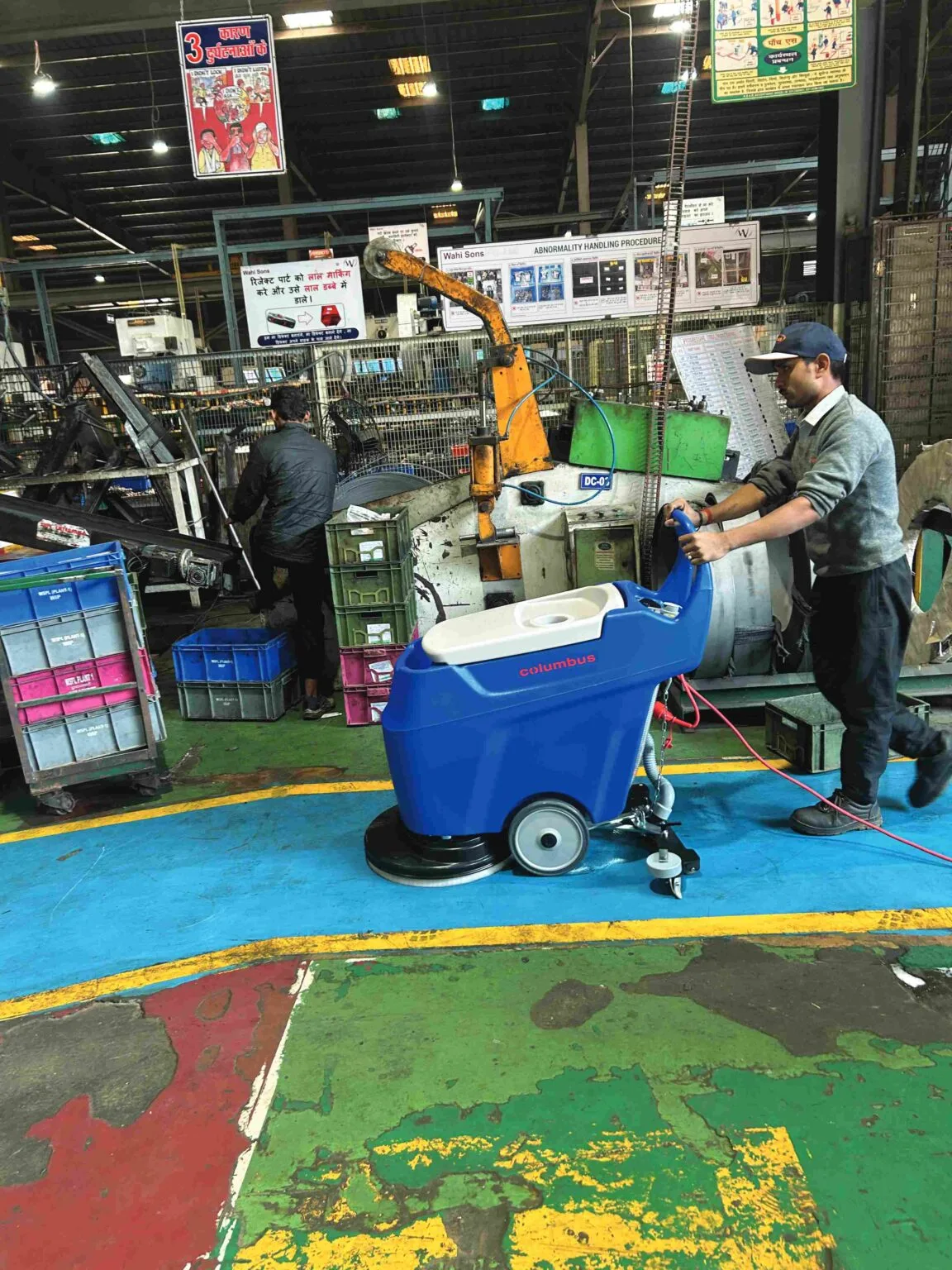
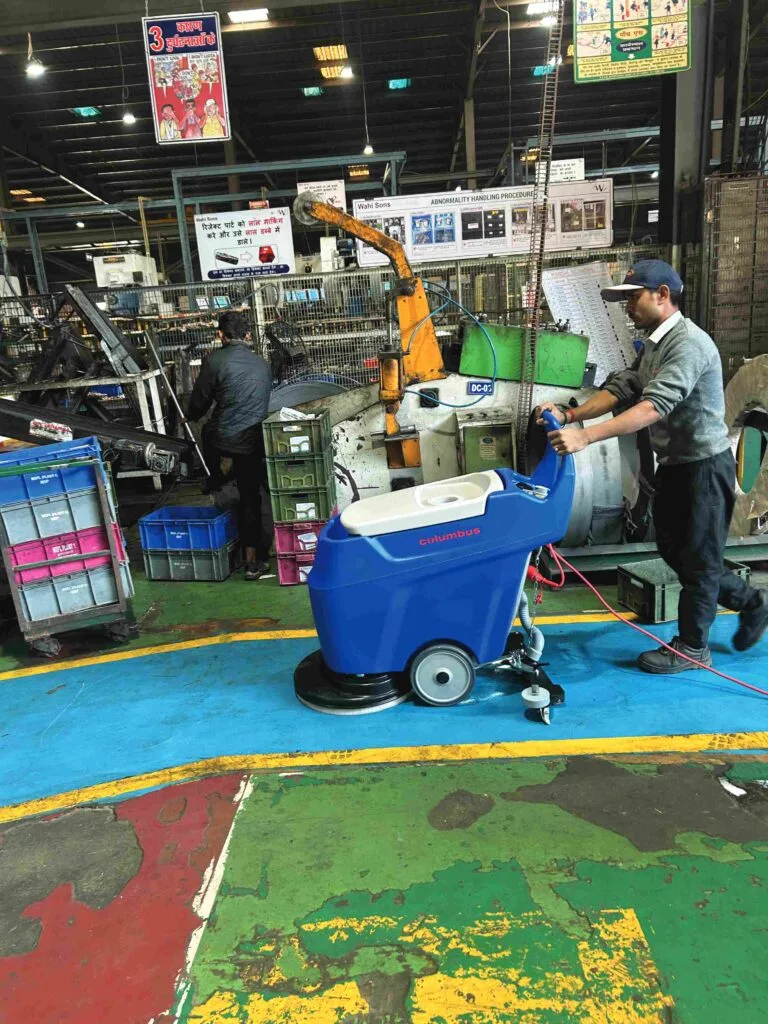
A recent project in a railway wagon manufacturing facility led to a 30% reduction in cleaning costs. By optimizing machine selection, the facility transitioned from three machines with three operators to two high-efficiency ARA100 ride-ons, maintaining cleanliness and safety while lowering operational expenses.

In the metals industry, specialized equipment is available to collect liquids such as oil and coolant along with metal chips, efficiently separating them for reuse or resale—minimizing waste and maximizing resource recovery.

In a non-woven fabric board manufacturing unit, airborne fabric fluffs from cutting and processing posed both a health risk and cleanliness challenge. A customized industrial vacuum system was integrated into the production line, effectively capturing lint at the source and improving workplace safety and hygiene.

An advanced airflow management system in the latest sweepers enhances dust control by integrating vacuum motors in the side brushes to capture airborne particles during sweeping. The ride-on models feature a self-leveling main brush to adjust for uneven factory or paver block flooring. Machines use an overthrow principle for maximizing hopper capacity, improving productivity, and reducing downtime.

Machines are designed with the lowest noise levels while providing the highest coverage area, brush, and suction pressures to ensure superior cleaning performance. A robust build with a steel chassis and high-quality components extends machine lifespan, reducing breakdowns and maintenance costs. This not only lowers overall ownership costs but also reduces environmental impact by minimizing plastic waste.

Maintenance, Operations, Effectiveness

A streamlined design focuses on essential components, eliminating unnecessary complexity for improved functionality and maintenance. Scrubber dryers feature just two operation buttons — one for water/brush and another for suction. Large ride-on machines have swivel recovery tanks for quick access to vital components and batteries. Simple electrical wiring and basic mechanical operations enhance ease of maintenance.

Each machine is supplied with easy-to-understand operation and maintenance manuals, along with self-help troubleshooting videos. A language-free, symbol-oriented maintenance card is included for daily and weekly upkeep, complemented by stickers on machine parts for easy reference. A yellow circle indicates daily cleaning, while a yellow square marks weekly maintenance tasks.

A highly capable team of technicians is always available for support, ensuring machines operate at peak efficiency with minimal downtime.

Cleaning chemicals and equipment
Expert Guide 8 min read

How To Decide on the Chemicals to Feed Your Equipment?


Not all cleaning chemicals are created equally, especially when it comes to protecting your equipment. Choosing the wrong solution can lead to corrosion, foaming, seal damage or even complete machine failure. This guide will help you evaluate which chemicals are safe, effective, and compatible with your floor scrubbers, vacuum cleaners, and other industrial cleaning machines.

Enzyme-Based Solutions: Decoding What is Truly Sustainable

Kshitiz Chaudhary, Founder & MD, Cizar Hygienecare Pvt. Ltd.

When evaluating enzyme-based cleaning solutions, buyers should start by closely examining the ingredients. A genuinely sustainable product should use biodegradable, non-toxic components, free from harsh chemicals, and pH is a factor when you can understand if it is safe or not.

There could be the claim that a cleaning chemical is enzyme-based, hence considered an eco-friendly cleaning chemical, but you can use enzymes to enhance the efficacy of your present toxic chemical-based cleaning chemicals. Buyers should look for full ingredient disclosure.

Beyond ingredients, efficacy and dilution are where enzyme-based products distinguish themselves. A good formulation will work effectively at high dilutions, reducing both cost-in-use and packaging waste and environmental impact.

Additionally, the contact time required for action should align with the intended application — fast-acting for daily cleaning, longer dwell times for deep cleaning or organic digestion. In sum, enzyme cleaners can offer powerful, sustainable alternatives to traditional chemicals when chosen based on transparent formulation, proven performance, and responsible use recommendations.

Choosing Equipment-Compatible Chemical Solutions

Sahil Jain, Managing Director, columbus Cleaning Machines Pvt Ltd.

Certain chemical solutions, while effective at cleaning, can inadvertently damage cleaning equipment if not chosen carefully. Harsh acids and bases — such as hydrochloric acid or sodium hydroxide — can corrode steel and degrade seals, leading to premature equipment failure.

Strong oxidisers like hydrogen peroxide, peracetic acid, or bleach may deteriorate plastics, rubber components, and sensitive fittings if not properly rinsed.

Solvent-based degreasers, often used to remove oily residues, can be particularly aggressive — drying out gaskets, softening tubing, or affecting pump seals. Even alcohols like isopropanol, though commonly used, can weaken machines over time.

These risks highlight the need to balance cleaning power with chemical compatibility to avoid compromising equipment performance.

Also, for particularly challenging or aggressive environments, we always suggest choosing the right SOPs along with specific machines like stainless steel chassis or oil-resistant squeegees and rubber guards.

On the other hand, certain formulations can help maintain and even extend the life of cleaning equipment. Neutral-pH detergents and low-residue disinfectants are generally safer for internal components and reduce the risk of buildup or clogging.

Degreasers, often water-based or emulsifying types, offer strong cleaning action for oily surfaces without the material damage associated with harsher solvents. Anti-foaming agents, when incorporated into cleaning solutions, also play a crucial role by preventing excessive foam generation that can disrupt sensors, or cause suction motors to fail.

Selecting cleaning agents with both performance and material safety in mind ensures operational reliability and extends the service life of critical cleaning equipment. We always advise customers to perform small-scale compatibility and efficacy tests before full-scale implementation, especially when using a new chemical or cleaning a new material.

Preserving Equipment in Critical Environments

Saleel Kodambadan, Sr. Manager – Training & Business Operations (Kerala), Tennant Company

When evaluating chemical solutions for critical area cleaning, it is essential to choose products that do not compromise the performance or longevity of cleaning equipment.

Chemicals should be tested and proven non-reactive with sensitive internal components like seals, pumps, tanks, spray nozzles, and dosing systems. This is especially important for machines that rely on automated chemical dosing, where the viscosity and concentration of the solution must remain consistent to ensure accurate delivery.

Using incompatible chemicals can lead to equipment breakdowns, inaccurate dosing, clogging, or even void warranties.

Equally important is choosing low-foam, non-corrosive, and residue-free formulations that meet hygiene and environmental standards. In critical environments such as pharmaceutical cleanrooms, hospitals, and food processing units, these solutions must leave no films or residues that could affect sterility or compliance.

Choose chemicals certified by recognised agencies like NSF, CE, or REACH, and aligned with cGMP, HACCP, or ISO cleanroom classifications. Most importantly, ensure they come with documented compatibility for specific equipment types — such as floor scrubbers, vacuum cleaners, or high-pressure washers — to maintain operational efficiency and support compliance goals.

Understanding Green Chemistry and Certification

Sandhya Shrivastava, PhD, Director, Bhavan’s Research Center, Retd. Associate Professor, Department of Microbiology, Bhavan’s College

Green chemicals, also known as environmentally friendly or sustainable chemicals, are substances designed to minimise harm to human health and the environment, as these aim to reduce or eliminate the use of hazardous substances during the design, manufacture, and application of chemical products.

Their relevance is growing rapidly, in almost all sectors as the general public, industry, and regulatory bodies are getting more concerned and cautious about environmental safety and sustainability.

Though there are multiple areas where green chemicals are being used, there is a focused approach for using the green chemicals in the areas of cleaning and disinfection, as most of the currently used chemicals are harsh, contributing to not only pollutants, but also leading to development of antimicrobial resistance.

Key Features

  1. Non-toxic or low toxicity, biodegradable: Traditional cleaning agents such as bleach, ammonia, phenols are being replaced by biodegradable actives, such as hydrogen peroxide, organic acids (viz. citric, lactic, or acetic), enzymes (viz. proteases, amylases, lipases), plant-based surfactants (viz. coconut, corn-derived).
  2. Environmental Footprint Reduction: The green chemicals degrade rapidly in natural environment, bioaccumulation and residual toxicity for aquatic life is minimal. Chemical burden in wastewater is reduced. Rate of development of resistance to antimicrobial agents is also lowered.
  3. Use of solvent-free or benign solvent systems: Using water-based or green solvents like ethanol, glycerol, or ethyl lactate, as against chlorinated or petrochemical-based agents.
  4. Compliance and Certifications: Products that follow sustainable cleaning chemistry principles are often certified under BIS Eco Mark (India), ECOCERT (Europe), US EPA Safer Choice (USA), etc.
  5. Limitations of using Green Chemicals: Higher cost (H₂O₂ vs phenolics), lesser efficacy (less potent, slow-acting), shorter shelf life (as are more sensitive to temperature, light, or contamination), standardisation and certification challenges.

Transitioning to Sustainable Cleaning Options for a Microbiology Laboratory

  • Reduction in environmental footprint: Green disinfectants like hydrogen peroxide or plant-based quats can replace harsher compounds like glutaraldehyde or chlorine-based agents.
  • Use of chemicals that degrade more readily, simplifying downstream waste treatment.
  • Improves safety for staff, thus helps with alignment with biosafety and regulatory requirements.
  • Aligns with ESG goals and sustainability mandates.

In conclusion, with numerous research laboratories and industries working on green chemicals, integration of green cleaning chemicals in all walks of life is a practical and ethical step toward safer, more sustainable practice for meeting one-health objective.

While initial adoption may require planning and investment, the long-term benefits — safer workspaces, regulatory compliance, and reduced environmental footprint — make the transition both necessary and worthwhile.

With increasing awareness and the growing availability of certified products in India, now is the ideal time for creating awareness and for institutions to embrace green chemistry.

Prioritising Ingredients to Align with Sustainability

Vanchinathan Sivaswamy, Head-Sales, SAARC, Rossari Professional

  1. Biodegradable Ingredients: Our formulations incorporate ingredients that break down naturally and quickly in the environment, minimising ecological impact.
  2. Non-Toxic Composition: We ensure our cleaning chemicals are free from harmful substances such as phosphates, chlorine, ammonia, VOCs and synthetic fragrances, promoting safety for both users and ecosystems.
  3. Use of Renewable and Natural Raw Materials: Rossari Professional emphasises sourcing ingredients derived from renewable resources, reducing dependency on petrochemical-based components and supporting sustainable supply chains.
  4. Elimination of Hazardous Chemicals: Our products are formulated to exclude persistent and hazardous substances, adhering to global safety and environmental standards.
  5. Low VOC Emissions: We develop products with low or zero VOC content to improve indoor air quality and reduce atmospheric pollution.
  6. Certifications and Eco-Labels: Our products often carry recognised sustainability certifications like Green Seal reflecting our commitment to environmental responsibility.
  7. Concentrated Formulations & Eco-Friendly Packaging: We focus on creating concentrated formulas that reduce packaging waste and transportation footprint, paired with recyclable and eco-conscious packaging options.
  8. Fragrance and Dye-Free Options: To promote health and environmental safety, many of our cleaning solutions are fragrance-free or utilise natural scents, avoiding synthetic dyes and fragrances.

Sahil Jain, Managing Director, columbus Cleaning Machines Pvt. Ltd.
Interview 5 min read

Need to Use Modern Machines to Improve Productivity and Sustainability


In today’s cleaning industry, efficiency, sustainability and consistent quality are no longer optional — they are essential. Advanced cleaning machines are transforming how organisations manage hygiene while reducing labour time, saving resources and ensuring uniform cleaning standards, says Sahil Jain, Managing Director, columbus Cleaning Machines Pvt. Ltd.

Advanced cleaning technology is not just about speed — it ensures consistent quality, reduces resource consumption and pays back its investment in under two years.

How does investing in advanced cleaning equipment reduce overall cleaning time and labour costs?

The implementation of ride-on scrubber dryers provides a reduction of over 50 per cent of working time compared to standard walk-behind scrubber dryers. The faster working speed enables time saving and labour cost savings.

The extra costs for the purchase of a ride-on scrubber dryer will be balanced within two years, with return on investment achievable in 18 to 20 months. Using ride-on scrubbers instead of walk-behind scrubbers leads to higher cost effectiveness.

Comparison between Walk-Behind and Ride-On Scrubber Dryers

  • Working Width: 55 cm (walk-behind) vs 66 cm (ride-on)
  • Cleaning Speed: 2.5 km/h vs 4–6 km/h
  • Practical Coverage Area: 1500 m²/h vs 2770 m²/h
  • Increased Efficiency (Surface): +1270 m² with ride-on
  • Time Saving per Hour: 32 minutes (54%)
  • Time Saving per Year: 640 hours

On a medium-sized area of 30,000 sqm

  • Walk-behind machines (5 units + 5 operators): ₹1,65,000 per month
  • Ride-on machines (3 units + 3 operators): ₹1,35,000 per month — an 18 per cent saving
  • Higher the area, higher the savings.

How does modern cleaning technology improve cleaning quality and consistency?

Modern cleaning technology provides a level of quality and consistency that is difficult to achieve with manual labour.

Automated machines are programmed to follow precise patterns and apply the correct amount of pressure, detergent and water, ensuring a uniform clean across all surfaces. This eliminates the risk of human error, such as skipping a spot or applying too much or too little cleaning solution.

columbus machines come with HACCP compliant tanks and advanced features like microfibre technology and specialised brushes and squeegees that capture microscopic dirt particles and allergens, leading to a deeper and more hygienic clean.

This is particularly important in sensitive environments like hospitals and food processing facilities, where a high standard of cleanliness is non-negotiable.

“We want to push forward, not just lead the way. We therefore focus our attention on the essentials: What are the innovations that solve real problems? How do we implement them without making the machines more frail? And last but not least, the supreme discipline of engineering: How can we simplify existing solutions to such an extent that our machines become even more robust and sustainable?”

How does automated or smart cleaning equipment impact energy, water and chemical usage costs?

Sustainability is a key feature of all modern cleaning equipment. Less material consumption thanks to purist engineering, targeted use of recyclable materials, intelligent metering systems, energy-efficient, smooth-running gearboxes with minimum three-years warranty – these are just some of the parameters through which we are continually optimising the sustainability of our products.

The most important, however, is and remains the durability of our machines. Because only what lasts a long time can really be green.

Water-saving features, such as smart-dosing systems, Quick-Stop, splash guard and the special columbus-patented Water-Stop brushes can reduce water consumption by a significant margin.

Similarly, chemical-dosing systems ensure that the precise amount of cleaning solution is used for each task, preventing wastage and reducing the overall cost of chemicals. This not only benefits the environment and surface but also leads to substantial long-term savings.

Energy-efficient motors, low-noise operation and timed cleaning cycles reduce power consumption. These optimisations directly contribute to lower utility bills and chemical procurement costs — further enhancing the bottom line while supporting environmental goals.

What role does equipment durability and low maintenance play in long-term profitability?

The initial investment in advanced cleaning equipment might seem high, but its durability and low maintenance requirements make it a profitable long-term asset.

High-quality machines are built with robust materials that can withstand rigorous daily use, reducing the frequency of repairs and replacements. This minimises downtime and ensures that cleaning operations run smoothly without interruption.

Moreover, all our machines are designed for easy maintenance, with modular parts that are simple to replace. This reduces maintenance costs and the need for specialised technicians.

The combination of durability and low maintenance ensures a longer lifespan for the equipment, providing a greater return on investment and contributing significantly to the company’s long-term profitability.

India Is Building at Scale. But Who’s Thinking About the Upkeep?
Industry 12 min read

India Is Building at Scale. But Who’s Thinking About the Upkeep?


India’s infrastructure-led growth is creating a ripple effect that is steadily reshaping the cleaning ecosystem. While the Union Budget stops short of direct policy triggers, the scale of new assets — from airports to industrial hubs — is set to drive long-term demand for maintenance, mechanisation and automation. The opportunity is clear but gradual, shaped by cost, skills and adoption realities. Clean India Journal’s Manka Behl spoke to industry experts on how the sector is evolving alongside this shift.

The country’s Union Budget, presented earlier in the year by Finance Minister Nirmala Sitharaman, doubles down on a familiar ambition — build bigger, build faster, and build across sectors. From high-speed rail corridors and logistics networks to industrial clusters and urban expansion — the blueprint for growth is firmly anchored in infrastructure.

But as cranes rise and concrete spreads, a quieter, less visible layer of this growth story is beginning to come into focus: What happens after the build is complete?

For India’s cleaning ecosystem, the Budget does not offer direct policy triggers. Yet it sets in motion a chain reaction. Every airport terminal, warehouse, hospital, metro station or industrial hub being planned today becomes, eventually, a space that must be cleaned, maintained and managed — not occasionally, but continuously.

The result is a sector that sits just outside the spotlight of policy, but increasingly at the centre of execution.

Industry voices suggest that the opportunity is real, expanding and inevitable — but also gradual, uneven and shaped by on-ground realities of cost, scale, skills and adoption.

Think Upkeep

As infrastructure creation accelerates, a key theme emerging from the industry is the need to align construction with long-term upkeep.

“India’s strong push toward infrastructure creation through record capital expenditure is undoubtedly a positive step for economic growth. However, while we are building world-class transport networks, logistics hubs, airports, industrial parks, and urban infrastructure at an unprecedented pace, the conversation around long-term maintenance of hygiene and cleanliness at these locations is still evolving,” says Vedant Matta, Director-Sales of Charnock Equipments Pvt Ltd.

Vedant points out that globally, infrastructure planning integrates mechanised cleaning, facility management and predictive maintenance at the design stage. “In India, however, maintenance technologies are often introduced only after the asset becomes operational,” he says.

This, he notes, can lead to inefficiencies, higher costs and faster deterioration of public infrastructure. “As the country expands its asset base, there is a growing need to embed modern cleaning technologies, smart facility management systems, and data-driven maintenance planning into infrastructure projects from the outset. This will not only extend the lifespan of assets but also ensure hygiene, safety, and sustainability in high-footfall environments such as airports, metro stations, hospitals, and public buildings,” adds Vedant.

“As the country expands its asset base, there is a growing need to embed modern cleaning technologies, smart facility management systems, and data-driven maintenance planning into infrastructure projects from the outset.”
— Vedant Matta

According to Sahil Jain, Managing Director of Columbus Cleaning Machines Pvt Ltd, the cleaning industry will not see an immediate spike, with most benefits expected to accrue over the long term. “The government’s focus on infrastructure development, civic spending and smart cities is expected to create opportunities over time. However, cleaning is not something which has come into direct focus as infrastructure projects will not generate immediate demand. But once they get commissioned, that will obviously add something to the industry segment,” says Jain.

In the near term, increased public capital expenditure could provide indirect support. “When they increase the public capital expenditure, it basically also acts as an impetus to the private sector infrastructure development,” adds Sahil.

According to him, this expansion is expected to create demand for cleaning services and systems. “If you have more warehouses, you will obviously need scanning machines, cleaning manpower, cleaning systems in place,” he adds.

“The government’s focus on infrastructure development, civic spending and smart cities is expected to create opportunities over time. However, cleaning is not something which has come into direct focus as infrastructure projects will not generate immediate demand. But once they get commissioned, that will obviously add something to the industry segment.”
— Sahil Jain

Big Change

As infrastructure scales up, the cleaning ecosystem is being pushed to evolve alongside it.

Vedant highlights that India’s cleaning ecosystem has historically been labour-intensive, largely because labour availability made manual cleaning economically viable. However, the scale and complexity of infrastructure being created today — large airports, metro systems, industrial corridors, logistics parks, and mega manufacturing facilities — are fundamentally changing operational requirements.

“The Union Budget’s continued focus on infrastructure expansion and rising capital expenditure is reinforcing the creation of large, high-footfall public and industrial assets that demand far more efficient and standardised maintenance practices. In such environments, manual cleaning alone is no longer sufficient. Facility operators increasingly require mechanised cleaning equipment, automation, and productivity-driven solutions to maintain large areas efficiently while meeting higher standards of hygiene and safety,” says Vedant.

The Budget positions robotics and AI as “core productivity drivers”. According to Anil Sathe, Chief Growth Officer at Kinetiq RRobotics, adoption on the ground is evolving in phases. “The mid-market is still evaluating, but the shift from ‘cost’ to ‘capability’ has clearly begun. There is a marginal shift in the outlook towards robots as productivity and efficient tools. However, large enterprises in India have already moved from discussion mode to piloting robots to measuring productivity and efficiency gains,” says Anil.

He adds that with millennials in decision-making roles gradually handing over to Gen Z, “we will witness a paradigm shift in the use of AI and robotics in the coming years and this will be very fast”.

On India’s ambition to become an automation execution hub, Anil believes that the country is “on the cusp,” with talent and adaptability already in place. However, he emphasises that policy support, infrastructure consistency and hardware localisation will be critical to scaling that vision.

However, Anil emphasises that the ecosystem will need to adapt, with greater focus on application-level and technician-focused training to support large-scale deployment and maintenance of robotics. “We have the necessary skill set available in the country, and with proper government funding and initiatives, this can be realised into the workforce seamlessly,” he says while underlining the need to align training with real-world operational requirements.

“India is on the cusp and a boost due from government policy and initiatives would be a major step in the right direction. India has the talent and adaptability to become an automation execution hub.”
— Anil Sathe

Opening Avenues

As infrastructure expands and policy direction supports technology adoption, the shift toward mechanised and robotic solutions is becoming more visible — though it remains closely tied to economics and real-world viability.

Vedant notes that while the budget may not directly legislate mechanisation, its broader policy direction — supporting infrastructure growth, manufacturing and technology adoption — “creates the right ecosystem for this transition”. “As the scale of assets increases, the economics naturally begin to favour machine-assisted cleaning systems that improve productivity, reduce dependence on large labour pools, and ensure consistent quality,” he says.

For Charnock Equipments Pvt. Ltd., Vedant describes this as a “significant inflection point”, adding that it will accelerate the adoption of mechanised cleaning across sectors.

At the same time, Anil highlights that adoption — especially in robotics — is evolving alongside funding access and business models. “MSMEs will adopt and will see a shift towards automated solutions as more local and government funding and initiatives are made accessible to the robotics sector. The market will evolve through Capex-led investments, but the real trigger will come from flexible models such as pay-as-you-use (PAYU) and Robotics-as-a-Service (RaaS),” he explains.

However, the transition is still strongly influenced by return on investment. While AI is already widely used in computing and design, Anil points out that robotic cleaning solutions still lag due to ROI constraints. “Once the price differential between mechanised and robotic solutions breaches approximately 40%, we will witness a shift towards robotic cleaning solutions. For wider adoption, robots need to deliver a clear 12–18-month payback. When the monthly cost aligns with 1.5–2 manpower equivalents, the decision becomes much easier,” adds Anil.

Early signals of this shift are already visible. “The budget has improved intent and enquiry levels. We are seeing more serious conversations, especially at leadership levels, though conversions still depend on ROI clarity. With infrastructure expanding, this shift towards AI and robotic solutions is beginning to reflect in sales funnels, supported by measurable data from proof-of-concept deployments across sectors,” says Anil.

Adoption is also likely to vary by sector. “Healthcare, food and pharma and education will lead adoption because hygiene is non-negotiable. In these environments, the value of consistency and compliance is immediate and measurable. At the same time, airports are already among the fastest and largest adopters of robotics, driven by large infrastructure players such as Adani, Grandhi Mallikarjuna Rao (GMR) and Gunupati Venkata Krishna Reddy (GVK),” says Anil.

Work In Progress

While the Union Budget continues to emphasise strengthening the country’s manufacturing ecosystem and industrial supply chains, industry voices suggest that the path toward localisation remains gradual and constrained by current market realities.

Vedant notes that the policy direction presents a significant opportunity for the professional cleaning equipment industry. “However, the current consumption volumes of mechanized cleaning machines in India do not justify the costs associated with producing completely indigenous equipment and are acting as a deterrent for Original Equipment Manufacturer (OEMs) like us to operate full scale end to end manufacturing units in India,” he says.

At present, certain high-end machines and critical components are still largely imported, particularly those involving advanced electronics, specialized motors, fleet management and automation technologies.

For now, import dependence remains significant. Matta explains that certain high-end machines and critical components continue to be largely imported, particularly those involving advanced electronics, specialised motors, fleet management and automation technologies.

A similar reality exists in robotics. Shares Anil, “India still lacks the infrastructure and capabilities for mass-scale production of robotics… and we have very few indigenous products in the market.”

However, he highlights that the country has strong software capabilities and skilled manpower, which are currently playing a key role in adapting robotics solutions for the domestic market. “We are on the right track to take a big leap,” he adds.

At the same time, access to policy incentives remains uneven. Sahil points out that manufacturing incentives are largely designed for large-scale industries, particularly sectors such as pharmaceuticals and electronics. “For a country as big as India, the cleaning machines industry is still very small. They give PLIs and incentives to big companies and the others like us where investments are lower generally do not get a lot of incentives from the government,” he says, noting that such benefits are typically linked to investments running into thousands of crores and large-scale employment generation.

Matta, however, sees a long-term shift underway. As domestic demand becomes more predictable, he says, there will be increasing incentives for localisation, supply chain development and technology investment within India. “For us, the opportunity lies in gradually strengthening local manufacturing while combining global technology with Indian engineering and cost efficiencies,” he says.

Over time, he adds, this could help reduce dependence on imports and position India not just as a large consumer market, but also as a competitive manufacturing hub for professional cleaning equipment.

Next Phase

As the Budget continues to emphasise infrastructure, industrial expansion and services, industry experts stress on the combination of policy direction, workforce readiness and operating models that will shape the future of the cleaning and automation ecosystem.

Vedant feels that if one policy direction has the potential to significantly transform the professional cleaning industry, it is the government’s continued emphasis on large-scale infrastructure and industrial development through sustained capital expenditure. He adds that India’s flagship initiative, “Swacch Bharat Abhiyan,” should gradually move towards the use of mechanised cleaning equipment to ensure more efficient and effective maintenance of cleaning standards across the country.

Vedant also highlights the growing importance of economic clusters such as manufacturing zones, logistics parks and integrated commercial hubs. “The development of these clusters will create significant opportunities for automated and industrial cleaning equipment. These environments operate on the synergy of vast built-up areas, high operational intensity and continuous movement of goods and people, all of which require consistent and efficient maintenance,” he says.

Anil emphasises that the next phase of growth will be driven by partnerships rather than standalone product sales. “The future lies in partnerships — especially with integrated facility management and facility management companies — where robotics is embedded into service delivery rather than sold as standalone products,” he says.

Anil added that companies are increasingly adopting a multi-point go-to-market approach, combining direct and indirect sales while working closely with facility management firms, which he described as “a great catalyst in this growth process.”

At the same time, workforce capability remains central to this transition. Matta is of the strong view that training and skill development will be absolutely critical as the industry moves towards mechanisation.

The Budget’s focus on linking education to employment in service sectors is therefore a positive step, creating opportunities for an influx of fresh manpower and structured skill development programmes.

According to Vedant, these can help workers transition from manual roles to machine operators, supervisors and facility management professionals, improving not just efficiency but also safety and long-term career prospects. “Ultimately, the future of the professional cleaning industry in India will depend not only on advanced equipment, but also on a well-trained workforce capable of operating and maintaining these technologies effectively,” he says.

COLUMBUS

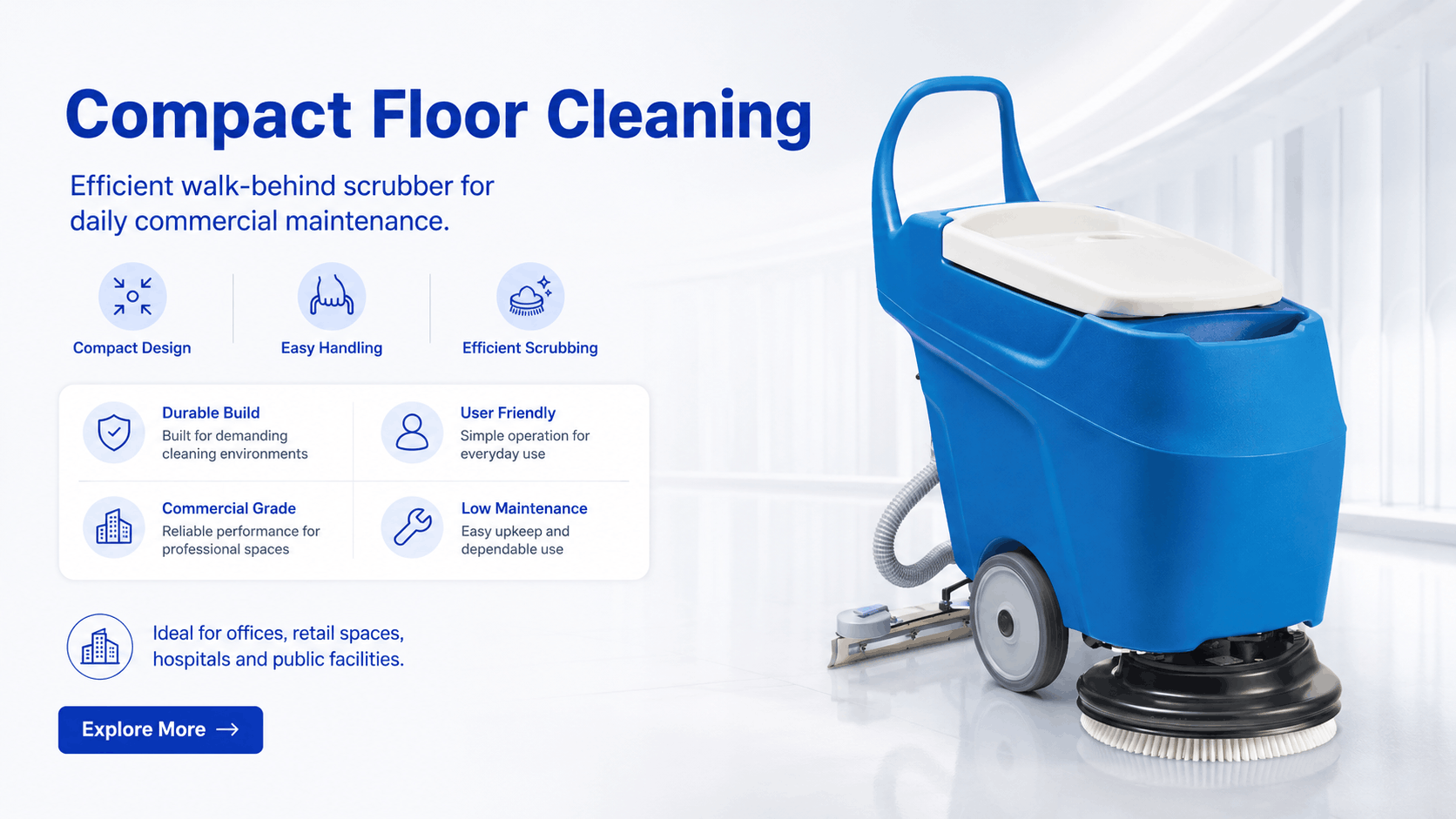
Compact Floor Cleaning — RA 55 | iK 40

Book a demo

Efficient walk-behind scrubbing for daily commercial maintenance.

A compact, mains-operated scrubber dryer built for continuous work on small and medium-sized surfaces. A single-axis design and moulded ergonomic handle make it manoeuvrable even in the tightest space, large wheels ease transport over steps, and its low weight suits pressure-sensitive floors. Brush contact pressure of 37 kg is exceptionally high for the class, which is what delivers results on extremely dirty floors using minimal water and chemical. EU tested and certified, HACCP compliant, and manufactured in Stuttgart, Germany.

Why Choose the RA 55 | iK 40?

37 kg brush pressure — highest in its class

Downforce does the work that extra chemical would otherwise have to. That is what produces a result on extremely dirty floors while keeping water and detergent consumption to a minimum.

Patented curved squeegee

Superb suction even in the tightest corners, over a 735 mm recovery width — floors come up streak-free and can be walked on immediately, with no drying time and no cordoned-off area.

Cleans right up to the wall

Edge-to-edge coverage decides whether the machine finishes the job or leaves a perimeter to be mopped by hand — which is where most of the labour saving quietly disappears.

Mains powered, continuous operation

No battery means no runtime ceiling, no charging window and no cell replacement down the line. The trade is a cable, so it suits sites with accessible sockets rather than open warehouse floor.

Product specifications
Product name
RA 55 | iK 40
Type
Walk-behind scrubber dryer
Power supply
Mains operated (cable)
Brush working width
550 mm
Vacuum working width
735 mm
Area performance
2,200 m²/h (theoretical max)
Solution tank
40 L
Recovery tank
45 L
Brush contact pressure
37 kg
Squeegee
Patented curved squeegee tool
Dimensions (L × W × H)
1130 × 525 × 1055 mm
Certification
EU tested and certified; HACCP compliant
Country of origin
Germany
Application areas
  • Offices
  • Retail spaces
  • Hospitals
  • Public facilities

Technical data for the Columbus RA 55 iK 40. Manufactured by Columbus Cleaning Machines G. Staehle GmbH u. Co. KG, Stuttgart. Configurations and options vary by order.

Robust mechanics
Only truly durable machines are also truly green

That line is Columbus's own, and it is the honest version of the sustainability argument: a machine that lasts twenty years is greener than one with an eco badge that fails in five. The RA 55 range is built accordingly — mechanical lowering of the brush unit and squeegee rather than electronics, a single-axis chassis with large wheels, and consumption reduced at source rather than through dosing instructions nobody follows.

Mechanical, not electronic

The brush unit and squeegee lower mechanically, so operation stays reliable without downtime and a technician can service the machine without specialist diagnostics.

Water-stop brushes and splash guard

Columbus's patented water-stop brushes and splash guard cut water and chemical consumption at source. An integrated chemical dosing system is available as an option.

Single axis, large wheels

The single-axis design gives effortless manoeuvrability in confined spaces, and large wheels make the machine easier to transport and to move over steps between areas.

Ask us anything
Questions about the RA 55 | iK 40

Mains powered. Columbus describe the RA 55|K 40 as the compact, mains-operated scrubber dryer for continuous operation on small and medium-sized surfaces.

The upside is real: no runtime ceiling, no charging window to schedule around, and no battery to replace in a few years. The trade-off is equally real — it needs sockets, so it suits offices, retail floors and hospital corridors more than open warehouse space. Battery versions of the RA 55 exist if a cable will not work for your site; ask our team.

Theoretical coverage is 2,200 m²/h on a 550 mm brush width.

That is the comparison figure, not a shift plan. Real coverage on a site with fixtures, corners and refills will be lower.

It is the highest in its class, and it changes what you have to put on the floor. High downforce means the machine gets a result on extremely dirty floors using the lowest possible amounts of water and chemical.

Over a year, that shows up in the detergent invoice as much as in the cleaning result.

The solution tank holds 40 litres and the recovery tank 45 litres. The recovery side is intentionally larger, so the machine runs out of clean water before it fills with dirty.

Yes — its low weight is specifically why Columbus positions it for pressure-sensitive floors, and large wheels spread the load during transport.

Brush and pad selection matters as much as the machine on delicate surfaces. Share your floor type and our team can specify the right tooling.

Yes on both counts. The patented curved squeegee tool achieves superb suction even in the tightest corners, and the machine is designed to clean right up to the wall.

The moulded ergonomic handle and single-axis design are what make that manoeuvrability possible in confined space.

It is EU tested and certified, and HACCP compliant — which is what matters in food handling areas, kitchens and healthcare corridors where cleaning has to be auditable.

Use the Book a Demo button to arrange a site assessment. Columbus also provides advice and training, financing options and ongoing technical service.

COLUMBUS

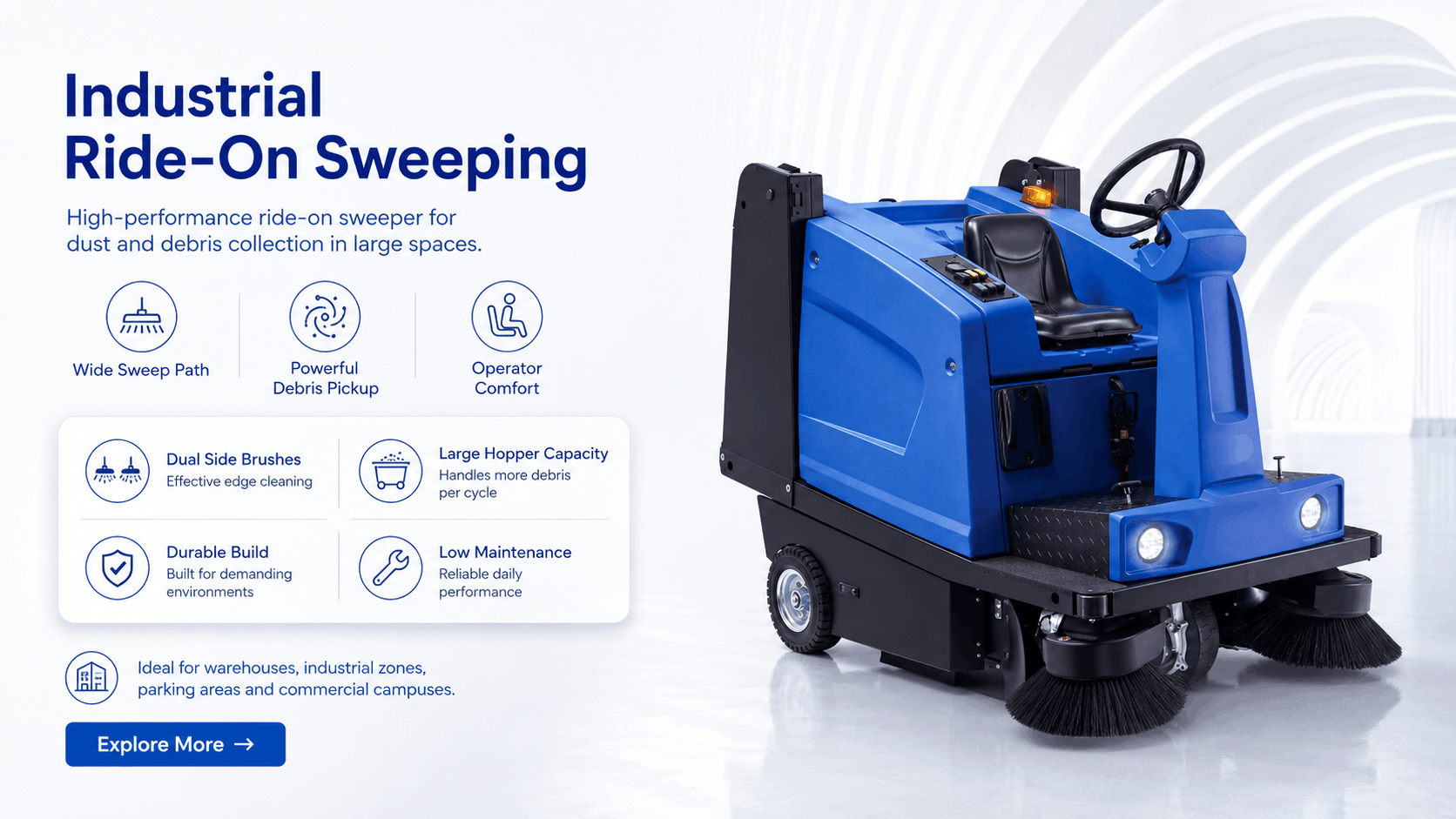
Industrial Ride-On Sweeping — AKS 70 | BM 95

Book a demo

High-performance ride-on sweeper for dust and debris collection in large spaces.

The AKS 70 | BM 95 is a compact ride-on sweeper built on a solid steel construction, with well-engineered components, side brushes, a large polyester cylinder cartridge filter and an electrical filter shaker for consistent sweeping performance across large areas. Shock absorbers on the side brushes protect both the machine and the property it works around. From Columbus Cleaning Machines Pvt. Ltd, a subsidiary of columbus Reinigungsmaschinen, Germany.

Why Choose the AKS 70 | BM 95?

Overthrow loading system

Debris is thrown over the brush into the hopper rather than dragged in, which fills the 95 litre container far more completely — longer operating times and fewer emptying breaks per shift.

Front driving position, no training needed

It drives like a car, so an operator is productive immediately rather than after a training programme — and forward visibility from the front position reduces the risk of damage on site.

Side brushes with vacuums

Vacuum motors built into the side brushes optimise airflow and capture airborne particles at the edge of the sweep — which is exactly where fine dust normally escapes a sweeper.

Solid steel construction

A steel chassis extends machine lifespan and reduces breakdowns, while shock absorbers on the side brushes protect both the machine and the racking, kerbs and fixtures it works around.

Product specifications
Product name
AKS 70 | BM 95
Type
Ride-on sweeper
Working width without side brush
700 mm
Working width with side brush
990 mm
Theoretical coverage area
5,445 m²/h
Batteries
24 V / 200 Ah / 990 W
Working hours
4 hrs
Hopper capacity
95 lt
Filter
6 m² cartridge filter
Traction
Rear-wheel drive
Speed
5.5 km/h
Dimensions (mm)
1460 × 1150 × 1220
Empty weight
215 kg
Application areas
  • Warehouses
  • Industrial zones
  • Parking areas
  • Commercial campuses

Technical data as published by Columbus Cleaning Machines Pvt. Ltd. Configurations may vary by order.

Minimalist engineering
Dust control, floor contact and filtration, solved together

A sweeper that lifts debris but releases the fines has moved the problem rather than solved it — and one that loses brush contact over an uneven paver-block floor leaves strips behind. Columbus addresses both at source: vacuum motors sit inside the side brushes, the main brush levels itself to the floor, and a large cartridge filter with an electrical shaker keeps airflow up across a full shift. The design philosophy is deliberately spare, because fewer components mean fewer failure points and simpler maintenance.

Advanced airflow management

Vacuum motors integrated into the side brushes capture airborne particles during sweeping, improving dust control precisely where debris is being thrown inward.

Self-levelling main brush

The main brush adjusts to uneven factory floors and paver-block surfaces, holding consistent contact instead of skipping the low spots and over-wearing the high ones.

Cartridge filter with electrical shaker

A 6 m² polyester cylinder cartridge filter traps fines, and an electrical shaker clears it on demand — so suction stays consistent rather than fading as the filter loads.

Ask us anything
Questions about the AKS 70 | BM 95

Instead of dragging debris into the hopper, the brush throws it over the top so the container fills from the back forward. The practical result is that the full 95 litres gets used rather than only the front portion.

That translates directly into longer operating times and fewer emptying breaks — on a large site, emptying trips are usually a bigger time cost than the sweeping itself.

No. The front driving position and intuitive controls mean it drives like a car, so no driver training is needed and an operator is productive from the first shift.

The forward position also improves visibility, which reduces the risk of damage when working around racking, kerbs and parked vehicles.

4 hours of working time from a 24 V / 200 Ah / 990 W battery set. At a theoretical coverage of 5,445 m²/h, that is a substantial area per charge.

Real-world coverage will be lower than the theoretical figure — turns, obstacles and emptying all take time out of the hour. Treat 5,445 m²/h as the comparison number, not the shift plan.

It depends entirely on area. The manual K 70|40 sweeps 700 mm with its side brush, covers 2,450 m²/h, holds 40 litres and weighs 25 kg — genuinely cost-effective for small to medium indoor and outdoor areas, and its handle folds down for storage.

The AKS 70 | BM 95 roughly doubles the coverage rate and more than doubles the hopper. Past a certain area the ride-on stops being an upgrade and starts being the only way to finish the shift. Our team can run the numbers for your site.

Yes — the main brush is self-levelling, adjusting to uneven factory flooring and paver-block surfaces so brush contact stays consistent.

Without that, an uneven surface leaves untouched strips in the low spots while wearing the brush unevenly on the high ones.

Three things work together. Vacuum motors inside the side brushes capture airborne particles at the edge of the sweep, a 6 m² polyester cylinder cartridge filter traps the fines, and an electrical filter shaker clears that filter on demand.

The shaker is the part that matters over a full shift: without it, suction fades as the filter loads and the machine quietly stops picking up the finest material.

Columbus designs for simple upkeep — straightforward electrical wiring, basic mechanical operation and easy access to components. Machines ship with plain-language operation manuals, self-help troubleshooting videos and a language-free, symbol-oriented maintenance card: a yellow circle marks daily cleaning tasks, a yellow square marks weekly ones, with matching stickers on the machine itself.

Use the Book a Demo button to arrange a site assessment. Columbus also provides advice and training, financing options and ongoing technical service.

COLUMBUS

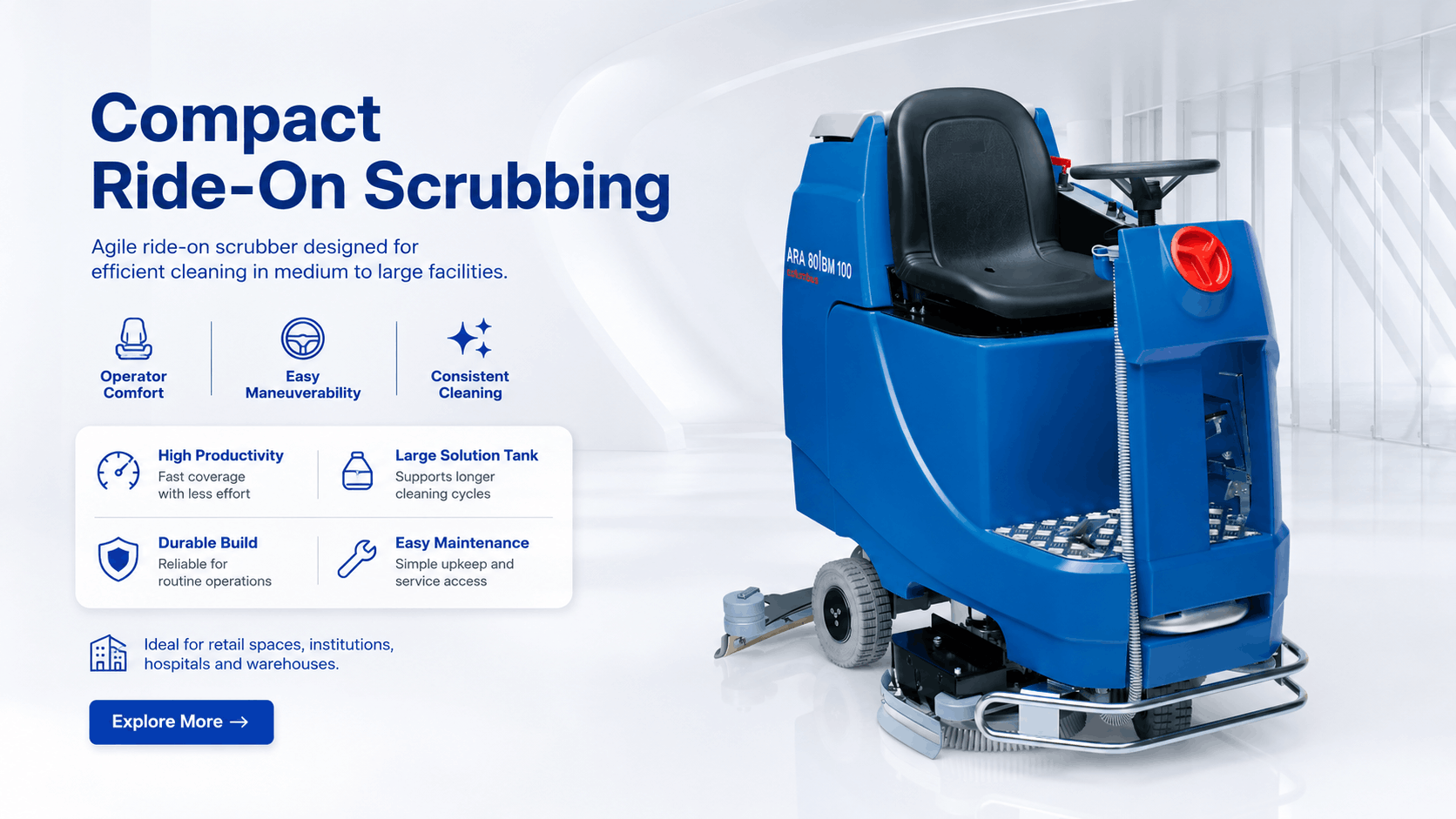
Ride-On Scrubbing — ARA 80 | BM 100

Book a demo

Does the job of two other machines, with 8 hours of battery time.

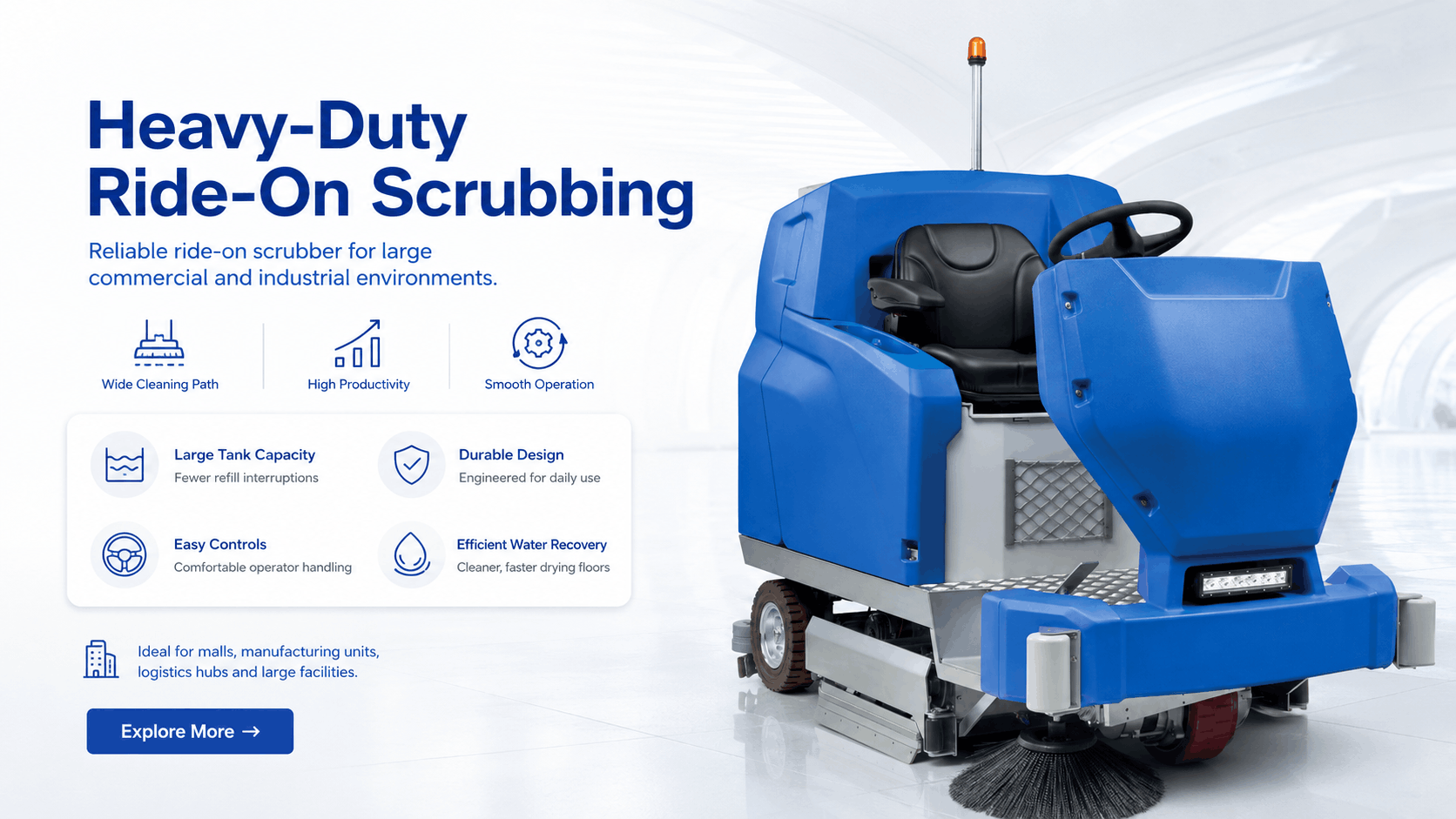
A sturdy ride-on scrubber dryer characterised by easy operation and reliable components. The ARA 80 | BM 100 carries a 390 Ah battery — the highest capacity of any cleaning machine in India — for a full 8-hour shift on a single charge, and pairs it with high brush pressure, superb suction and a 1.9 m turning circle. At 64 dB(A) it is quiet enough to run in a hospital during the day. From Columbus Cleaning Machines Pvt. Ltd, a subsidiary of columbus Reinigungsmaschinen, Germany.

Why Choose the ARA 80 | BM 100?

8 hours on a single charge

A 390 Ah battery — the highest capacity in any cleaning machine in India — covers a full shift without a mid-day recharge. Fewer machines and fewer operators for the same area means lower investment and lower manpower cost.

Super silent at 64 dB(A)

Quiet enough to be used in hospitals during daytime — which turns floor care from a night-shift task into something that can happen when the floor actually needs it.

1.9 m turning circle

The machine turns in its own place, so a ride-on platform works narrow corridors and hallways as well as open floor — no swapping to a walk-behind for the tight sections.

Easy to service, no lifting

The recovery tank swivels to the side, leaving components and the battery fully accessible. The machine never has to be lifted or tilted to be serviced, which saves both time and manhours.

Product specifications
Product name
ARA 80 | BM 100
Type
Ride-on scrubber dryer
Battery capacity
390 Ah
Runtime
8 hours on a single charge
Noise level
64 dB(A)
Turning circle
1.9 m
Chassis
Complete steel chassis
Controls
Mechanical switches; mechanical lowering of brushes and squeegee
Servicing
Swivelling recovery tank — no lifting or tilting required
Application areas
  • Malls
  • Manufacturing units
  • Logistics hubs
  • Hospitals
  • Large facilities

Technical data as published by Columbus Cleaning Machines Pvt. Ltd. Configurations may vary by order.

Rugged mechanics, not electronics
Built so that less can go wrong

Columbus deliberately keeps electronics out of the places they are not needed. Where a competitor adds a control board, this machine uses a switch and a mechanical linkage — because the supreme discipline of engineering, as Columbus puts it, is simplifying a solution until the machine becomes more robust rather than more fragile. Fewer components mean fewer failure points, simpler maintenance and a longer working life, which is also the honest definition of sustainability: only what lasts a long time can really be green.

Simple mechanical controls

Straightforward switches for on/off and forward/backward, with mechanical lowering of the brushes and squeegee. Two operating buttons is the whole interface — nothing to misconfigure.

High brush pressure, low consumption

Excellent results on very dirty surfaces using the lowest possible amounts of water and chemical — pressure doing the work that dosing would otherwise have to.

Superb suction, walk-on-immediately floors

Suction strong enough to guarantee streak-free floors that can be walked on the moment the machine has passed — no drying time, no cordoned-off aisle, no slip risk.

Ask us anything
Questions about the ARA 80 | BM 100

Yes — 8 hours on a single charge, from a 390 Ah battery that Columbus states is the highest capacity in any cleaning machine in India.

The commercial point is not the number itself but what it removes: no mid-shift recharge, no second battery set, and no second machine bought to cover the gap.

At 64 dB(A), yes. Columbus specifies it for daytime hospital use.

That changes the scheduling maths. Floor care stops being a night-shift-only task, which usually means it happens when the floor needs it rather than when the building is empty.

The turning circle is 1.9 m and the machine turns in its own place, which is what makes a ride-on viable in narrow corridors and hallways rather than only on open floor.

Share a site layout and our team can confirm fit before you commit.

On the numbers Columbus publishes: a ride-on cuts working time by over 50% against a standard walk-behind — 2,770 m²/h practical coverage versus 1,500 m²/h, saving roughly 32 minutes per hour, or around 640 hours a year.

On a 30,000 sqm site, five walk-behinds with five operators cost about ₹1,65,000 a month against three ride-ons with three operators at ₹1,35,000 — an 18% saving, and the larger the area the wider the gap. Payback on the extra purchase cost typically lands at 18 to 20 months.

Deliberate design. Simple switches handle on/off and forward/backward, and the brushes and squeegee lower mechanically. Fewer electronic components mean fewer failure points and simpler diagnosis when something does go wrong.

It also means an operator can be productive without navigating a control panel, and a technician can service the machine without specialist equipment.

High brush pressure delivers results on very dirty surfaces with the lowest possible amounts of water and chemical — the pressure does work that dosing would otherwise have to.

Across the Columbus range, smart-dosing, Quick-Stop, splash guard and the patented Water-Stop brushes reduce water consumption significantly, and chemical dosing systems meter precisely rather than by guesswork.

The recovery tank swivels to the side so components and the battery are fully accessible — the machine never needs lifting or tilting to service. Machines ship with plain-language manuals, self-help troubleshooting videos and a language-free symbol maintenance card: a yellow circle for daily tasks, a yellow square for weekly, with matching stickers on the machine.

Use the Book a Demo button to arrange a site assessment. Columbus also provides advice and training, financing options and ongoing technical service.

COLUMBUS

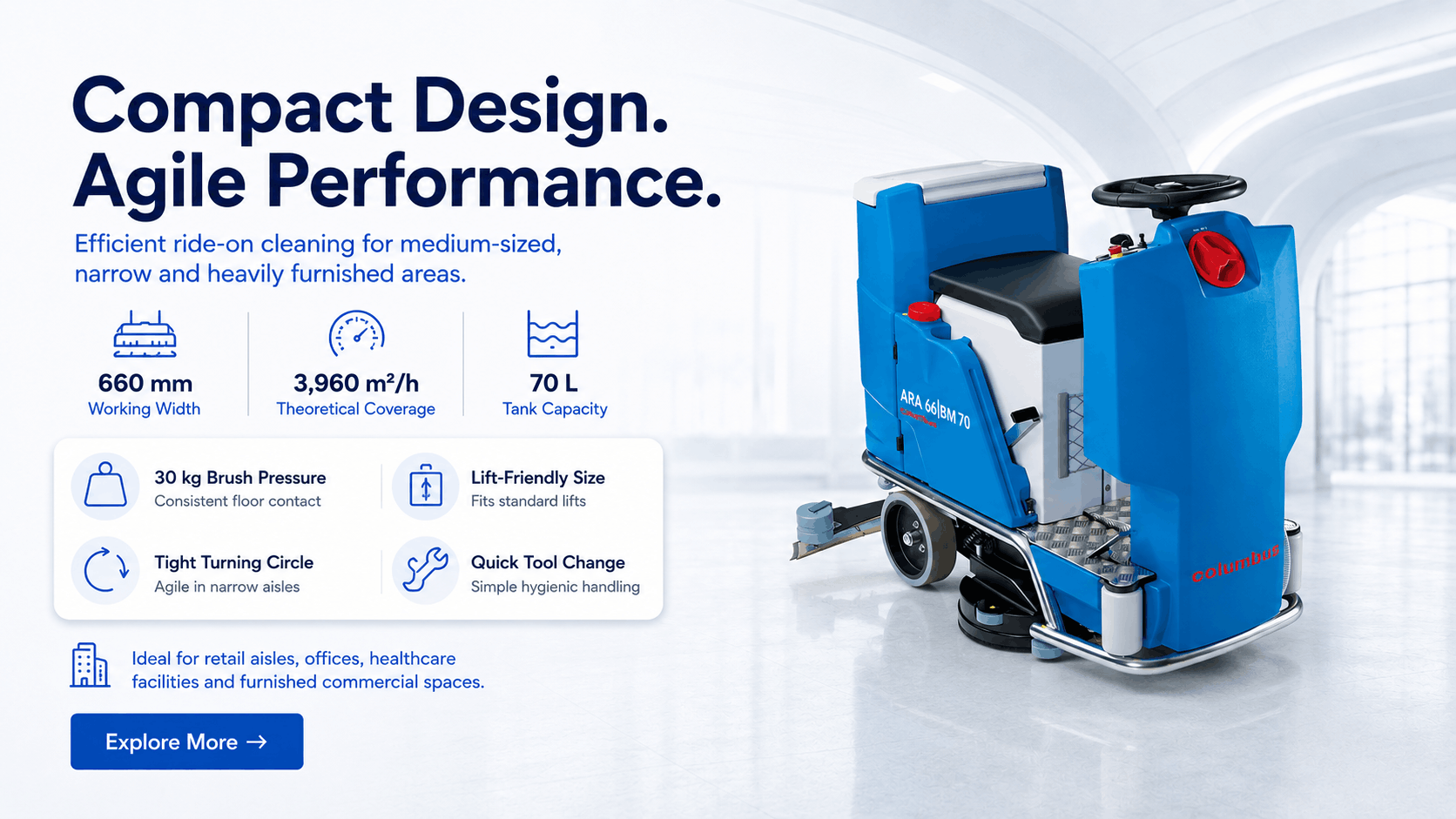
Compact Ride-On Scrubbing — ARA 66 | BM 70

Book a demo

Agile ride-on scrubbing for efficient cleaning in medium to large facilities.

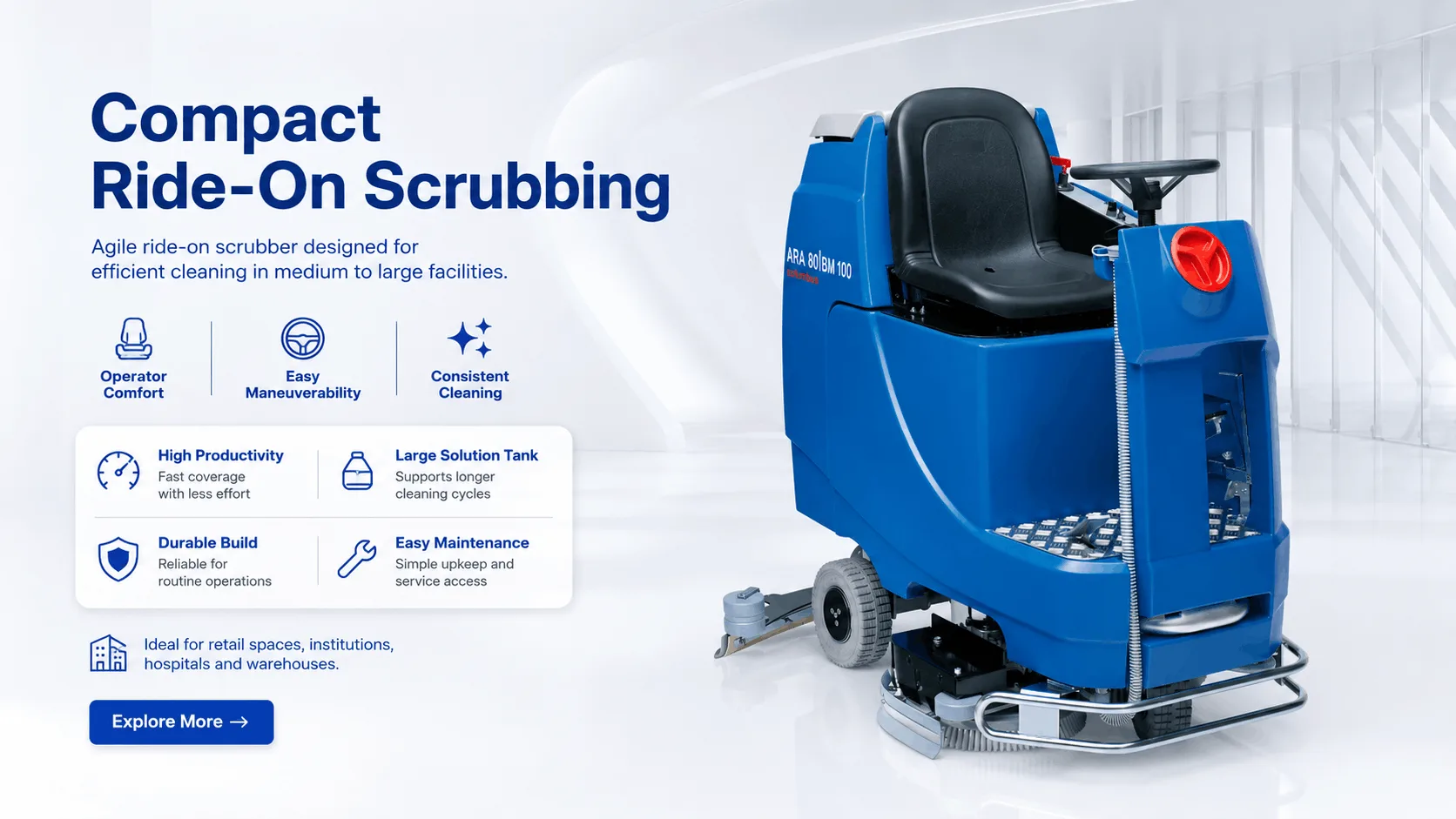
The ARA 66 | BM 70 is the compact machine in the Columbus ride-on scrubber dryer range — 660 mm of working width and 4,620 m²/h of area performance in a 1380 × 680 mm footprint. It is built to be effortless and extremely easy to operate even in narrow aisles and on surfaces with frequent corners, and it cleans right up to the wall rather than leaving an edge for someone to mop by hand. Manufactured in Stuttgart, Germany.

Why Choose the ARA 66 | BM 70 iL?

Cleans right up to the wall

Edge-to-edge coverage is what decides whether a machine finishes the job or hands a perimeter back to manual mopping — which is where most of the labour saving quietly disappears.

Walk-on-immediately floors

32 l/s of airflow at 110 mbar guarantees streak-free floors that can be walked on the moment the machine has passed — no drying time, no cordoned aisle, no slip risk in a live building.

Easy in narrow aisles and tight corners

A 1380 × 680 mm footprint keeps a ride-on platform usable in retail aisles and around fixtures, where a larger machine would spend the shift reversing.

Fast, clean refills

The 70 litre solution tank fills quickly and cleanly through an integrated system coupling — turning a spill-prone hose-and-bucket routine into a connector.

Product specifications
Product name
ARA 66 | BM 70 iL
Type
Ride-on scrubber dryer
Item code
17316101
Working width
660 mm
Suction width
850 mm
Area performance
4,620 m²/h
Solution tank
70 L
Recovery tank
80 L
Voltage
24 V
Battery capacity
200 Ah (wet) / 180 Ah (gel)
Power
1,690 W
Traction speed
7 km/h
Traction power
750 W
Brush pressure
30 kg
Brush speed
180 rpm
Air flow
32 l/s
Vacuum
110 mbar
Noise level
63 / 59 dB(A)
Dimensions (L × W × H)
1380 × 680 × 1170 mm
Weight
187 kg empty / 456 kg operating
Country of origin
Germany
Application areas
  • Retail spaces
  • Institutions
  • Hospitals
  • Warehouses

Technical data for the Columbus ARA 66BM 70 iL (item 17316101). Manufactured by Columbus Cleaning Machines G. Staehle GmbH u. Co. KG, Stuttgart. Configurations may vary by order.

Compact without compromise
Small footprint, full-size cleaning performance

Compact machines usually trade something away — brush pressure, suction, or the tank capacity that decides how long you go between refills. The ARA 66 | BM 70 iL is specified to avoid that trade: 30 kg of brush pressure and 110 mbar of vacuum are figures you would expect on a larger machine, and a 70 litre solution tank supports genuinely long cleaning cycles from a 1380 mm chassis.

30 kg brush pressure at 180 rpm

Downforce does the work that extra water and chemical would otherwise have to, which is what lets a compact machine handle ground-in soiling rather than just surface dust.

32 l/s airflow, 850 mm suction width

The squeegee is wider than the brush path, so the machine recovers everything it lays down even on a curve — the reason floors come up dry rather than merely wet-cleaned.

70 L solution, 80 L recovery

The recovery tank is deliberately larger than the solution tank, so the machine never fills up before it runs out — fewer interruptions, and no risk of overflow mid-aisle.

Ask us anything
Questions about the ARA 66 | BM 70 iL

Area performance is rated at 4,620 m²/h on a 660 mm working width, at a traction speed of up to 7 km/h.

That is a theoretical figure. Real coverage on a site with aisles, fixtures and refills will be lower — treat it as the number for comparing machines, not for planning a shift.

The machine is 1380 × 680 mm and is specified as effortless to operate in narrow aisles and on surfaces with frequent corners.

Share a floor plan with aisle widths and our team can confirm fit, or recommend the walk-behind if the site is tighter still.

The solution tank holds 70 litres and the recovery tank 80 litres — the recovery side is deliberately larger, so the machine runs out of clean water before it fills up with dirty.

Refilling is through an integrated system coupling rather than an open hose, which keeps the process quick and clean.

It is rated at 63 / 59 dB(A) — two figures because there is a reduced-noise mode. At 59 dB(A) it sits around the level of normal conversation.

For the quietest option in the range, the heavy-duty ARA 80 | BM 100 is specified at 64 dB(A) with explicit approval for daytime hospital use. Our team can advise which suits your environment.

Different jobs. This machine is 660 mm wide with a 70 L tank, sized for retail floors, institutions and medium warehouses where access matters.

The heavy-duty ARA 80 | BM 100 is wider, carries a 390 Ah battery for a full 8-hour shift and turns in 1.9 m. If the site is large and open, that machine finishes more of it per shift.

No. With 32 l/s of airflow at 110 mbar across an 850 mm squeegee, floors are streak-free and can be walked on immediately after the machine passes.

In a live retail or healthcare environment that matters twice over — no cordoning, and no wet-floor slip exposure.

Use the Book a Demo button to enquire. Columbus can assess the site, recommend the right machine across the ride-on and walk-behind range, and cover training, financing and technical service.

Configurations vary by order, so a walkthrough gives a more useful answer than a list price.

Enquire Now

Please enable JavaScript in your browser to complete this form.