









 CIJConnect Bot-enabled WhatsApp today at 4:00 PM.
In a conversation with Clean India Journal, Dr Abhimanyu Bishnu, CEO, Innovhealth Services, and Chief Clinical Excellence Officer, Saroj Gupta Cancer Centre & Research Institute, Kolkata, breaks down the true price of hospital-acquired infections.
Hospital-acquired infections (HAIs) are infections patients develop during hospitalisation or even after discharge. The most common include CR-UTI, CR-BSI, VAP and SSI. While they are a clinical problem, they are also an economic crisis.

According to WHO, nearly 1.4 million people acquire an infection in hospital every single day. In developing countries, the burden is heavier — on average; 1 in 10 hospitalised patients will contract an HAI.
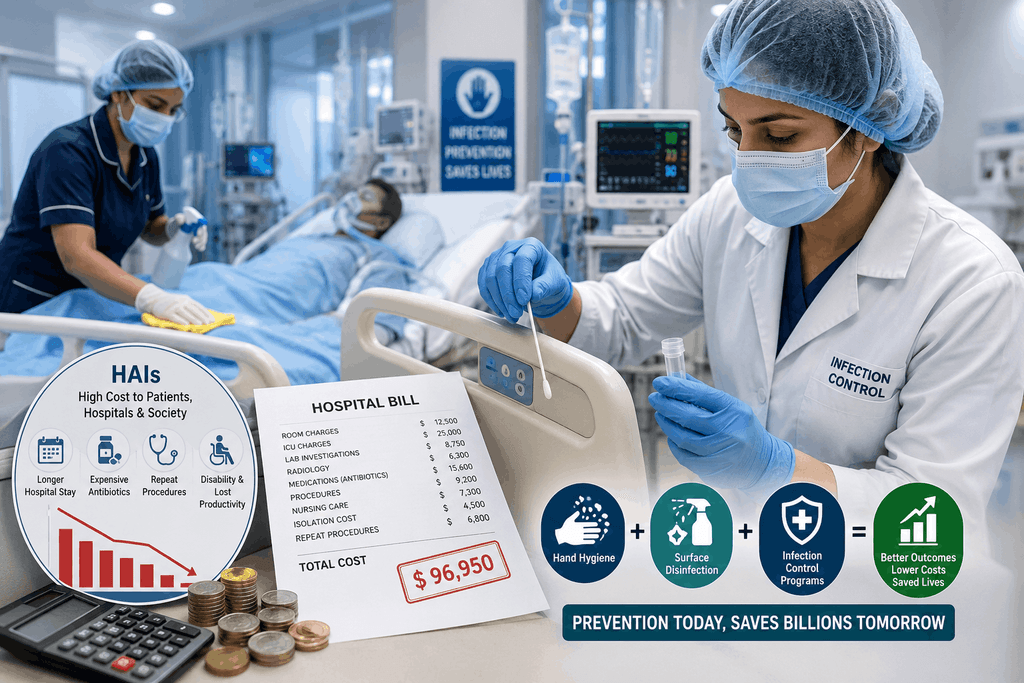
The cost is staggering. HAIs drain health systems of billions of dollars annually through prolonged hospital stays, expensive antibiotics, repeated procedures and lost bed days. Beyond direct treatment costs, there are indirect losses too: Reduced hospital efficiency, strained resources, and the wider societal impact of disability and lost productivity.
HAIs hit both the patient and the system. The economic impact comes as direct costs of care and indirect costs to families and the healthcare system. Together, they put enormous pressure on already stretched hospital resources.
Direct Costs
The major financial implications of HAIs are borne by hospitals and third-party payers, which are in the form of direct costs to healthcare providers. The mechanisms with which direct medical costs escalate are the following:
• Increased length of hospitalization: The length of stay (LOS) is known to increase in patients acquiring HAIs, due to increased time by days or weeks for recovery and discharge. This blocks the hospital beds, limiting new admissions and thus generation of new procedures or investigations. This has a detrimental effect on the hospital’s revenue.
• Interventions due to HAIs: Management of HAIs involves additional / specialized laboratory and radiology investigations, intensive medical and nursing care, intensive isolation protocols for multi-drug resistant organisms (MDROs). This has an associated cost which is absorbed by the patients.
• Drug treatment: Treatment of HAIs involves the usage of advanced, high-cost antimicrobial drugs, the cost of acquisition of which is borne by the hospital and the usage cost by the patients
The major financial implications of HAIs are borne by hospitals and third-party payers, which are in the form of direct costs to healthcare providers”— Dr Abhimanyu Bishnu Chief Clinical Excellence Officer, Saroj Gupta Cancer Centre & Research Institute, Kolkata
Indirect Costs
The indirect costs can be looked at from a macroeconomic level. At a societal level, beyond the hospital, the economic impact can be gauged by several factors. The impact of these is felt after the patient has been discharged from the hospital, and include the following:
• Financial burden post- discharge: The most immediate impact upon patients is in the form of an increased requirement of medicines, investigations and outpatient care by general practitioners or specialists. Readmission rates are also higher in patients contracting HAIs. These factors drive up the financial burden on patients subsequent to discharge.
• Loss of productivity: Due to HAIs, patients may suffer from prolonged illness or permanent disability. Due to this, patients may suffer from work absenteeism, which leads to loss of productivity. Caregivers of patients may also sacrifice working hours, due to which loss of productivity may be faced. The overall cost to society increases ranges from approximately $10 billion to over $200 billion annually in major Western economies.
Comparative Study
Not all HAIs have the same financial impact. Complex bloodstream and respiratory infections incur vastly greater expenses than localized urinary tract issues.
Infection Control
From a health economics standpoint, investing heavily in an Infection Control Programme (ICP) yields a highly favourable return on investment (ROI).
• Cost-benefit ratio: There are costs involved in implementing hand hygiene and infection control resources, manpower engagement and training. There are also costs of treating outbreak events. However, the savings from averting the costs of infection offset the cost incurred on infection control strategy implementation.
• Bed optimisation: Effective prevention strategies effectively release scarce bed-days back to the hospital, maximising patient throughput and reducing systemic financial waste.
It makes sense to invest in infection control activities both at the institutional and macroeconomic level rather than incur costs on HAI management. In a healthcare scenario where resources are scarce, the economic case for HAI prevention needs to be studied and considered in detail.
| Infection Type | Primary Cause of Cost | Relative Financial Weight |
| Catheter-associated urinary tract infections (CAUTI) | Basic diagnostics, standard oral/IV antibiotics | Moderate |
| Central line-associated bloodstream infections (CLABSI) | High-cost IV antimicrobials, critical care monitoring | Very High |
| Ventilator-associated pneumonia (VAP) | Extended ICU days, intensive mechanical support | Very High |
| Surgical site infections (SSI) | Wound revision, prolonged surgical ward stay | High |
| A hypothetical working of Cost vs Savings for HAIs is given blow: | |
| 250 BED HOSPITAL | |
| BUDGET FOR INFECTION CONTROL | |
| BUDGET HEADING | AMOUNT |
| Training | 1,60,000 |
| Equipments, appliances & Consumables | 26,00,000 |
| Manpower | 16,00,000 |
| Renovation and Modifications | 10,00,000 |
| Total Budget (A) | 53,60,000 |
| Revenue Impact due to HAI | |
| Heading | Amount |
| ARPOB (Average Revenue per occupied bed per day) | 20,000 |
| Total revenue per bed per day @ 70% occupancy | 21,00,000 |
| Total revenue per year | 68,46,00,000 |
| Hypothetical cost due to HAI @ 2% of revenue (B) | 1,36,92,000 |
| B > A, thus the investment on infection control implementation can be easily recovered from the savings from avoided infections and the associated morbidity. The savings when looked at from a societal perspective are even higher. | |