



























How India’s Growth Push Benefits the Cleaning & FM Sectors

Heavy infrastructure investment, clean energy expansion and manufacturing incentives under the Union Budget 2026 presented by Nirmala Sitharaman open fresh growth avenues for India’s cleaning industry. Increased urban development, industrial expansion and decarbonisation initiatives are set to drive demand for facility management, industrial cleaning, waste management and sustainable hygiene solutions. As public and private investments scale up, the cleaning sector stands poised to benefit from rising compliance standards, new infrastructure assets and expanding organised operations. Clean India Journal’s Manka Behl shares the highlights of the Union Budget 2026-27.
Heavy infrastructure investment, tax reforms, scaling domestic manufacturing and a renewed push towards clean energy marked the Union Budget 2026–27, as the central government laid out its economic priorities for the year ahead.

Beyond the headline announcements, the budget outlines allocations and policy measures that will directly affect sectors central to the Clean India mandate — including urban infrastructure, incentives and allocations aimed at scaling renewable energy and storage capacity, support for critical minerals and component manufacturing, continued focus on decentralised energy solutions, funding for industrial emissions reduction technologies, and policy support for cleaner fuels and electrification in transport and urban services.
Renewable & Solar
Renewable energy remains a key pillar of the country’s power planning, and the Union Budget 2026 reinforces this focus through higher allocations and targeted policy measures.
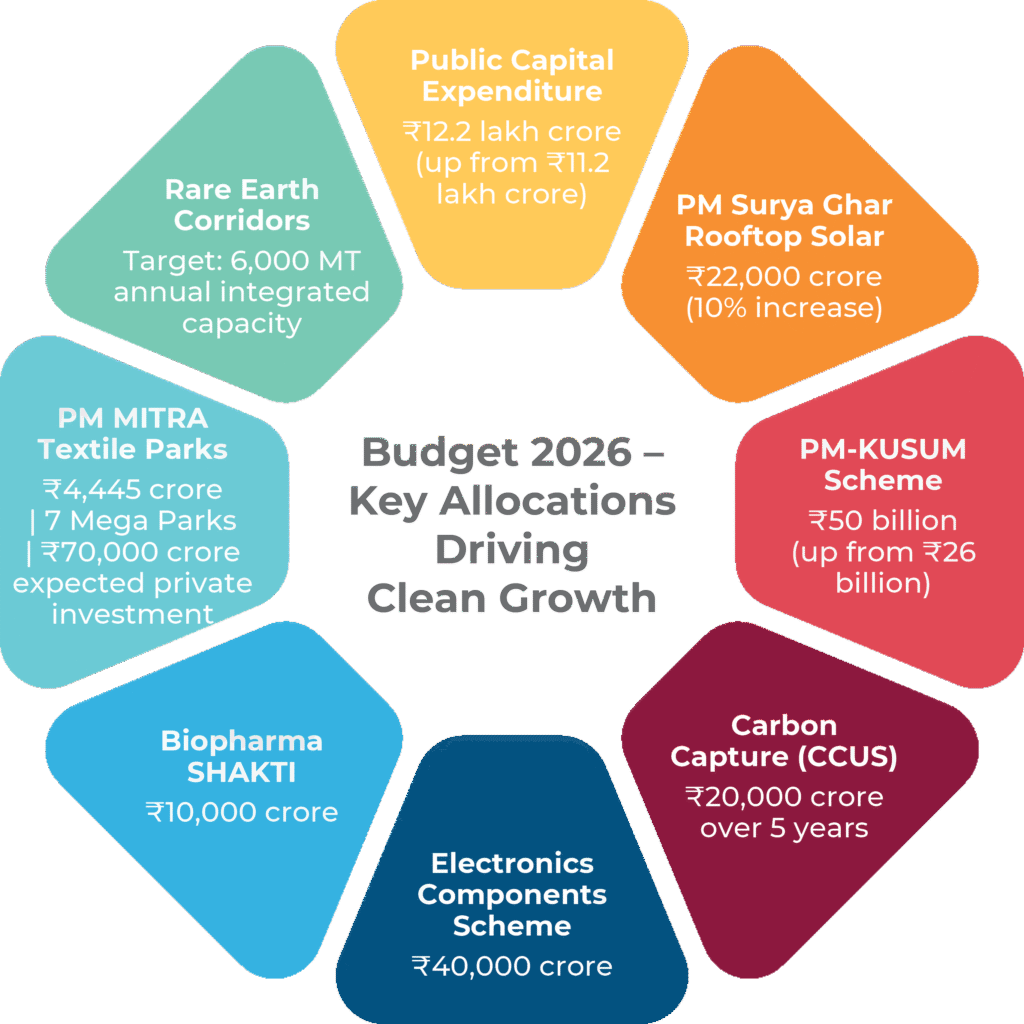
The allocation for the PM Surya Ghar rooftop solar programme has been increased to ₹22,000 crore to accelerate household solar adoption across the country, compared with ₹20,000 crore in the previous Budget — representing a 10% rise.
In a move aimed at strengthening domestic solar manufacturing and lowering production costs, the Basic Customs Duty (BCD) on Sodium Antimonate, a critical raw material used in the production of solar glass, has been reduced from 7.5% to nil.
The Budget also raised the outlay for the PM-KUSUM scheme, which promotes solarisation in the agricultural sector, from ₹26 billion last year to ₹50 billion this fiscal, reflecting an expanded push toward decentralised solar power generation in rural areas.
Infra-Led Expansion
Infrastructure remained central to the government’s growth strategy in Budget 2026–27, with the public capital expenditure increased to ₹12.2 lakh crore, up from ₹11.2 lakh crore in the previous year.
The budget also proposed the development of seven high-speed rail corridors aimed at strengthening inter-city connectivity across major economic zones. In addition, the government has proposed the creation of City Economic Regions in Tier-2 and Tier-3 cities, with ₹5,000 crore allocated per region over a five-year period to support infrastructure and economic activity. Measures have also been introduced to facilitate private participation in infrastructure through risk-sharing mechanisms, along with plans to monetise public sector real estate assets.
Together, these steps indicate a sustained focus on expanding transport networks, urban infrastructure and regional
growth corridors in the coming financial year.
Decarbonisation
One of the most consequential announcements is the allocation of ₹20,000 crore over five years for Carbon Capture, Utilisation and Storage (CCUS) technologies. The funding aims to support pilot projects and deployment across emission-intensive sectors such as steel, cement, fertilisers and thermal power.
Unlike renewable energy expansion, which addresses the power sector directly, CCUS targets industries where emissions are harder to eliminate. For sectors critical to infrastructure growth, the policy shift suggests that decarbonisation is being aligned with industrial competitiveness rather than seen as a constraint.
This move signals an evolution in India’s climate strategy. While previous budgets largely emphasised renewable targets and electric mobility, this one introduced deeper structural interventions in industrial emissions, indicating that the government is broadening its approach to include heavy industry transformation.
Deepening & Expanding
The budget unveiled an expansive push to strengthen India’s domestic manufacturing ecosystem, with targeted funding, expanded production-linked incentives (PLI), and cluster-based infrastructure aimed at reducing import dependence and building global competitiveness across strategic industries.
Finance Minister Nirmala Sitharaman laid out a multi-sector manufacturing roadmap spanning biopharmaceuticals, electronics components, rare earth magnets, chemicals, textiles and capital equipment — signalling a calibrated move from broad-based incentives to sector-specific scale-building.
Among the headline announcements is the ₹10,000 crore ‘Biopharma SHAKTI’ initiative, designed to develop a globally competitive manufacturing base for biologics and biosimilars. The scheme aims to build ecosystem infrastructure, enhance R&D-to-manufacturing linkages, and reduce reliance on high-value imports.
Industry stakeholders view the allocation as a long-term play to position India as a manufacturing hub for advanced therapies, especially as global supply chains diversify.
In electronics manufacturing, the government substantially enhanced the outlay of the Electronics Components Manufacturing Scheme (ECMS) to ₹40,000 crore, nearly doubling its earlier allocation.
The move is intended to deepen value addition within India’s electronics supply chain — from components to sub-assemblies — and complement the country’s semiconductor ambitions. The expansion also aligns with broader efforts to integrate domestic players into global electronics manufacturing networks.
Allocations under certain PLI segments, including white goods such as air-conditioners and LED lighting, have also been increased — underscoring the government’s intent to scale domestic capacity in sunrise and high-import segments.
Rare Earth Corridors
Recognising the strategic importance of rare earth permanent magnets — essential for electric vehicles, wind turbines and advanced electronics — the budget announced the creation of Dedicated Rare Earth Corridors across mineral-rich states including Odisha, Kerala, Andhra Pradesh and Tamil Nadu.
These corridors are expected to support mining, processing and magnet manufacturing in an integrated value-chain model. Previous approvals for the rare earth permanent magnet (REPM) scheme, with financial support in the range of ₹7,000+ crore, are now being operationalised through this corridor approach.
The government aims to build an integrated capacity of approximately 6,000 metric tonnes per annum, supported by sales-linked incentives and capital subsidies.
Manufacturing Clusters
The budget reinforced the development of PM MITRA Scheme (Pradhan Mantri Mega Integrated Textile Region and Apparel Scheme), which carries a total financial outlay of ₹4,445 crore and is being implemented over a seven-year period from 2021 to 2028.
Under the scheme, seven mega textile parks have been approved across Tamil Nadu, Telangana, Karnataka, Maharashtra, Gujarat, Madhya Pradesh and Uttar Pradesh. Each greenfield park is eligible for central support of up to ₹500 crore, while brownfield parks can receive up to ₹200 crore. The government estimates that the scheme could attract nearly ₹70,000 crore in private investment and generate around 20 lakh jobs, both direct and indirect.
Parallel to the textile initiative, the Union Budget has proposed establishment of three dedicated chemical parks under a new scheme, with an allocation of ₹600 crore. These parks will be developed through a challenge-based selection process in partnership with states and are expected to operate on a cluster-based, plug-and-play model.
The infrastructure will include common effluent treatment plants, shared utilities, waste management systems, and centralised environmental compliance mechanisms, aimed at improving operational efficiency while addressing regulatory requirements.
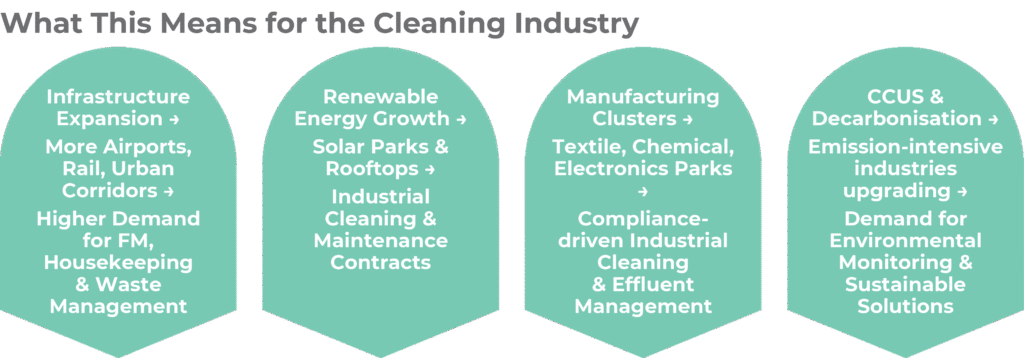
| Sectoral Impact on Cleaning & FM | |
| Budget Push | Direct Impact on Cleaning Sector |
| Capex Boost | More commercial & industrial assets |
| Renewable Expansion | O&M cleaning contracts for solar & infra |
| CCUS Allocation | Environmental compliance services |
| Manufacturing PLI | Organised facility management growth |
| Chemical Parks | Waste & effluent treatment demand |
Ask the expert
Have a question about this article? Put it to the people in it. We pass your details on and they come back to you directly.