






Sunday, September 6, 2026
 - 
Afrikaans
 - 
af
Albanian
 - 
sq
Amharic
 - 
am
Arabic
 - 
ar
Armenian
 - 
hy
Azerbaijani
 - 
az
Basque
 - 
eu
Belarusian
 - 
be
Bengali
 - 
bn
Bosnian
 - 
bs
Bulgarian
 - 
bg
Catalan
 - 
ca
Cebuano
 - 
ceb
Chichewa
 - 
ny
Chinese (Simplified)
 - 
zh-CN
Chinese (Traditional)
 - 
zh-TW
Corsican
 - 
co
Croatian
 - 
hr
Czech
 - 
cs
Danish
 - 
da
Dutch
 - 
nl
English
 - 
en
Esperanto
 - 
eo
Estonian
 - 
et
Filipino
 - 
tl
Finnish
 - 
fi
French
 - 
fr
Frisian
 - 
fy
Galician
 - 
gl
Georgian
 - 
ka
German
 - 
de
Greek
 - 
el
Gujarati
 - 
gu
Haitian Creole
 - 
ht
Hausa
 - 
ha
Hawaiian
 - 
haw
Hebrew
 - 
iw
Hindi
 - 
hi
Hmong
 - 
hmn
Hungarian
 - 
hu
Icelandic
 - 
is
Igbo
 - 
ig
Indonesian
 - 
id
Irish
 - 
ga
Italian
 - 
it
Japanese
 - 
ja
Javanese
 - 
jw
Kannada
 - 
kn
Kazakh
 - 
kk
Khmer
 - 
km
Korean
 - 
ko
Kurdish (Kurmanji)
 - 
ku
Kyrgyz
 - 
ky
Lao
 - 
lo
Latin
 - 
la
Latvian
 - 
lv
Lithuanian
 - 
lt
Luxembourgish
 - 
lb
Macedonian
 - 
mk
Malagasy
 - 
mg
Malay
 - 
ms
Malayalam
 - 
ml
Maltese
 - 
mt
Maori
 - 
mi
Marathi
 - 
mr
Mongolian
 - 
mn
Myanmar (Burmese)
 - 
my
Nepali
 - 
ne
Norwegian
 - 
no
Pashto
 - 
ps
Persian
 - 
fa
Polish
 - 
pl
Portuguese
 - 
pt
Punjabi
 - 
pa
Romanian
 - 
ro
Russian
 - 
ru
Samoan
 - 
sm
Scots Gaelic
 - 
gd
Serbian
 - 
sr
Sesotho
 - 
st
Shona
 - 
sn
Sindhi
 - 
sd
Sinhala
 - 
si
Slovak
 - 
sk
Slovenian
 - 
sl
Somali
 - 
so
Spanish
 - 
es
Sundanese
 - 
su
Swahili
 - 
sw
Swedish
 - 
sv
Tajik
 - 
tg
Tamil
 - 
ta
Telugu
 - 
te
Thai
 - 
th
Turkish
 - 
tr
Ukrainian
 - 
uk
Urdu
 - 
ur
Uzbek
 - 
uz
Vietnamese
 - 
vi
Welsh
 - 
cy
Xhosa
 - 
xh
Yiddish
 - 
yi
Yoruba
 - 
yo
Zulu
 - 
zu
Our Services
Integrated Facility Management Solutions
About Us
Tech-Enabled Integrated Facility Management

SMC Integrated Facility Management Solutions Ltd. is an SIS Group enterprise operating across India since 2008, with affiliations to international FM leaders from the USA. SMC delivers integrated facility management built on digitization, mechanization and automation — a technology and productivity framework applied to the work of running a facility, rather than a headcount supplied against a scope.

The portfolio spans integrated facility management, smart surface disinfection, CMMS-led maintenance, digital hospital portering, UVGI, indoor air quality, energy audit and next-generation disinfection. With a workforce of over 40,000 professionals — including hotel management graduates and engineers — SMC serves healthcare, manufacturing, pharmaceuticals, retail, education and residential estates, with a stated commitment to guiding clients towards a net-zero sustainable future.

Clean India Show by Clean India Journal

Why SMC
Capabilities & Strengths That Set Us Apart

Pan-India Service Network

450 districts covered from 35 branch offices, enabling consistent, localized support anywhere in India.

Scale & Reach

750+ clients, over 170 million sq. ft. of area under management, and a workforce of 40,000+ trained professionals.

Compliance & Certifications

ISO 45001 certified for occupational health and safety.

Tech-Enabled Operations

Digitization, mechanization and real-time data analytics, with CMMS holding the asset register, the schedule and the outcome in one system.

Sustainability & ESG

A stated commitment to a net-zero sustainable future, working with clients on practices that reduce their ecological impact.

Sector Expertise & Domain Depth

Proven delivery across six sectors: healthcare, manufacturing, pharma, retail, education and residential.

Enquire Now

Please enable JavaScript in your browser to complete this form.
In Conversation
How SMC is Driving Tech-Enabled Facility Management

Is Your Hospital Safe? The Hidden Crisis in Indian Healthcare Infrastructure

Welcome to Clean India Journal, your trusted source for insights on hygiene, healthcare facility management, sustainability, and safe built environments.In this video, Edward D'Souza from SMC shares expert insights on the critical role of facility management in healthcare. From hospital fire safety and preventive maintenance to infection control, HVAC systems, indoor air quality, UVGI air disinfection, and healthcare infrastructure, this discussion highlights how non-clinical services directly impact patient safety, operational efficiency, and patient trust.Whether you're a healthcare professional, hospital administrator, facility manager, infection prevention specialist, housekeeping professional, engineer, or simply interested in improving healthcare environments, this channel brings expert discussions, industry insights, and practical knowledge that matter.

View More Podcasts
Our Perspectives
Latest Insights

Ready to Optimize Your Facility Management?

Partner with SMC for tech-enabled integrated facility management across soft services, technical services, disinfection and energy — delivered by a 40,000+ workforce across 450 districts.

Book a Demo

Subscribe For Download Our Media Kit

Get notified about new articles

SMC

Smart Surface Disinfection — H.K 2.0

Book a demo

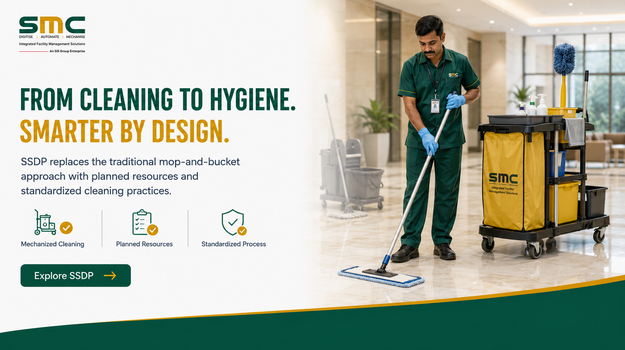
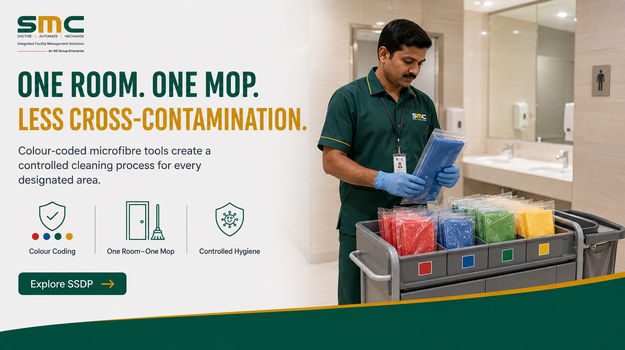
Mop and bucket replaced by pre-soaked microfibre on a one-room-one-mop rule, then verified by Glo-Germ and ATP testing — so a surface is measured clean, not assumed clean.

A complete transition away from traditional mop-and-bucket cleaning to a mechanized smart approach: a pre-wet mop system for cross-contamination control, auto dilution to control chemical usage, colour-coded microfibre dusters to reduce healthcare-associated infection risk, and mops and dusters laundered and disinfected between uses. Product, method and process changed together to align people, materials and machinery for infection prevention. From SMC Integrated Facility Management Solutions Limited, an SIS Group enterprise.

Why Choose H.K 2.0?

One room, one mop

A bucket carried between rooms moves contamination as efficiently as it removes it. Pre-soaked microfibre retired after a single room breaks that chain at its source.

Measured clean, not assumed clean

Glo-Germ and ATP testing verify the result rather than the routine. A surface that looks clean and a surface that tests clean are not the same thing, and only one of them is auditable.

Auto dilution, controlled chemistry

Dosing by eye is where chemical cost and residue problems begin. Automatic dilution makes the concentration a setting rather than a judgement call on a busy shift.

What the solution covers
Solution
Smart Surface Disinfection Program — H.K 2.0
Approach
Mechanized smart cleaning replacing traditional mop-and-bucket methods
Pre-wet mop system
Mops pre-soaked to a set dilution for cross-contamination control
Mop rule
One room, one mop — no re-dipping between rooms
Auto dilution
Automatic chemical dilution to control usage and concentration
Microfibre dusters
Colour-coded by area to reduce healthcare-associated infection risk
Laundering
Mops and dusters laundered and disinfected between uses
Verification — Glo-Germ
Fluorescent marker testing to check cleaning coverage
Verification — ATP
ATP testing to measure residual organic soil on a surface
Change model
Product, method and process changed together — people, materials and machinery aligned
Objective
Infection prevention alongside cleanliness and efficiency
Company
SMC Integrated Facility Management Solutions Limited, an SIS Group enterprise
Healthcare footprint
350+ healthcare delivery units; 120,000+ beds serviced; 19,000+ healthcare skilled resources
Scale
170 million ft² of area operations; 750+ clients; 40,000+ employees
Headquarters
Okhla Industrial Area, Phase-I, New Delhi
Where it is used
  • Healthcare
  • Pharma
  • Manufacturing
  • Retail
  • Education
  • Residential

Scope as published by SMC and by this listing. Colour-coding schemes, mop change frequency and testing cadence are set per site against your infection-control protocol. Contact the team for a walkthrough rather than a catalogue specification.

How it works
A mop in a bucket is a device for distributing contamination evenly

Put a soiled mop back into the bucket and everything it collected is now in the solution. Carry that bucket to the next room and you have moved the problem rather than removed it. The conventional answer is to change the water more often, which depends entirely on whether a busy housekeeper remembers to. H.K 2.0 removes the judgement call instead: mops arrive pre-soaked at the right dilution, one room gets one mop, and the used ones go to laundry rather than back into circulation. Then the result gets tested rather than trusted.

Pre-wet system, auto dilution

Mops are charged in advance at a controlled concentration. Nobody is judging a dose by eye at the end of a shift, and nothing gets re-dipped into contaminated solution.

Colour coding that survives a bad day

Colour-coded microfibre keeps washroom tools out of patient areas without anyone needing to think about it. Systems that rely on memory fail exactly when the ward is busiest.

Glo-Germ and ATP verification

Glo-Germ shows whether the surface was actually covered; ATP measures what organic soil remains. One checks the technique, the other checks the outcome — together they turn cleaning into a measurement.

Ask us anything
Questions about H.K 2.0

Once a soiled mop goes back into the bucket, everything it picked up is in the solution. Carry that to the next room and the contamination travels with it.

The conventional fix is to change the water more often, which depends on a busy housekeeper remembering to. H.K 2.0 removes the judgement call: mops arrive pre-soaked at a set dilution, one room gets one mop, and used mops go to laundry rather than back into the bucket.

A fresh pre-soaked microfibre mop per room, retired after use and sent for laundering and disinfection rather than re-dipped.

It changes the consumables and laundry logistics, which is worth scoping honestly at proposal stage — the infection-control benefit is real, and so is the operational change behind it.

Two methods that answer different questions. Glo-Germ uses a fluorescent marker to show whether a surface was actually covered — it tests the technique. ATP testing measures residual organic soil — it tests the outcome.

Together they turn cleaning from an assumed result into a measured one, which is what makes it auditable. Confirm with the team whether verification is included as standard on your contract or offered as an option.

To keep tools used in washrooms out of patient and food areas without anyone needing to remember a rule. Colour coding works precisely because it does not depend on attention.

SMC positions this specifically at reducing healthcare-associated infection risk, though the same logic applies in food processing and any audited environment.

It makes the chemical concentration a setting rather than a judgement. Dosing by eye is where both chemical overspend and surface residue problems start, and it varies with whoever is on shift.

Controlled dilution also makes consumption predictable, which is the part procurement notices.

No. SMC applies it across healthcare, pharma, manufacturing, retail, education and residential — anywhere cleanliness is audited rather than eyeballed.

The infection-control framing is sharpest in healthcare, but the underlying problem — cross-contamination through shared cleaning water and shared tools — exists in every building.

Use the Book a demo button. SMC also offers a free Facilities Management Maturity Assessment.

For this programme, ask for an ATP baseline on your current cleaning before switching. Without a before reading, the improvement afterwards is a claim rather than a measurement — and measurement is the whole point of this approach.

SMC

iPorter — Uberizing Hospital Operations

Book a demo

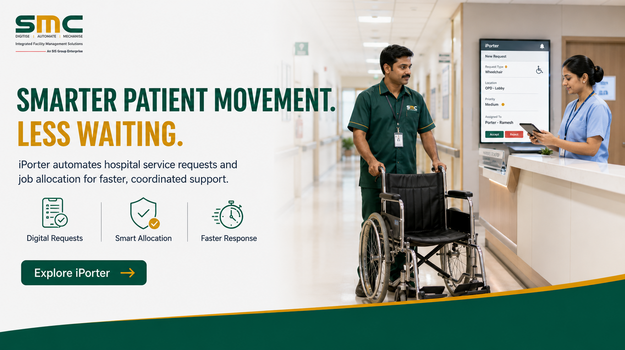
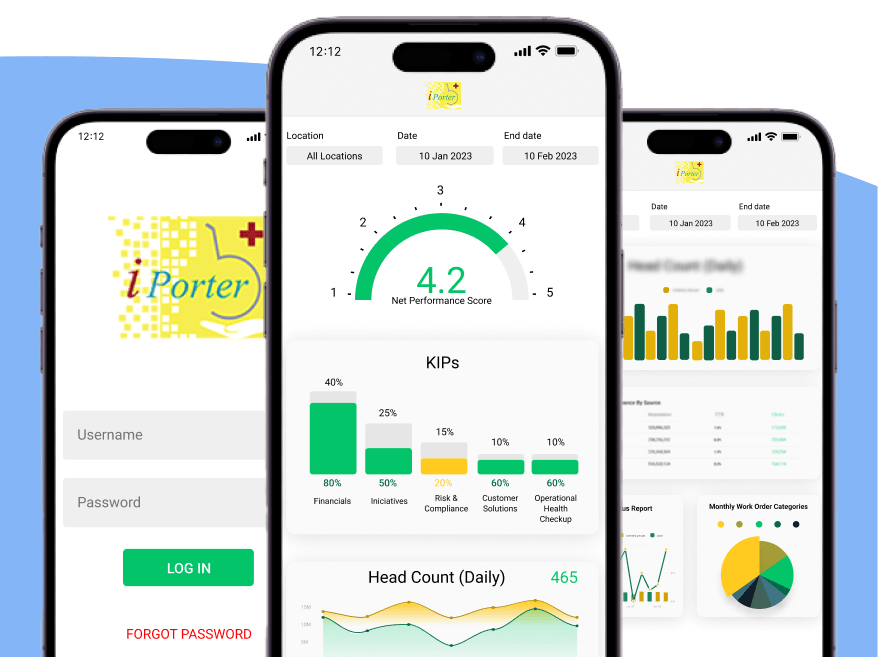
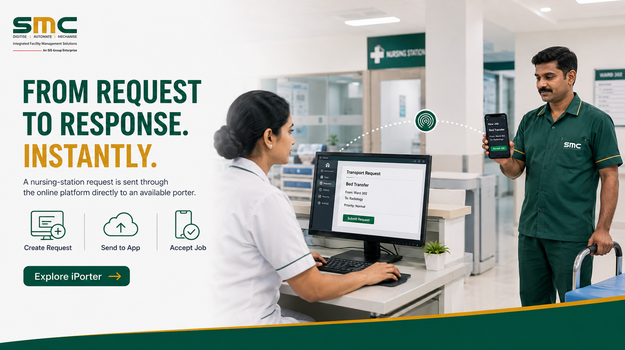
iBeacon-based porter tracking that automates job allocation across transport, pharmacy, wheelchair and stretcher requests — cutting patient wait times by up to 40% and giving clinical staff real-time visibility.

An iBeacon-based intelligent porter tracking and hospital management system that automates service requests and job allocation. Instead of a nurse phoning around to find someone free, the request goes into the system and reaches the nearest available porter — with real-time tracking of transport, patient, pharmacy, wheelchair and stretcher movements throughout. Award-winning digital portering from SMC Integrated Facility Management Solutions Limited, an SIS Group enterprise.

Why Choose iPorter?

Shorter waits, faster clinical response

A patient waiting for a stretcher is a bed not turning over and a procedure running late. Getting the request to the nearest available porter automatically is what removes that delay.

Real-time indoor tracking

IoT-based iBeacon devices give accurate location inside the building, where GPS does not work. Allocation is based on who is actually nearest rather than who answers the phone.

Demand patterns you can plan around

Every request is logged, so transport peaks stop being a surprise. Rostering against real demand is where the productivity gain becomes a manpower saving.

What the solution covers
Solution
iPorter — intelligent porter tracking and hospital management system
Technology
IoT-based iBeacon devices for accurate indoor tracking
Request types
Transport, patient, pharmacy, wheelchair and stretcher
Job allocation
Automated allocation of service requests to available porters
Tracking
Real-time location of porters within hospital premises
Wait times
Reduced patient wait times — up to 40% per the CIJ listing; see build note 1
Clinical response
Improved clinical response time
Productivity
Improved porter and support staff productivity
Cost
Reduced labour cost through better resource utilisation
Planning
Trend and pattern data on transport requests for resource planning
Recognition
Award-winning digital portering solution
Healthcare footprint
350+ healthcare delivery units; 120,000+ beds serviced; 19,000+ healthcare skilled resources
Company
SMC Integrated Facility Management Solutions Limited, an SIS Group enterprise
Scale
170 million ft² of area operations; 750+ clients; 40,000+ employees
Headquarters
Okhla Industrial Area, Phase-I, New Delhi
Privacy
A dedicated privacy policy is published for the Porter Management System (iPorter)
Where it is used
  • Hospitals
  • Multi-speciality facilities
  • Emergency departments
  • Diagnostics & imaging
  • Pharmacy & stores
  • Outpatient areas

Scope as published by SMC. Beacon density, request categories and escalation rules are configured per hospital — building layout and department mix drive the design. Contact the team for a site walkthrough rather than a catalogue specification.

How it works
In most hospitals, portering is coordinated by phone call and goodwill

A nurse needs a patient moved. She rings the porter desk, or she rings a porter she knows, or she waits. Nobody can see who is free, where anyone is, or how long the last three requests took. The porters are working hard the entire time — the failure is not effort, it is that the allocation is happening in someone's head. iPorter replaces that with a system: the request is logged, routed to whoever is actually nearest, and tracked until it closes.

iBeacon indoor positioning

GPS does not work inside a hospital. IoT-based beacons give location accurate to within metres across floors and wings, which is what makes nearest-porter allocation possible at all.

Requests that route themselves

Transport, pharmacy, wheelchair and stretcher requests are raised, allocated, accepted and closed on the device. The desk stops being a bottleneck and becomes an exception handler.

Utilisation you can measure

How each porter spends the shift, where the demand peaks fall, which routes take longest. That is the difference between suspecting you are understaffed at 11am and knowing it.

Ask us anything
Questions about iPorter

Allocation. In most hospitals portering is coordinated by phone call — a nurse rings the desk or a porter she knows, and nobody can see who is free or where they are.

The porters are working hard throughout; the inefficiency sits in the coordination, not the effort. iPorter logs the request, routes it to whoever is genuinely nearest, and tracks it to closure.

GPS does not work reliably indoors, and a hospital is exactly the environment where that matters — multiple floors, wings, basements and lift shafts.

IoT-based iBeacon devices give indoor location accurate to within metres, which is the precondition for nearest-porter allocation working at all.

Transport, patient movement, pharmacy, wheelchair and stretcher requests — all raised, allocated, accepted and closed within the system.

It is stated as up to 40%, and it should be read that way. The result depends on your starting position — a hospital already running a well-staffed central transport desk has less to gain than one coordinating by phone.

Ask SMC which deployment that figure came from and whether the hospital is comparable to yours in size and layout. Then measure your own baseline wait times before go-live, so the improvement is demonstrable rather than asserted.

Not necessarily fewer — better used. SMC positions the benefit as improved productivity and reduced labour cost through better resource utilisation.

In practice most hospitals find the same team covers more requests, and the demand-pattern data lets them roster against real peaks rather than a flat shift plan.

SMC publishes a dedicated privacy policy for the Porter Management System. Since the system tracks staff location during working hours, that is worth reviewing with your HR and IT teams before deployment.

Ask specifically about what location data is retained, for how long, and who can see it — those are the questions staff representatives will raise.

Use the Book a demo button. SMC also offers a free Facilities Management Maturity Assessment.

For iPorter specifically, a site walkthrough matters — beacon density and escalation rules depend on your building layout and department mix, so this is not a catalogue specification.

SMC

Indoor Air Quality

Book a demo

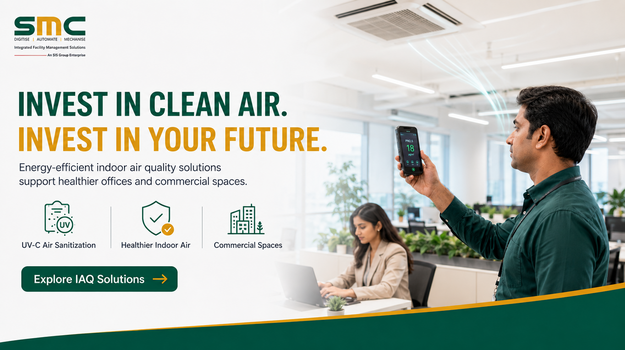
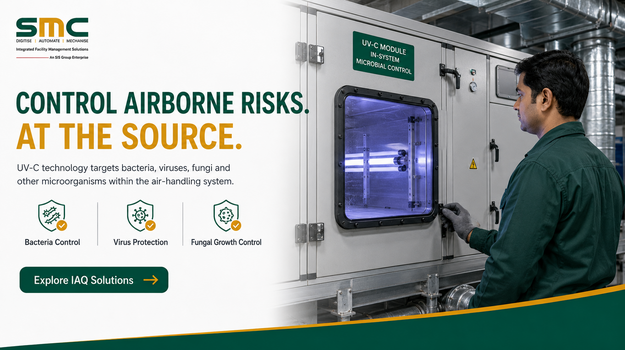
Commercial UV-C sanitizers installed at the AHU, treating return air and keeping biofilm off the cooling coil — so air quality, airflow and cooling efficiency improve from the same intervention.

Used air returns from the floor through the duct to the air handling unit. A UVGI system installed there disinfects that return air before it is supplied back, using UV-C to alter the DNA of bacteria, viruses, fungi and other microorganisms so they cannot reproduce. Continuous exposure also keeps the evaporator and cooling coil free of biofilm, dust and fungal growth — which is where the energy benefit comes from. From SMC Integrated Facility Management Solutions Limited, an SIS Group enterprise.

Why Choose SMC Indoor Air Quality?

Cleaner supplied air, no residual odour

Return air is disinfected at the AHU rather than filtered at the outlet. With adequate UV dose, microorganisms are inactivated and no residual odour is carried back onto the floor.

Hygiene that pays for itself in energy

A coil with no biofilm exchanges heat properly. The compressor works less to reach floor temperature and the AHU motor works less at improved CFM — so the same install that cleans the air also lowers consumption.

Continuous, not periodic

Chemical coil cleaning is a scheduled event, and the coil begins fouling again the next day. UV-C exposure runs whenever the plant runs, so the coil never gets the chance to foul.

What the solution covers
Solution
Indoor Air Quality — Commercial Ultraviolet Air Sanitizer
Technology
Ultraviolet Germicidal Irradiation (UVGI) using UV-C
Mode of action
UV-C alters the DNA of bacteria, viruses, fungi and other microorganisms so they cannot reproduce
Installation point
At the air handling unit (AHU), treating return air from the floor
Coil protection
Prevents biofilm formation on the evaporator and cooling coil surface
Coil condition
Zero biofilm, dust or fungal generation under continuous UV exposure
Airflow
Better coil clearance to airflow, improving CFM on the floor
Heat exchange
Clean coil allows optimum heat exchange and improved cooling efficiency
Compressor load
Compressor target reduced to meet required floor temperature
AHU motor
Motor target reduced with improved CFM, adding energy savings
Odour
Adequate UV intensity ensures nil residual odours after microorganisms are killed in return air
Dose
High-quality installation maintains adequate UV dose for effective germicidal eradication
Coil maintenance
Reduces reliance on manual and chemical coil cleaning cycles
Buildings supported
Conventional and smart buildings with AHU-based HVAC
Company
SMC Integrated Facility Management Solutions Limited, an SIS Group enterprise
Scale
170 million ft² of area operations; 750+ clients; 40,000+ employees
Network
303 districts (footer) / 450 districts covered; 35 branch offices — see build note 4
Sectors served
  • Healthcare
  • Manufacturing
  • Pharma
  • Retail
  • Education
  • Residential

Scope as published by SMC. UV dose, lamp count and placement are engineered per AHU — coil size, airflow and the target organism all affect the design. Contact the team for a site survey rather than a catalogue specification.

How it works
The dirtiest surface in your building is one nobody looks at

A cooling coil is permanently cold, permanently wet and permanently in the path of every cubic foot of air the building breathes. That makes it an excellent place for biological growth — and the resulting biofilm does two things at once. It sits in the airstream that gets supplied back to the floor, and it insulates the coil so heat exchange falls off. Most buildings treat that as a cleaning task on a schedule. UVGI treats it as a condition to be prevented continuously, which is why one intervention improves both air quality and energy consumption.

UV-C at the return air path

The system sits at the AHU, where used air from the floor arrives through the duct. Disinfecting there treats the whole recirculated volume rather than one room at a time.

A coil that stays clean

Continuous exposure prevents biofilm, dust and fungal growth on the coil surface. Better clearance means better airflow; a clean surface means heat transfers as designed.

Two savings from one install

With heat exchange restored, the compressor works less to hold floor temperature and the AHU motor works less at improved CFM. The hygiene case and the energy case are the same case.

Ask us anything
Questions about SMC Indoor Air Quality

UV-C alters the DNA of bacteria, viruses, fungi and other microorganisms so they can no longer reproduce. The germicidal effect of that part of the spectrum has been recognised in science for around a century.

The important detail is dose. A UV-C lamp is not automatically effective — intensity, exposure time and the target organism's susceptibility all matter. A high-quality installation is one engineered to maintain an adequate dose, which is why this is a survey job rather than a product purchase.

At the air handling unit. Used air from the office floor travels through the duct to the AHU, and the UVGI system disinfects that return air before it is supplied back.

It also continuously irradiates the cooling coil, which is the second half of the benefit.

A cooling coil is cold, damp and in the path of all the building's air — ideal conditions for biological growth. The resulting biofilm insulates the coil and restricts airflow.

Remove it and heat exchange improves, so the compressor works less to hold floor temperature. Airflow improves too, so the AHU motor works less at better CFM. SMC positions this as the energy case that comes free with the hygiene case.

It changes the problem from removal to prevention. Chemical cleaning is a scheduled event and the coil starts fouling again immediately afterwards; continuous UV exposure means it never gets the chance.

Discuss your existing cleaning regime with the team — how much of it can be reduced depends on your plant, its age and its condition at the point of install.

Yes. With adequate UV intensity, SMC states there are nil residual odours once microorganisms in the return air have been killed.

Odour in recirculated air is usually microbial in origin, which is why treating the return path addresses it at source rather than masking it.

That depends entirely on your plant — coil condition at install, AHU age, run hours, climate and load. SMC describes the mechanism rather than publishing a universal percentage, which is the honest position.

Ask for measured figures from an installation comparable to yours, and take your own baseline consumption reading before the install. Without a baseline, no efficiency claim from any supplier can be verified afterwards.

Use the Book a demo button. SMC also offers a free Facilities Management Maturity Assessment.

For this solution specifically, the useful first step is a coil condition check on your older AHUs. Rising static pressure, longer chiller runtime at the same load, and creeping HVAC consumption at unchanged occupancy are the signs worth looking for.

SMC

Computerised Maintenance Management System

Book a demo

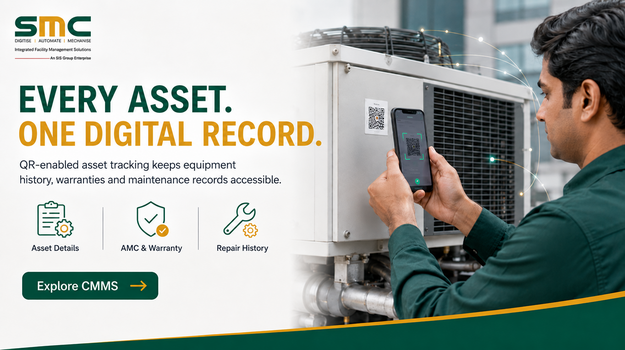
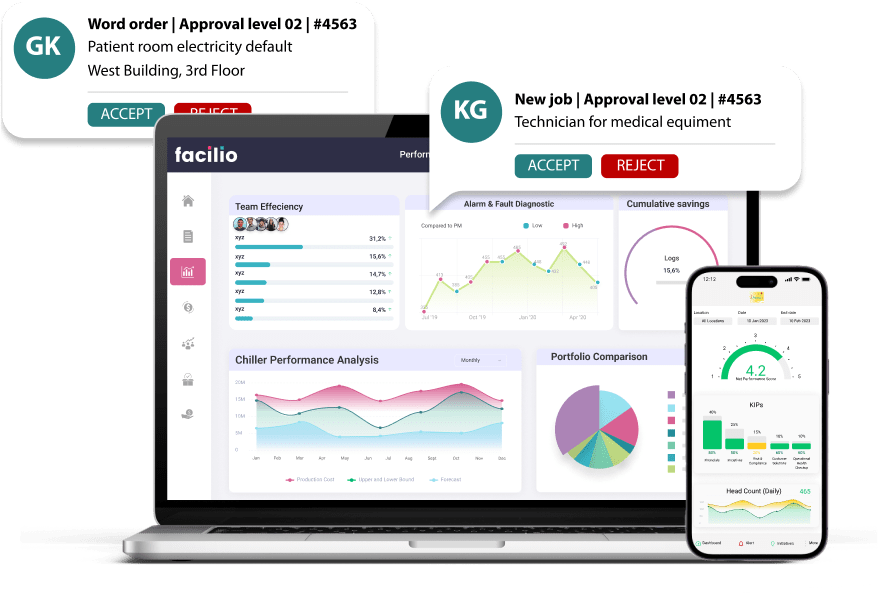
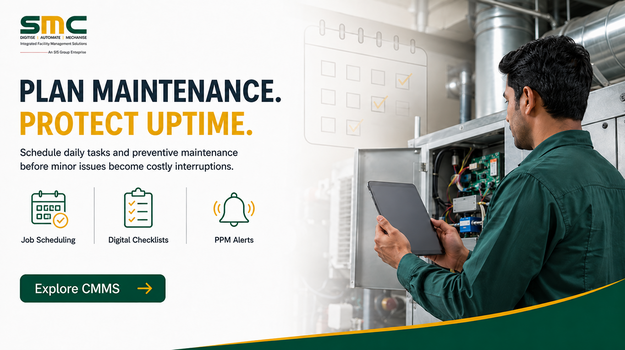
Asset register, work orders, spares and SLA reporting held in one system — so maintenance runs to a schedule set against the asset, instead of being triggered by the breakdown it was meant to prevent.

CMMS gives 360° visibility of operations and maintenance across conventional and smart buildings. It streamlines workflows so every technician has the right information at the right time, turns maintenance from reactive scrambles into planned intervention, and manages spare parts inventory, preventive scheduling and compliance in the same place. From SMC Integrated Facility Management Solutions Limited, an SIS Group enterprise.

Why Choose SMC CMMS?

360° visibility of O&M

Energy, assets and maintenance expenditure in one view. The blind spots in a facility budget are usually not hidden — they are just spread across three systems and a spreadsheet.

Planned, not reactive

Preventive scheduling and fault diagnostics extend asset life cycle and cut repair and maintenance cost. The intervention you plan is always cheaper than the one the alarm chooses.

SLA reporting as an output, not a project

MIS, MMR and SLA reports are generated from the work as it happens. Compliance stops being something assembled before a review and becomes the normal state of the contract.

What CMMS covers
Solution
Computerised Maintenance Management System (CMMS)
Asset management
Asset register, lifecycle tracking and performance history
Operations & maintenance
Planned and reactive maintenance managed in one system
Help desk management
Request logging, routing and resolution tracking
Work order management
Work orders raised, assigned, approved and closed digitally
Store & spares management
Spare parts inventory and consumption control
Attendance management
Workforce attendance captured against the site
MIS / MMR / SLA reporting
Management information, monthly reports and SLA performance
Improved asset life cycle
Planned intervention extends the working life of installed assets
Fault detection & diagnostics
Faults identified and diagnosed rather than discovered on failure
Utility tracking & benchmarking
Consumption tracked and compared across sites and periods
Energy analytics & BI
Energy data turned into business intelligence for decisions
Cost outcome
Reduced repair and maintenance cost
Buildings supported
Conventional and smart buildings
Company
SMC Integrated Facility Management Solutions Limited, an SIS Group enterprise
Scale
170 million ft² of area operations; 750+ clients; 40,000+ employees
Network
303 districts (footer) / 450 districts covered; 35 branch offices — see build note 4
Headquarters
Okhla Industrial Area, Phase-I, New Delhi
Sectors served
  • Healthcare
  • Manufacturing
  • Pharma
  • Retail
  • Education
  • Residential

Scope as published by SMC. CMMS is configured per site — module set, integrations and reporting formats depend on your asset base and existing systems. Contact the team for a scoped proposal.

How it works
The bridge between data and decisions

Traditional facility management fails in a recognisable way: a manual delivery approach, paperwork for documentation, no real-time records, delayed reporting and consumption analysis done by hand. None of those is a competence problem. They are a visibility problem, and they produce the same outcome every time — decisions made late, on stale data, about assets nobody was watching. CMMS closes that gap by capturing the work where it happens and turning it into something you can act on.

The right information at the right time

Work orders reach the technician with the asset history, the spares position and the procedure attached — which is what turns a site visit into a repair rather than a diagnosis trip.

Energy analytics and benchmarking

Utility consumption tracked and compared across sites and periods. A figure only becomes actionable once you can see what it should have been.

A compliance guardian

Adherence to industry standards is evidenced continuously through MIS, MMR and SLA reporting, rather than reconstructed from paperwork when someone asks for it.

Ask us anything
Questions about SMC CMMS

Seven modules: asset management, operations and maintenance, help desk, work order management, store and spares, attendance management, and MIS/MMR/SLA reporting.

They matter as a set rather than individually. A work order is only useful if it knows the asset's history and whether the spare is in stock — which is why these live in one system instead of three.

It comes as part of SMC's facility management delivery rather than as shelf software. The system is configured to your asset base, and SMC's team operates against it.

That distinction matters commercially: you are not buying a licence and then hiring someone to populate it. Ask what the configuration period looks like for a site your size.

SMC publishes five outcomes: improved asset life cycle, fault detection and diagnostics, utility tracking and benchmarking, energy analytics and BI, and reduced repair and maintenance cost.

In a healthcare deployment at Kokilaben Dhirubhai Ambani Hospital, SMC reports a 30% manpower reduction, a 2.5× improvement in customer satisfaction and a 20% rise in overall service quality. Those are that site's figures in a hospital setting — worth asking for a comparable reference in your own sector.

CMMS is built for both conventional and smart buildings, so it does not assume a BMS or a new-build asset base.

Integration with what you already run — BMS, ERP, existing asset registers — should be scoped explicitly at proposal stage. That is the question that decides how long implementation takes.

Every action is captured as it happens and surfaced through MIS, MMR and SLA reporting. Adherence to industry standards is evidenced continuously rather than reconstructed from paperwork before a review.

A useful test for any provider: ask to see what a month of unedited reporting looks like. That answers more than a feature list.

Visibility. Traditional FM runs on manual delivery, paperwork documentation, no real-time records, delayed reporting and consumption analysis done by hand.

None of that is a competence problem — it is a data problem, and it produces the same outcome every time: decisions made late, on stale information, about assets nobody was watching.

Use the Book a demo button. SMC also offers a free Facilities Management Maturity Assessment, which identifies where cost savings sit in your current operation before you commit to anything.

Bring your asset register, current maintenance arrangements and energy consumption to that conversation — without a baseline, no efficiency claim from any provider can be verified later.

Edward D'souza, CEO, SMC Integrated Facility Management Solutions
Interview 5 min read

SMC Plans Growth in Different Tiers Under New Leadership


The evolving demands of facility management (FM) in India have created a clear need for companies that can provide customised, scalable and environmentally conscious solutions. SMC, a growing name in integrated FM services, is now stepping into the advanced phase under the leadership of the new CEO, Edward D'souza. With a strategic focus on technology, sustainability and operational depth, Edward aims to reshape the FM landscape, particularly in sectors and geographies that are under-served. In this exclusive interview, he shares SMC's vision, growth plans and why Tier-II and Tier-III cities hold the key to the future of FM in India.

"The real opportunity in facility management lies beyond the metros. Tier 2 and 3 cities are ready for smart, sustainable solutions — and we are building the ecosystem to deliver exactly that."
— Edward D'souza

What direction is SMC taking under your leadership?

We are sharpening our focus on delivering FM services that are not only efficient and high-quality but are also deeply sustainable. Our roadmap is guided by three priorities: technology adoption, ESG-driven solutions, and expansion beyond metropolitan hubs. There is tremendous opportunity in Tier 2 and Tier 3 cities, where infrastructure is growing but facility services are still catching up. We want to be the first movers there.

How will technology drive your strategy?

Technology is not just an enabler; it is a differentiator. We are integrating IoT, CAFM platforms, and automation tools to enhance visibility and predictability in service delivery. But we are also focusing on simplicity. The goal is to make tech adoption seamless for the client while reducing energy use, waste, and inefficiencies. For instance, our smart cleaning schedules, driven by occupancy patterns, are already saving clients up to 18% on operational costs.

What does ESG mean for a company like yours?

ESG is no longer optional; it is fundamental to how modern FM must operate. At SMC, our ESG approach begins with the basics: energy audits, water-saving retrofits, waste segregation at source. But we are now moving towards circularity — reusing treated water for landscaping, converting organic waste into compost, and reducing single-use consumables in daily operations. Our people are trained not only in technical skills but in sustainability thinking. Clients are also evolving — they want partners who align with their ESG goals.

What sectors are you targeting for growth?

We are seeing strong demand from sectors such as healthcare, education, logistics, and manufacturing. These are sectors where hygiene, compliance, and uptime are non-negotiable. Our expertise in managing high-sensitivity environments — such as pharma units and hospitals — is helping us stand out. We are also strengthening our presence in co-working and residential community spaces, where customer experience plays a key role.

You spoke about Tier 2 and 3 cities. Why are these important?

The FM market in metros is crowded and competitive. But real India is growing in cities like Nagpur, Surat, Coimbatore, and Indore. These regions are seeing rapid investments in industrial clusters, IT parks, and institutional campuses. However, FM service quality there is fragmented. By building local teams, using regional vendors, and offering service guarantees, we are bringing big-city FM standards to smaller cities. This is also more inclusive — we hire and train local talent, which builds community trust and long-term continuity.

What is your approach to workforce management?

People remain at the core of FM. We invest significantly in training and upskilling — not just for compliance, but to build careers. Our digital onboarding and LMS platforms ensure consistent training delivery, even in remote locations. We are also working on a multilingual mobile app that will allow our field teams to access SOPs, log issues, and receive feedback in real time. FM is about consistency and culture — and that comes from investing in your people.

What is next for SMC?

We will be launching a new ESG-aligned service model by the end of this year. It will include green certifications, carbon footprint tracking, and sustainability reporting integrated into our FM dashboards. We are also expanding into waste management and soft services, where bundled contracts offer clients better value. Internally, we are building an insights team that will use data to continuously improve service outcomes. We want to move from reactive service delivery to predictive FM.

Finally, what do you believe will define the future of FM in India?

Customisation, sustainability, and accountability. Clients no longer want standard packages — they want FM solutions that fit their operational culture and environmental vision. The players who combine tech, talent, and transparency will lead. At SMC, we want to be that kind of partner — future-ready but rooted in ground realities.

Digital CAFM dashboard monitoring facility management operations in real time
Technology 1 min read

Software: The New Backbone of Facility Management


The conversation between FM providers and their corporate clients has shifted. How many people a provider can deploy now counts for less than how their work is monitored, measured and reported in real time.

Manual logbooks, paper checklists and end-of-day summaries are giving way to integrated digital platforms — and increasingly, to AI-powered CAFM systems that move facility management from reactive to predictive, and from record-keeping to autonomous action.

In this Focus, three industry leaders share how software is reshaping the sector.

Vinayak Bhise of iSmart Facitech describes a Mumbai-based provider's rebuild of its operational backbone around a centralised digital platform.

Sathish Rajendren of Newmark maps the five ways AI is transforming CAFM, with the numbers behind predictive maintenance and autonomous workflows.

Anuj Rajain of Tenon Group explains how integrated ecosystems like M-Neo are turning automation and live dashboards into the new operating standard at scale.

Frontline facility management workers affected by India's new labour codes
Policy 15 min read

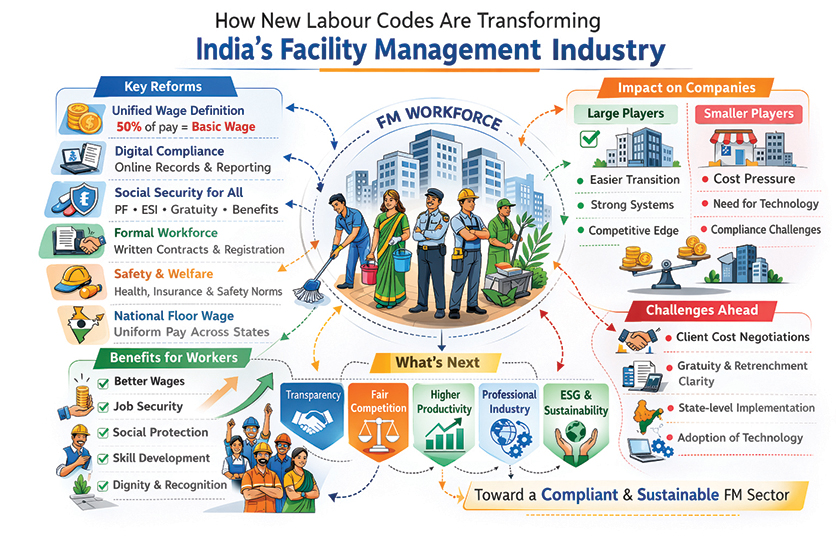
Rewriting the Rules of Work: How New Labour Codes Will Be Transforming India's FM Industry


India's facility management industry is entering a defining phase as sweeping labour reforms begin to reshape how millions of frontline workers are hired, paid and protected. The transition is set to influence costs, compliance and workforce structure across the sector. Clean India Journal's Manka Behl speaks to experts in companies and examines how they are navigating the shift and what it means for the future of facility management.

India's facility management industry — built on millions of frontline workers who clean, maintain, secure and sustain the country's infrastructure — is standing at a turning point.

The sweeping consolidation of 29 labour laws into four codes is not just a regulatory shift; it is quietly redefining how this workforce is hired, paid, protected and perceived. For an industry long driven by cost efficiency and contract labour, the transition signals something deeper: a move toward structure, transparency and accountability.

As the new labour framework edges closer to full implementation, the question is no longer whether the facility management sector will adapt. Instead, it is how fundamentally it will transform in the process.

Industry leaders, while broadly aligned with the intent of the reforms, are now navigating the realities of implementation — where every change in definition, documentation and responsibility has a direct bearing on margins, manpower and service delivery.

Simple, complex

At its core, the reform aims to simplify a fragmented system.

Calling it a much-awaited move, Sudhir Mani Sahay, Chief Operating Officer at Allied Resource Management Services (I) Pvt Ltd, points out that consolidating multiple laws into "compact and crisp" codes reduces administrative clutter, allowing companies to focus more on delivery and performance rather than paperwork. "This will boost organised players to be in the race," he says.

"Consolidating multiple laws into compact and crisp codes reduces administrative clutter, allowing companies to focus more on delivery and performance rather than paperwork."
— Sudhir Mani Sahay

Echoing this, Edward D'Souza, CEO of SMC India Integrated FMS Ltd (an SIS Group enterprise), calls the consolidation "a genuine leap toward ease of doing business". "The new labour codes bring clarity on wages, working hours, and social security, which will push the FM industry to move beyond pure manpower supply. I see this as an opportunity to invest in multi-skilling, ensuring our staff are valued for their expertise rather than just their presence," he says.

Edward also believes that replacing multiple registrations with a single framework could streamline compliance. "However, real impact depends on state-level implementation and clarity in rules. For FM companies operating across multiple states, uniformity will help," the expert says.

"In the next five years, the 'unorganised' tag will disappear from facility management. We will see a highly professionalised industry."
— Edward D'Souza

Digital shift

What appears as simplification on paper is in practice a complete overhaul of how companies manage compliance.

Vinayak Bhise, MD, iSMART Facitech Pvt Ltd, explains that while the legal framework reduces fragmentation, the compliance burden does not disappear — it shifts. "For FM companies — who typically deploy large numbers of contract and site-based employees across multiple establishments and states — the compliance burden will not necessarily reduce but will shift towards structured digital compliance," says Vinayak.

Facility management firms, he says, will now have to invest in integrated payroll and HR compliance systems to align with the statutory definition of wages, centralised digital compliance platforms for maintaining electronic registers, worker data management tools particularly for contract labour, and automated statutory contribution tracking (PF, ESI, gratuity, etc.) based on the revised wage structure.

"The new labour codes do not eliminate the labour-intensive nature of the FM industry. However, they do promote greater formalisation and standardisation of employment practices."
— Vinayak Bhise

From an operational standpoint, Ankur Sachdev, CEO of Tenon FM, also stresses the urgency of automation. "To meet the new compliance norms, automation of the HR portal for maintaining digitalisation records and a statutory dashboard for timely adherence of the compliances — including wage payments, appointment letters, leave encashment, Full-Time Equivalent (FTE contract) and welfare facility schemes — will be needed," he says.

"As a service provider, we have revised our payroll structures and are issuing updated appointment letters in line with the new labour framework."
— Ankur Sachdev

According to Sanjeev Kumar NGS, CEO at Dusters Total Solutions Services Private Limited, larger, organised players have already started aligning their compliance systems, digitised payroll, and documentation frameworks. "However, a significant portion of the industry — especially smaller, regional operators — still rely on manual processes and fragmented compliance practices. The facility management industry is partially prepared but unevenly so," he says.

The expert adds that the transition will accelerate formalisation, with increased focus on digital compliance tracking, standardised wage structures and audit-ready documentation. "Overall, the industry is on the path to readiness, but full compliance maturity will take time," says Sanjeev.

"Over the next five years, FM companies that invest in people, processes, and technology will emerge stronger, while unorganised players may struggle to sustain. The new labour codes are not just a compliance change — they are a structural shift towards a more transparent, fair, and sustainable FM industry."
— Sanjeev Kumar NGS

Wage reset

Perhaps the most immediate and impactful change for the industry lies in the new definition of wages.

Under the Code on Wages, a uniform definition of 'wages' is now applicable across multiple labour laws. The basic pay must constitute at least 50% of total remuneration, a move that directly increases statutory liabilities.

According to Vinayak, this restructuring can have a substantial cumulative financial impact on labour-intensive sectors like facility management. "In practice, FM service providers generally operate under fixed commercial contracts with clients, where manpower cost constitutes a substantial portion of the service cost. Many organisations would structure salaries with lower basic wages and higher allowances to optimise statutory contributions. But under the new legal framework, such structures will no longer be sustainable, as this change will significantly raise payroll-linked costs, including provident fund, gratuity, bonus and leave encashment," he explains.

The increased statutory labour cost will ultimately have to be incorporated into service pricing structures, the expert adds.

Ankur admits that the revised wage definition is already creating friction at the client level, with increased costs requiring renegotiation and approval before implementation. "As a service provider, we are facing on-ground challenges from clients in implementing the revised wage definition under the labour codes. Since all statutory benefits are linked to this, costs are increasing, and any change in overall cost requires client approval and consent. Accordingly, we have revised our payroll structures and are issuing updated appointment letters in line with the new labour framework," he says.

However, the impact is not uniform across the industry.

Suresh Shinde, Head – HR, IR & Admin at FF Services Pvt Ltd, indicates that the impact of the 50% wage definition may not be uniform across the industry. "Any compliant facility management company is unlikely to face significant challenges, as they are already paying minimum wages to all staff according to their respective designations. Since minimum wages already constitute more than 50% of the wage calculation, such companies are unlikely to face major margin pressures," he explains.

However, Suresh cautions that organisations that have not been following proper wage structures and have been undercutting prices to secure business may find it difficult to manage under the new framework.

Suresh further notes that this change extends beyond traditional employment structures. "Short-term contracts will also be eligible for statutory benefits such as gratuity, leave encashment and other entitlements. Apart from this, gig workers, consultants and employees on fixed-term contracts will also receive fair and equitable remuneration, which is a positive development from an employment perspective," the expert adds.

"The most significant aspect of the new labour codes will be the standardised definition of wages and stronger compliance with statutory benefits. This will ensure that employees receive proper social security benefits such as provident fund and gratuity."
— Suresh Shinde

Overall, Suresh is hopeful that the reforms will significantly strengthen the principle of equal and fair remuneration across the workforce.

Suresh identifies the standardised definition of wages and stronger compliance with statutory benefits as the single most important change shaping the future of the industry. "This will ensure employees receive proper social security benefits such as provident fund and gratuity, while also bringing greater transparency in wage structures. Over time, this will encourage fair competition and push companies toward more compliant and professional service delivery," he says.

The introduction of a national floor wage is also expected to influence labour movement across regions. Says Sudhir: "The new norms will lead to uniform supply of labour all across the demography, unlike the past where migrants from the eastern part of the country would travel to the north-west for better wages." With wage standardisation, this migration pattern may reduce, as workers find viable opportunities closer to home.

While this could improve retention and stability, it may also impact the availability of migrant labour in certain markets — creating both opportunities and challenges for service providers.

Sanjeev is also of the view that the implementation of the new labour codes will significantly reshape pricing models and margins across the industry. "These reforms will introduce greater transparency and standardisation, particularly in areas such as wages, social security, and working conditions. As a result, companies are likely to face upward pressure on costs, especially in labour-intensive contracts, while also experiencing reduced flexibility in how they structure these costs," he says.

In the context of long-term agreements, Sanjeev suggests that renegotiations will become almost inevitable. "While some progressive clients may be willing to absorb a portion of the increased costs, this may not always be the case. In such scenarios, service providers will need to focus on operational optimisation to remain competitive, even as margins come under pressure in the short term," he adds.

However, the expert strongly believes that this transition could ultimately lead to a more stable and sustainable pricing environment. "Over time, pricing is expected to become more realistic, helping to curb the practice of undercutting and fostering a healthier competitive landscape," says Sanjeev.

Formal workforce

Beyond compliance and cost, the labour codes signal a structural shift in how the workforce is organised. The Occupational Safety, Health and Working Conditions Code focuses on improving workplace safety, welfare facilities and working conditions.

Edward believes this shift will push the industry beyond a manpower-driven model toward a skill-based, service-oriented approach, where workers are valued for expertise rather than sheer numbers. "I see this as an opportunity to invest in multi-skilling, ensuring our staff are valued for their expertise rather than just their presence," he says.

Apart from this, the mandate for written appointment letters for every worker will be a gamechanger for dignity, adds Edward. "By bringing 'invisible' staff into the formal economy with guaranteed social security and a national floor wage, we are validating their essential role in urban infrastructure. This structural shift moves them from 'daily wagers' to 'professional service providers'," he says.

Vinayak too sees the reforms as a move toward formalisation. "The new labour codes do not eliminate the labour-intensive nature of the FM industry. However, they do promote greater formalisation and standardisation of employment practices. Collectively, these provisions indicate a policy shift toward formal, regulated employment rather than informal low-cost labour arrangements. Over time, this can encourage increased mechanisation and technology adoption in facility services, bring more emphasis on skilled and multi-tasking workforce models and improve employment documentation and statutory compliance," he says.

Improved labour standards are also expected to have a direct impact on productivity and service quality. Sudhir emphasises that provisions such as mandatory health check-ups and stronger safety measures will lead to a healthier, more stable workforce. "A happy, productive and long-tenured team can significantly improve efficiency, consistency and output — particularly in demanding environments such as healthcare facilities, airports and commercial complexes. The emphasis on welfare is especially critical in sanitation and waste management roles, which continue to be a taboo in our country. Better wages, safety and dignity could encourage more workers to take up these roles," he says.

Ultimately, the new norms will lead to a more stable, formal and compliant workforce ecosystem, says Sanjeev. "At the same time, there will be additional challenges for local and small regional players who have currently been working with compliance standards below par, and due to which they get some advantage over other competitors," he adds.

Bigger challenges

The transition, however, is not going to be equally easy for all.

Edward feels that smaller service providers may come under more pressure. "Increased focus on formal wages, Provident Fund (PF), Employees' State Insurance (ESI) and documentation raises cost and compliance requirements. Large FM companies already operate within structured systems, while smaller players will need to upgrade processes, which could impact margins and scalability in the short term," he says.

Vinayak echoes this view, stating that the readiness of the service industry is mixed and varies significantly by organisation size and compliance maturity. "Large and organised FM companies already comply with most statutory social security obligations and are therefore likely to face limited structural challenges, apart from adapting payroll systems to the revised wage definition. However, smaller service providers may encounter multiple challenges, including worker registration and documentation, digital compliance reporting, the financial impact of expanded statutory contributions, and maintaining statutory records for large, distributed workforces," he explains.

At the operational level, FM companies will face several practical challenges. Highlights Sanjeev: "These include transitioning legacy systems to new compliance frameworks, managing cost escalations in existing contracts, and ensuring vendor and subcontractor compliance. Companies will also need to focus on training internal teams on new regulations and processes, while handling increased documentation and audit complexity. Additionally, the lack of clarity during the initial implementation phases may create short-term uncertainty."

Vinayak further points out that the Code on Social Security, 2020 also introduces provisions enabling social security schemes for gig workers, platform workers and unorganised workers, which will require extensive administrative coordination between employers, aggregators and government authorities. "While the legal framework is comprehensive, its practical implementation will depend significantly on the readiness of digital compliance systems and the level of employer awareness — factors that could vary widely across the industry," he says.

Compliance as a differentiator

As compliance becomes more structured and transparent, it is increasingly influencing how service providers are evaluated and selected. Industry voices indicate that stronger adherence to labour norms is beginning to shape both performance outcomes and client expectations.

As per Sanjeev, clients will increasingly evaluate FM partners on compliance capability, not just cost. "We will see a shift towards a clear preference for organised, compliant players, along with greater scrutiny of statutory adherence and audit readiness. There is also likely to be inclusion of compliance metrics in RFP evaluations. This, in turn, will reduce the viability of low-cost, non-compliant operators and create a level playing field for quality-driven service providers," he says.

Sudhir notes that stronger labour compliance helps service providers retain experienced teams and deliver consistent results, making them more attractive to clients. "This is not only mandated by law, but such arrangements help to have and retain experienced and long-tenure teams on the ground, which helps in achieving desired results from the service provider," he says.

Suresh adds that standardised wage definitions and statutory benefits will promote fair competition, reducing the advantage previously held by non-compliant players. "The facility management industry is highly client-driven, and we are actively engaging with clients to explain the importance of implementing the wage code and its benefits for both employees and employers while ensuring compliance at sites. A majority of clients have now changed their mindset, with many proactively approaching service providers for revised proposals, reflecting a broader positive shift across industries," he says.

The expert adds that if service providers are already paying the prescribed minimum wages, there should be no major issue, as clients are also required to comply with the same government regulations. "The restrictions and compliance requirements have been designed to be applicable to both parties. However, for those who have been compromising on statutory compliances, it will now become very difficult to manage under the new wage code framework," adds Suresh.

The road ahead

While the new labour codes lay down a comprehensive framework, industry stakeholders note that certain operational ambiguities and implementation challenges still need to be addressed. At the same time, there is broad consensus that the reforms will drive the sector toward greater structure, transparency and professionalism in the years ahead.

Ankur points to the lack of clarity around gratuity payment frequency — whether it should be monthly, quarterly or annual — which is creating disagreements with clients. "Most of the clients are not agreeing to pay it on a monthly basis. Also, retrenchment compensation is statutory, so in cases where contracts are terminated by clients, clearer allocation of responsibility is needed," he says. These unresolved areas, he indicates, could impact smooth implementation unless addressed through detailed guidelines.

Overall, looking ahead, industry leaders anticipate a more structured, transparent and professional ecosystem. Edward believes that in the next five years, the "unorganised" tag will disappear from facility management. "We will see a highly professionalised industry where ESG (Environmental, Social, and Governance) compliance is the baseline. The codes will ensure that only ethical, tech-enabled players survive, turning Indian FM into a globally competitive, service-first sector," he says.

Sanjeev too believes that over the next five years, FM companies that invest in people, processes, and technology will emerge stronger, while unorganised players may struggle to sustain. "The new labour codes are not just a compliance change — they are a structural shift towards a more transparent, fair, and sustainable FM industry," he says.

Vinayak underscores that transparent wage structures and accurate statutory compliance will become non-negotiable. Sudhir foresees improved retention, stability and productivity, while Suresh expects stronger compliance to drive fair competition.

As the transition unfolds, the industry is moving toward a new normal — where structure replaces informality, and professionalism becomes the standard rather than the exception.

For companies, the shift demands investment in systems, processes and people.

For workers, it promises security, dignity and opportunity.

And for the industry as a whole, it signals a move away from informality toward a future defined by compliance, capability and credibility.

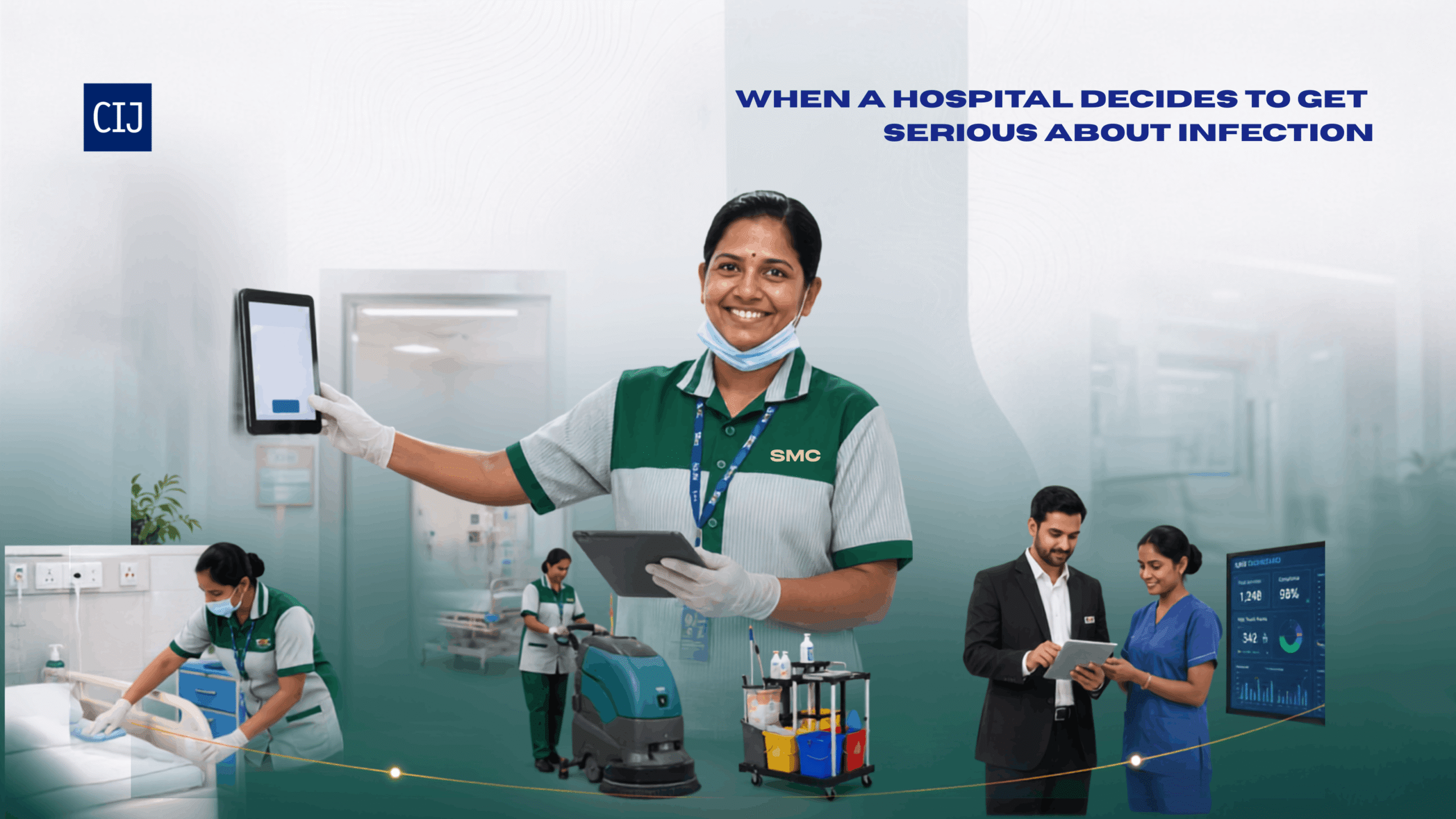
Housekeeping staff following infection control protocols at Caritas Hospital, Kottayam
Healthcare 5 min read

When a Hospital Decides to Get Serious About Infection


Priyanka Bane Kamble, Assistant Vice President, ESG and Healthcare Facility Strategist — under the direction of Edward D'Souza — explains how SMC Integrated Facility Management Solutions Limited is changing the standard of care at Caritas Hospital & Institute of Health Sciences, Kottayam: 271,000 sq ft, two campuses, one uncompromising programme.

Every hospital administrator eventually confronts the same question — usually after an HAI incident, an audit finding, or a near-miss that never makes it into any report: are we actually preventing infection, or are we just cleaning?

In most Indian hospitals, the honest answer is the latter. Not because the staff aren't working. Because the framework was never built for infection prevention. It was built for appearance. In healthcare, those are two entirely different briefs.

Caritas Hospital & Institute of Health Sciences in Kottayam decided not to wait for a forcing event. In February 2026, they brought SMC Facility Services onto two campuses — the Cardiology and Oncology blocks of their multi-speciality complex and Caritas Matha Super Speciality Hospital — covering 271,000 sq ft. The mandate wasn't housekeeping. It was infection control.

Everyday use

SMC's Smart Surface Disinfection Programme (SSDP) is reverse-engineered from NABH and JCI standards, with 60% of those guidelines embedded into daily operations. The goal isn't to pass an inspection. It's to protect the person in the bed, on every shift, whether an auditor is present or not.

SSDP runs on five pillars: Man, Material, Machine, Method, and Measure. At Caritas, each pillar replaced something the industry had quietly accepted as good enough.

  • Man: Caritas's existing staff transitioned to SMC's payroll — same people, now with full statutory benefits and, for many, the first structured healthcare training of their careers. Curriculum: 7-step cleaning, ICU and OT protocols, discharge room procedures, needle-stick injury response, spillage management, patient-area etiquette. They didn't just learn to clean differently. They learned why it matters.
  • Material: cotton mops and wringer buckets were replaced with microfibre flat mops on a pre-wet system — one fresh sleeve per room, sealed after use. Colour-coded mops and dusters assign every tool to a specific zone. What touches a washroom never enters a patient room. Auto-dilution dispensers replaced spray cans, protecting patients with respiratory conditions from aerosolised chemicals. Rubbermaid janitor carts keep cleaners within their zones. On-site laundry with full IPC protocol closes the loop from first use to safe reuse.
  • Machine: equipment chosen on clinical performance. Floor scrubbers in lobbies, OTs, ICUs, and the Cathlab. Single morning service replaced with morning and evening — double the intervention window.
  • Method: clockwise room sequences. Dedicated discharge protocols. High-touch surfaces — bed rails, call buttons, IV stands, light switches — as a non-negotiable daily priority. Glow Germ assessments. Deep cleans for critical areas. International standards, applied without exception.
  • Measure: three feedback layers — SMC supervisor inspections via IQMS barcode scanning, real-time nursing staff input, and patient satisfaction scores. Monthly management dashboards give leadership a clear, honest view of FM performance. Because what doesn't get scored doesn't get better.

"Traditional FM manages people; Smart FM measures impact, accountability and operational performance."

Technology use

IQMS — Intelligent Quality Management System — turns every inspection into a timestamped data point. No clipboards. No subjectivity. Hospital leadership sees performance as numbers, not impressions.

iPorter is a beacon-based dispatch platform — the Uber model applied to patient attendant services. Bed baths, shaving, bedpan assistance, patient transport: matched to available staff on demand, in real time. Manpower goes where it's needed. Patients stop waiting.

Sustainability method

Pre-wet systems cut water use per clean. Auto-dilution eliminates chemical waste at source. Reusable microfibre reduces landfill load. Demand-based staffing cuts idle deployment. Full statutory compliance advances the hospital's own ESG social pillar. SMC's sustainability contribution isn't a separate initiative — it's what happens when the job is done correctly.

Enquire Now

Please enable JavaScript in your browser to complete this form.