








 CIJConnect Bot-enabled WhatsApp today at 4:00 PM.
 An increasing number of processes and devices are being digitalised, both in facility management and in the field of cleaning services. Thus the opportunity presents itself to interconnect work steps and increase efficiency across the board, from technical services or manning the canteen to cleaning tasks. Cleaning on demand makes it possible to work in a needs-based way on the basis of relevant data. In the future, a central task will be to further improve digital solutions and the way that data is used and to finally transform them into a central task management system: To combine what already works today with how the world will look tomorrow.
Status quo:
When cleaners gather data.

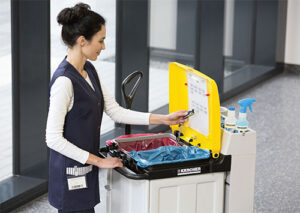 It is already possible to implement cleaning as part of infrastructural facility management and to interconnect cleaning tasks with other facility management tasks. This is because cleaners not only see what tasks need to be completed in order to fully clean a room, they also see when, for example, an LED is broken or when a window won’t close properly or when the heating doesn’t work. Facility management systems such as Kärcher Manage can directly pass on such cases to those who can fix them. Ready-made damage reports are available as barcodes and can be scanned in. At the end of a shift, the data is sent off so that any necessary repair work can be scheduled. In this way, it is guaranteed for technical defects to be detected and corrected as soon as possible – a service quality benefit that is highly valued by the customer.
The next step:
Transmitting data, on a case-by-case basis and in real time.
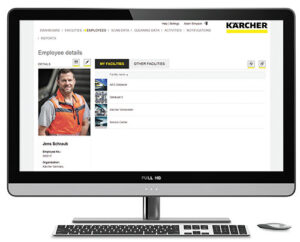 In order to make the whole system even faster and more efficient, it will be possible in future to make an app available for cleaners to have on their own smartphones. This would, on the one hand, allow them to record where and when they cleaned, which makes the work that has been done significantly more transparent. On the other hand, they can record any damage with a photo and a caption and the cleaning location can be precisely determined using NFC (Near Field Communication) or Bluetooth.
Depending on how the underlying task management system is organised, the damage report is either sent to a suitable designated email address so that the service technician responsible can be deployed, or the message is sent directly to the service provider’s CAFM system (computer-aided facility management). In this case, the system administrator creates a service ticket and assigns the task to the respective service technician. As yet, this step is not automated simply because the underlying logic is too complex: At the moment, only a person can check who is suitable for a scheduled task, which employees are available, where they currently are and how to efficiently manage the processes.
One more thing:
Needs-based cleaning with smart data.
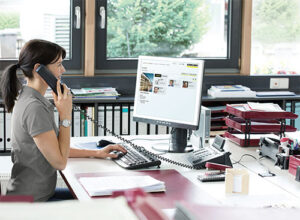 Until now, the main subject has been the interconnectedness between cleaning and other facility management services, but another important point is the introduction of data-supported work procedures as part of cleaning on demand. Special systems that record data, which exist in most facilities, can also be used to implement these procedures: Lighting, heating and lift sensors provide an indirect indication as to the number of people using an area and thus the degree of dirt in a room or floor. Alternatively, or in addition, sensors can be used which record data which is tailored to cleaning requirements, such as the concentration of dust in the air.
If such information can be utilised, cleaning becomes needs-based. Effort is not expended unnecessarily and upcoming requirements are clearly displayed. Thus, cleaning on demand makes it possible to establish and enforce uniform standards, including for all staff, even personnel that changes on a regular basis, and when new properties are added to the facility. In addition, superfluous transit times disappear since no one needs to check whether the necessary data was entered correctly as it is supplied automatically.
Many advantages emerge from this, especially regarding large properties with an unpredictable visitor frequency, such as airports, office buildings or department stores. Initial pilot projects show that both the work time and the time that cleaning devices are switched on for is reduced by about ten per cent. In addition, cleaning on demand does not just indicate which areas need to be cleaned. Sensors can also measure the quality of the cleaning carried out in an area. This high degree of transparency could be the foundation for new pay scale models, e.g. base pay plus additional pay. Feedback systems in representative areas provide an opportunity to monitor customer satisfaction and to make cleaning a perceptible part of the overall impression.
Where our journey leads:
Interconnecting cleaning on demand and facility management.
The integration of cleaning on demand in facility management has already presented many opportunities because it allows needsbased work, damage reporting and the quick rectification of technical defects to be combined.
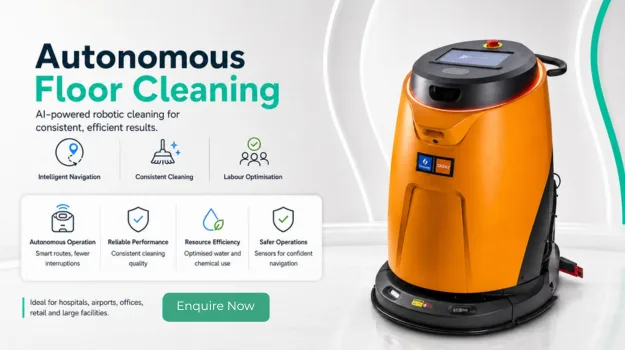
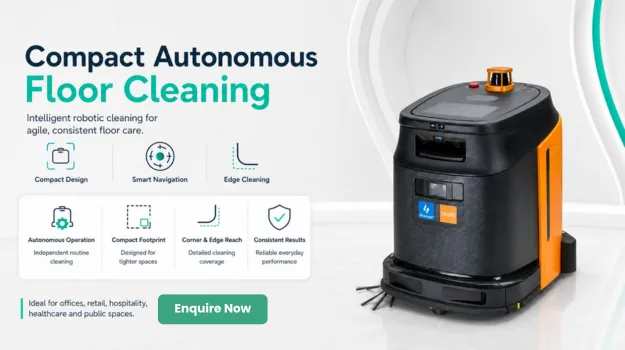
 The future may hold an even more complex scenario: CAFM and cleaning on demand systems could become so interconnected that relevant data is transmitted in both directions. Sensors record where cleaning or repair work is required and these messages may soon no longer be sent to individual contact persons but directly to a superordinate task management system. From there, service tickets would automatically be distributed to suitable employees or even to cleaning robots which could also make up part of the system. If connected to the internal lift system, they could communicate with the lift after receiving the cleaning ticket and travel to the correct floor, complete their work and return to their docking station.
That day may still be a few years down the line. However, the fact remains that the digitalisation and interconnectedness of different tasks holds a great deal of potential for the efficient and transparent organisation of work procedures.