








 CIJConnect Bot-enabled WhatsApp today at 4:00 PM.
JCB India Ltd– A case study
 When it comes to housekeeping in industries, it involves more than just cleaning up an area. Industrial housekeeping is one important factor in stabilising a process by making continual efforts to reduce waste, by keeping the work area in a clean, safe and orderly state. The industrial cleaning schedule and intensity vary from industry to industry.
The complexity of housekeeping in any automotive manufacturing unit begins with the shop floor which is usually stained with oil spills or paint sprays. Cleaning becomes even more challenging a task, when more than 100 vehicles incessantly drive in and out of the shop floor…

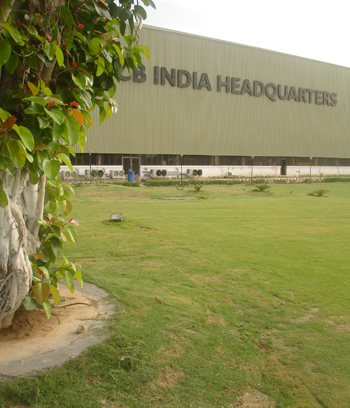
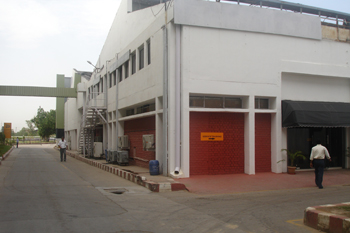
Forbes Facility Services Pvt. Ltd has been diligently wiping out these stains off the floors of Asia’s largest construction equipment manufacturing centre of JCB India Ltd at Ballabgarh, Haryana. Spread over seven acres of green land with 60% covered by the manufacturing facility, this unit produces the world’s largest number of backhoe loaders.
The JCB Ballabgarh facility consists of two units, an exclusive area for testing machines, store area, washroom area and facility for the security officers that are cleaned and maintained by Forbes Facility.
In keeping with the company’s international policy – Save Electricity, Save Cost, Save Environment – JCB India has installed CFLs and power generation systems, said Harish Kerpal, GM-General Affairs, JCB India Ltd.
 “We are working towards making this facility world-class. The first step in this direction is engaging the right housekeeping services, as the first thing to catch the eye of anyone walking into the premises is cleanliness & hygiene. With the commissioning of the new state-of-the-art unit and regular international guests, including dealers and vendors, coming in, we have taken up mechanised cleaning even more seriously. We are constantly adopting newer technologies along with Forbes Facility for cleaning solutions.”
Systematic scheduling and constant monitoring of various housekeeping activities all through the week is compiled and compared at the end of the month. Dalbir Singh Dahiya, Operations Manager-North, Forbes Facility, explained, “On a daily basis, we get customer feedback from the respective area in-charge which is compared on a weekly basis and a graph compiled. At the end of the month, we get a customer feedback on the performance and a comparative graph is drawn.”
In every department, a person has been made responsible to give his feedback on the cleaning performance of the housekeeping staff. “Thus, the whole idea is to bring about improvement and create a benchmark,” said Harish Kerpal.
“We also have the cross functional team of four-five staff from every department doing a surprise visit to other departments and recording their feedback. This helps us to understand the loopholes and also to advise the housekeeping on how to use better technology or equipment to enhance performance in any particular grey area,” said Kerpal.
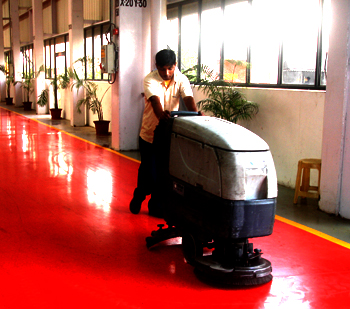
 “We have recently introduced the ride-on scrubber drier in the plant area to clean up oil spills,” said Dalbir Singh. The backhoe loaders are loaded on to the conveyor belt before being test driven. Oil spills from these vehicles stain the shop floor. Vehicles, rolling over oil, make the entire area dirty. The floor gets slippery and there are tyre stains all over the place. Earlier, walk behind scrubber drier was deployed to clean the area. But with constant equipment movement, Forbes Facility has introduced ride-on scrubber drier in the plant area. “We already have a ride-on road sweeper which is being used to the clean the roads within the premises.”
Besides the floor, the high glass façade needs regular cleaning. “We clean the façade under a separate contract where workers have been hired exclusively for this task. Our workers go up the walls carrying the backvac vacuum cleaners and do deep cleaning every three months.
“On a weekly basis, cleaning of verticals up to 20ft is done with the help of telescopic rods from Unger. We also use Sparkling chemical from Eureka Forbes.”
The general cleaning of the premises is done in two shifts where in 70% of the workers come in the morning shift and the rest in the evening shift. At least 50% of the workers in the morning shift are engaged in the plant areas.
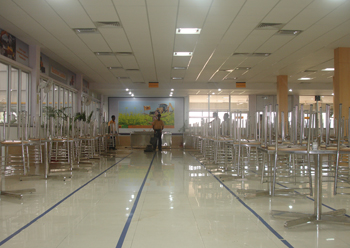 The office floor and other areas are cleaned using squeegee and floor cleaner Marboline. Mechanised cleaning is taken up after the working hours in the evening. The office and cafeteria areas are cleaned using single disc scrubber. “In the cafeteria, after scrubbing we follow it up with wet and dry vacuuming to ensure the floor is absolutely dry.”
Every day, 30-40 drivers who visit the facility have a separate shed with restrooms, resting place, drinking water and also recreational facilities. JCB along with TCI and Castrol organises programmes every month on hygiene and safe driving for them.
Championing the cause of pragmatic responsibility in managing one of development’s most volatile by-products – solid waste – JCB has initiated competent compost production.
Kicking off the campaign, JCB has hosted seminars addressing the issue, focusing on policy planning and strategy, management of municipal solid waste & treatment, solid waste management, and operable alternative methods.