









 CIJConnect Bot-enabled WhatsApp today at 4:00 PM.
[box type=”shadow” ]
Facilities Management has seen significant evolution over the last two decades in its scope and intent. The progressive evolution in the industry has been based on the changing needs of the business and the rapid improvement in building and workplace design.

[/box]
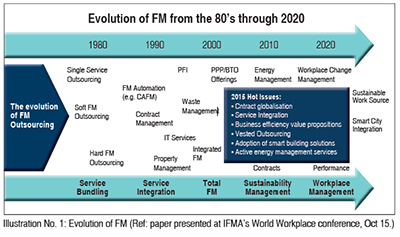 From out tasking disparate services, bundling of services, integrating services and now progressive levels of outsourcing of services, the facilities management industry has undergone paradigm change over the last two decades. The illustration below gives a graphical glimpse of progressive migration of services and scope of facilities management.
In the late 80s, it started with single services approach like soft services like cleaning, catering and pantry services, reception, security, electrical, air conditioning, plumbing etc, where separate contracts for each service were outsourced and placed by the buyer with specialist providers. These disparate & non – core activities to the business are contracted based on the inputs (read activities) and focused on the number of outsourced staff deployed or the number of transactions going into the process. Clear objective was to control and reduce cost. The facility manager had the ownership to ensure that all these organizations deliver in sync with overall outsourcing and out tasking objectives by the Principle employer (read the client/customer).
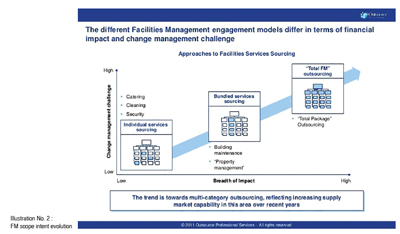 As businesses started to out task more and more services to the facility management companies, performance management, cost efficiency, alignment to the customers’ overall business strategy were increasingly becoming the key expectations of all customers. Hence, regional and global outsourcing engagements started to gain momentum where organizations wanted equivalent performance standards from their FM partners across geographies. This gave birth to Integrated facility management contracts (IFM) from mid – 90s onwards. Refer illustrations no. 2,3.
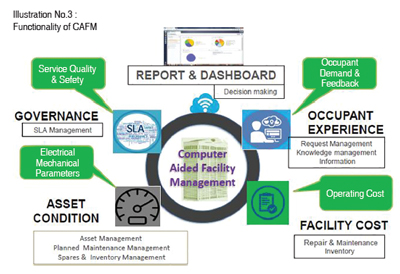 Progressively, the scope, intent and the performance expectations of these IFM contracts necessitated real time data tracking, data aggregation, trend and their analysis and forecasting functions for the clients to review performance cost, customer satisfaction and any other critical business performance metrics with the help of their facility management partners. Facility management organizations therefore started using IT tools like ERP, CAFM or customized software solutions to perform these functions across multiple locations and time zones which could help them present performance dashboards, automated reports and financial (spend) reports in an integrated manner.
Alongside, the construction and building industry had also seen progressive enhancements in design helping building and workplaces to be space efficient, energy neutral, flexible in terms of usage patterns, sustainable and smart(connected). All these demanded that the facility management industry undertook measures to deliver and achieve the design intent of these features while being operated.
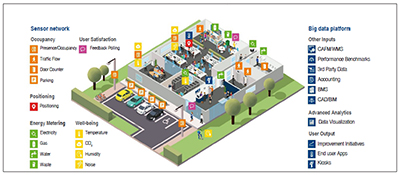
Illustration No. 3 : progressive evolution of building controls (BMS) to smart controls
Over a period, it has been observed that conventional transaction or output based approaches kept buyers and suppliers limited to the extent of the contract agreement. Conflicts within buyers aroused out of fear of failure, perception of losing control and commercial risk out of the arrangement. Because of multi-dimensional business relationships, the absence of collaboration, innovation and sharing value had the potential to disrupt even the best-intentioned outsourced contracts.
This led the way to a new outcome outsourced contract that are based on vested relationship between the buyer and the provider for a win-win situation.
In this strategic partnership, service providers play a greater role in the strategic direction of customers’ companies, and contracts serve as guidelines. These contracts generally tend to operate under a longer time frame as they become more strategic and require greater investment in the relationship. Such contracts are rewarded as per successfully achieved business outcomes, not on compliance measures. Thus, the best service provider will move to a more collaborative structure fundamentally with equal responsibility and high degree of openness & information sharing.










2 comments
I always look forward to reading your articles. You obviously put a lot of effort into this post, and I appreciate that.
Thank you Jessica Salvador for your positive encouragement. We truly appreciate it.
Comments are closed.